Fijian
Fijian (Na vosa vaka-Viti) is an Austronesian language of the Malayo-Polynesian family spoken by some 350,000–450,000 ethnic Fijians as a native language. In the 2013 constitution, Fijian (referred to as iTaukei) is a national language of Fiji, along with English and Hindi. Fijian is a VOS language. Standard Fijian is based on the Bau dialect, which is an East Fijian language. A pidginized form is used by many Indo-Fijians and Chinese on the islands, while Pidgin Hindustani is used by many rural ethnic Fijians and Chinese in areas dominated by Indo-Fijians.
Translate in Fijian ↗Fijian (Na vosa vaka-Viti) is an Austronesian language of the Malayo-Polynesian family spoken by some 350,000–450,000 ethnic Fijians as a native language. In the 2013 constitution, Fijian (referred to as iTaukei) is a national language of Fiji, along with English and Hindi. Fijian is a VOS language. Standard Fijian is based on the Bau dialect, which is an East Fijian language. A pidginized form is used by many Indo-Fijians and Chinese on the islands, while Pidgin Hindustani is used by many rural ethnic Fijians and Chinese in areas dominated by Indo-Fijians.
Oceania
Present-day use
The captured source does not contain a separate current-use account.
Origins
The captured article does not contain a separate origins section. See the historical account and linked source.
Development
The Fijian language was introduced to Fiji c. 3500 years ago by the islands' first settlers. For millennia, it was the only spoken language in Fiji. In 1835, Methodist missionaries from Australia worked in Fiji to develop a written form of the language. By 1840, they had already developed a writing system, and had published various books on the different dialects of the language. After the independence of Fiji in 1970, Fijian has been used in radio, television, books, and periodicals, and has been taught in schools.
Writing
The Fijian alphabet is based on the Latin script and consists of the following letters. There is almost a one-to-one correspondence between letters and phonemes. In the 1980s, scholars compiling a dictionary added several more consonants and a few consonant clusters to the alphabet. These newcomers were necessary to handle words entering Standard Fijian from not only English, but from other Fijian languages or dialects as well. These are the most important additions: ⟨z⟩ [ⁿdʒ], as in ⟨ziza⟩ 'ginger' and ⟨h⟩ [h], as in ⟨haya⟩ 'hire'. For phonological reasons ⟨ti⟩ and ⟨di⟩ are pronounced [tʃi], [ⁿdʒi] rather than [ti], [ⁿdi] (cf. Japanese chi kana, or in standard Brazilian Portuguese). Hence, the Fijian name for Fiji, ⟨Viti⟩, from an allophonic pronunciation of [βitʃi] as [ɸidʒi]. In addition, the digraph ⟨dr⟩ stands for retroflex [ᶯɖ], or a prenasalized trill [ɳɖr] in careful pronunciation, or more commonly for some people and in some dialects. The vowel letters ⟨a e i o u⟩ have roughly their IPA values, [a ɛ~e i ɔ~o u]. The vowel length contrast is not usually indicated in writing, except in dictionaries and textbooks for learners of the language, where it is indicated by a macron over the vowel in question; Dixon, in the work cited below, doubles all long vowels in his spelling system. Diphthongs are ⟨ai au ei eu oi ou iu⟩, pronounced [ɛi̯ ɔu̯ ei̯ eu̯ oi̯ ou̯ i̯u].
Beyond the typeface.
Signs, manuscripts, published pages and contextual photographs, with their place, period, source and reuse terms. Captions identify historical spellings, regional examples, community references and character imagery.
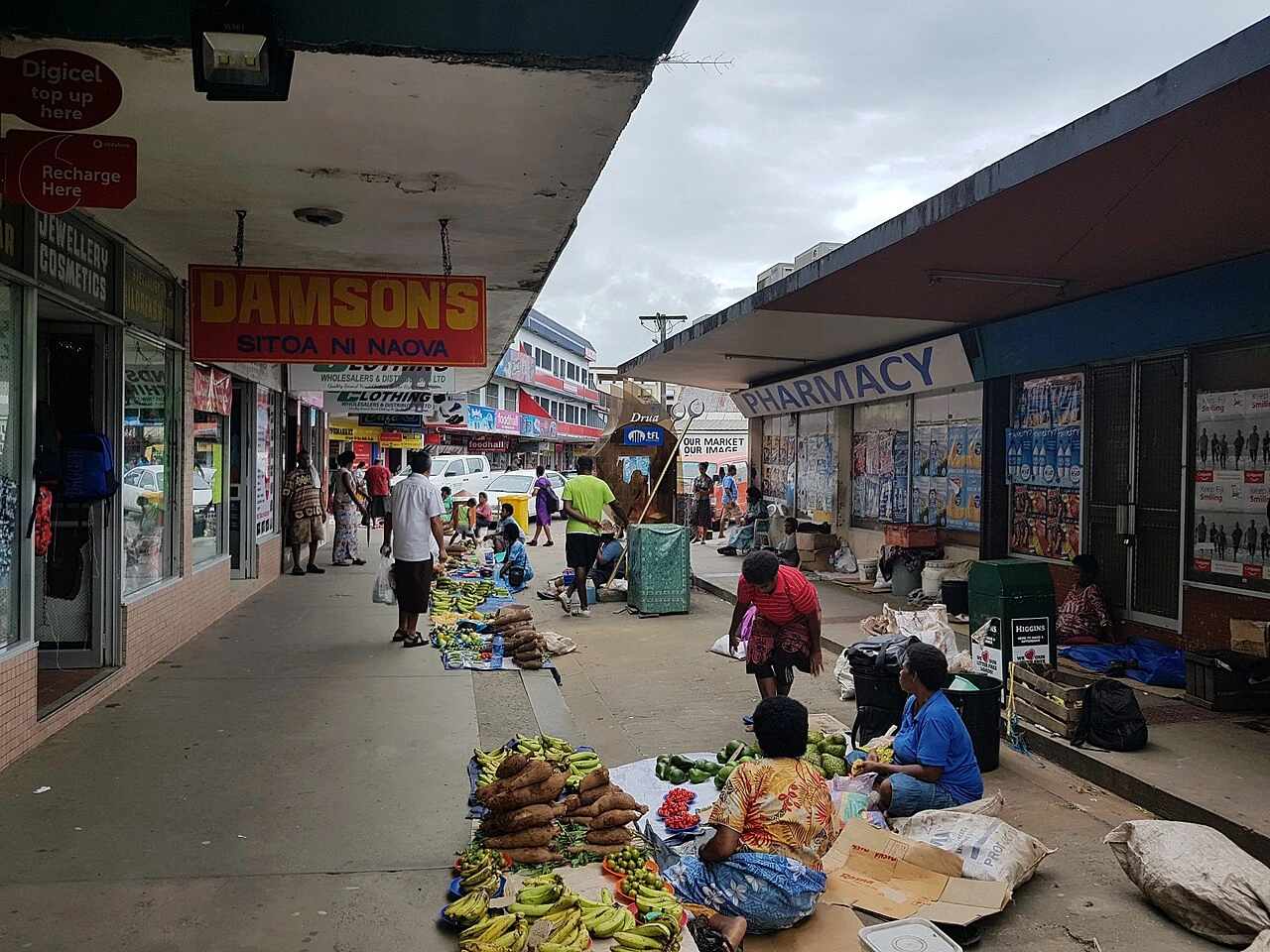
Writing in use at Sigatoka market, catalogued by Commons as Fijian-language signage.
Saved in Babelbook · resized display copy. Select the image to open it independently of its source.
Maksym Kozlenko · Source ↗CC BY-SA 4.0 ↗View the local visual field note
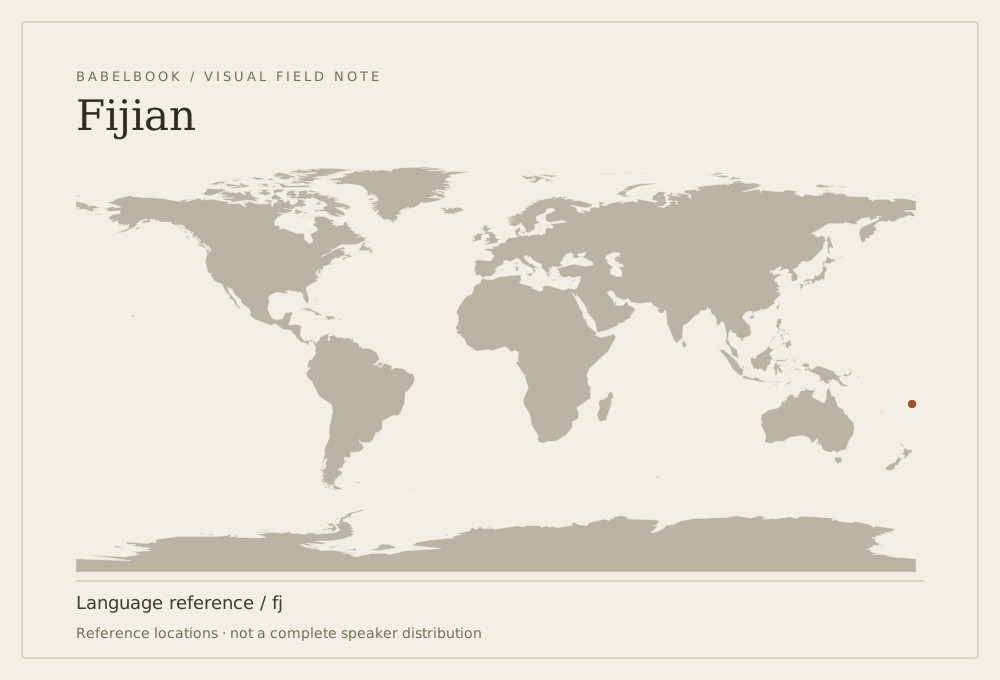
Representative reference points from Glottolog. Historical entries show reference locations, not current speakers. 1 point.
Reference & context ↗Babelbook · original editorial illustration · CC BY 4.0 · Glottolog locations; public-domain Natural Earth land
Source excerpts, selected, shortened and where noted editorially corrected from Fijian language by Wikipedia contributors. Retrieved 2026-10-05. CC BY-SA 4.0. These excerpts are not an independently verified scholarly history; missing accounts are identified above.
Read further in the source
History of the language
The Fijian language was introduced to Fiji c. 3500 years ago by the islands' first settlers. For millennia, it was the only spoken language in Fiji. In 1835, Methodist missionaries from Australia worked in Fiji to develop a written form of the language. By 1840, they had already developed a writing system, and had published various books on the different dialects of the language. After the independence of Fiji in 1970, Fijian has been used in radio, television, books, and periodicals, and has been taught in schools.
Orthography
The Fijian alphabet is based on the Latin script and consists of the following letters. There is almost a one-to-one correspondence between letters and phonemes.
In the 1980s, scholars compiling a dictionary added several more consonants and a few consonant clusters to the alphabet. These newcomers were necessary to handle words entering Standard Fijian from not only English, but from other Fijian languages or dialects as well. These are the most important additions: ⟨z⟩ [ⁿdʒ], as in ⟨ziza⟩ 'ginger' and ⟨h⟩ [h], as in ⟨haya⟩ 'hire'. For phonological reasons ⟨ti⟩ and ⟨di⟩ are pronounced [tʃi], [ⁿdʒi] rather than [ti], [ⁿdi] (cf. Japanese chi kana, or in standard Brazilian Portuguese). Hence, the Fijian name for Fiji, ⟨Viti⟩, from an allophonic pronunciation of [βitʃi] as [ɸidʒi]. In addition, the digraph ⟨dr⟩ stands for retroflex [ᶯɖ], or a prenasalized trill [ɳɖr] in careful pronunciation, or more commonly for some people and in some dialects. The vowel letters ⟨a e i o u⟩ have roughly their IPA values, [a ɛ~e i ɔ~o u]. The vowel length contrast is not usually indicated in writing, except in dictionaries and textbooks for learners of the language, where it is indicated by a macron over the vowel in question; Dixon, in the work cited below, doubles all long vowels in his spelling system. Diphthongs are ⟨ai au ei eu oi ou iu⟩, pronounced [ɛi̯ ɔu̯ ei̯ eu̯ oi̯ ou̯ i̯u].