Faroese
Faroese ( FAIR-oh-EEZ, FARR-; endonym: føroyskt [ˈføːɹɪst]) is a North Germanic language spoken as a first language by about 69,000 Faroe Islanders, of whom 21,000 reside mainly in Denmark and elsewhere. It is one of five languages descended from Old West Norse spoken in the Middle Ages; the others include Norwegian, Icelandic, and the extinct Norn and Greenlandic Norse. Faroese and Icelandic, its closest extant relative, are not easily mutually intelligible in speech, but the written languages resemble each other quite closely, largely owing to Faroese's etymological orthography.
Translate in Faroese ↗Faroese ( FAIR-oh-EEZ, FARR-; endonym: føroyskt [ˈføːɹɪst]) is a North Germanic language spoken as a first language by about 69,000 Faroe Islanders, of whom 21,000 reside mainly in Denmark and elsewhere. It is one of five languages descended from Old West Norse spoken in the Middle Ages; the others include Norwegian, Icelandic, and the extinct Norn and Greenlandic Norse. Faroese and Icelandic, its closest extant relative, are not easily mutually intelligible in speech, but the written languages resemble each other quite closely, largely owing to Faroese's etymological orthography.
Europe
Present-day use
The captured source does not contain a separate current-use account.
Origins
The captured article does not contain a separate origins section. See the historical account and linked source.
Development
Around 900 AD, the language spoken in the Faroes was Old Norse, which Norse settlers had brought with them during the time of the settlement of Faroe Islands (landnám) that began in 825. However, many of the settlers were not from Scandinavia, but descendants of Norse settlers in the Irish Sea region. In addition, women from Norse-occupied Ireland, the Norse–Gaelic Isles, Orkney, and Shetland often married native Scandinavian men before settling in the Faroe Islands and Iceland. As a result, the Middle Irish language has had some influence on both Faroese and Icelandic. There is speculation about Gaelic language place names in the Faroes: for example, the names of Mykines, Stóra Dímun, Lítla Dímun and Argir have been hypothesized to contain Celtic roots. Other examples of early-introduced words of Celtic origin are: blak/blaðak (buttermilk), cf. Middle Irish bláthach; drunnur (tail-piece of an animal), cf. Middle Irish dronn; grúkur (head, headhair), cf. Middle Irish gruaig; lámur (hand, paw), cf. Middle Irish lámh; tarvur (bull), cf. Middle Irish tarbh; and ærgi (pasture in the outfield), cf. Middle Irish áirge. Between the 9th and the 15th centuries, a distinct Faroese language evolved, although it was probably still mutually intelligible with Old West Norse, and remained similar to the Norn language of Orkney and Shetland during Norn's earlier phase. Faroese ceased to be a written language after the Danish–Norwegian Reformation of the early 16th century, with Danish replacing Faroese as the language of administration and education. The islanders continued to use the language in ballads, folktales, and everyday life.
Writing
Latin or customary script (catalog classification; see the source for context).
Beyond the typeface.
Signs, manuscripts, published pages and contextual photographs, with their place, period, source and reuse terms. Captions identify historical spellings, regional examples, community references and character imagery.
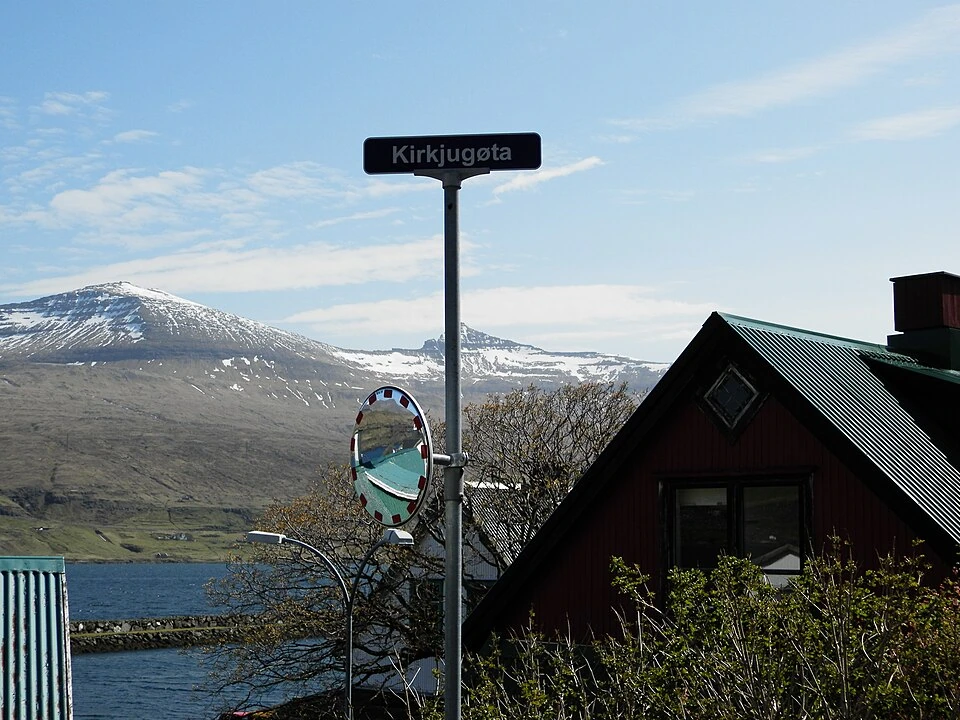
Kirkjugøta street sign in Haldarsvík, Faroe Islands; the Commons file is categorized as Faroese language. Language identification follows Commons metadata; not independently transcribed.
Saved in Babelbook · resized display copy. Select the image to open it independently of its source.
EileenSanda · Source ↗CC BY-SA 3.0 ↗View the local visual field note
Representative reference points from Glottolog. Historical entries show reference locations, not current speakers. 1 point.
Reference & context ↗Babelbook · original editorial illustration · CC BY 4.0 · Glottolog locations; public-domain Natural Earth land
Source excerpts, selected, shortened and where noted editorially corrected from Faroese language by Wikipedia contributors. Retrieved 2026-10-05. CC BY-SA 4.0. These excerpts are not an independently verified scholarly history; missing accounts are identified above.
Read further in the source
History
Around 900 AD, the language spoken in the Faroes was Old Norse, which Norse settlers had brought with them during the time of the settlement of Faroe Islands (landnám) that began in 825. However, many of the settlers were not from Scandinavia, but descendants of Norse settlers in the Irish Sea region. In addition, women from Norse-occupied Ireland, the Norse–Gaelic Isles, Orkney, and Shetland often married native Scandinavian men before settling in the Faroe Islands and Iceland. As a result, the Middle Irish language has had some influence on both Faroese and Icelandic. There is speculation about Gaelic language place names in the Faroes: for example, the names of Mykines, Stóra Dímun, Lítla Dímun and Argir have been hypothesized to contain Celtic roots. Other examples of early-introduced words of Celtic origin are: blak/blaðak (buttermilk), cf. Middle Irish bláthach; drunnur (tail-piece of an animal), cf. Middle Irish dronn; grúkur (head, headhair), cf. Middle Irish gruaig; lámur (hand, paw), cf. Middle Irish lámh; tarvur (bull), cf. Middle Irish tarbh; and ærgi (pasture in the outfield), cf. Middle Irish áirge. Between the 9th and the 15th centuries, a distinct Faroese language evolved, although it was probably still mutually intelligible with Old West Norse, and remained similar to the Norn language of Orkney and Shetland during Norn's earlier phase. Faroese ceased to be a written language after the Danish–Norwegian Reformation of the early 16th century, with Danish replacing Faroese as the language of administration and education. The islanders continued to use the language in ballads, folktales, and everyday life. This maintained a rich spoken tradition, but for 300 years the language was not used in written form. In 1823, the Danish Bible Society published a diglot of the Gospel of Matthew, with Faroese on the left and Danish on the right. Venceslaus Ulricus Hammershaimb and the Icelandic grammarian and politician Jón Sigurðsson published a written standard for Modern Faroese in 1854, which still exists. They set a standard for the orthography of the language, based on its Old Norse roots and similar to that of Icelandic. The main purpose of this was for the spelling to represent the diverse dialects of Faroese in equal measure. Additionally, it had the advantages of being etymologically clear and keeping the kinship with the Icelandic written language. The actual pronunciation, however, often differs considerably from the written rendering. The letter ð, for example, has no specific phoneme attached to it. Jakob Jakobsen devised a rival system of orthography, based on his wish for a phonetic spelling, but this system was never taken up by the speakers. In 1908, Scripture Gift Mission published the Gospel of John in Faroese. In 1937, Faroese replaced Danish as the official school language, in 1938, as the church language, and in 1948, as the national language by the Home Rule Act of the Faroe Islands. The first complete translation of the Bible was completed in 1948. Up until the 1980s, public radio broadcasts were primarily conducted in Norwegian and Danish. This helps to explain why older generations can speak Norwegian in addition to Danish and Faroese. Faroese broadcasts quickly replaced earlier programs and now all radio content is transmitted in the language, alongside all local newspapers. Today, Danish is considered a foreign language, although around 5% of residents on the Faroes learn it as a first language. Both Danish and English are obligatory at the primary and secondary school levels, with fluency in English becoming increasingly valued particularly among the younger generations. Films and television are frequently shown in English with Danish subtitles. In 2017, the tourist board Visit Faroe Islands launched a website entitled Faroe Islands Translate. Text can be entered in thirteen languages, including English, Chinese, Russian, Japanese, French, Spanish, and Portuguese. Instead of an instant machine translation being given, the text goes to a volunteer who will provide a live video translation, or else a recorded one later. The aim of this project was to get Faroese featured on Google Translate.
Dialects
Faroese is a highly variable language with many dialects actively used across the islands’ approximately 120 communities. While the dialect of Tórshavn is the most prominent due to the city's outstanding size, there is no official spoken standard variety and little evidence that the Tórshavn dialect has developed prestige status. Faroese speech communities are tightly knit and the use of dialectal speech is widely encouraged. The study of Faroese dialectology began hundreds of years ago, with the scholar Lucas Debes noting a north–south distinction as early as 1673. In the 18th century linguist Jens Christian Svabo made further distinctions, such as identifying the Tórshavn dialect, though his categorization lacked thorough justification. In 1891 Venceslaus Ulricus Hammershaimb would write a more definitive study of the language's variation, noting distinguishing characteristics of the north–south divide such as the northern aspiration of unvoiced plosives after long vowels and the pronunciation of ⟨ó⟩ as /œ/ in most of the north compared to /ɔ/ in the south. The most recent and detailed classification by Hjalmar P. Petersen divides the language into four major varieties including North-Western Faroese, Central Faroese, Northern Faroese, and Southern Faroese. Additional sub-dialects of particular islands and villages have also been identified. Most of the analysis by Petersen and earlier authors is based on phonological evidence. The southern variety of Faroese is very distinct, possibly due to geographic distance exacerbated by the lack of underwater tunnels which have connected most other islands north of Sandur. The dialect of these islands is characterized by a unique form of certain personal pronouns, alongside phonological features such as the intervocalic voicing of non-geminate stops. The fortis consonants /p/, /t/, and /k/ are weakened. The central dialect area centered around Suðurstreymoy features a merging of ⟨i⟩ and ⟨u⟩ in unstressed ending syllables. The fortis consonants are neither aspirated nor weakened. The island of Nólsoy is a notable transitional area due to its unique realization of long ⟨ó⟩ as [au:] and short ⟨ó⟩ as [ɔ] compared to the [ɔu:] and [œ] found in Tórshavn and elsewhere. The northern dialect is characterized by preaspirated fortis consonants /p/, /t/, and /k/ following certain long vowels and a monophthongal pronunciation of ⟨á⟩ in ending syllables, i.e., /aː/. The realization of ⟨ei⟩ as [ɔi:] dominates in this region, although small parts of the central and northwestern regions use this pronunciation as well. The northwestern dialect features aspirated fortis consonants after long vowels. The ⟨i⟩ and ⟨u⟩ vowels remain unmerged in unstressed ending syllables. Long ⟨ó⟩ is pronounced [ɔu] and short ⟨ó⟩ is pronounced [œ].