French
French (français [fʁɑ̃sɛ] or langue française [lɑ̃ɡ fʁɑ̃sɛːz] ) is a Romance language of the Indo-European family. Like all other Romance languages, French and its closest relatives—the langues d'oïl, historically spoken in northern France and southern Belgium—descended from the Vulgar Latin of the Roman Empire. It was influenced by native Celtic languages of Northern Roman Gaul and by the Germanic Frankish language of the post-Roman Frankish invaders. Over time, French largely supplanted most regional Romance varieties across France, Belgium and Switzerland. As a result of French and later Belgian colonialism, it was introduced to new territories in the Americas, Africa, and Asia, and numerous French-based creole languages, most notably Haitian Creole, were developed. A French-speaking person or nation may be referred to as Francophone in both English and French. French is the 22nd most natively spoken language in the world, the sixth most spoken language by total number of speakers, and is among the top five most studied languages worldwide, with about 120 million learners as of 2017. It is estimated to have about 310 million speakers, of which about 74 million are native speakers; it is spoken as a first language (in descending order of the number of speakers) in France, Canada (Quebec), Belgium (Wallonia and the Brussels-Capital Region), western Switzerland (Romandy region), Luxembourg, and Monaco. Meanwhile, in Francophone Africa it is spoken mainly as a second language or lingua franca, though it has also become a native language in several urban areas.
Translate in French ↗According to the OIF, approximately 321 million people worldwide are "able to speak the language" as of 2022, without specifying the criteria for this estimation or whom it encompasses. French is regarded as an influential world language because of its wide use in the worlds of journalism, jurisprudence, education, and diplomacy, though its use, geography, and sociopolitical context continues to shift with declines in some areas, including academia, and growth in others. Given the demographic prospects of the French-speaking nations of Africa, researcher Pascal-Emmanuel Gobry wrote in 2014 that French "could be the language of the future"; despite this growth in parts of Central and West Africa, where it had been entrenched as an official, administrative and educational language in numerous states, countries in North Africa and the Sahel have generally distanced themselves from the language due to colonial connections: some countries such as Algeria intermittently attempted to eradicate the use of French, and it was removed as an official language in Mali, Burkina Faso and Niger in 2023, 2024, and 2025, respectively.
Europe
Present-day use
During the 17th century, French replaced Latin as the most important language of diplomacy and international relations (lingua franca). It retained this role until approximately the middle of the 20th century, when it was replaced by English as the United States became the dominant global power following the Second World War. Stanley Meisler of the Los Angeles Times said that the fact that the Treaty of Versailles was written in English as well as French was the "first diplomatic blow" against the language. During the Grand Siècle (17th century), France, under the rule of powerful leaders such as Cardinal Richelieu and Louis XIV, enjoyed a period of prosperity and prominence among European nations. Richelieu established the Académie française to protect the French language. By the early 1800s, Parisian French had become the primary language of the aristocracy in France. Near the beginning of the 19th century, the French government began to pursue policies with the end goal of eradicating the many minorities and regional languages (patois) spoken in France. This began in 1794 with Henri Grégoire's "Report on the necessity and means to annihilate the patois and to universalize the use of the French language". When public education was made compulsory, only French was taught and the use of any other (patois) language was punished. The goals of the public school system were made especially clear to the French-speaking teachers sent to teach students in regions such as Occitania and Brittany. Instructions given by a French official to teachers in the department of Finistère, in western Brittany, included the following: "And remember, Gents: you were given your position in order to kill the Breton language".
Origins
The captured article does not contain a separate origins section. See the historical account and linked source.
Development
French is a Romance language (meaning that it is descended primarily from Vulgar Latin) that evolved out of the Gallo-Romance dialects spoken in northern France. The language's early forms include Old French and Middle French.
Writing
French orthography is alphabetic but relatively deep. It represents not only phonological information but also morphological, grammatical, lexical and historical distinctions. In the influential analysis of Nina Catach, the French writing system combines a phonographic component with morphographic and other non-phonographic information. Estimates depend on how graphemes and phonemes are counted, but recent descriptions commonly give about 130 graphemes for roughly three dozen phonemes. The system is considerably more predictable in the direction from spelling to pronunciation than from pronunciation to spelling. A phoneme may have several possible spellings, and many written letters have no independent pronunciation. For example, inflectional morphology is frequently visible in writing but not in speech: the plural -s in amis and many verbal endings are normally silent, while homophonous verbal endings can have different spellings. Morphological knowledge therefore contributes substantially to French spelling, including the spelling of otherwise silent letters. Historical sound change is another source of mismatch between spelling and pronunciation. In addition, some spellings were deliberately reshaped to reflect etymology. For example, modern doigt 'finger' descends from Latin digitus; the g in the modern spelling is part of an etymological reshaping of older French forms such as doi and doit. Many word-final consonant letters are silent, but this is not a general rule that is suspended whenever the next word begins with a vowel. Some final consonants are pronounced in all contexts, while others are latent and may surface in liaison. Liaison is a morphophonological process that occurs only in particular syntactic and lexical contexts before a vowel-initial word; depending on the context, it can be obligatory, optional or prohibited.
Beyond the typeface.
Signs, manuscripts, published pages and contextual photographs, with their place, period, source and reuse terms. Captions identify historical spellings, regional examples, community references and character imagery.

Rue du Petit-Musc street plaque in Paris, photographed in 2009. Modern French. Displayed at reduced size; no additional crop.
Saved in Babelbook · resized display copy. Select the image to open it independently of its source.
Tangopaso · Source ↗CC BY-SA 3.0 ↗View the local visual field note
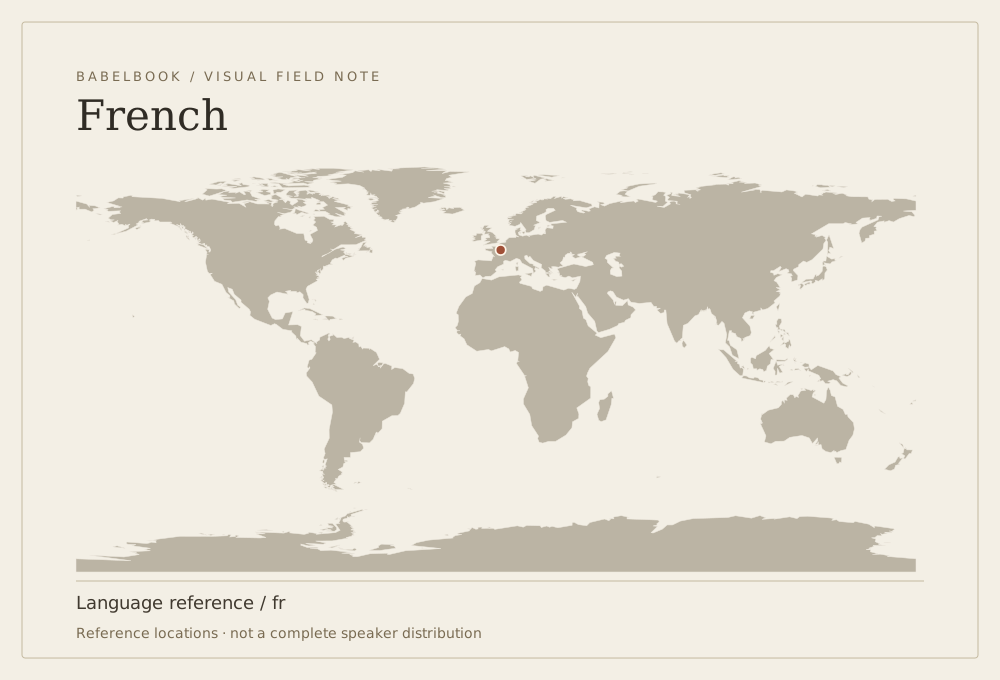
Representative reference points from Glottolog. Historical entries show reference locations, not current speakers. 1 point.
Reference & context ↗Babelbook · original editorial illustration · CC BY 4.0 · Glottolog locations; public-domain Natural Earth land
Source excerpts, selected, shortened and where noted editorially corrected from French language by Wikipedia contributors. Retrieved 2026-10-05. CC BY-SA 4.0. These excerpts are not an independently verified scholarly history; missing accounts are identified above.
Read further in the source
History
French is a Romance language (meaning that it is descended primarily from Vulgar Latin) that evolved out of the Gallo-Romance dialects spoken in northern France. The language's early forms include Old French and Middle French.
Current status and importance
According to the OIF, approximately 321 million people worldwide are "able to speak the language" as of 2022, without specifying the criteria for this estimation or whom it encompasses. French is regarded as an influential world language because of its wide use in the worlds of journalism, jurisprudence, education, and diplomacy, though its use, geography, and sociopolitical context continues to shift with declines in some areas, including academia, and growth in others. Given the demographic prospects of the French-speaking nations of Africa, researcher Pascal-Emmanuel Gobry wrote in 2014 that French "could be the language of the future"; despite this growth in parts of Central and West Africa, where it had been entrenched as an official, administrative and educational language in numerous states, countries in North Africa and the Sahel have generally distanced themselves from the language due to colonial connections: some countries such as Algeria intermittently attempted to eradicate the use of French, and it was removed as an official language in Mali, Burkina Faso and Niger in 2023, 2024, and 2025, respectively. Its use is also largely declined in parts of Asia, particularly in former French colonies such as Vietnam, Laos, and Cambodia, where it has been replaced by local languages and English in both public life and education. In diplomacy, French is one of the six official languages of the United Nations (and one of the UN Secretariat's only two working languages), one of twenty official and three procedural languages of the European Union, an official language of NATO, the International Olympic Committee, the Council of Europe, the Organisation for Economic Co-operation and Development, Organization of American States (alongside Spanish, Portuguese and English), the Eurovision Song Contest, one of eighteen official languages of the European Space Agency, World Trade Organization and the least used of the three official languages in the North American Free Trade Agreement countries. It is also a working language in nonprofit organisations such as the Red Cross (alongside English, German, Spanish, Portuguese, Arabic and Russian), Amnesty International (alongside 32 other languages of which English is the most used, followed by Spanish, Portuguese, German, and Italian), Médecins sans Frontières (used alongside English, Spanish, Portuguese and Arabic), and Médecins du Monde (used alongside English). Significant as a judicial language, French is one of the official languages of such major international and regional courts, tribunals, and dispute-settlement bodies as the African Court on Human and Peoples' Rights, the Caribbean Court of Justice, the Court of Justice for the Economic Community of West African States, the Inter-American Court of Human Rights, the International Court of Justice, the International Criminal Tribunal for the former Yugoslavia, International Criminal Tribunal for Rwanda, the International Tribunal for the Law of the Sea the International Criminal Court and the World Trade Organization Appellate Body. It is the sole internal working language of the Court of Justice of the European Union, and makes with English the European Court of Human Rights's two working languages. In the European Union, French was the dominant language within all institutions until the 1990s. After several enlargements of the EU (1995, 2004), French significantly lost ground in favour of English, which is more widely spoken and taught in most EU countries. French currently remains one of the three working languages, or "procedural languages", of the EU, along with English and German. It is the second-most widely used language within EU institutions after English, but remains the preferred language of certain institutions or administrations such as the Court of Justice of the European Union, where it is the sole internal working language, or the Directorate-General for Agriculture. Since 2016, Brexit has rekindled discussions on whether or not French should again hold greater role within the institutions of the European Union. In 1997, George Weber published, in Language Today, a comprehensive academic study entitled "The World's 10 most influential languages". In the article, Weber ranked French as, after English, the second-most influential language of the world, ahead of Spanish. His criteria were the numbers of native speakers, the number of secondary speakers (especially high for French among fellow world languages), the number of countries using the language and their respective populations, the economic power of the countries using the language, the number of major areas in which the language is used, and the linguistic prestige associated with the mastery of the language (Weber highlighted that French in particular enjoys considerable linguistic prestige). In a 2008 reassessment of his article, Weber concluded that his findings were still correct since "the situation among the top ten remains unchanged." Knowledge of French is often considered to be a useful skill by business owners in the United Kingdom; a 2014 study found that 50% of British managers considered French to be a valuable asset for their business, thus ranking French as the most sought-after foreign language there, ahead of German (49%) and Spanish (44%). MIT economist Albert Saiz calculated a 2.3% premium for those who have French as a foreign language in the workplace. In 2011, Bloomberg Businessweek ranked French the third most useful language for business, after English and Standard Mandarin Chinese.
Orthography
French orthography is alphabetic but relatively deep. It represents not only phonological information but also morphological, grammatical, lexical and historical distinctions. In the influential analysis of Nina Catach, the French writing system combines a phonographic component with morphographic and other non-phonographic information. Estimates depend on how graphemes and phonemes are counted, but recent descriptions commonly give about 130 graphemes for roughly three dozen phonemes. The system is considerably more predictable in the direction from spelling to pronunciation than from pronunciation to spelling. A phoneme may have several possible spellings, and many written letters have no independent pronunciation. For example, inflectional morphology is frequently visible in writing but not in speech: the plural -s in amis and many verbal endings are normally silent, while homophonous verbal endings can have different spellings. Morphological knowledge therefore contributes substantially to French spelling, including the spelling of otherwise silent letters. Historical sound change is another source of mismatch between spelling and pronunciation. In addition, some spellings were deliberately reshaped to reflect etymology. For example, modern doigt 'finger' descends from Latin digitus; the g in the modern spelling is part of an etymological reshaping of older French forms such as doi and doit. Many word-final consonant letters are silent, but this is not a general rule that is suspended whenever the next word begins with a vowel. Some final consonants are pronounced in all contexts, while others are latent and may surface in liaison. Liaison is a morphophonological process that occurs only in particular syntactic and lexical contexts before a vowel-initial word; depending on the context, it can be obligatory, optional or prohibited. Thus forms such as les amis and beaux-arts contain liaison [z], but a following vowel does not automatically cause every silent final consonant to be pronounced. French uses numerous multiletter graphemes, such as ⟨ou⟩, ⟨au⟩, ⟨eau⟩, ⟨ch⟩ and vowel–nasal-consonant sequences. Sequences of a vowel followed by ⟨n⟩ or ⟨m⟩ often represent a nasal vowel when the nasal consonant is word-final or followed by another consonant; before a following vowel or a doubled nasal consonant, the vowel is commonly oral and the nasal consonant is pronounced. There are lexical and morphological exceptions, so this is a spelling tendency rather than a complete rule. Orthographic double consonants do not normally represent phonemic consonant length in contemporary French. Surface lengthening can nevertheless occur in particular morphological, lexical or prosodic environments; it should not be described as a straightforward spelling-to-sound rule.