Western Frisian
West Frisian (Westerlauwersk Frysk; Dutch: Westerlauwers Fries), or simply Frisian (Frysk [frisk]; Dutch: Fries [fris]), is a West Germanic language spoken mostly in the province of Friesland (Fryslân) in the north of the Netherlands, mostly by those of Frisian ancestry. It is the most widely spoken of the Frisian languages. In the study of the evolution of English, West Frisian is notable as being the most closely related foreign tongue to the various dialects of Old English spoken across the Heptarchy, these being part of the Anglo-Frisian branch of the West Germanic family.
Translate in Western Frisian ↗Most speakers of West Frisian live in the province of Friesland in the north of the Netherlands. Friesland has 643,000 inhabitants (2005), of whom 94% can understand spoken West Frisian, 74% can speak West Frisian, 75% can read West Frisian, and 27% can write it. For over half of the inhabitants of the province of Friesland, 55% (c. 354,000 people), West Frisian is the native language. In the central east, West Frisian speakers spill over the province border, with some 4,000–6,000 of them actually living in the province of Groningen, in the triangular area of the villages Marum (West Frisian: Mearum), De Wilp (De Wylp), and Opende (De Grinzer Pein). Also, many West Frisians have left their province in the last 60 years for more prosperous parts of the Netherlands. Therefore, possibly as many as 150,000 West Frisian speakers live in other Dutch provinces, particularly in the urban agglomeration in the West, and in neighbouring Groningen and newly reclaimed Flevoland. A Frisian diaspora exists abroad; Friesland sent more emigrants than any other Dutch province between the Second World War and the 1970s. Frisian is still spoken by some Dutch Canadians, Dutch Americans, Dutch Australians and Dutch New Zealanders. Apart from the use of West Frisian as a first language, it is also spoken as a second language by about 120,000 people in the province of Friesland. West Frisian is considered by UNESCO to be a language in danger of becoming extinct, officially listed as "vulnerable". In 1951, Frisian language activists, protesting at the exclusive use of Dutch in the courts, caused a riot in Leeuwarden. The resulting inquiry led to the establishment of a committee of inquiry. This committee recommended that the Frisian language should receive legal status as a minority language.
Europe
Present-day use
In 1951, Frisian language activists, protesting at the exclusive use of Dutch in the courts, caused a riot in Leeuwarden. The resulting inquiry led to the establishment of a committee of inquiry. This committee recommended that the Frisian language should receive legal status as a minority language. Subsequently, the Use of Frisian in Legal Transactions Act of 11 May 1956 was passed, which provided for the use of Frisian in transactions with the courts. Since 1956, West Frisian has an official status along with and equal to Dutch in the province of Friesland. It is used in many domains of Frisian society, among which are education, legislation, and administration. In 2010, some sixty public transportation ticket machines in Friesland and Groningen added a West Frisian-language option. Although in the courts of law the Dutch language is still mainly used, in the province of Friesland, Frisians have the right to give evidence in their own language. Also, they can take the oath in Frisian in courts anywhere in the Netherlands. Primary education in Friesland was made bilingual in 1956, which means West Frisian can be used as a teaching medium. In the same year, West Frisian became an official school subject, having been introduced to primary education as an optional extra in 1937. It was not until 1980, however, that West Frisian had the status of a required subject in primary schools, and not until 1993 that it was given the same position in secondary education. In 1997, the province of Friesland officially changed its name from the Dutch form Friesland to the West Frisian Fryslân. So far 4 out of 18 municipalities (Dantumadiel, De Fryske Marren, Noardeast-Fryslân, Súdwest-Fryslân) have changed their official geographical names from Dutch to West Frisian.
Origins
The captured article does not contain a separate origins section. See the historical account and linked source.
Development
The captured article does not contain a distinct historical account. No chronology has been invented.
Writing
West Frisian uses the Latin alphabet. A, E, O and U may be accompanied by circumflex or acute accents. In alphabetical listings both I and Y are usually found between H and J. When two words differ only because one has I and the other one has Y (such as stikje and stykje), the word with I precedes the one with Y. In handwriting, IJ (used for Dutch loanwords and personal names) is written as a single letter (see IJ (digraph)), whereas in print the string IJ is used. In alphabetical listings IJ is most commonly considered to consist of the two letters I and J, although in dictionaries there is an entry IJ between X and Z telling the user to browse back to I.
Beyond the typeface.
Signs, manuscripts, published pages and contextual photographs, with their place, period, source and reuse terms. Captions identify historical spellings, regional examples, community references and character imagery.
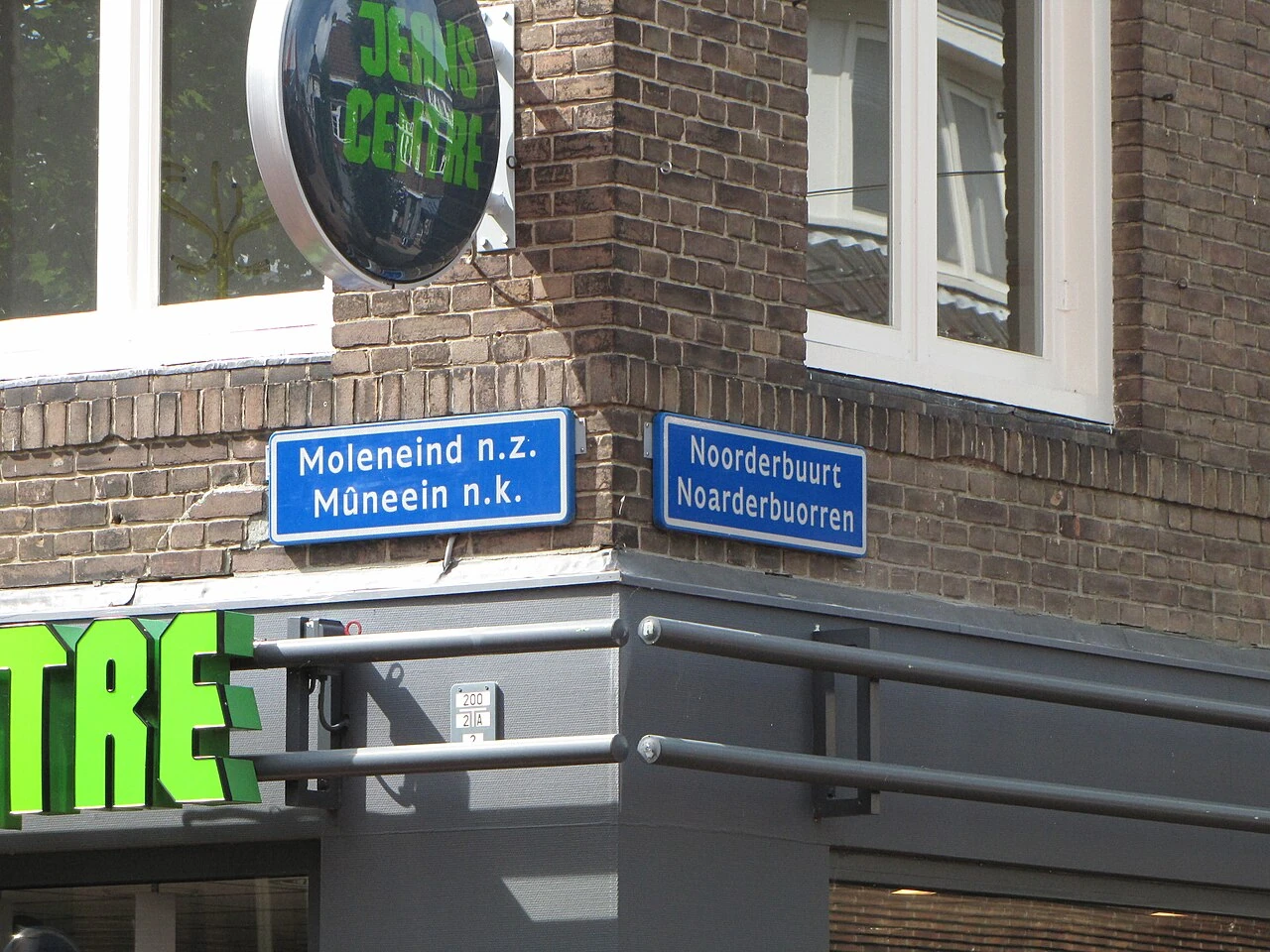
Dutch–Frisian street signs in Drachten, photographed in 2011. The source description identifies Frisian; the specific Commons category identifies West Frisian inscriptions.
Saved in Babelbook · resized display copy. Select the image to open it independently of its source.
Ziko van Dijk · Source ↗CC BY-SA 3.0 ↗View the local visual field note
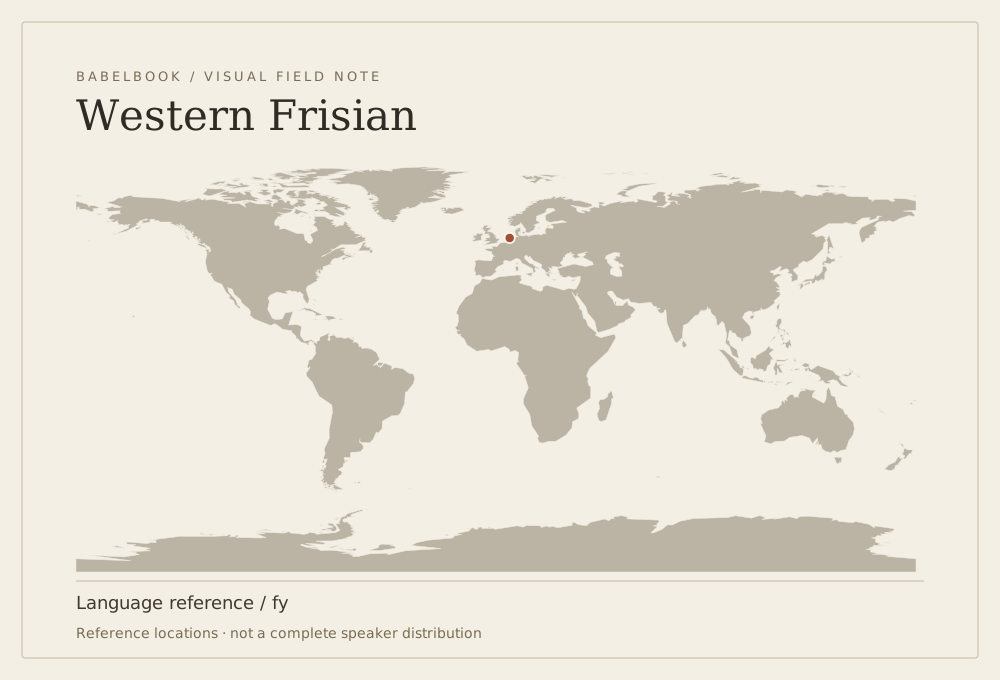
Representative reference points from Glottolog. Historical entries show reference locations, not current speakers. 1 point.
Reference & context ↗Babelbook · original editorial illustration · CC BY 4.0 · Glottolog locations; public-domain Natural Earth land
Source excerpts, selected, shortened and where noted editorially corrected from West Frisian language by Wikipedia contributors. Retrieved 2026-10-05. CC BY-SA 4.0. These excerpts are not an independently verified scholarly history; missing accounts are identified above.
Read further in the source
Speakers
Most speakers of West Frisian live in the province of Friesland in the north of the Netherlands. Friesland has 643,000 inhabitants (2005), of whom 94% can understand spoken West Frisian, 74% can speak West Frisian, 75% can read West Frisian, and 27% can write it. For over half of the inhabitants of the province of Friesland, 55% (c. 354,000 people), West Frisian is the native language. In the central east, West Frisian speakers spill over the province border, with some 4,000–6,000 of them actually living in the province of Groningen, in the triangular area of the villages Marum (West Frisian: Mearum), De Wilp (De Wylp), and Opende (De Grinzer Pein). Also, many West Frisians have left their province in the last 60 years for more prosperous parts of the Netherlands. Therefore, possibly as many as 150,000 West Frisian speakers live in other Dutch provinces, particularly in the urban agglomeration in the West, and in neighbouring Groningen and newly reclaimed Flevoland. A Frisian diaspora exists abroad; Friesland sent more emigrants than any other Dutch province between the Second World War and the 1970s. Frisian is still spoken by some Dutch Canadians, Dutch Americans, Dutch Australians and Dutch New Zealanders. Apart from the use of West Frisian as a first language, it is also spoken as a second language by about 120,000 people in the province of Friesland. West Frisian is considered by UNESCO to be a language in danger of becoming extinct, officially listed as "vulnerable".
Status
In 1951, Frisian language activists, protesting at the exclusive use of Dutch in the courts, caused a riot in Leeuwarden. The resulting inquiry led to the establishment of a committee of inquiry. This committee recommended that the Frisian language should receive legal status as a minority language. Subsequently, the Use of Frisian in Legal Transactions Act of 11 May 1956 was passed, which provided for the use of Frisian in transactions with the courts. Since 1956, West Frisian has an official status along with and equal to Dutch in the province of Friesland. It is used in many domains of Frisian society, among which are education, legislation, and administration. In 2010, some sixty public transportation ticket machines in Friesland and Groningen added a West Frisian-language option. Although in the courts of law the Dutch language is still mainly used, in the province of Friesland, Frisians have the right to give evidence in their own language. Also, they can take the oath in Frisian in courts anywhere in the Netherlands. Primary education in Friesland was made bilingual in 1956, which means West Frisian can be used as a teaching medium. In the same year, West Frisian became an official school subject, having been introduced to primary education as an optional extra in 1937. It was not until 1980, however, that West Frisian had the status of a required subject in primary schools, and not until 1993 that it was given the same position in secondary education. In 1997, the province of Friesland officially changed its name from the Dutch form Friesland to the West Frisian Fryslân. So far 4 out of 18 municipalities (Dantumadiel, De Fryske Marren, Noardeast-Fryslân, Súdwest-Fryslân) have changed their official geographical names from Dutch to West Frisian. Some other municipalities, like Heerenveen and the 11 towns, use two names (both Dutch and West Frisian) or only a West Frisian name. Within ISO 639 West Frisian falls under the codes fy and fry, which were assigned to the collective Frisian languages.
Dialectal comparison
There are few if any differences in morphology or syntax among the West Frisian dialects, all of which are easily mutually intelligible, but there are slight variances in lexicon.
Orthography
West Frisian uses the Latin alphabet. A, E, O and U may be accompanied by circumflex or acute accents. In alphabetical listings both I and Y are usually found between H and J. When two words differ only because one has I and the other one has Y (such as stikje and stykje), the word with I precedes the one with Y. In handwriting, IJ (used for Dutch loanwords and personal names) is written as a single letter (see IJ (digraph)), whereas in print the string IJ is used. In alphabetical listings IJ is most commonly considered to consist of the two letters I and J, although in dictionaries there is an entry IJ between X and Z telling the user to browse back to I.