Irish
Irish (Standard Irish: Gaeilge), also known as Irish Gaelic (Gaeilge na hÉireann) or (primarily outside Ireland) simply Gaelic ( GAY-lik), is a Celtic language within the Indo-European language family native to the Irish people and indigenous to the island of Ireland. It was the first language of the majority of the population until the 19th century, when English gradually became dominant, particularly in the last decades of the century. Today, Irish is still commonly spoken as a first language in Ireland's Gaeltacht regions, in which 2% of Ireland's population lived in 2022. The total number of people (aged 3 and over) in Ireland who declared they could speak Irish in April 2022 was 1,873,997, representing 40% of respondents, but of these, 472,887 said they never spoke it and a further 551,993 said they only spoke it within the education system. Linguistic analyses of Irish speakers are therefore based primarily on the number of daily users in Ireland outside the education system, which in 2022 was 20,261 in the Gaeltacht and 51,707 outside it, totalling 71,968. In the 2021 census of Northern Ireland, 43,557 individuals stated they spoke Irish on a daily basis, 26,286 spoke it on a weekly basis, 47,153 spoke it less often than weekly, and 9,758 said they could speak Irish, but never spoke it.
Translate in Irish ↗In 1996, the three electoral divisions in the State where Irish had the most daily speakers were An Turloch (91%+), Scainimh (89%+), Min an Chladaigh (88%+).
Europe
Present-day use
Early Modern Irish, dating from the 13th century, was the basis of the literary language of both Ireland and Gaelic-speaking Scotland. Modern Irish, sometimes called Late Modern Irish, as attested in the work of such writers as Geoffrey Keating, is said to date from the 17th century, and was the medium of popular literature from that time on. The Gaelic revival (Irish: Athbheochan na Gaeilge) was the late-nineteenth-century national revival of interest in the Irish language and Irish Gaelic culture (including folklore, mythology, sports, music, arts, etc.). The Gaelic League (Conradh na Gaeilge) was established in 1893 by Eoin MacNeill and other enthusiasts of Gaelic language and culture. Its first president was Douglas Hyde. The objective of the league was to encourage the use of Irish in everyday life in order to counter the ongoing anglicisation of the country. It organised weekly gatherings to discuss Irish culture, hosted conversation meetings, edited and periodically published a newspaper named An Claidheamh Soluis, and successfully campaigned to have Irish included in the school curriculum. The league grew quickly, having more than 48 branches within four years of its foundation and 400 within 10. It had fraught relationships with other cultural movements of the time, such as the Pan-Celtic movement and the Irish Literary Revival. Important writers of the Gaelic revival include Peadar Ua Laoghaire, Patrick Pearse (Pádraig Mac Piarais) and Pádraic Ó Conaire. The late 18th and 19th centuries saw a reduction in the number of Dublin's Irish speakers, in keeping with the trend elsewhere. This continued until the end of the 19th century, when the Gaelic revival saw the creation of a strong Irish-speaking network, typically united by various branches of the Conradh na Gaeilge, and accompanied by renewed literary activity.
Origins
The captured article does not contain a separate origins section. See the historical account and linked source.
Development
The captured article does not contain a distinct historical account. No chronology has been invented.
Writing
A native writing system, Ogham, was used to write Primitive Irish and Old Irish until Latin script was introduced in the 5th century CE. After that, the main typeface used to write Irish was Gaelic type until it was replaced by Roman type during the mid-20th century. The traditional Irish alphabet (aibítir) consists of 18 letters: ⟨a, b, c, d, e, f, g, h, i, l, m, n, o, p, r, s, t, u⟩; it does not contain ⟨j, k, q, v, w, x, y, z⟩. But contemporary Irish uses the full Latin alphabet, with previously unused letters used in modern loanwords; ⟨v⟩ occurs in a small number of (mainly onomatopoeic) native words and colloquialisms. Vowels may be accented with an acute accent (⟨á, é, í, ó, ú⟩; Irish and Hiberno-English: (síneadh) fada "long (sign)"), but it is ignored for purposes of alphabetisation. It is used, among other conventions, to mark long vowels, e.g. ⟨e⟩ is /ɛ/ and ⟨é⟩ is /eː/. The overdot (ponc séimhithe "dot of lenition") was used in traditional orthography to indicate lenition; An Caighdeán uses a following ⟨h⟩ for this purpose, i.e. the dotted letters (litreacha buailte "struck letters") ⟨ḃ, ċ, ḋ, ḟ, ġ, ṁ, ṗ, ṡ, ṫ⟩ are equivalent to ⟨bh, ch, dh, fh, gh, mh, ph, sh, th⟩. The use of Gaelic type and the overdot today is restricted to when a traditional style is consciously being used, e.g. Óglaiġ na h-Éireann on the Irish Defence Forces cap badge (see above). Extending the use of the overdot to Roman type would theoretically have the advantage of making Irish texts significantly shorter, e.g. gheobhaidh sibh "you (pl.) will get" would become ġeoḃaiḋ siḃ.
Beyond the typeface.
Signs, manuscripts, published pages and contextual photographs, with their place, period, source and reuse terms. Captions identify historical spellings, regional examples, community references and character imagery.
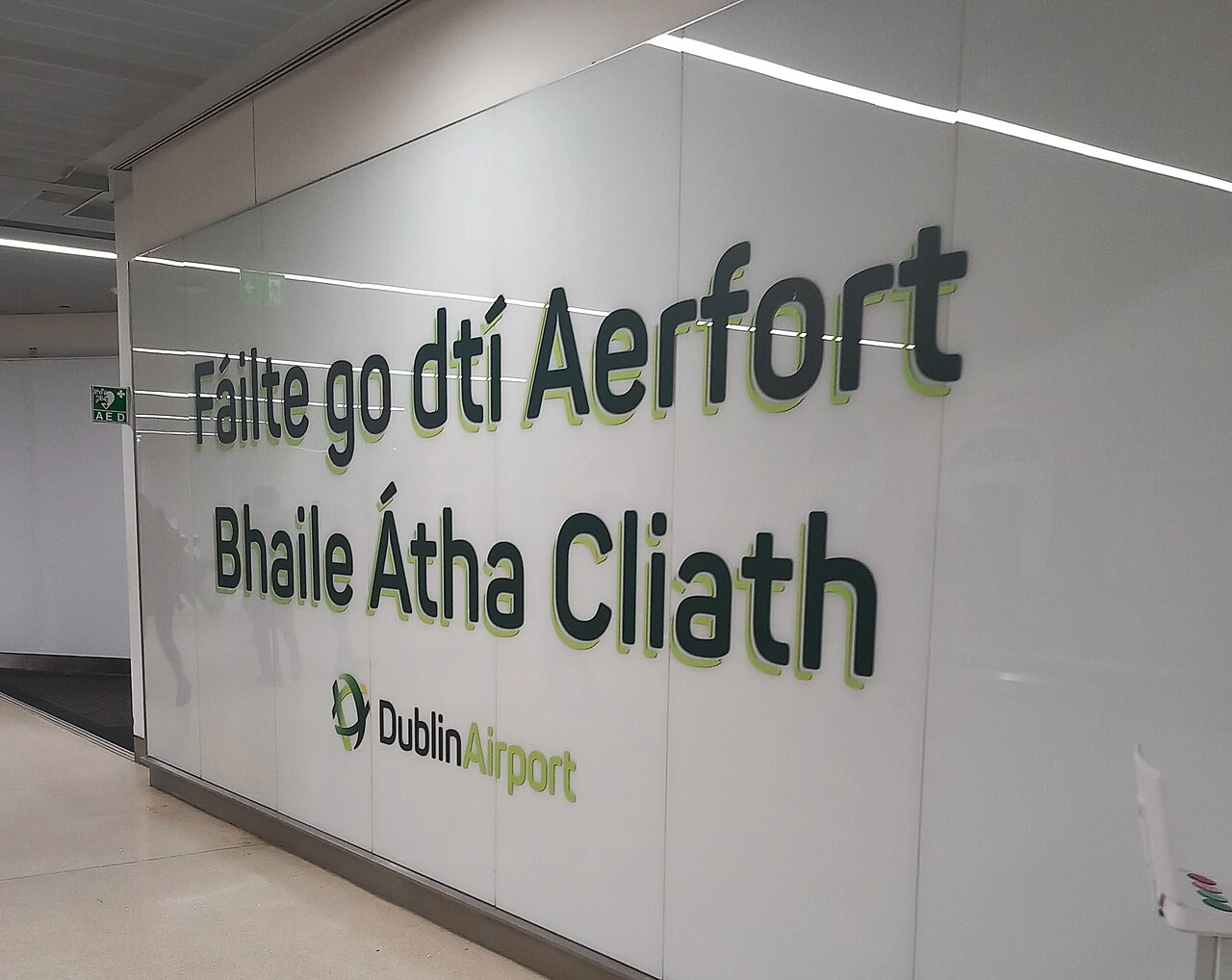
Irish and English welcome sign in Dublin Airport, Terminal 1. Language identification follows the source description; not independently transcribed.
Saved in Babelbook · resized display copy. Select the image to open it independently of its source.
Darren J. Prior · Source ↗CC BY 4.0 ↗View the local visual field note
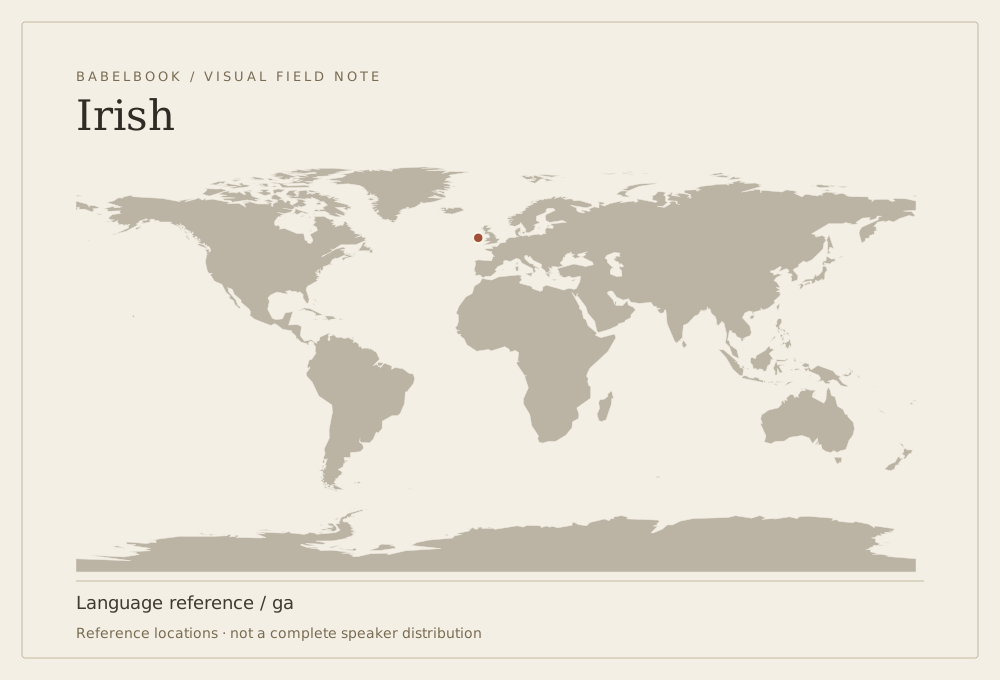
Representative reference points from Glottolog. Historical entries show reference locations, not current speakers. 1 point.
Reference & context ↗Babelbook · original editorial illustration · CC BY 4.0 · Glottolog locations; public-domain Natural Earth land
Source excerpts, selected, shortened and where noted editorially corrected from Irish language by Wikipedia contributors. Retrieved 2026-10-05. CC BY-SA 4.0. These excerpts are not an independently verified scholarly history; missing accounts are identified above.
Read further in the source
The Gaelic Revival
The Gaelic revival (Irish: Athbheochan na Gaeilge) was the late-nineteenth-century national revival of interest in the Irish language and Irish Gaelic culture (including folklore, mythology, sports, music, arts, etc.). The Gaelic League (Conradh na Gaeilge) was established in 1893 by Eoin MacNeill and other enthusiasts of Gaelic language and culture. Its first president was Douglas Hyde. The objective of the league was to encourage the use of Irish in everyday life in order to counter the ongoing anglicisation of the country. It organised weekly gatherings to discuss Irish culture, hosted conversation meetings, edited and periodically published a newspaper named An Claidheamh Soluis, and successfully campaigned to have Irish included in the school curriculum. The league grew quickly, having more than 48 branches within four years of its foundation and 400 within 10. It had fraught relationships with other cultural movements of the time, such as the Pan-Celtic movement and the Irish Literary Revival. Important writers of the Gaelic revival include Peadar Ua Laoghaire, Patrick Pearse (Pádraig Mac Piarais) and Pádraic Ó Conaire.
Daily Irish speakers in Gaeltacht areas between 2011 and 2022
In 1996, the three electoral divisions in the State where Irish had the most daily speakers were An Turloch (91%+), Scainimh (89%+), Min an Chladaigh (88%+).
Dialects
Irish is represented by several traditional dialects and by various varieties of "urban" Irish. The latter have acquired lives of their own and a growing number of native speakers. Differences between the dialects make themselves felt in stress, intonation, vocabulary and structural features. Roughly speaking, the three major dialect areas which survive coincide roughly with the provinces of Connacht (Cúige Chonnacht), Munster (Cúige Mumhan) and Ulster (Cúige Uladh). Records of some dialects of Leinster (Cúige Laighean) were made by the Irish Folklore Commission and others. Newfoundland, in eastern Canada, had a form of Irish derived from the Munster Irish of the later 18th century (see Newfoundland Irish).
Standardisation
There is no single official standard for pronouncing the Irish language. Certain dictionaries, such as Foclóir Póca, provide a single pronunciation. Online dictionaries such as Foclóir Béarla-Gaeilge provide audio files in the three major dialects. The differences between dialects are considerable, and have led to recurrent difficulties in conceptualising a "standard Irish." In recent decades contacts between speakers of different dialects have become more frequent and the differences between the dialects are less noticeable. An Caighdeán Oifigiúil ("The Official Standard"), often shortened to An Caighdeán, is a standard for the spelling and grammar of written Irish, developed and used by the Irish government. Its rules are followed by most schools in Ireland, though schools in and near Irish-speaking regions also use the local dialect. It was published by the translation department of Dáil Éireann in 1953 and updated in 2012 and 2017.
Orthography
A native writing system, Ogham, was used to write Primitive Irish and Old Irish until Latin script was introduced in the 5th century CE. After that, the main typeface used to write Irish was Gaelic type until it was replaced by Roman type during the mid-20th century. The traditional Irish alphabet (aibítir) consists of 18 letters: ⟨a, b, c, d, e, f, g, h, i, l, m, n, o, p, r, s, t, u⟩; it does not contain ⟨j, k, q, v, w, x, y, z⟩. But contemporary Irish uses the full Latin alphabet, with previously unused letters used in modern loanwords; ⟨v⟩ occurs in a small number of (mainly onomatopoeic) native words and colloquialisms. Vowels may be accented with an acute accent (⟨á, é, í, ó, ú⟩; Irish and Hiberno-English: (síneadh) fada "long (sign)"), but it is ignored for purposes of alphabetisation. It is used, among other conventions, to mark long vowels, e.g. ⟨e⟩ is /ɛ/ and ⟨é⟩ is /eː/. The overdot (ponc séimhithe "dot of lenition") was used in traditional orthography to indicate lenition; An Caighdeán uses a following ⟨h⟩ for this purpose, i.e. the dotted letters (litreacha buailte "struck letters") ⟨ḃ, ċ, ḋ, ḟ, ġ, ṁ, ṗ, ṡ, ṫ⟩ are equivalent to ⟨bh, ch, dh, fh, gh, mh, ph, sh, th⟩. The use of Gaelic type and the overdot today is restricted to when a traditional style is consciously being used, e.g. Óglaiġ na h-Éireann on the Irish Defence Forces cap badge (see above). Extending the use of the overdot to Roman type would theoretically have the advantage of making Irish texts significantly shorter, e.g. gheobhaidh sibh "you (pl.) will get" would become ġeoḃaiḋ siḃ.