Galician
Galician ( gə-LISH-(ee-)ən, UK also gə-LISS-ee-ən), also known as Galego (endonym: galego), is a Western Ibero-Romance language. Around 2.4 million people have at least some degree of competence in the language, mainly in Galicia, an autonomous community located in northwestern Spain, where it has official status along with Spanish. The language is also spoken in some border zones of the neighbouring Spanish regions of Asturias and Castile and León, as well as by Galician migrant communities in the rest of Spain; in Latin America, including Argentina and Uruguay; and in Puerto Rico, the United States, Switzerland and elsewhere in Europe. Modern Galician is classified as part of the West Iberian language group, a family of Romance languages. Galician evolved locally from Vulgar Latin and developed from what modern scholars have called Galician-Portuguese. The earliest document written integrally in the local Galician variety dates back to 1230, although the subjacent Romance permeates most written Latin local charters after the High Middle Ages, being especially noteworthy in personal and place names recorded in those documents, as well as in terms originated in languages other than Latin.
Translate in Galician ↗Galician is spoken by some three million people, including most of the population of Galicia and the numerous Galician communities established elsewhere, in Spain (Madrid, Barcelona, Biscay), in other European cities (Andorra la Vella, Geneva, London, Paris), and in the Americas (New York, New Jersey, Buenos Aires, Córdoba/Argentina, Montevideo, Mexico City, Havana, Caracas, San Juan in Puerto Rico, São Paulo, Managua, Mayagüez, Ponce, Panama City). Galician is today official, together with the Spanish language, in the autonomous community of Galicia, where it is recognised as the autochthonous language (lingua propia), being by law the first language of the local administrations and governments. By law it is supposed to be taught bilingually, alongside Spanish, in both primary and secondary education, although the accomplishment of this law is allegedly doubted. It is also used at the three universities established in Galicia, having also the consideration of official language of the three institutions. Galician has also legal recognition in the Bierzo region in León, and in four municipalities in Zamora. The other languages with official status elsewhere in Spain are Spanish, Catalan (or Valencian), Basque and Aranese. Galician has also been accepted orally as Portuguese in the European Parliament, being used by some Galician representatives, among others: José Posada, Camilo Nogueira and Xosé Manuel Beiras. Controversy exists regarding the inclusion of Eonavian (spoken in the western end of Asturias, bordering Galicia) in the Galician language, as it has some traits in common with Western Asturian (spoken in the middle west of Asturias). There are those defending these linguistic varieties as dialects of transition to the Astur-Leonese group on the one hand, and those defending it as clearly Galician varieties on the other (actually both views are compatible).
Europe
Present-day use
Galician is spoken by some three million people, including most of the population of Galicia and the numerous Galician communities established elsewhere, in Spain (Madrid, Barcelona, Biscay), in other European cities (Andorra la Vella, Geneva, London, Paris), and in the Americas (New York, New Jersey, Buenos Aires, Córdoba/Argentina, Montevideo, Mexico City, Havana, Caracas, San Juan in Puerto Rico, São Paulo, Managua, Mayagüez, Ponce, Panama City). Galician is today official, together with the Spanish language, in the autonomous community of Galicia, where it is recognised as the autochthonous language (lingua propia), being by law the first language of the local administrations and governments. By law it is supposed to be taught bilingually, alongside Spanish, in both primary and secondary education, although the accomplishment of this law is allegedly doubted. It is also used at the three universities established in Galicia, having also the consideration of official language of the three institutions. Galician has also legal recognition in the Bierzo region in León, and in four municipalities in Zamora. The other languages with official status elsewhere in Spain are Spanish, Catalan (or Valencian), Basque and Aranese. Galician has also been accepted orally as Portuguese in the European Parliament, being used by some Galician representatives, among others: José Posada, Camilo Nogueira and Xosé Manuel Beiras. Controversy exists regarding the inclusion of Eonavian (spoken in the western end of Asturias, bordering Galicia) in the Galician language, as it has some traits in common with Western Asturian (spoken in the middle west of Asturias). There are those defending these linguistic varieties as dialects of transition to the Astur-Leonese group on the one hand, and those defending it as clearly Galician varieties on the other (actually both views are compatible).
Origins
The captured article does not contain a separate origins section. See the historical account and linked source.
Development
Latinate Galician charters from the 8th century onward show that the local written Latin was heavily influenced by local spoken Romance, yet is not until the 12th century that there is evidence for the identification of the local language as a language different from Latin itself. During this same 12th century there are full Galician sentences being inadvertently used inside Latin texts, while its first reckoned use as a literary language dates to the last years of this same century. The linguistic stage from the 13th to the 15th centuries is usually known as Galician-Portuguese (or Old Portuguese, or Old Galician) as an acknowledgement of the cultural and linguistic unity of Galicia and Portugal during the Middle Ages, as the two linguistic varieties differed only in dialectal minor phenomena. This language flourished during the 13th and 14th centuries as a language of culture, developing a rich lyric tradition of which some 2000 compositions (cantigas, meaning 'songs') have been preserved—a few hundred even with their musical score—in a series of collections, and belonging to four main genres: cantigas de amor, love songs, where a man sings for his ladylove; cantigas de amigo, where a woman sings for her boyfriend; cantigas de escarnio, crude, taunting, and sexual songs of scorn; cantigas de maldecir, where the poet vents his spleen openly; and also the Cantigas de Santa María, which are religious songs. The oldest known document is the poem Ora faz ost'o Senhor de Navarra by Joam Soares de Paiva, written around 1200. The first non-literary documents in Galician-Portuguese date from the early 13th century, the Noticia de Torto (1211) and the Testamento of Afonso II of Portugal (1214), both samples of medieval notarial prose. Its most notable patrons—themselves reputed authors—were King Dom Dinis in Portugal, and King Alfonso X the Learned in Galicia, Castile and León, who was a great promoter of both Galician and Castilian Spanish languages.
Writing
The current official Galician orthography is guided by the "Normas ortográficas e morfolóxicas do Idioma Galego" (NOMIGa), first introduced in 1982, by the Royal Galician Academy (RAG), based on a report by the Instituto da Lingua Galega (ILG). In July 2003, the Royal Galician Academy modified the language normative to admit and promote some archaic Galician-Portuguese forms conserved in modern Portuguese, merging the NOMIG and the main proposals of the moderate sectors of reintegrationism; the resulting orthography is used by the vast majority of media, cultural production and virtually all official matters including education. The Galician Language Association (AGAL) maintains a separate orthography known as International Galician or Reintegrationist, which was first published in 1983 and converges with modern Portuguese orthography. It does not have official status in Galicia but is accepted as a form of Portuguese in international institutions such as the Community of Portuguese Language Countries or the European Parliament. In recent years, there has been greater social support for binormativism, the legal recognition of both norms, as in the case of the Norwegian language.
Beyond the typeface.
Signs, manuscripts, published pages and contextual photographs, with their place, period, source and reuse terms. Captions identify historical spellings, regional examples, community references and character imagery.
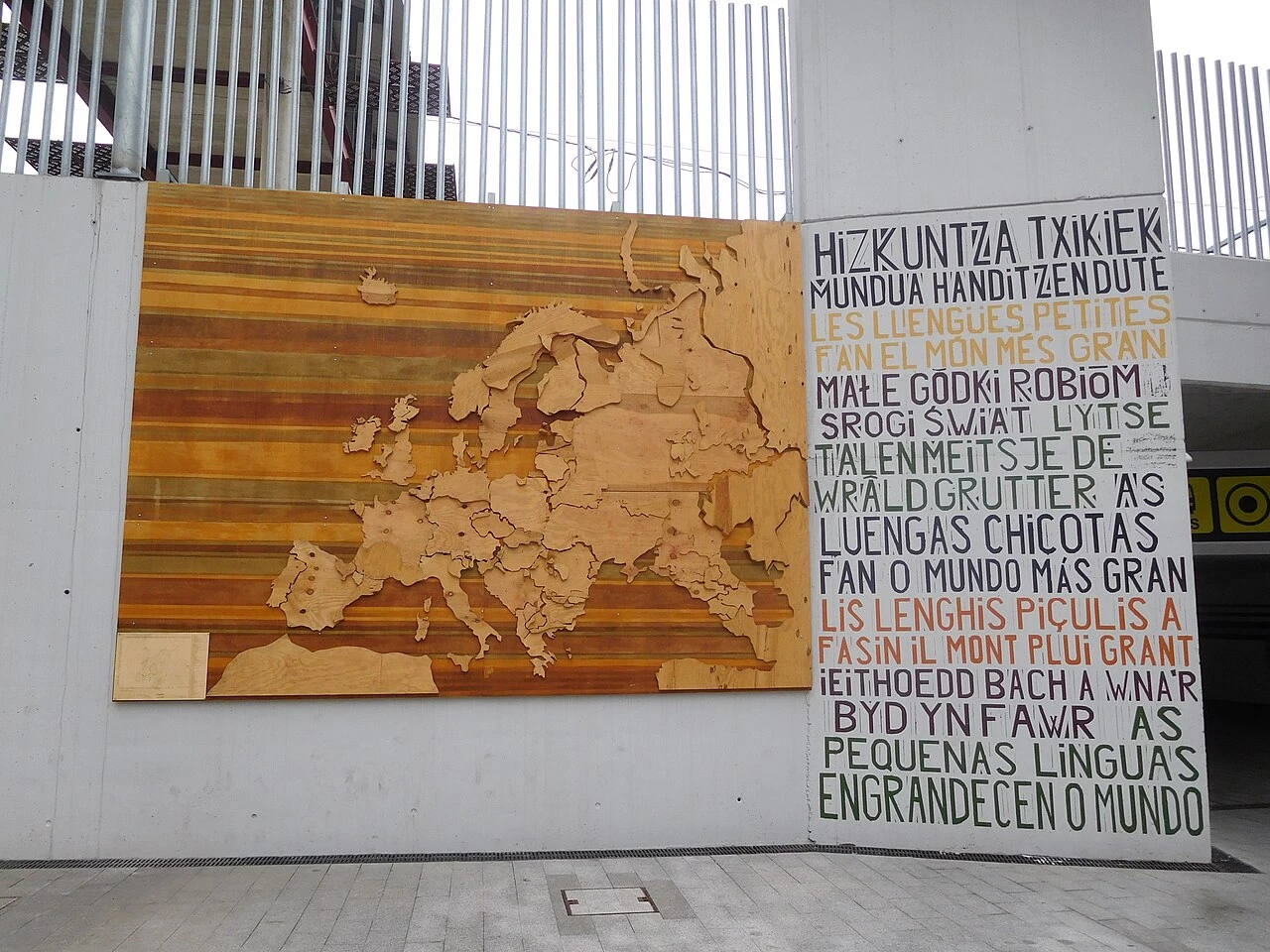
Multilingual street artwork celebrating smaller languages in San Sebastián, photographed in 2016. Includes Basque, Catalan and Galician among eight languages. Language identification follows Commons descriptions or categories; not independently transcribed.
Saved in Babelbook · resized display copy. Select the image to open it independently of its source.
Vasconium · Source ↗CC BY-SA 4.0 ↗View the local visual field note
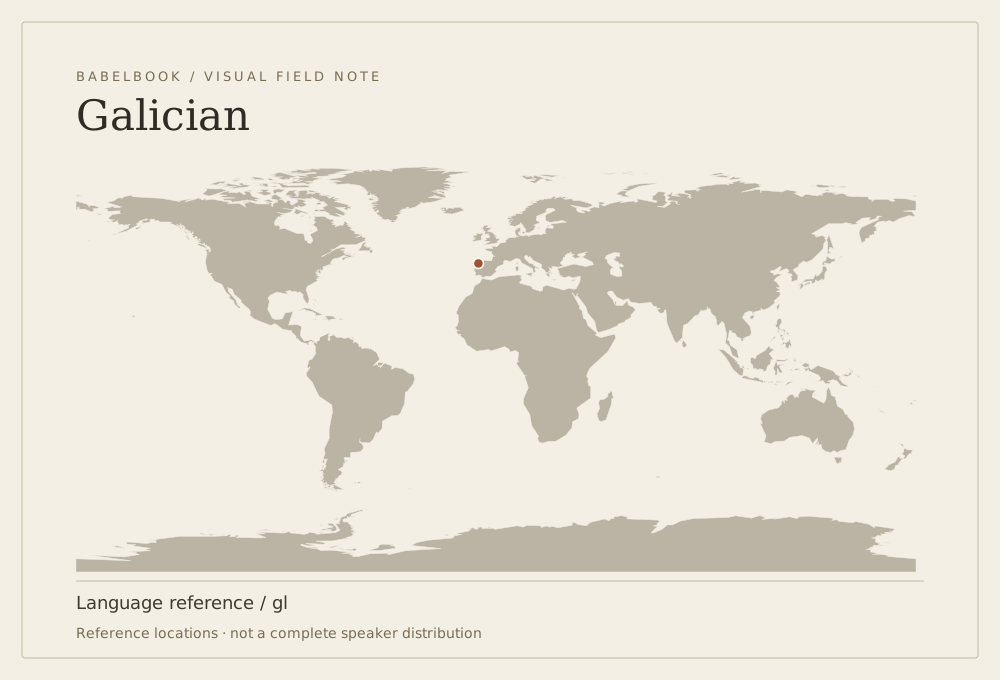
Representative reference points from Glottolog. Historical entries show reference locations, not current speakers. 1 point.
Reference & context ↗Babelbook · original editorial illustration · CC BY 4.0 · Glottolog locations; public-domain Natural Earth land
Source excerpts, selected, shortened and where noted editorially corrected from Galician language by Wikipedia contributors. Retrieved 2026-10-05. CC BY-SA 4.0. These excerpts are not an independently verified scholarly history; missing accounts are identified above.
Read further in the source
Geographic distribution and legal status
Galician is spoken by some three million people, including most of the population of Galicia and the numerous Galician communities established elsewhere, in Spain (Madrid, Barcelona, Biscay), in other European cities (Andorra la Vella, Geneva, London, Paris), and in the Americas (New York, New Jersey, Buenos Aires, Córdoba/Argentina, Montevideo, Mexico City, Havana, Caracas, San Juan in Puerto Rico, São Paulo, Managua, Mayagüez, Ponce, Panama City). Galician is today official, together with the Spanish language, in the autonomous community of Galicia, where it is recognised as the autochthonous language (lingua propia), being by law the first language of the local administrations and governments. By law it is supposed to be taught bilingually, alongside Spanish, in both primary and secondary education, although the accomplishment of this law is allegedly doubted. It is also used at the three universities established in Galicia, having also the consideration of official language of the three institutions. Galician has also legal recognition in the Bierzo region in León, and in four municipalities in Zamora. The other languages with official status elsewhere in Spain are Spanish, Catalan (or Valencian), Basque and Aranese. Galician has also been accepted orally as Portuguese in the European Parliament, being used by some Galician representatives, among others: José Posada, Camilo Nogueira and Xosé Manuel Beiras. Controversy exists regarding the inclusion of Eonavian (spoken in the western end of Asturias, bordering Galicia) in the Galician language, as it has some traits in common with Western Asturian (spoken in the middle west of Asturias). There are those defending these linguistic varieties as dialects of transition to the Astur-Leonese group on the one hand, and those defending it as clearly Galician varieties on the other (actually both views are compatible). The recent edition of the cartularies of Oscos in the Old Common Council of Castropol and cartularies of Obona, Cornellana, Corias and Belmonte in middle west of Asturias have shown a huge difference in the medieval speech between the two banks of the Navia river. An examination of the old documents of the Eonavian monastery of Oscos, written from the late 12th to early 14th century to 16th century, shows a clear identification of this language with the Galician-Portuguese linguistic group; while contemporary parchments elsewhere in Asturias are written in Spanish. The two most important traits of those commonly used to tell apart Galician-Portuguese and Asturian-Leonese varieties are the preservation of the mid-open vowels /ɛ/ and /ɔ/, which became diphthongs in Asturian-Leonese, and the loss of intervocalic /n/, preserved in the latter language.
History
Latinate Galician charters from the 8th century onward show that the local written Latin was heavily influenced by local spoken Romance, yet is not until the 12th century that there is evidence for the identification of the local language as a language different from Latin itself. During this same 12th century there are full Galician sentences being inadvertently used inside Latin texts, while its first reckoned use as a literary language dates to the last years of this same century. The linguistic stage from the 13th to the 15th centuries is usually known as Galician-Portuguese (or Old Portuguese, or Old Galician) as an acknowledgement of the cultural and linguistic unity of Galicia and Portugal during the Middle Ages, as the two linguistic varieties differed only in dialectal minor phenomena. This language flourished during the 13th and 14th centuries as a language of culture, developing a rich lyric tradition of which some 2000 compositions (cantigas, meaning 'songs') have been preserved—a few hundred even with their musical score—in a series of collections, and belonging to four main genres: cantigas de amor, love songs, where a man sings for his ladylove; cantigas de amigo, where a woman sings for her boyfriend; cantigas de escarnio, crude, taunting, and sexual songs of scorn; cantigas de maldecir, where the poet vents his spleen openly; and also the Cantigas de Santa María, which are religious songs. The oldest known document is the poem Ora faz ost'o Senhor de Navarra by Joam Soares de Paiva, written around 1200. The first non-literary documents in Galician-Portuguese date from the early 13th century, the Noticia de Torto (1211) and the Testamento of Afonso II of Portugal (1214), both samples of medieval notarial prose. Its most notable patrons—themselves reputed authors—were King Dom Dinis in Portugal, and King Alfonso X the Learned in Galicia, Castile and León, who was a great promoter of both Galician and Castilian Spanish languages. Not only the kings but also the noble houses of Galicia and Portugal encouraged literary creation in Galician-Portuguese, as being an author or bringing reputed troubadours into one's home became a way of promoting social prestige. As a result, many noblemen, businessmen and clergymen of the 13th and 14th centuries became notable authors, such as Paio Gomes Charinho, lord of Rianxo, and the aforementioned kings. Aside from the lyric genres, Galicia developed also a minor tradition on literary prose, most notably in translation of European popular series, as those dealing with King Arthur written by Chrétien de Troyes, or those based on the war of Troy, usually paid and commissioned by noblemen who desired to read those romances in their own language. Other genres include history books (either translation of Spanish ones, or original creations like the Chronicle of St. Mary of Iria, by Rui Vasques), religious books, legal studies, and a treaty on horse breeding. Most prose literary creation in Galician had stopped by the 16th century, when printing press became popular; the first complete translation of the Bible was not printed until the 20th century. As for other written uses of Galician, legal charters (last wills, hirings, sales, constitutional charters, city council book of acts, guild constitutions, books of possessions, and any type of public or private contracts and inventories) written in Galicia are to be found from 1230 to 1530—the earliest one probably a document from the monastery of Melón, dated in 1231—being Galician by far the most used language during the 13th, 14th and 15th centuries, in substitution of Latin.
Dialects
Some authors are of the opinion that Galician possesses no real dialects. Despite this, Galician local varieties are collected in three main dialectal blocks, each block comprising a series of areas, being local linguistic varieties that are all mutually intelligible. Some of the main features which distinguish the three blocks are:
The resolution of medieval nasalised vowels and hiatus: these sometimes turned into diphthongs in the east, while in the center and west the vowels in the hiatus were sometimes assimilated. Later, in the eastern—except Ancarese Galician—and central blocks, the nasal trait was lost, while in the west the nasal trait usually developed into an implosive nasal consonant /ŋ/. In general, these led to important dialectal variability in the inflection in genre and number of words ended in a nasal consonant. So, from medieval irmão 'brother', ladrões 'robbers', irmãas 'sisters' developed eastern Galician irmao, ladrois, irmás; central Galician irmao, ladrós, irmás; western Galician irmán, ladróns, irmáns. An exception to this rule is constituted by the hiatus in which the first vowel was a nasalised i or u. In those cases, a nasal, palatal /ɲ/ or velar /ŋ/ was usually inserted: ũa 'a / one (fem.)' > unha (Portuguese uma), -ina > -ĩa > -iña (Portuguese -inha). Nevertheless, in Ancarese and Asturian Galician, this process did not take place: A-G vecía, Ancarese vecĩa vs. standard veciña '(female) neighbor' (Port. vizinha), A-G úa, Ancarese ũa vs. standard unha (Port. uma). The resolution of hiatus formed by oral vowels had similar developments, most notably those derived from the loss of /l/, which again had important consequences for the declension of words ending in /l/. So, Medieval Galician animaes 'animals' (sing. animal); central and western Galician animás; eastern Galician animais; Asturian Galician animales (/l/ is preserved). In the west, /ɡ/ is rendered as a fricative [x ~ ħ ~ h] (gheada), except after a nasal, where it can become a stop [k]. Stressed vowel metaphony is most notable in the west and center, while in the east it is unknown. It is triggered by a final /o/, which tends to close open-mid vowels, or by a final /a/ which tends to open close-mid ones. There are three main sibilant systems, all derived from the medieval Galician one, which was richer and more complex: The common one, extended in the eastern and center regions, presents an opposition /ʃ/ – /s/ – /θ/. In the westernmost parts of this area the opposition of /s/ and /θ/ is lost in postnuclear position, in the coda, both being produced /s/. In the coastal western areas the opposition is /ʃ/ – /s/, /s/ being produced in some regions as a laminal or in some others as an apical. Sometimes this system is even further reduced to just a single /s/. On the other hand, in some areas final /s/ is produced as /ʃ/, as in plenty of Portuguese dialects. In the Limia Baixa region an old six sibilant system is still preserved, with voiced/voiceless opposition: /ʃ/ – /ʒ/; /s̺/ – /z̺/ (apical) and /s̻/ – /z̻/ (laminal). Each dialectal area is then further defined by these and other more restricted traits or isoglosses:
Eastern Galician: Asturian area (Eonavian), Ancares area, Zamora area and Central-Eastern area. Central Galician: Mindoniense area, Lucu-auriense area, Central Transitional area, and Eastern Transitional area. Western Galician: Bergantiños area, Fisterra area, Pontevedra area and Lower Limia area. Standard Galician is usually based on Central Galician characteristics, but it also incorporates western and eastern traits and features.
Orthography
The current official Galician orthography is guided by the "Normas ortográficas e morfolóxicas do Idioma Galego" (NOMIGa), first introduced in 1982, by the Royal Galician Academy (RAG), based on a report by the Instituto da Lingua Galega (ILG). In July 2003, the Royal Galician Academy modified the language normative to admit and promote some archaic Galician-Portuguese forms conserved in modern Portuguese, merging the NOMIG and the main proposals of the moderate sectors of reintegrationism; the resulting orthography is used by the vast majority of media, cultural production and virtually all official matters including education. The Galician Language Association (AGAL) maintains a separate orthography known as International Galician or Reintegrationist, which was first published in 1983 and converges with modern Portuguese orthography. It does not have official status in Galicia but is accepted as a form of Portuguese in international institutions such as the Community of Portuguese Language Countries or the European Parliament. In recent years, there has been greater social support for binormativism, the legal recognition of both norms, as in the case of the Norwegian language.