Middle High German
Middle High German (MHG; endonym: diutsch or tiutsch; New High German: Mittelhochdeutsch [ˈmɪtl̩hoːxˌdɔʏtʃ] , shortened as Mhdt. or Mhd.) is the term for the form of High German spoken in the High Middle Ages. It is conventionally dated between 1050 and 1350, developing from Old High German (OHG) into Early New High German (ENHG). High German is defined as those varieties of German which were affected by the Second Sound Shift; the Middle Low German (MLG) and Middle Dutch languages spoken to the North and North West, which did not participate in this sound change, are not part of MHG. While there is no standard MHG, the prestige of the Hohenstaufen court gave rise in the late 12th century to a supra-regional literary language (mittelhochdeutsche Dichtersprache) based on Swabian, an Alemannic dialect. This historical interpretation is complicated by the tendency of modern editions of MHG texts to use normalised spellings based on this variety (usually called "Classical MHG"), which make the written language appear more consistent than it actually is in the manuscripts. Scholars are uncertain as to whether the literary language reflected a supra-regional spoken language of the courts. An important development in this period was the Ostsiedlung, the eastward expansion of German settlement beyond the Elbe-Saale line which marked the limit of Old High German.
Translate in Middle High German ↗Middle High German (MHG; endonym: diutsch or tiutsch; New High German: Mittelhochdeutsch [ˈmɪtl̩hoːxˌdɔʏtʃ] , shortened as Mhdt. or Mhd.) is the term for the form of High German spoken in the High Middle Ages. It is conventionally dated between 1050 and 1350, developing from Old High German (OHG) into Early New High German (ENHG). High German is defined as those varieties of German which were affected by the Second Sound Shift; the Middle Low German (MLG) and Middle Dutch languages spoken to the North and North West, which did not participate in this sound change, are not part of MHG. While there is no standard MHG, the prestige of the Hohenstaufen court gave rise in the late 12th century to a supra-regional literary language (mittelhochdeutsche Dichtersprache) based on Swabian, an Alemannic dialect. This historical interpretation is complicated by the tendency of modern editions of MHG texts to use normalised spellings based on this variety (usually called "Classical MHG"), which make the written language appear more consistent than it actually is in the manuscripts. Scholars are uncertain as to whether the literary language reflected a supra-regional spoken language of the courts. An important development in this period was the Ostsiedlung, the eastward expansion of German settlement beyond the Elbe-Saale line which marked the limit of Old High German. This process started in the 11th century, and all the East Central German dialects are a result of this expansion. "Judeo-German", the precursor of the Yiddish language, is attested in the 12th–13th centuries, as a variety of Middle High German written in Hebrew characters.
Europe
Present-day use
The captured source does not contain a separate current-use account.
Origins
The captured article does not contain a separate origins section. See the historical account and linked source.
Development
The captured article does not contain a distinct historical account. No chronology has been invented.
Writing
Middle High German texts are written in the Latin alphabet. There was no standardised spelling, but modern editions generally standardise according to a set of conventions established by Karl Lachmann in the 19th century. There are several important features in this standardised orthography which are not characteristics of the original manuscripts: the marking of vowel length is almost entirely absent from MHG manuscripts. the marking of umlauted vowels is often absent or inconsistent in the manuscripts. a curly-tailed z (⟨ȥ⟩ or ⟨ʒ⟩) is used in modern handbooks and grammars to indicate the /s/ or /s/-like sound which arose from Germanic /t/ in the High German consonant shift. This character has no counterpart in the original manuscripts, which typically use ⟨s⟩ or ⟨z⟩ to indicate this sound. the original texts often use ⟨i⟩ and ⟨uu⟩ for the semi-vowels /j/ and /w/. A particular problem is that many manuscripts are of much later date than the works they contain; as a result, they bear the signs of later scribes having modified the spellings, with greater or lesser consistency, in accord with conventions of their time. In addition, there is considerable regional variation in the spellings that appear in the original texts, which modern editions largely conceal.
Beyond the typeface.
Signs, manuscripts, published pages and contextual photographs, with their place, period, source and reuse terms. Captions identify historical spellings, regional examples, community references and character imagery.
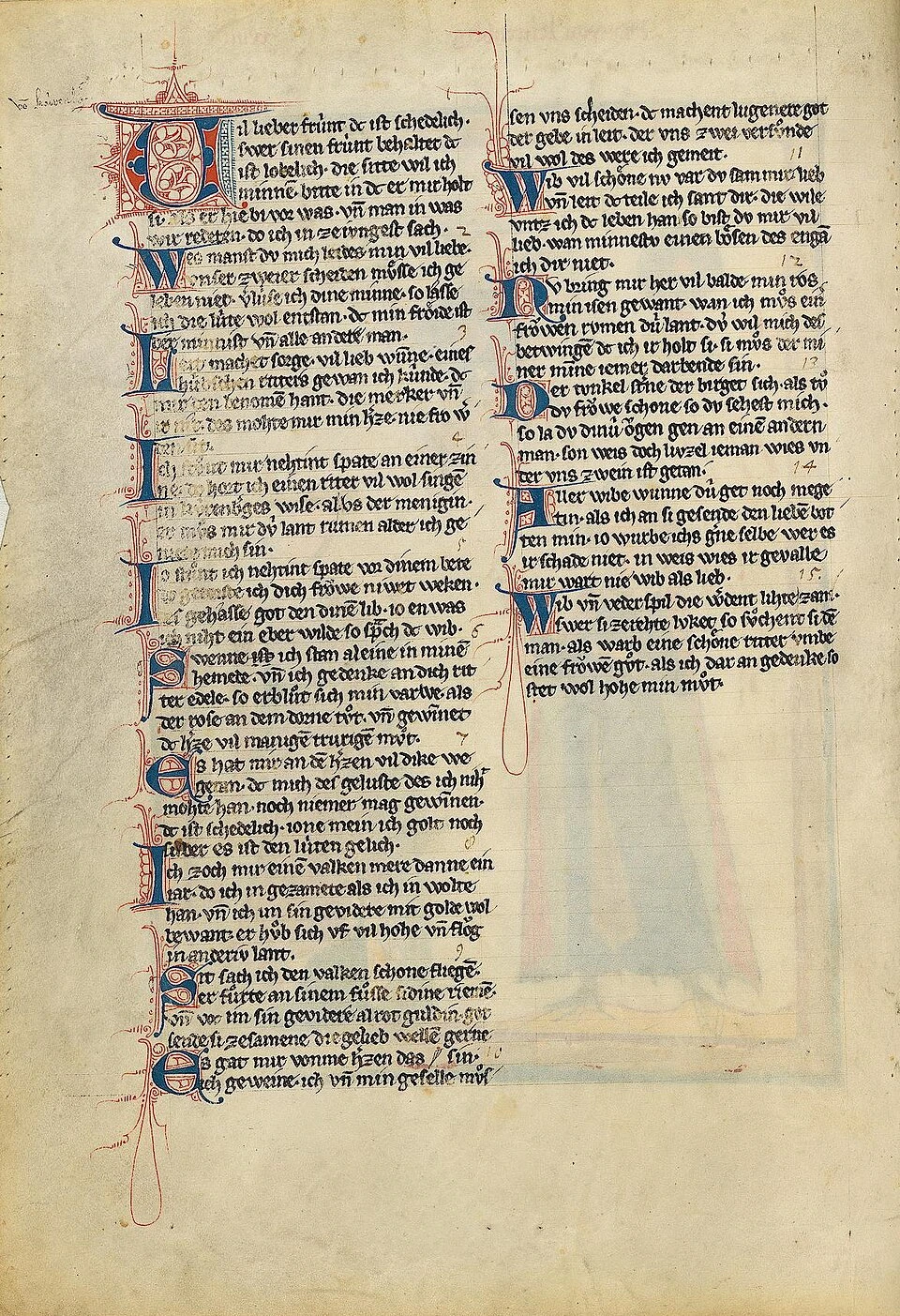
Fifteen stanzas of Middle High German verse attributed to Der von Kürenberg in the Codex Manesse.
Saved in Babelbook · resized display copy. Select the image to open it independently of its source.
Der von Kürenberg (verse); manuscript scribe unidentified · Source ↗Public domain ↗View the local visual field note
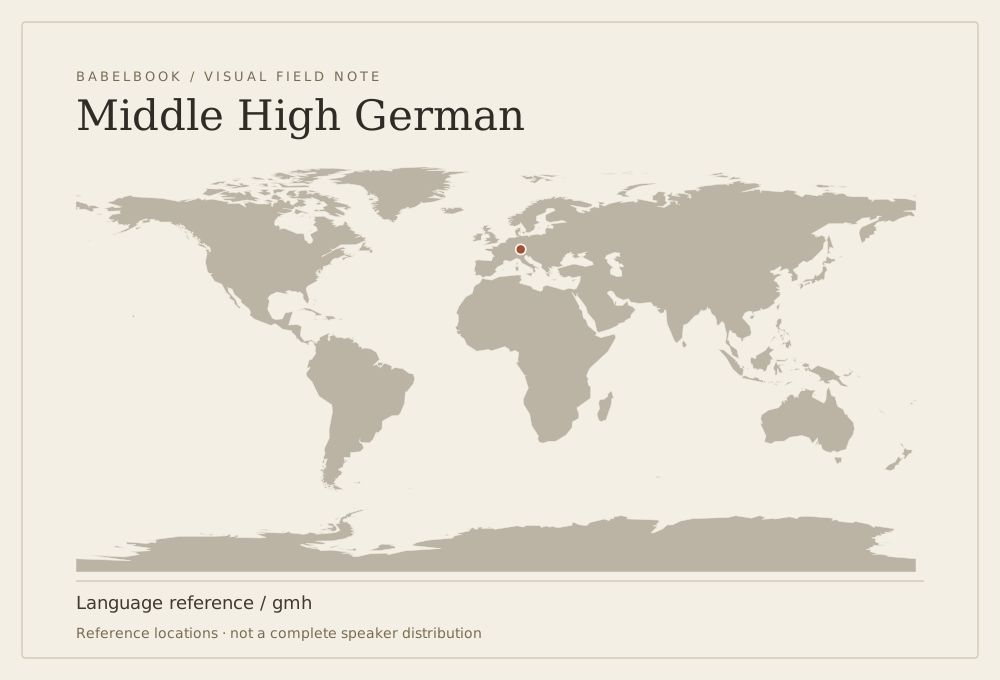
Representative reference points from Glottolog. Historical entries show reference locations, not current speakers. 1 point.
Reference & context ↗Babelbook · original editorial illustration · CC BY 4.0 · Glottolog locations; public-domain Natural Earth land
Source excerpts, selected, shortened and where noted editorially corrected from Middle High German by Wikipedia contributors. Retrieved 2026-10-05. CC BY-SA 4.0. These excerpts are not an independently verified scholarly history; missing accounts are identified above.
Read further in the source
Dialects
The dialect map of Germany by the end of the Middle High German period was much the same as that at the start of the 20th century, though the boundary with Low German was further south than it now is: Central German (Mitteldeutsch)
West Central German (Westmitteldeutsch) Central Franconian (Mittelfränkisch) Ripuarian (Ripuarisch) Moselle Franconian (Moselfränkisch) Rhine Franconian (Rheinfränkisch) Hessian (Hessisch) East Central German (Ostmitteldeutsch) Thuringian (Thüringisch) Upper Saxon (Obersächsisch) Silesian (Schlesisch) High Prussian (Hochpreußisch) Upper German (Oberdeutsch)
East Franconian (Ostfränkisch) South Rhine Franconian (Süd(rhein)fränkisch) Alemannic (Alemannisch) North Alemannic (Nordalemannisch) Swabian (Schwäbisch) Low Alemannic (Niederalemannisch/Oberrheinisch) High Alemannic/South Alemannic (Hochalemannisch/Südalemannisch) ) Bavarian (Bairisch) Northern Bavarian (Nordbairisch) Central Bavarian (Mittelbairisch) Southern Bavarian (Südbairisch) With the exception of Thuringian, the East Central German dialects are new dialects resulting from the Ostsiedlung and arise towards the end of the period.
Writing system
Middle High German texts are written in the Latin alphabet. There was no standardised spelling, but modern editions generally standardise according to a set of conventions established by Karl Lachmann in the 19th century. There are several important features in this standardised orthography which are not characteristics of the original manuscripts:
the marking of vowel length is almost entirely absent from MHG manuscripts. the marking of umlauted vowels is often absent or inconsistent in the manuscripts. a curly-tailed z (⟨ȥ⟩ or ⟨ʒ⟩) is used in modern handbooks and grammars to indicate the /s/ or /s/-like sound which arose from Germanic /t/ in the High German consonant shift. This character has no counterpart in the original manuscripts, which typically use ⟨s⟩ or ⟨z⟩ to indicate this sound. the original texts often use ⟨i⟩ and ⟨uu⟩ for the semi-vowels /j/ and /w/. A particular problem is that many manuscripts are of much later date than the works they contain; as a result, they bear the signs of later scribes having modified the spellings, with greater or lesser consistency, in accord with conventions of their time. In addition, there is considerable regional variation in the spellings that appear in the original texts, which modern editions largely conceal.