Guarani
Guarani (avañe'ẽ) is a Tupian language belonging to the Tupi–Guarani branch of South America. It is one of the two official languages of Paraguay (along with Spanish), where it is spoken by the majority of the population, and where half of the rural population are monolingual speakers of the language. Guarani is one of the most widely spoken Native American languages and remains commonly used among the Paraguayan people and neighboring communities. This is unique among American languages; language shift towards European colonial languages (in this case, the other official language of Spanish) has otherwise been a nearly universal phenomenon in the Western Hemisphere, but Paraguayans have maintained their traditional language while also adopting Spanish. In South America, the indigenous language that is most widely spoken amongst non-indigenous communities is Guaraní. South America is home to more than 280,000 Guaraní people, 51,000 of whom reside in Brazil. The Guaraní people inhabit regions in Brazil, Paraguay, Bolivia, as well as Argentina. There are more than four million speakers of Guaraní across these regions. The name "Guarani" is generally used for the official language of Paraguay. However, this is part of a dialect chain, most of whose components are also often called Guarani.
Translate in Guarani ↗Variants of the language are spoken by communities in neighboring countries including parts of northeastern Argentina, southeastern Bolivia and southwestern Brazil. It is the second official language of the Argentine province of Corrientes since 2004 and the Brazilian city of Tacuru since 2010. Guarani is also one of the three official languages of Mercosur, alongside Spanish and Portuguese. The United Nations Educational, Scientific and Cultural Organization (UNESCO) classified Guaraní's language vitality as "vulnerable". UNESCO's definition of "vulnerable" is meant to highlight that although the majority of Guaraní children can speak Guaraní, the use of the language is restricted to particular contexts (e.g., familial settings). In 2002, 28% of Paraguayans were monolingual Guaraní speakers, but by 2022 only 12% were. On the other hand, Spanish monolingualism did not rise over the same period, indicating the continued vivacity of Guaraní in a multilingual population. Although the Guaraní language may only be classified as "vulnerable," there are other languages within the Tupí-Guaraní branch that are classified as "extinct" and "critically endangered" (e.g., Amanayé and Anambé respectively). Widely spoken, Paraguayan Guarani has nevertheless been repressed by Paraguayan governments throughout most of its history since independence. It was prohibited in state schools for over 100 years. However, populists often used pride in the language to excite nationalistic fervor and promote a narrative of social unity. During the autocratic regime of Alfredo Stroessner, his Colorado Party used the language to appeal to common Paraguayans although Stroessner himself never gave an address in Guarani. Upon the advent of Paraguayan democracy in 1992, Guarani was established in the new constitution as a language equal to Spanish. Jopara, a mixture of Spanish and Guarani, is spoken by an estimated 90% of the population of Paraguay.
Central & South America
Present-day use
The United Nations Educational, Scientific and Cultural Organization (UNESCO) classified Guaraní's language vitality as "vulnerable". UNESCO's definition of "vulnerable" is meant to highlight that although the majority of Guaraní children can speak Guaraní, the use of the language is restricted to particular contexts (e.g., familial settings). In 2002, 28% of Paraguayans were monolingual Guaraní speakers, but by 2022 only 12% were. On the other hand, Spanish monolingualism did not rise over the same period, indicating the continued vivacity of Guaraní in a multilingual population. Although the Guaraní language may only be classified as "vulnerable," there are other languages within the Tupí-Guaraní branch that are classified as "extinct" and "critically endangered" (e.g., Amanayé and Anambé respectively). Widely spoken, Paraguayan Guarani has nevertheless been repressed by Paraguayan governments throughout most of its history since independence. It was prohibited in state schools for over 100 years. However, populists often used pride in the language to excite nationalistic fervor and promote a narrative of social unity. During the autocratic regime of Alfredo Stroessner, his Colorado Party used the language to appeal to common Paraguayans although Stroessner himself never gave an address in Guarani. Upon the advent of Paraguayan democracy in 1992, Guarani was established in the new constitution as a language equal to Spanish. Jopara, a mixture of Spanish and Guarani, is spoken by an estimated 90% of the population of Paraguay. Code-switching between the two languages takes place on a spectrum in which more Spanish is used for official and business-related matters, and more Guarani is used in art and in everyday life. Guarani is also an official language of Bolivia and of Corrientes Province in Argentina.
Origins
The captured article does not contain a separate origins section. See the historical account and linked source.
Development
While Guarani, in its Classical form, was the only language spoken in the expansive missionary territories, Paraguayan Guarani has its roots outside of the Jesuit Reductions. Modern scholarship has shown that Guarani was always the primary language of colonial Paraguay, both inside and outside the reductions. Following the expulsion of the Jesuits in the 18th century, the residents of the reductions gradually migrated north and west towards Asunción, a demographic shift that brought about a decidedly one-sided shift away from the Jesuit dialect that the missionaries had curated in the southern and eastern territories of the colony. By and large, the Guarani of the Jesuits shied away from direct phonological loans from Spanish. Instead, the missionaries relied on the agglutinative nature of the language to formulate new precise translations or calque terms from Guarani morphemes. This process often led the Jesuits to employ complicated, highly synthetic terms to convey European concepts. By contrast, the Guarani spoken outside of the missions was characterized by a free, unregulated frequently, Spanish words and phrases were simply incorporated into Guarani with minimal phonological adaptation. A good example of that phenomenon is found in the word "communion". The Jesuits, using their agglutinative strategy, rendered this word "Tupârahava", a calque based on the word "Tupâ", meaning God. In modern Paraguayan Guarani, the same word is rendered "komuño". Following the out-migration from the reductions, these two distinct dialects of Guarani came into extensive contact for the first time. The vast majority of speakers abandoned the less colloquial, highly regulated Jesuit variant in favor of the variety that evolved from actual use by speakers in Paraguay. This contemporary form of spoken Guarani is known as Jopará, meaning "mixture" in Guarani.
Writing
Sounds which only become nasalized due to nasal harmony are typically written as their phonemic values rather than their phonetic ones. For example, if a vowel is not 'canonically' nasal, but is under context of nasal harmony, it is still written without a diacritic.
Beyond the typeface.
Signs, manuscripts, published pages and contextual photographs, with their place, period, source and reuse terms. Captions identify historical spellings, regional examples, community references and character imagery.
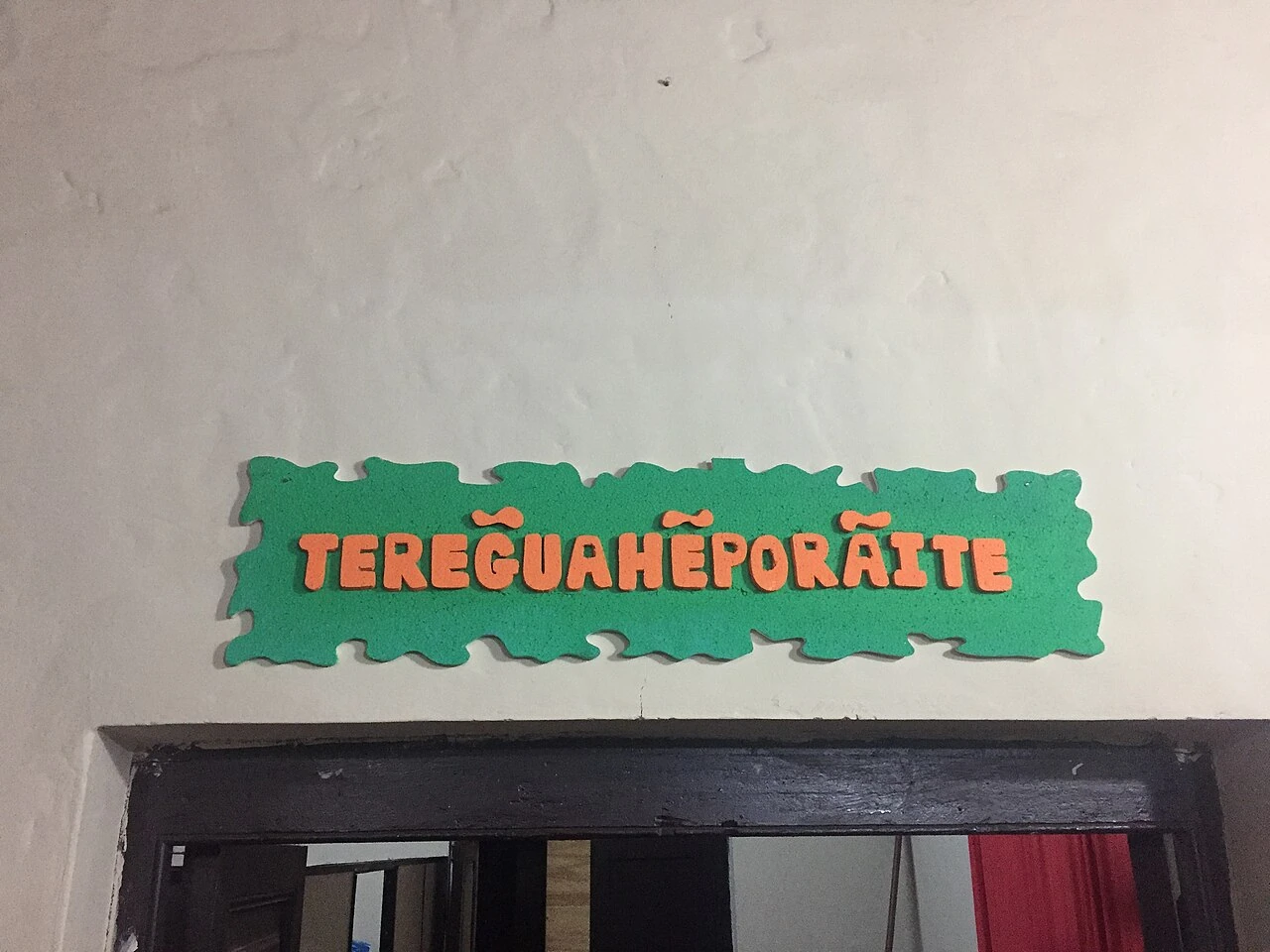
A Guarani welcome message inside the Yvy Marãe’ỹ Foundation in San Lorenzo, Paraguay.
Saved in Babelbook · resized display copy. Select the image to open it independently of its source.
Fadesga · Source ↗CC BY-SA 4.0 ↗View the local visual field note
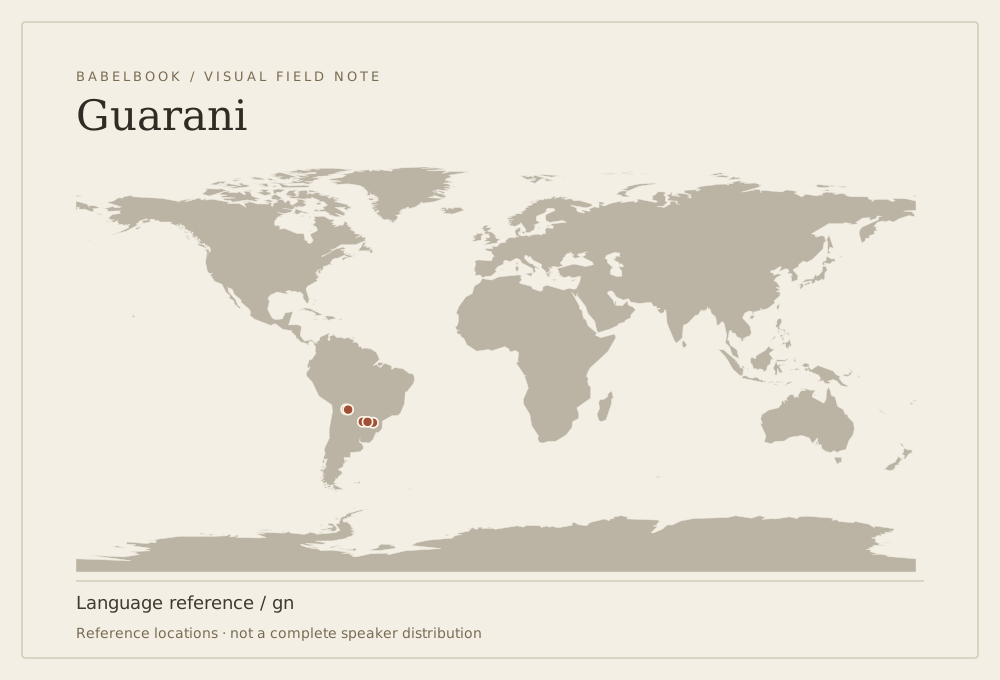
Representative reference points from Glottolog. Historical entries show reference locations, not current speakers. 5 points.
Reference & context ↗Babelbook · original editorial illustration · CC BY 4.0 · Glottolog locations; public-domain Natural Earth land
Source excerpts, selected, shortened and where noted editorially corrected from Guarani language by Wikipedia contributors. Retrieved 2026-10-05. CC BY-SA 4.0. These excerpts are not an independently verified scholarly history; missing accounts are identified above.
Read further in the source
Geographical distribution
Variants of the language are spoken by communities in neighboring countries including parts of northeastern Argentina, southeastern Bolivia and southwestern Brazil. It is the second official language of the Argentine province of Corrientes since 2004 and the Brazilian city of Tacuru since 2010. Guarani is also one of the three official languages of Mercosur, alongside Spanish and Portuguese.
Status
The United Nations Educational, Scientific and Cultural Organization (UNESCO) classified Guaraní's language vitality as "vulnerable". UNESCO's definition of "vulnerable" is meant to highlight that although the majority of Guaraní children can speak Guaraní, the use of the language is restricted to particular contexts (e.g., familial settings). In 2002, 28% of Paraguayans were monolingual Guaraní speakers, but by 2022 only 12% were. On the other hand, Spanish monolingualism did not rise over the same period, indicating the continued vivacity of Guaraní in a multilingual population. Although the Guaraní language may only be classified as "vulnerable," there are other languages within the Tupí-Guaraní branch that are classified as "extinct" and "critically endangered" (e.g., Amanayé and Anambé respectively).
History
While Guarani, in its Classical form, was the only language spoken in the expansive missionary territories, Paraguayan Guarani has its roots outside of the Jesuit Reductions. Modern scholarship has shown that Guarani was always the primary language of colonial Paraguay, both inside and outside the reductions. Following the expulsion of the Jesuits in the 18th century, the residents of the reductions gradually migrated north and west towards Asunción, a demographic shift that brought about a decidedly one-sided shift away from the Jesuit dialect that the missionaries had curated in the southern and eastern territories of the colony. By and large, the Guarani of the Jesuits shied away from direct phonological loans from Spanish. Instead, the missionaries relied on the agglutinative nature of the language to formulate new precise translations or calque terms from Guarani morphemes. This process often led the Jesuits to employ complicated, highly synthetic terms to convey European concepts. By contrast, the Guarani spoken outside of the missions was characterized by a free, unregulated frequently, Spanish words and phrases were simply incorporated into Guarani with minimal phonological adaptation. A good example of that phenomenon is found in the word "communion". The Jesuits, using their agglutinative strategy, rendered this word "Tupârahava", a calque based on the word "Tupâ", meaning God. In modern Paraguayan Guarani, the same word is rendered "komuño". Following the out-migration from the reductions, these two distinct dialects of Guarani came into extensive contact for the first time. The vast majority of speakers abandoned the less colloquial, highly regulated Jesuit variant in favor of the variety that evolved from actual use by speakers in Paraguay. This contemporary form of spoken Guarani is known as Jopará, meaning "mixture" in Guarani.
Political status
Widely spoken, Paraguayan Guarani has nevertheless been repressed by Paraguayan governments throughout most of its history since independence. It was prohibited in state schools for over 100 years. However, populists often used pride in the language to excite nationalistic fervor and promote a narrative of social unity. During the autocratic regime of Alfredo Stroessner, his Colorado Party used the language to appeal to common Paraguayans although Stroessner himself never gave an address in Guarani. Upon the advent of Paraguayan democracy in 1992, Guarani was established in the new constitution as a language equal to Spanish. Jopara, a mixture of Spanish and Guarani, is spoken by an estimated 90% of the population of Paraguay. Code-switching between the two languages takes place on a spectrum in which more Spanish is used for official and business-related matters, and more Guarani is used in art and in everyday life. Guarani is also an official language of Bolivia and of Corrientes Province in Argentina.
Orthography
Sounds which only become nasalized due to nasal harmony are typically written as their phonemic values rather than their phonetic ones. For example, if a vowel is not 'canonically' nasal, but is under context of nasal harmony, it is still written without a diacritic.
Distribution
Guarani temporal markers are only productive with indefinites, possessives, demonstratives, and qualification in nominal phrases. Depending on the clarification of the phrase they are in, they may or may not be applicable, as is represented in the chart below. Through analyzing this chart, one can see that -kue is not applicable to artifacts of a food or natural origin, and that -kue is also not applicable when combined with nouns that represent permanent relations.
Note. Chart above reprinted from J. Tonhauser.