Old High German
Old High German (OHG; German: Althochdeutsch (Ahdt., Ahd.)) is the earliest stage of the German language, conventionally identified as the period from around 500/750 to 1050. Rather than representing a single supra-regional form of German, Old High German encompasses the numerous West Germanic dialects that had undergone the set of consonantal changes called the Second Sound Shift. At the start of this period, dialect areas reflected the territories of largely independent tribal kingdoms, but by 788 the conquests of Charlemagne had brought all OHG dialect areas into a single polity. The period also saw the development of a stable linguistic border between German and Gallo-Romance, later French. Old High German largely preserved the synthetic inflectional system inherited from its ancestral Germanic forms. The eventual disruption of these patterns, which led to the more analytic grammar, are generally considered to mark the transition to Middle High German. Surviving Old High German texts were all composed in monastic scriptoria, so the overwhelming majority of them are religious in nature or, when secular, belong to the Latinate literary culture of Christianity. The earliest instances, which date to the latter half of the 8th century, are glosses—notes added to the margins or between lines that provide translation of the (Latin) text or other aid to the reader.
Translate in Old High German ↗Old High German (OHG; German: Althochdeutsch (Ahdt., Ahd.)) is the earliest stage of the German language, conventionally identified as the period from around 500/750 to 1050. Rather than representing a single supra-regional form of German, Old High German encompasses the numerous West Germanic dialects that had undergone the set of consonantal changes called the Second Sound Shift. At the start of this period, dialect areas reflected the territories of largely independent tribal kingdoms, but by 788 the conquests of Charlemagne had brought all OHG dialect areas into a single polity. The period also saw the development of a stable linguistic border between German and Gallo-Romance, later French. Old High German largely preserved the synthetic inflectional system inherited from its ancestral Germanic forms. The eventual disruption of these patterns, which led to the more analytic grammar, are generally considered to mark the transition to Middle High German. Surviving Old High German texts were all composed in monastic scriptoria, so the overwhelming majority of them are religious in nature or, when secular, belong to the Latinate literary culture of Christianity. The earliest instances, which date to the latter half of the 8th century, are glosses—notes added to the margins or between lines that provide translation of the (Latin) text or other aid to the reader.
Europe
Present-day use
The captured source does not contain a separate current-use account.
Origins
The captured article does not contain a separate origins section. See the historical account and linked source.
Development
This list has the sound changes that transformed Common West Germanic into Old High German but not the Late OHG changes that affected Middle High German: /ɣ/, /β/ > /ɡ/, /b/ in all positions (/ð/ > /d/ already took place in West Germanic. Most but not all High German areas are subject to the change. PwGmc *sibi > OHG sib (cf. Old English: sife), PwGmc *gesteran > OHG gestaron (cf. OE ġeostran, ⟨ġ⟩ representing a fricative /ʝ/ ) High German consonant shift: Inherited voiceless plosives are lenited into fricatives and affricates, and voiced fricatives are hardened into plosives and in some cases devoiced. Ungeminated post-vocalic /p/, /t/, /k/ spirantize intervocalically to /ff/, /ss/, /xx/ and elsewhere to /f/, /s/, /x/. Cluster /tr/ is exempt. Compare OE slǣpan to OHG slāfan. Word-initially, after a resonant and when geminated, the same consonants affricatized to /pf/, /ts/ and /kx/, OE tam: OHG zam. Spread of /k/ > /k͡x/ is geographically very limited and is not reflected in Modern Standard German. /b/, /d/ and /ɡ/ are devoiced. In what ultimately gave rise to Standard German, this applies to /d/ in all positions but to /b/ and /ɡ/ only when they are geminated. PwGmc *bruggju > brucca > Brücke, but *leugan > liogan > lügen. *ē2 and *ō are diphthongized into /ie/ and /uo/, respectively. Proto-Germanic *ai became ei except before /r/, /h/, /w/ and word-finally, when it monophthongizes into ē, which is also the reflex of unstressed *ai. Similarly, *au > ō before /r/, /h/ and all dentals; otherwise, *au > ou. PwGmc *dauþu > OHG tōd, but *haubud > houbit. /h/ refers there only to inherited /h/ from PIE *k, not to the result of the consonant shift /x/, which is sometimes written as ⟨h⟩. /eu/ merges with /iu/ under i-umlaut and u-umlaut but elsewhere is /io/ (earlier /eo/). In Upper German varieties, it also becomes /iu/ before labials and velars. /θ/ fortifies to /d/ in all German dialects. Initial /w/ and /h/ before another consonant are dropped.
Writing
Old High German marked the culmination of a shift away from runic writing of the pre-OHG period to the Latin alphabet. This shift led to considerable variations in spelling conventions, as individual scribes and scriptoria had to develop their own transliteration of sounds not native to Latin script. Otfrid von Weissenburg, in one of the prefaces to his Evangelienbuch, offers comments on and examples of some of the issues which arise in adapting the Latin alphabet for German: "...sic etiam in multis dictis scriptio est propter litterarum aut congeriem aut incognitam sonoritatem difficilis." ("...so also, in many expressions, spelling is difficult because of the piling up of letters or their unfamiliar sound.") The careful orthographies of the OHG Isidor or Notker show a similar awareness.
Beyond the typeface.
Signs, manuscripts, published pages and contextual photographs, with their place, period, source and reuse terms. Captions identify historical spellings, regional examples, community references and character imagery.
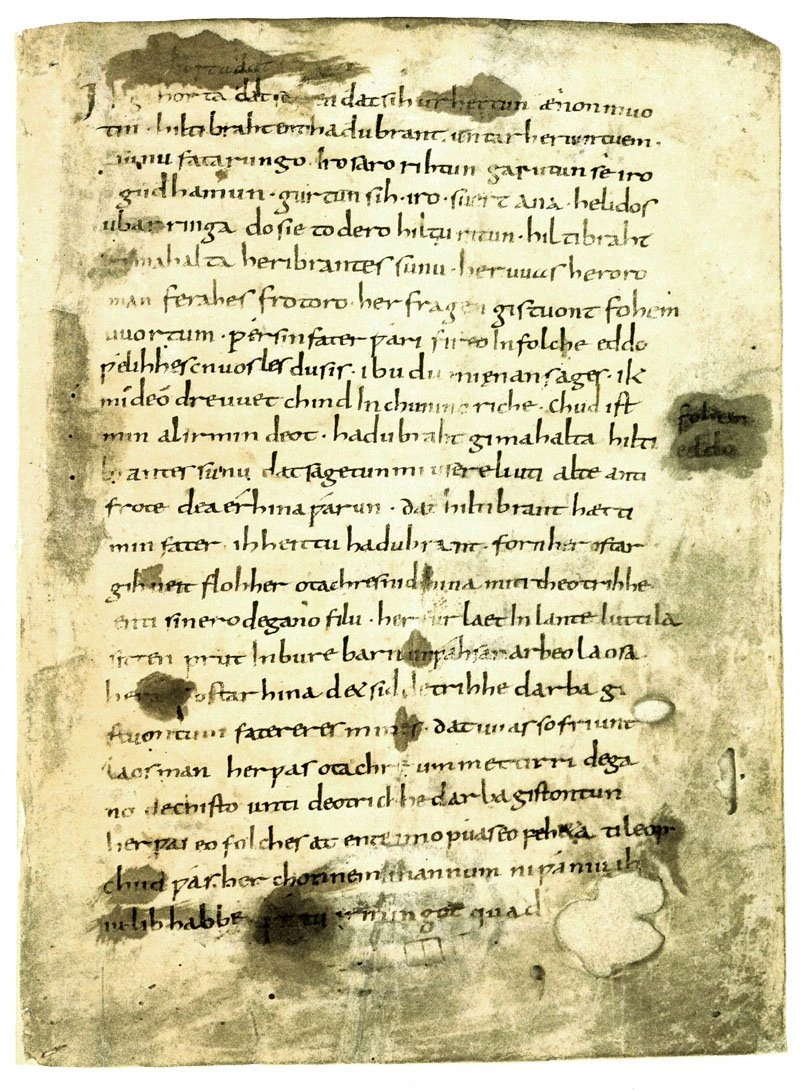
First manuscript page of the Hildebrandslied, Kassel 2° Ms. theol. 54, folio 1r. Commons places the work in Old High German; the author of the manuscript is not identified.
Saved in Babelbook · resized display copy. Select the image to open it independently of its source.
Unknown scribe; Landes- und Murhardsche Bibliothek, Kassel · Source ↗Public domain ↗View the local visual field note
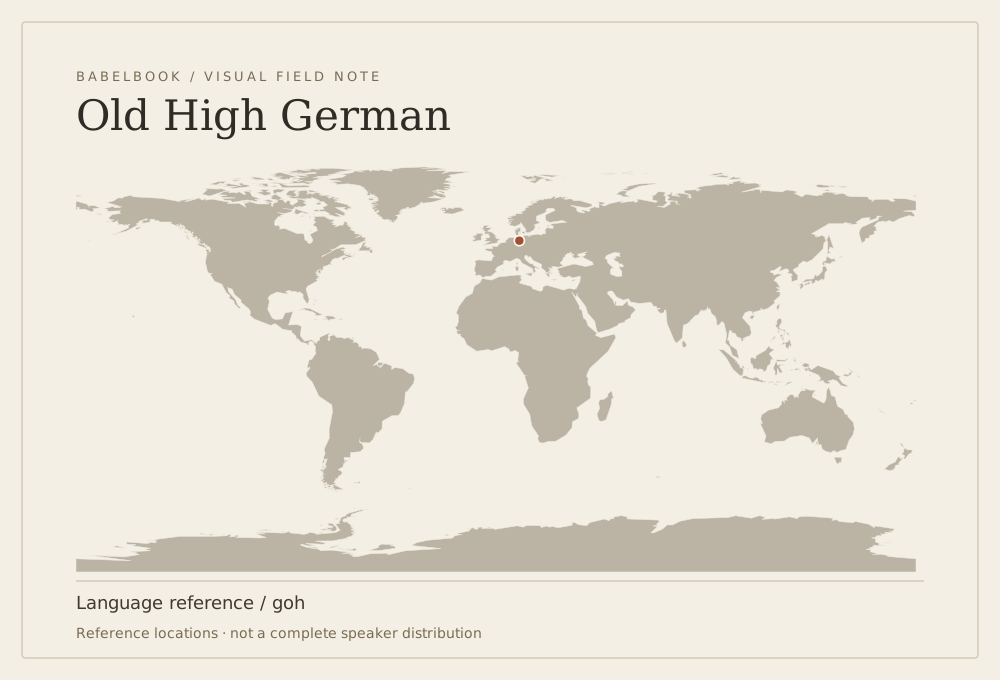
Representative reference points from Glottolog. Historical entries show reference locations, not current speakers. 1 point.
Reference & context ↗Babelbook · original editorial illustration · CC BY 4.0 · Glottolog locations; public-domain Natural Earth land
Source excerpts, selected, shortened and where noted editorially corrected from Old High German by Wikipedia contributors. Retrieved 2026-10-05. CC BY-SA 4.0. These excerpts are not an independently verified scholarly history; missing accounts are identified above.
Read further in the source
Dialects
There was no standard or supra-regional variety of Old High German—every text is written in a particular dialect, or in some cases a mixture of dialects. Broadly speaking, the main dialect divisions of Old High German seem to have been similar to those of later periods—they are based on established territorial groupings and the effects of the Second Sound Shift, which have remained influential until the present day. But because the direct evidence for Old High German consists solely of manuscripts produced in a few major ecclesiastical centres, there is no isogloss information of the sort on which modern dialect maps are based. For this reason the dialects may be termed "monastery dialects" (German Klosterdialekte). The main dialects, with their bishoprics and monasteries:
Central German (referred to as "Franconian" by some authors) Middle Franconian: Trier, Echternach, Cologne Rhine Franconian: Lorsch, Speyer, Worms, Mainz, Frankfurt South Rhine Franconian: Wissembourg Upper German Alemannic: Murbach, Reichenau, Sankt Gallen, Strasbourg Bavarian: Freising, Passau, Regensburg, Augsburg, Ebersberg, Wessobrunn, Benediktbeuern, Tegernsee, Salzburg, Mondsee Transitional between Central and Upper German: East Franconian: Fulda, Bamberg, Würzburg In addition, there are two poorly attested dialects:
Thuringian, a Central German dialect, is attested only in four runic inscriptions and some possible glosses. Langobardic was the dialect of the Lombards who invaded Northern Italy in the 6th century, and little evidence of it remains apart from names and individual words in Latin texts, and a few runic inscriptions. It declined after the conquest of the Lombard Kingdom by the Franks in 774. It is classified as Upper German on the basis of evidence of the Second Sound Shift. Some scholars exclude Langobardic from Old High German because of its poor state of preservation. The continued existence of a West Frankish dialect in the Western, Romanized part of Francia is uncertain. Claims that this might have been the language of the Carolingian court or that it is attested in the Ludwigslied, whose presence in a French manuscript suggests bilingualism, are controversial.
Writing system
Old High German marked the culmination of a shift away from runic writing of the pre-OHG period to the Latin alphabet. This shift led to considerable variations in spelling conventions, as individual scribes and scriptoria had to develop their own transliteration of sounds not native to Latin script. Otfrid von Weissenburg, in one of the prefaces to his Evangelienbuch, offers comments on and examples of some of the issues which arise in adapting the Latin alphabet for German: "...sic etiam in multis dictis scriptio est propter litterarum aut congeriem aut incognitam sonoritatem difficilis." ("...so also, in many expressions, spelling is difficult because of the piling up of letters or their unfamiliar sound.") The careful orthographies of the OHG Isidor or Notker show a similar awareness.