Gothic
Gothic is a now-extinct East Germanic language that was spoken by the Goths. It is known primarily from the Codex Argenteus, a 6th-century copy of a 4th-century Bible translation, and is the only East Germanic language with a sizeable text corpus. It is the earliest Germanic language that is attested in any sizable texts, but it lacks any modern descendants. The oldest documents in Gothic date back to the fourth century. The language was in decline by the mid-sixth century, partly because of the military defeat of the Goths at the hands of the Franks, the elimination of the Goths in Italy, and geographic isolation (in Spain, the Gothic language lost its last and probably already declining function as a church language when the Visigoths converted from Arianism to Nicene Christianity in 589). The language survived as a domestic language in the Iberian Peninsula (modern-day Spain and Portugal) as late as the eighth century. Gothic-seeming terms are found in manuscripts subsequent to this date, but these may or may not belong to the same language. A language known as Crimean Gothic survived in Crimea as late as the second half of the 18th century. Lacking certain sound changes characteristic of Gothic, however, Crimean Gothic cannot be a lineal descendant of the language attested in the Codex Argenteus. The existence of such early attested texts makes Gothic a language of considerable interest in comparative linguistics.
Translate in Gothic ↗Gothic is a now-extinct East Germanic language that was spoken by the Goths. It is known primarily from the Codex Argenteus, a 6th-century copy of a 4th-century Bible translation, and is the only East Germanic language with a sizeable text corpus. It is the earliest Germanic language that is attested in any sizable texts, but it lacks any modern descendants. The oldest documents in Gothic date back to the fourth century. The language was in decline by the mid-sixth century, partly because of the military defeat of the Goths at the hands of the Franks, the elimination of the Goths in Italy, and geographic isolation (in Spain, the Gothic language lost its last and probably already declining function as a church language when the Visigoths converted from Arianism to Nicene Christianity in 589). The language survived as a domestic language in the Iberian Peninsula (modern-day Spain and Portugal) as late as the eighth century. Gothic-seeming terms are found in manuscripts subsequent to this date, but these may or may not belong to the same language. A language known as Crimean Gothic survived in Crimea as late as the second half of the 18th century. Lacking certain sound changes characteristic of Gothic, however, Crimean Gothic cannot be a lineal descendant of the language attested in the Codex Argenteus. The existence of such early attested texts makes Gothic a language of considerable interest in comparative linguistics.
Europe
Present-day use
The captured source does not contain a separate current-use account.
Origins
The captured article does not contain a separate origins section. See the historical account and linked source.
Development
Only a few documents in Gothic have survived – not enough for a complete reconstruction of the language. Most Gothic-language sources are translations or glosses of other languages (namely, Greek), so foreign linguistic elements most certainly influenced the texts. These are the primary sources: The largest body of surviving documentation consists of various codices, mostly from the sixth century, copying the Bible translation that was commissioned by the Arian bishop Ulfilas (Wulfila, 311–382), leader of a community of Visigothic Christians in the Roman province of Moesia (modern-day Serbia, Bulgaria/Romania). He commissioned a translation into the Gothic language of the Greek Bible, of which translation roughly three-quarters of the New Testament and some fragments of the Old Testament have survived. The extant translated texts, produced by several scholars, are collected in the following codices and in one inscription: Codex Argenteus (Uppsala), including the Speyer fragment: 188 leaves. The best-preserved Gothic manuscript, dating from the sixth century, it was preserved and transmitted by northern Ostrogoths in modern-day Italy. It contains a large portion of the four gospels. Since it is a translation from Greek, the language of the Codex Argenteus is replete with borrowed Greek words and Greek usages. The syntax in particular is often copied directly from the Greek. Codex Ambrosianus (Milan) and the Codex Taurinensis (Turin): Five parts, totaling 193 leaves. It contains scattered passages from the New Testament (including parts of the gospels and the Epistles), from the Old Testament (Nehemiah), and some commentaries known as Skeireins.
Writing
Gothic (catalog classification; see the source for context).
Beyond the typeface.
Signs, manuscripts, published pages and contextual photographs, with their place, period, source and reuse terms. Captions identify historical spellings, regional examples, community references and character imagery.
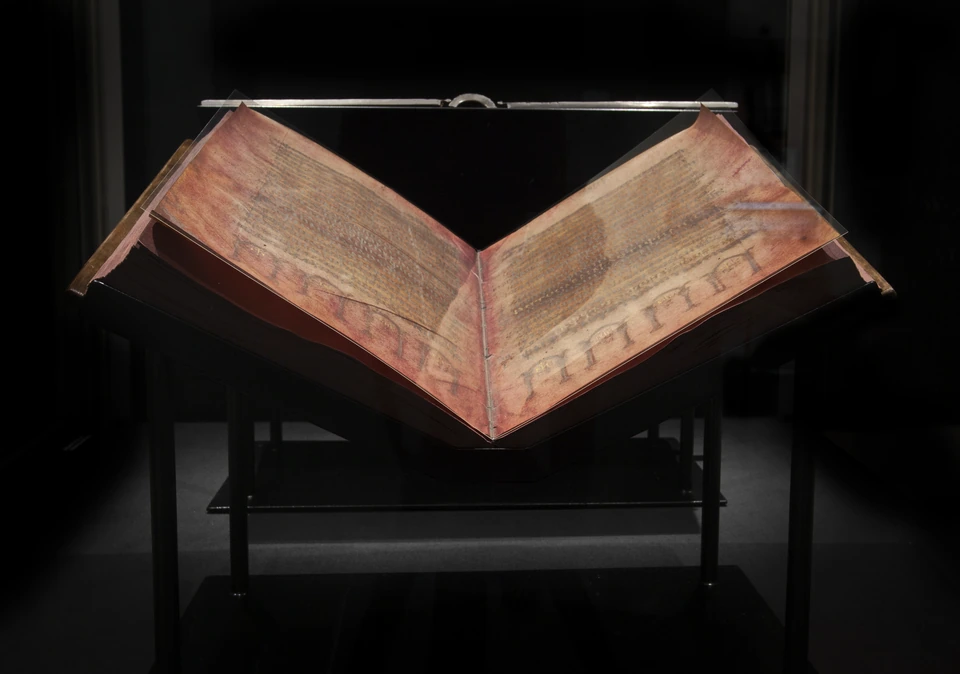
The Codex Argenteus, a sixth-century Gothic manuscript in silver and gold on purple parchment, photographed in 2020. Language and date follow the Swedish Commons description. Not independently transcribed.
Saved in Babelbook · resized display copy. Select the image to open it independently of its source.
Magnus Hjalmarsson / Uppsala University Library · Source ↗CC BY 4.0 ↗View the local visual field note
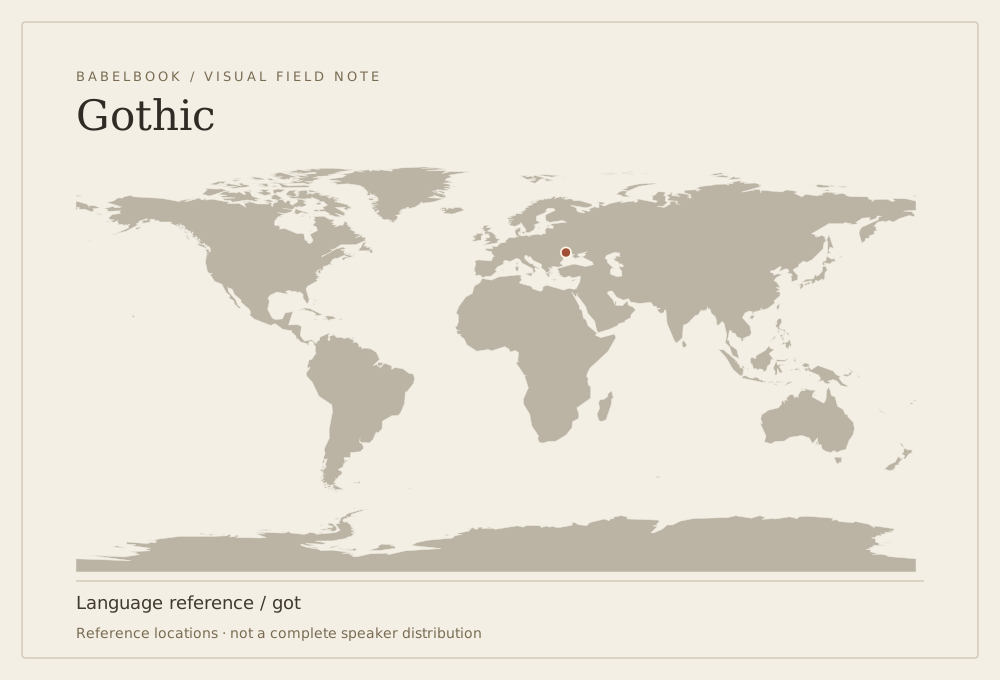
Representative reference points from Glottolog. Historical entries show reference locations, not current speakers. 1 point.
Reference & context ↗Babelbook · original editorial illustration · CC BY 4.0 · Glottolog locations; public-domain Natural Earth land
Source excerpts, selected, shortened and where noted editorially corrected from Gothic language by Wikipedia contributors. Retrieved 2026-10-05. CC BY-SA 4.0. These excerpts are not an independently verified scholarly history; missing accounts are identified above.
Read further in the source
History and evidence
Only a few documents in Gothic have survived – not enough for a complete reconstruction of the language. Most Gothic-language sources are translations or glosses of other languages (namely, Greek), so foreign linguistic elements most certainly influenced the texts. These are the primary sources:
The largest body of surviving documentation consists of various codices, mostly from the sixth century, copying the Bible translation that was commissioned by the Arian bishop Ulfilas (Wulfila, 311–382), leader of a community of Visigothic Christians in the Roman province of Moesia (modern-day Serbia, Bulgaria/Romania). He commissioned a translation into the Gothic language of the Greek Bible, of which translation roughly three-quarters of the New Testament and some fragments of the Old Testament have survived. The extant translated texts, produced by several scholars, are collected in the following codices and in one inscription: Codex Argenteus (Uppsala), including the Speyer fragment: 188 leaves. The best-preserved Gothic manuscript, dating from the sixth century, it was preserved and transmitted by northern Ostrogoths in modern-day Italy. It contains a large portion of the four gospels. Since it is a translation from Greek, the language of the Codex Argenteus is replete with borrowed Greek words and Greek usages. The syntax in particular is often copied directly from the Greek. Codex Ambrosianus (Milan) and the Codex Taurinensis (Turin): Five parts, totaling 193 leaves. It contains scattered passages from the New Testament (including parts of the gospels and the Epistles), from the Old Testament (Nehemiah), and some commentaries known as Skeireins. The text likely had been somewhat modified by copyists. Codex Gissensis (Gießen): One leaf with fragments of Luke 23–24 (apparently a Gothic-Latin diglot) was found in an excavation in Arsinoë in Egypt in 1907 and was destroyed by water damage in 1945, after copies had already been made by researchers. Codex Carolinus (Wolfenbüttel): Four leaves, fragments of Romans 11–15 (a Gothic-Latin diglot). Codex Vaticanus Latinus 5750 (Vatican City): Three leaves, pages 57–58, 59–60, and 61–62 of the Skeireins. This is a fragment of Codex Ambrosianus E. Gothica Bononiensia (also known as the Codex Bononiensis or "Bologna fragment"), a palimpsest fragment, discovered in 2009, of two folios with what appears to be a sermon, containing besides non-biblical text a number of direct Bible quotes and allusions, both from previously attested parts of the Gothic Bible (the text is clearly taken from Ulfilas's translation) and from previously unattested ones (e.g., Psalms, Genesis). Fragmenta Pannonica (also known as the Hács-Béndekpuszta fragments or Tabella Hungarica), which consist of fragments of a one-millimetre-thick (0.039 in) lead plate with remnants of verses from the Gospels. The Mangup Graffiti: five inscriptions written in the Gothic alphabet discovered in 2015 from the basilica church of Mangup, Crimea. The graffiti all date from the mid-9th century, making this perhaps the youngest attestation of the Gothic alphabet (being seemingly slightly more recent than the two Carolingian alphabets listed below). The five texts include a quotation from the otherwise unattested Psalm 76 and some prayers; the language is not noticeably different from Wulfila's and only contains words known from other parts of the Gothic Bible. A scattering of minor fragments: two deeds (the Naples and Arezzo deeds, on papyri), two Carolingian-era Gothic alphabets recorded in otherwise non-Gothic manuscripts (respectively the late eighth to early ninth century Gothica Vindobonensia and the ninth-century Gothica Parisina), a calendar (in the Codex Ambrosianus A), glosses found in a number of manuscripts and a few runic inscriptions (between three and 13) that are known or suspected to be Gothic, among which the gold ring of Pietroasa: some scholars believe that these inscriptions are not at all Gothic. Sten Konow and Krause thought that the names Irila and Ciṭa, the latter perhaps denoting Ostrogothic Tsitta, in an Indian inscription of a temple near Junnar were possibly Gothic. Konow explains the name Ciṭa by an original Gothic form hild-, which was pronounced as Ciṭa in a Prakrit language. Reports of the discovery of other parts of Ulfilas's Bible have not been substantiated. Heinrich May in 1968 claimed to have found in England twelve leaves of a palimpsest containing parts of the Gospel of Matthew. Only fragments of the Gothic translation of the Bible have been preserved. The translation was apparently done in the Balkans region by people in close contact with Greek Christian culture. The Gothic Bible was apparently used by the Visigoths in Occitania until the loss of Visigothic Occitania at the start of the 6th century, in Visigothic Iberia until about 700, and perhaps for a time in Italy, the Balkans, and Ukraine until at least the mid-9th century. Apart from biblical texts, the only substantial Gothic document that still exists – and the only lengthy text known to have been composed originally in the Gothic language – is the Skeireins, a few pages of commentary on the Gospel of John. Very few medieval secondary sources make reference to the Gothic language after about 800. In De incrementis ecclesiae Christianae (840–842), Walafrid Strabo, a Frankish monk who lived in Swabia, writes of a group of monks who reported that even then certain peoples in Scythia (Dobruja), especially around Tomis, spoke a sermo Theotiscus ('Germanic language'), the language of the Gothic translation of the Bible, and that they used such a liturgy. Many writers of the medieval texts that mention the Goths used the word Goths to mean any Germanic people in eastern Europe (such as the Varangians), many of whom certainly did not use the Gothic language as known from the Gothic Bible. Some writers even referred to Slavic-speaking people as "Goths". However, it is clear from Ulfilas's translation that the Gothic language belongs with the Germanic language group, not with Slavic. Christoph Hartknoch writes in his Alt- und Neues Preussen Oder Preussischer Historien Zwey Theile from 1684 how bishop Paulus Piafecius said that Adam Maccovius under request of king Sigismund iii, traveled to Spain in 1622 to find writings in the Gothic and Vandalic language. He allegedly found a Hebrew church history (Hebraer Kirchen-Historiae) written in the Gothic language which he brought to Poland. Generally, the term "Gothic language" refers to the language of Ulfilas, but the attestations themselves date largely from the 6th century, long after Ulfilas had died.