Ancient Greek
Ancient Greek (Ἑλληνική, Hellēnikḗ [hellɛːnikɛ̌ː]) includes the forms of the Greek language used in ancient Greece and the ancient world from around 1500 BC to 300 BC. It is often roughly divided into the following periods: Mycenaean Greek (c. 1400 – c. 1200 BC), Dark Ages (c. 1200 – c. 800 BC), the Archaic or Homeric period (c. 800 – c. 500 BC), and the Classical period (c. 500 – c. 300 BC). Ancient Greek was the language of Homer and of fifth- and fourth-century Athenian historians, playwrights, and philosophers. It has contributed many words to English vocabulary and has been a standard subject of study in educational institutions of the Western world since the Renaissance. This article primarily contains information about the Epic and Classical periods of the language, which are the best-attested periods and considered most typical of Ancient Greek. From the Hellenistic period (c. 300 BC), Ancient Greek was followed by Koine Greek, which is regarded as a separate historical stage, though its earliest form closely resembles Attic Greek, and its latest form approaches Medieval Greek, and Koine may be classified as Ancient Greek in a wider sense – being an ancient rather than medieval form of Greek, though over the centuries increasingly resembling Medieval and Modern Greek. Ancient Greek comprised several dialects, such as Attic, Ionic, Doric, Aeolic, and Arcadocypriot; among them, Attic Greek became the basis of Koine Greek.
Translate in Ancient Greek ↗Ancient Greek (Ἑλληνική, Hellēnikḗ [hellɛːnikɛ̌ː]) includes the forms of the Greek language used in ancient Greece and the ancient world from around 1500 BC to 300 BC. It is often roughly divided into the following periods: Mycenaean Greek (c. 1400 – c. 1200 BC), Dark Ages (c. 1200 – c. 800 BC), the Archaic or Homeric period (c. 800 – c. 500 BC), and the Classical period (c. 500 – c. 300 BC). Ancient Greek was the language of Homer and of fifth- and fourth-century Athenian historians, playwrights, and philosophers. It has contributed many words to English vocabulary and has been a standard subject of study in educational institutions of the Western world since the Renaissance. This article primarily contains information about the Epic and Classical periods of the language, which are the best-attested periods and considered most typical of Ancient Greek. From the Hellenistic period (c. 300 BC), Ancient Greek was followed by Koine Greek, which is regarded as a separate historical stage, though its earliest form closely resembles Attic Greek, and its latest form approaches Medieval Greek, and Koine may be classified as Ancient Greek in a wider sense – being an ancient rather than medieval form of Greek, though over the centuries increasingly resembling Medieval and Modern Greek. Ancient Greek comprised several dialects, such as Attic, Ionic, Doric, Aeolic, and Arcadocypriot; among them, Attic Greek became the basis of Koine Greek. Unlike Koine, which is generally treated as a later form of Ancient Greek, Mycenaean Greek is treated separately from the later language, reflecting its age, and the very different nature of the material and of the type of scholarship required to study it.
Europe
Present-day use
Modern authors rarely write in ancient Greek, though Jan Křesadlo wrote some poetry and prose in the language, and Harry Potter and the Philosopher's Stone, some volumes of Asterix, and The Adventures of Alix have been translated into ancient Greek. Ὀνόματα Kεχιασμένα (Onomata Kechiasmena) is the first magazine of crosswords and puzzles in ancient Greek. Its first issue appeared in April 2015 as an annex to Hebdomada Aenigmatum. Alfred Rahlfs included a preface, a short history of the Septuagint text, and other front matter translated into ancient Greek in his 1935 edition of the Septuagint; Robert Hanhart also included the introductory remarks to the 2006 revised Rahlfs–Hanhart edition in the language as well. Akropolis World News reports weekly a summary of the most important news in ancient Greek. Ancient Greek is also used by organizations and individuals, mainly Greek, who wish to denote their respect, admiration or preference for the use of this language. This use is sometimes considered graphical, nationalistic or humorous. In any case, the fact that modern Greeks can still wholly or partly understand texts written in non-archaic forms of ancient Greek shows the affinity of the modern Greek language to its ancestral predecessor. Ancient Greek is often used in the coinage of modern technical terms in the European languages: see English words of Greek origin. Latinized forms of ancient Greek roots are used in many of the scientific names of species and in scientific terminology.
Origins
The captured article does not contain a separate origins section. See the historical account and linked source.
Development
The origins, early form and development of the Hellenic language family are not well understood because of a lack of contemporaneous evidence. Several theories exist about what Hellenic dialect groups may have existed between the divergence of early Greek-like speech from the common Proto-Indo-European language and the Classical period. They have the same general outline but differ in some of the detail. The only attested dialect from this period is Mycenaean Greek, but its relationship to the historical dialects and the historical circumstances of the times imply that the overall groups already existed in some form. Scholars assume that major Ancient Greek period dialect groups developed no later than 1120 BC, at the time of the Dorian invasions—and that their first appearances as precise alphabetic writing began in the 8th century BC. The invasion would not be "Dorian" unless the invaders had some cultural relationship to the historical Dorians. The invasion is known to have displaced population to the later Attic-Ionic regions, who regarded themselves as descendants of the population displaced by or contending with the Dorians. The Greeks of this period believed there were three major divisions of all Greek people – Dorians, Aeolians, and Ionians (including Athenians), each with their own defining and distinctive dialects. Allowing for their oversight of Arcadian, an obscure mountain dialect, and Cypriot, far from the center of Greek scholarship, this division of people and language is quite similar to the results of modern archaeological-linguistic investigation. One standard formulation for the dialects is: West Group Northwest Greek Doric Aeolic Group Aegean/Asiatic Aeolic Thessalian Boeotian Ionic-Attic Group Attic Ionic Euboean and colonies in Italy Cycladic Asiatic Ionic Arcadocypriot Greek Arcadian Cypriot West vs. non-West Greek is the strongest-marked and earliest division, with non-West in subsets of Ionic-Attic (or Attic-Ionic) and Aeolic vs.
Writing
The earliest extant examples of ancient Greek writing (c. 1450 BC) are in the syllabic script Linear B. Beginning in the 8th century BC, however, the Greek alphabet became standard, albeit with some variation among dialects. Early texts are written in boustrophedon style, but left-to-right became standard during the classic period. Modern editions of ancient Greek texts are usually written with accents and breathing marks, interword spacing, modern punctuation, and sometimes mixed case, but these were all introduced later.
Beyond the typeface.
Signs, manuscripts, published pages and contextual photographs, with their place, period, source and reuse terms. Captions identify historical spellings, regional examples, community references and character imagery.
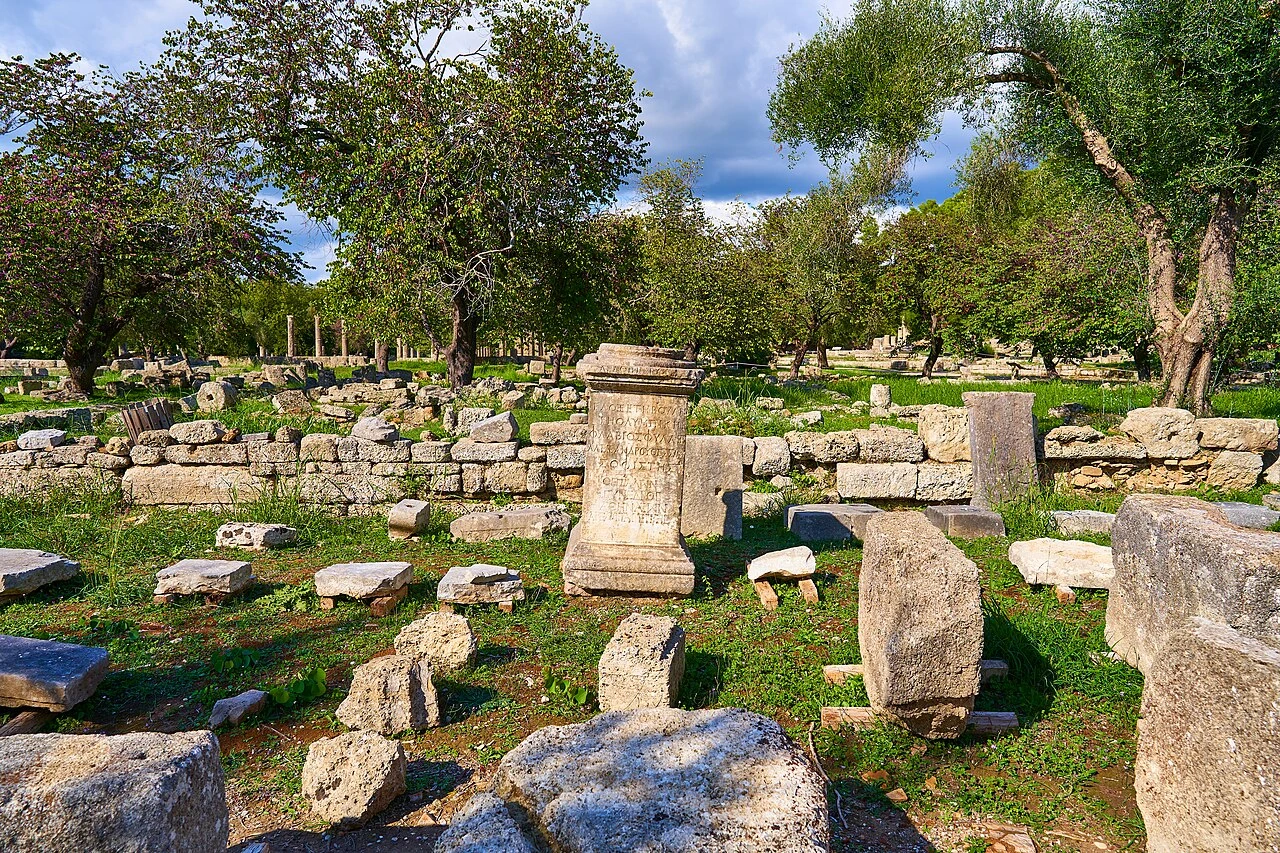
Ancient Greek inscription honoring Flavius Fylax, dated by the source to the second–third century CE. Photographed in 2020; this is not modern Greek. Displayed at reduced size; no additional crop.
Saved in Babelbook · resized display copy. Select the image to open it independently of its source.
George E. Koronaios · Source ↗CC BY-SA 4.0 ↗View the local visual field note
Representative reference points from Glottolog. Historical entries show reference locations, not current speakers. 1 point.
Reference & context ↗Babelbook · original editorial illustration · CC BY 4.0 · Glottolog locations; public-domain Natural Earth land
Source excerpts, selected, shortened and where noted editorially corrected from Ancient Greek by Wikipedia contributors. Retrieved 2026-10-05. CC BY-SA 4.0. These excerpts are not an independently verified scholarly history; missing accounts are identified above.
Read further in the source
Dialects
Ancient Greek was a pluricentric language, divided into many dialects. The main dialect groups are Attic and Ionic, Aeolic, Arcadocypriot, and Doric, many of them with several subdivisions. Some dialects are found in standardized literary forms in literature, while others are attested only in inscriptions. There are also several historical forms. Homeric Greek is a literary form of Archaic Greek (derived primarily from Ionic and Aeolic) used in the epic poems, the Iliad and the Odyssey, and in later poems by other authors. Homeric Greek had significant differences in grammar and pronunciation from Classical Attic and other Classical-era dialects.
History
The origins, early form and development of the Hellenic language family are not well understood because of a lack of contemporaneous evidence. Several theories exist about what Hellenic dialect groups may have existed between the divergence of early Greek-like speech from the common Proto-Indo-European language and the Classical period. They have the same general outline but differ in some of the detail. The only attested dialect from this period is Mycenaean Greek, but its relationship to the historical dialects and the historical circumstances of the times imply that the overall groups already existed in some form. Scholars assume that major Ancient Greek period dialect groups developed no later than 1120 BC, at the time of the Dorian invasions—and that their first appearances as precise alphabetic writing began in the 8th century BC. The invasion would not be "Dorian" unless the invaders had some cultural relationship to the historical Dorians. The invasion is known to have displaced population to the later Attic-Ionic regions, who regarded themselves as descendants of the population displaced by or contending with the Dorians. The Greeks of this period believed there were three major divisions of all Greek people – Dorians, Aeolians, and Ionians (including Athenians), each with their own defining and distinctive dialects. Allowing for their oversight of Arcadian, an obscure mountain dialect, and Cypriot, far from the center of Greek scholarship, this division of people and language is quite similar to the results of modern archaeological-linguistic investigation. One standard formulation for the dialects is:
West Group Northwest Greek Doric Aeolic Group Aegean/Asiatic Aeolic Thessalian Boeotian Ionic-Attic Group Attic Ionic Euboean and colonies in Italy Cycladic Asiatic Ionic Arcadocypriot Greek Arcadian Cypriot West vs. non-West Greek is the strongest-marked and earliest division, with non-West in subsets of Ionic-Attic (or Attic-Ionic) and Aeolic vs. Arcadocypriot, or Aeolic and Arcado-Cypriot vs. Ionic-Attic. Often non-West is called 'East Greek'. Arcadocypriot apparently descended more closely from the Mycenaean Greek of the Bronze Age. Boeotian Greek had come under a strong Northwest Greek influence, and can in some respects be considered a transitional dialect, as exemplified in the poems of the Boeotian poet Pindar who wrote in Doric with a small Aeolic admixture. Thessalian likewise had come under Northwest Greek influence, though to a lesser degree. Pamphylian Greek, spoken in a small area on the southwestern coast of Anatolia and little preserved in inscriptions, may be either a fifth major dialect group, or it is Mycenaean Greek overlaid by Doric, with a non-Greek native influence. Regarding the speech of the ancient Macedonians diverse theories have been put forward, but the epigraphic activity and the archaeological discoveries in the Greek region of Macedonia during the last decades has brought to light documents, among which the first texts written in Macedonian, such as the Pella curse tablet, as Hatzopoulos and other scholars note. Based on the conclusions drawn by several studies and findings such as Pella curse tablet, Emilio Crespo and most scholars suggest that ancient Macedonian was a Northwest Doric dialect, which shares isoglosses with its neighboring Thessalian dialects spoken in northeastern Thessaly. Some have also suggested an Aeolic Greek classification. The Lesbian dialect was Aeolic. For example, fragments of the works of the poet Sappho from the island of Lesbos are in Aeolian. Most of the dialect sub-groups listed above had further subdivisions, generally equivalent to a city-state and its surrounding territory, or to an island. Doric notably had several intermediate divisions as well, into Island Doric (including Cretan Doric), Southern Peloponnesus Doric (including Laconian, the dialect of Sparta), and Northern Peloponnesus Doric (including Corinthian). All the groups were represented by colonies beyond Greece proper as well, and these colonies generally developed local characteristics, often under the influence of settlers or neighbors speaking different Greek dialects.
Writing system
The earliest extant examples of ancient Greek writing (c. 1450 BC) are in the syllabic script Linear B. Beginning in the 8th century BC, however, the Greek alphabet became standard, albeit with some variation among dialects. Early texts are written in boustrophedon style, but left-to-right became standard during the classic period. Modern editions of ancient Greek texts are usually written with accents and breathing marks, interword spacing, modern punctuation, and sometimes mixed case, but these were all introduced later.