Gujarati
Gujarati is an Indo-Aryan language native to the Indian state of Gujarat and spoken predominantly by the Gujarati people. Gujarati is descended from Old Gujarati (c. 1100–1500 CE). In India, it is one of the 22 scheduled languages of the Union. It is also the official language in the state of Gujarat, as well as an official language in the union territory of Dadra and Nagar Haveli and Daman and Diu. As of 2011, Gujarati is the 6th most widely spoken language in India by number of native speakers, spoken by 55.5 million speakers which amounts to about 4.5% of the total Indian population. It is the 26th most widely spoken language in the world by number of native speakers as of 2007. Gujarati, along with Meitei (alias Manipuri), hold the third place among the fastest growing languages of India, following Hindi (first place) and Kashmiri language (second place), according to the 2011 census of India. Outside of Gujarat, Gujarati is spoken in many other parts of South Asia by Gujarati migrants, especially in Mumbai and Pakistan (mainly in Karachi). Gujarati is also widely spoken in many countries outside South Asia by the Gujarati diaspora. In North America, Gujarati is one of the fastest-growing and most widely spoken Indian languages in the United States (especially in New Jersey and New York City) and Canada. In Europe, Gujaratis form the second largest of the British South Asian speech communities, and Gujarati is the fourth most commonly spoken language in the UK's capital, of London.
Translate in Gujarati ↗Of the approximately 62 million speakers of Gujarati in 2022, roughly 60 million resided in India, 250,000 in Tanzania, 210,000 in Kenya, and some thousands in Pakistan. Many Gujarati speakers in Pakistan are shifting to Urdu; however, some Gujarati community leaders in Pakistan claim that there are 3 million Gujarati speakers in Karachi. Mahatma Gandhi used Gujarati to serve as a medium of literary expression. He helped to inspire a renewal in its literature, and in 1936 he introduced the current spelling convention at the Gujarati Literary Society's 12th meeting. Some Indo-Mauritians and many Réunion islanders are of Gujarati descent and some of them still speak Gujarati. A considerable Gujarati-speaking population exists in North America, especially in the New York City Metropolitan Area and in the Greater Toronto Area, which have over 100,000 speakers and over 75,000 speakers, respectively, but also throughout the major metropolitan areas of the United States and Canada. According to the 2016 census, Gujarati is the fourth most-spoken South Asian language in Toronto after Hindustani, Punjabi and Tamil. The UK has over 200,000 speakers, many of them situated in the London area, especially in North West London (in Harrow and Wembley), but also in Birmingham, Manchester, and in Leicester, Coventry, Rugby, Bradford and the former mill towns within Lancashire. A portion of these numbers consists of East African Gujaratis who, under increasing discrimination and policies of Africanisation in their newly independent resident countries (especially Uganda, where Idi Amin expelled 50,000 Asians), were left with uncertain futures and citizenships. Most, with British passports, settled in the UK. Gujarati is offered as a GCSE subject for students in the UK. Some Gujarati parents in the diaspora are not comfortable with the possibility that their children will not be fluent in the language.
South Asia
Present-day use
A major phonological change was the deletion of final ə, such that the modern language has consonant-final words. Grammatically, a new plural marker of -o developed. In literature, the third quarter of the 19th century saw a series of milestones for Gujarati, which previously had verse as its dominant mode of literary composition. In the 1920s, the efforts to standardise Gujarati were carried out. Gujarati is one of the twenty-two official languages. It is the official language of the state of Gujarat and the union territory of Dadra and Nagar Haveli and Daman and Diu. Gujarati is recognised and taught as a minority language in the states of Rajasthan, Madhya Pradesh, Maharashtra, and Tamil Nadu and the union territory of Delhi.
Origins
The captured article does not contain a separate origins section. See the historical account and linked source.
Development
Gujarati (sometimes spelled Gujerati, Gujarathi, Guzratee, Guujaratee, Gujrathi, and Gujerathi) is a modern Indo-Aryan (IA) language evolved from Sanskrit. The traditional practice is to differentiate the IA languages on the basis of three historical stages: Old IA (Vedic and Classical Sanskrit) Middle IA (various Prakrits and Apabhramshas) New IA (modern languages such as Hindi, Punjabi, Bengali, etc.) Another view postulates successive family tree splits, in which Gujarati is assumed to have separated from other IA languages in four stages: IA languages split into Northern, Eastern, and Western divisions based on the innovate characteristics such as plosives becoming voiced in the Northern (Skt. danta "tooth" > Punj. dānd) and dental and retroflex sibilants merging with the palatal in the Eastern (Skt. sandhya "evening" > Beng. śājh). Western, into Central and Southern. Central, in Gujarati/Rajasthani, Western Hindi, and Punjabi/Lahanda/Sindhi, on the basis of innovation of auxiliary verbs and postpositions in Gujarati/Rajasthani. Gujarati/Rajasthani into Gujarati and Rajasthani through development of such characteristics as auxiliary ch- and the possessive marker -n- during the 15th century. The principal changes from the Middle Indo-Aryan stage are the following:
Writing
Similar to other Nāgarī writing systems, the Gujarati script is an abugida. It is used to write the Gujarati and Kutchi languages. It is a variant of the Devanāgarī script, differentiated by the loss of the characteristic horizontal line running above the letters and by a small number of modifications in the remaining characters. The Gujarati alphabet, called Kakko, has between 47 and 48 letters. Many letters of the Kakko highlight the utilization of breath when speaking. For instance, the pronunciation of ક (ka) versus ખ (kha) relies on the placing an emphasis on "kh" for the latter letter.
Beyond the typeface.
Signs, manuscripts, published pages and contextual photographs, with their place, period, source and reuse terms. Captions identify historical spellings, regional examples, community references and character imagery.
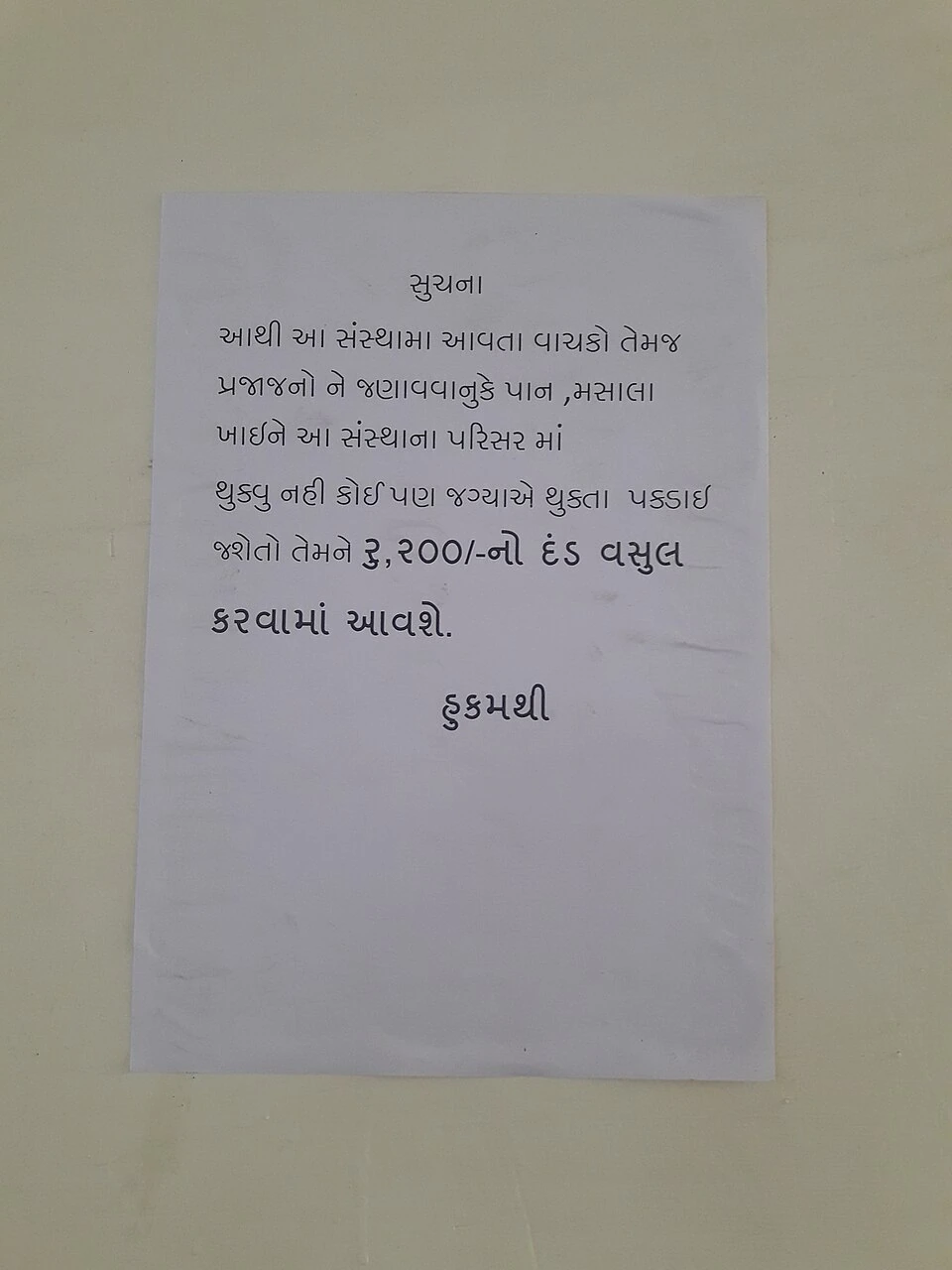
Gujarati notice at Himmatnagar District Library, Gujarat, photographed in 2020. Source-identified language; displayed without additional cropping.
Saved in Babelbook · resized display copy. Select the image to open it independently of its source.
Gazal world · Source ↗CC BY-SA 4.0 ↗View the local visual field note
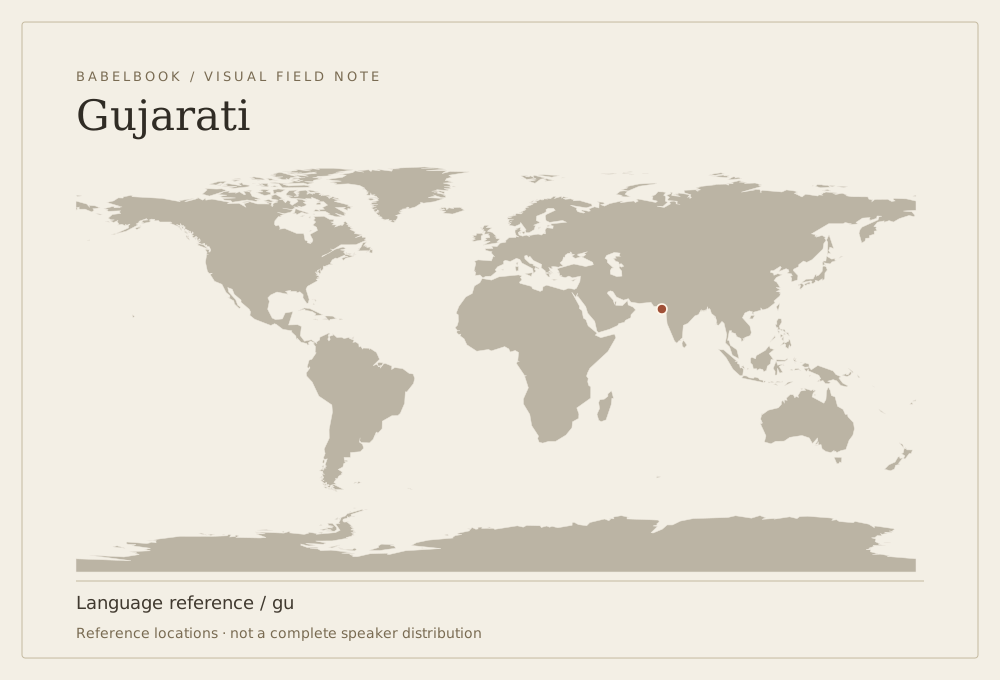
Representative reference points from Glottolog. Historical entries show reference locations, not current speakers. 1 point.
Reference & context ↗Babelbook · original editorial illustration · CC BY 4.0 · Glottolog locations; public-domain Natural Earth land
Source excerpts, selected, shortened and where noted editorially corrected from Gujarati language by Wikipedia contributors. Retrieved 2026-10-05. CC BY-SA 4.0. These excerpts are not an independently verified scholarly history; missing accounts are identified above.
Read further in the source
History
Gujarati (sometimes spelled Gujerati, Gujarathi, Guzratee, Guujaratee, Gujrathi, and Gujerathi) is a modern Indo-Aryan (IA) language evolved from Sanskrit. The traditional practice is to differentiate the IA languages on the basis of three historical stages:
Old IA (Vedic and Classical Sanskrit) Middle IA (various Prakrits and Apabhramshas) New IA (modern languages such as Hindi, Punjabi, Bengali, etc.) Another view postulates successive family tree splits, in which Gujarati is assumed to have separated from other IA languages in four stages:
IA languages split into Northern, Eastern, and Western divisions based on the innovate characteristics such as plosives becoming voiced in the Northern (Skt. danta "tooth" > Punj. dānd) and dental and retroflex sibilants merging with the palatal in the Eastern (Skt. sandhya "evening" > Beng. śājh). Western, into Central and Southern. Central, in Gujarati/Rajasthani, Western Hindi, and Punjabi/Lahanda/Sindhi, on the basis of innovation of auxiliary verbs and postpositions in Gujarati/Rajasthani. Gujarati/Rajasthani into Gujarati and Rajasthani through development of such characteristics as auxiliary ch- and the possessive marker -n- during the 15th century. The principal changes from the Middle Indo-Aryan stage are the following:
Demographics and distribution
Of the approximately 62 million speakers of Gujarati in 2022, roughly 60 million resided in India, 250,000 in Tanzania, 210,000 in Kenya, and some thousands in Pakistan. Many Gujarati speakers in Pakistan are shifting to Urdu; however, some Gujarati community leaders in Pakistan claim that there are 3 million Gujarati speakers in Karachi. Mahatma Gandhi used Gujarati to serve as a medium of literary expression. He helped to inspire a renewal in its literature, and in 1936 he introduced the current spelling convention at the Gujarati Literary Society's 12th meeting. Some Indo-Mauritians and many Réunion islanders are of Gujarati descent and some of them still speak Gujarati. A considerable Gujarati-speaking population exists in North America, especially in the New York City Metropolitan Area and in the Greater Toronto Area, which have over 100,000 speakers and over 75,000 speakers, respectively, but also throughout the major metropolitan areas of the United States and Canada. According to the 2016 census, Gujarati is the fourth most-spoken South Asian language in Toronto after Hindustani, Punjabi and Tamil. The UK has over 200,000 speakers, many of them situated in the London area, especially in North West London (in Harrow and Wembley), but also in Birmingham, Manchester, and in Leicester, Coventry, Rugby, Bradford and the former mill towns within Lancashire. A portion of these numbers consists of East African Gujaratis who, under increasing discrimination and policies of Africanisation in their newly independent resident countries (especially Uganda, where Idi Amin expelled 50,000 Asians), were left with uncertain futures and citizenships. Most, with British passports, settled in the UK. Gujarati is offered as a GCSE subject for students in the UK. Some Gujarati parents in the diaspora are not comfortable with the possibility that their children will not be fluent in the language. In a study, 80% of Malayali parents felt that "Children would be better off with English", compared to 36% of Kannada parents and only 19% of Gujarati parents. Besides being spoken by the Gujarati people, many non-Gujarati residents of Gujarat also speak it, among them the Kutchis (as a literary language) and the Parsis (adopted as a mother tongue).
Official status
Gujarati is one of the twenty-two official languages. It is the official language of the state of Gujarat and the union territory of Dadra and Nagar Haveli and Daman and Diu. Gujarati is recognised and taught as a minority language in the states of Rajasthan, Madhya Pradesh, Maharashtra, and Tamil Nadu and the union territory of Delhi.
Dialects
According to British historian and philologist William Tisdall, who was an early scholar of Gujarati grammar, three major varieties of Gujarati exist: a standard 'Hindu' dialect, a 'Parsi' dialect and a 'Muslim' dialect. However, Gujarati has undergone contemporary reclassification with respect to the widespread regional differences in vocabulary and phrasing; notwithstanding the number of poorly attested dialects and regional variations in naming.
Standard Gujarati: this forms something of a standardised variant of Gujarati across news, education and government. It is also spoken in pockets of Maharashtra. The varieties of it include Mumbai Gujarati, Nagari. Saurashtra: spoken primarily by the Saurashtrians who migrated from the Lata region of present-day Gujarat to Southern India in the Middle Ages. Saurashtra is closely related to Gujarati and the older dialects of Rajasthani and Sindhi. The script of this language is derived from the Devanagari script and shares similarities with modern-day Gujarati. Amdawadi Gujarati: spoken primarily in Ahmedabad and the surrounding regions, in addition to Bharuch and Surat, where it is colloquially known as 'Surati'. The varieties of it include Ahmedabad Gamadia, Anawla, Brathela, Charotari, Eastern Broach Gujarati, Gramya, Patani, Patidari, Surati, Vadodari. Kathiawari: a distinctive variant spoken primarily in the Kathiawar region and subject to significant Sindhi influence. The varieties of it include Bhavnagari, Gohilwadi, Holadi/Halari, Jhalawadi, Sorathi. Kharwa, Kakari and Tarimuki (Ghisadi) are also often cited as additional varieties of Gujarati.
Parsi: spoken by the Zoroastrian Parsi minority. This highly distinctive variety has been subject to considerable lexical influence by Avestan, the liturgical Zoroastrian language. Lisan ud-Dawat: spoken primarily by Gujarati Muslim Bohra communities, it has been subject to greater lexical influence by Arabic and Persian and is written in the Arabic script. Kutchi is often referred to as a dialect of Gujarati, but most linguists consider it closer to Sindhi. In addition, the Memoni is related to Gujarati, albeit distantly. Furthermore, words used by the native languages of areas where the Gujarati people have become a diaspora community, such as East Africa (Swahili), have become loanwords in local dialects of Gujarati. The Linguistic Survey of India noted nearly two dozen dialects of Gujarati: Standard, Old, Standard Ahmedabad, Standard Broach, Nāgarī, Bombay, Suratī, Anāvla or Bhāṭelā, Eastern Broach, Pārsī, Carotarī, Pāṭīdārī, Vaḍodarī, Gāmaḍiā of Ahmedabad, Paṭanī, Thar and Parkar, Cutch, Kāṭhiyāvāḍī, Musalmān (Vhorāsī and Kharwā), Paṭṇulī, Kākarī, and Tārīmukī or Ghisāḍī. A manuscript containing Judeo-Gujarati, Gujarati written in Hebrew characters, by Rahamim Jacob Kohen is preserved in the Alalay microfilms of the British Library's Asia, Pacific and Africa Collections.
Writing system
Similar to other Nāgarī writing systems, the Gujarati script is an abugida. It is used to write the Gujarati and Kutchi languages. It is a variant of the Devanāgarī script, differentiated by the loss of the characteristic horizontal line running above the letters and by a small number of modifications in the remaining characters. The Gujarati alphabet, called Kakko, has between 47 and 48 letters. Many letters of the Kakko highlight the utilization of breath when speaking. For instance, the pronunciation of ક (ka) versus ખ (kha) relies on the placing an emphasis on "kh" for the latter letter.