Manx
Manx (endonym: Gaelg, y Ghaelg or Gailck, y Ghailck, pronounced [ɡilʲkʲ, ə ˈɣilʲkʲ]), also known as Manx Gaelic, is a Gaelic language of the insular Celtic branch of the Celtic language family, itself a branch of the Indo-European language family. Manx is the heritage language of the Manx people. Although no children native to the Isle of Man speak Manx as a first language, there has been a steady increase in the number of speakers since 1974, when Ned Maddrell, considered the last speaker to grow up in a Manx-speaking community environment, died. Despite this, the language has never fallen completely out of use, with a minority having some knowledge of it as a heritage language, and it is still an important part of the island's culture and cultural heritage. Manx is often cited as a good example of language revitalization efforts; in 2021, around 2,023 people had varying levels of second-language conversational ability. Since the late 20th century, Manx has become more visible on the island, with increased signage, radio broadcasts and a Manx-medium primary school. The revival of Manx has been made easier because the language was well recorded, e.g. the Bible and the Book of Common Prayer had been translated into Manx, and audio recordings had been made of native speakers.
Translate in Manx ↗Manx is not officially recognised by any national or regional government, although its contribution to Manx culture and tradition is acknowledged by some governmental and non-governmental bodies. The Standing Orders of the House of Keys provide that: "The proceedings of the House shall be in English; but if a Member at any point pronounces a customary term or sentence in Manx Gaelic or any other language, the Speaker may call upon the Member for a translation." An example was at the sitting on 12 February 2019, when an MHK used the expression boghtnid, stated to mean "nonsense". Manx is used in the annual Tynwald ceremony and Manx words are used in official Tynwald publications. For the purpose of strengthening its contribution to local culture and community, Manx is recognised under the European Charter for Regional or Minority Languages and in the framework of the British-Irish Council. The Isle of Man comprised the one site for the Manx language in the Atlas Linguarum Europae, a project that compared dialects and languages across all countries in Europe. Manx is taught as a second language at all of the island's primary and secondary schools. The lessons are optional and instruction is provided by the Department of Education's Manx Language Team which teach up to A Level standard. The Bunscoill Ghaelgagh, a primary school at St John's, has 67 children, as of September 2016, who receive nearly all of their education through the medium of the language. Children who have attended the school have the opportunity to receive some of their secondary education through the language at Queen Elizabeth II High School in Peel. The playgroup organisation Mooinjer Veggey, which operates the Bunscoill Ghaelgagh, runs a series of preschool groups that introduce the language. Bilingual road, street, village and town boundary signs are common throughout the Isle of Man.
Europe
Present-day use
Following the decline in the use of Manx during the 19th century, Yn Çheshaght Ghailckagh (The Manx Language Society) was founded in 1899. By the mid-20th century, only a few elderly native speakers remained (the last of them, Ned Maddrell, died 27 December 1974), but by then a scholarly revival had begun and a few people had started teaching it in schools. The Manx Language Unit was formed in 1992, consisting of three members and headed by Manx Language Officer Brian Stowell, a language activist and fluent speaker, "which was put in charge of all aspects of Manx language teaching and accreditation in schools." This led to an increased interest in studying the Manx language and encouraged a renewed sense of ethnic identity. The revival of Manx was aided by the recording work done in the 20th century by researchers. Most notably, the Irish Folklore Commission was sent in with recording equipment in 1948 by Éamon de Valera. Also important in preserving the Manx language was work conducted by the late Brian Stowell, who is considered personally responsible for the current revival of the Manx language. The Manx Language Strategy was released in 2017, outlining a five-year plan for the language's continued revitalisation. Culture Vannin employs a Manx Language Development Officer (Manx: Yn Greinneyder) to encourage and facilitate the use of the language. In 2009, UNESCO's Atlas of the World's Languages in Danger declared Manx an extinct language, despite the presence of hundreds of speakers on the Isle of Man. Historian and linguist Jennifer Kewley Draskau reacted to this declaration, stating "Unesco ought to know better than to declare Manx a dead language.
Origins
The captured article does not contain a separate origins section. See the historical account and linked source.
Development
Manx is a Goidelic language, closely related to Irish and Scottish Gaelic. On the whole it is partially mutually intelligible with these, and native speakers of one find it easy to gain passive, and even spoken, competency in the other two. It has been suggested that a little-documented Brythonic language (i.e. related to modern Welsh, Cornish and Breton) may have been spoken on the Isle of Man before the arrival of Christian missionaries from Ireland in the early Middle Ages. However, there is little surviving evidence about the language spoken on the island at that time. Manx (like Irish and Scottish Gaelic) is descended from Primitive Irish. The island either lends its name to or takes its name from Manannán, the Brythonic and Gaelic sea god who is said in myth to have once ruled the island. Primitive Irish is first attested in Ogham inscriptions from the 4th century AD. These writings have been found throughout Ireland and the west coast of Great Britain. Primitive Irish transitioned into Old Irish through the 5th century. Old Irish, dating from the 6th century, used the Latin script and is attested mainly in marginalia to Latin manuscripts, but there are no extant examples from the Isle of Man. Latin was used for ecclesiastical records from the establishment of Christianity in the Isle of Man in the 5th century AD. Many words concerning religion, writing and record keeping entered Manx at this time. The Isle of Man was conquered by Norse Vikings in the 9th century. Though there is some evidence in the form of runic inscriptions that Norse was used by some of these settlers, the Vikings who settled around the Irish Sea and West Coast of Scotland soon became Gaelic-speaking Norse–Gaels. During the 9th century AD, the Gaelic of the inhabitants of the Isle of Man, like those of Scotland and the North of Ireland, may have been significantly influenced by Norse speakers.
Writing
Manx orthography is based on Elizabethan English, and to a lesser extent Middle Welsh, developed by people who had an education in English (and Welsh until the 16th century). The result is an inconsistent and only partly phonemic spelling system, similar to English orthography and completely incomprehensible to readers of Irish and Scottish Gaelic. This is because both Irish and Scottish Gaelic use spelling systems derived from Classical Gaelic, the common literary language of Man, Ireland, and Scotland until the Bardic schools closed down in the 17th century, which makes them very etymological. Both Irish and Scottish Gaelic use only 18 letters to represent around 50 phonemes. While Manx uses 24 letters (the ISO basic Latin alphabet, excluding ⟨x⟩ and ⟨z⟩), covering a similar range of phonemes, all three make use of many digraphs and trigraphs. In 1932, Celticist T. F. O'Rahilly expressed the opinion that Manx orthography is inadequate, as it is neither traditional nor phonetic. Therefore, if a form of Classical Gaelic orthography adapted to Manx had survived or if one based on the reforms of Theobald Stapleton were to be developed and introduced, the very close relationship between Manx, Irish, and Scottish Gaelic would be obvious to readers at first sight and Manx would be much easier for other Gaels to read and understand. However, evidence of Gaelic type ever having been used on the island has not been found.
Beyond the typeface.
Signs, manuscripts, published pages and contextual photographs, with their place, period, source and reuse terms. Captions identify historical spellings, regional examples, community references and character imagery.
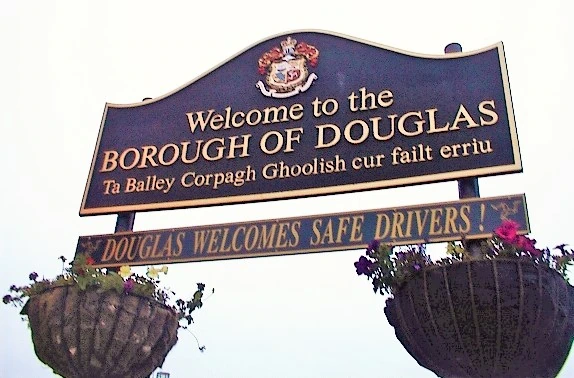
Bilingual Manx and English welcome sign in Douglas, Isle of Man. Language identification follows Commons metadata; not independently transcribed.
Saved in Babelbook · resized display copy. Select the image to open it independently of its source.
Man vyi · Source ↗CC SA 1.0 ↗View the local visual field note
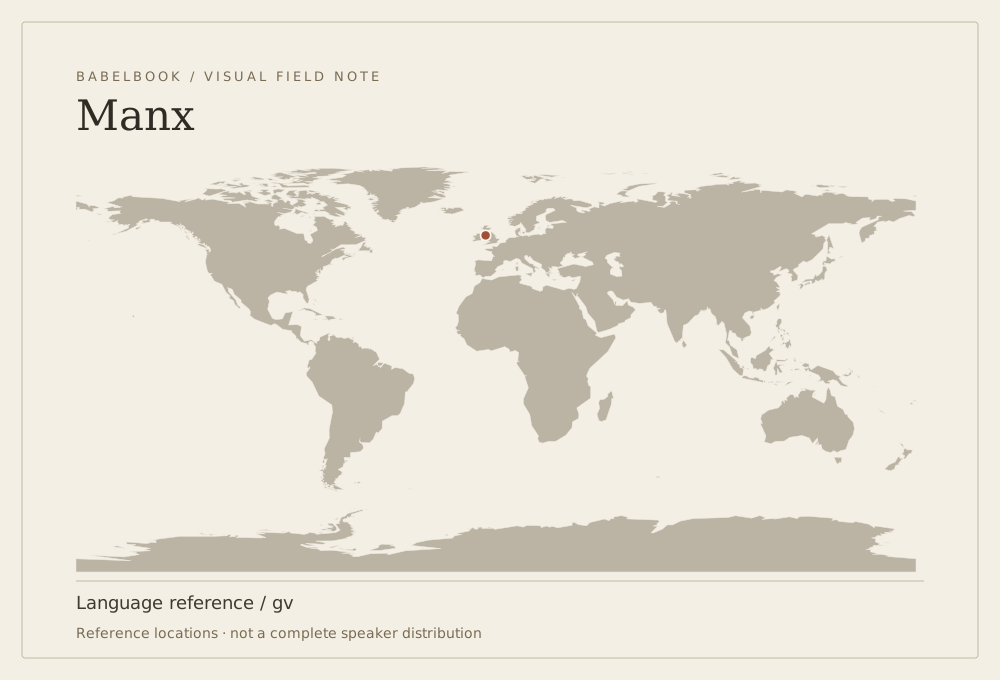
Representative reference points from Glottolog. Historical entries show reference locations, not current speakers. 1 point.
Reference & context ↗Babelbook · original editorial illustration · CC BY 4.0 · Glottolog locations; public-domain Natural Earth land
Source excerpts, selected, shortened and where noted editorially corrected from Manx language by Wikipedia contributors. Retrieved 2026-10-05. CC BY-SA 4.0. These excerpts are not an independently verified scholarly history; missing accounts are identified above.
Read further in the source
History
Manx is a Goidelic language, closely related to Irish and Scottish Gaelic. On the whole it is partially mutually intelligible with these, and native speakers of one find it easy to gain passive, and even spoken, competency in the other two. It has been suggested that a little-documented Brythonic language (i.e. related to modern Welsh, Cornish and Breton) may have been spoken on the Isle of Man before the arrival of Christian missionaries from Ireland in the early Middle Ages. However, there is little surviving evidence about the language spoken on the island at that time. Manx (like Irish and Scottish Gaelic) is descended from Primitive Irish. The island either lends its name to or takes its name from Manannán, the Brythonic and Gaelic sea god who is said in myth to have once ruled the island. Primitive Irish is first attested in Ogham inscriptions from the 4th century AD. These writings have been found throughout Ireland and the west coast of Great Britain. Primitive Irish transitioned into Old Irish through the 5th century. Old Irish, dating from the 6th century, used the Latin script and is attested mainly in marginalia to Latin manuscripts, but there are no extant examples from the Isle of Man. Latin was used for ecclesiastical records from the establishment of Christianity in the Isle of Man in the 5th century AD. Many words concerning religion, writing and record keeping entered Manx at this time. The Isle of Man was conquered by Norse Vikings in the 9th century. Though there is some evidence in the form of runic inscriptions that Norse was used by some of these settlers, the Vikings who settled around the Irish Sea and West Coast of Scotland soon became Gaelic-speaking Norse–Gaels. During the 9th century AD, the Gaelic of the inhabitants of the Isle of Man, like those of Scotland and the North of Ireland, may have been significantly influenced by Norse speakers. While Norse had very little impact on the Manx language overall, a small number of modern place names on the Isle of Man are Norse in origin, e.g. Laxey (Laksaa) and Ramsey (Rhumsaa). Other Norse legacies in Manx include loanwords and personal names. By the 10th century, it is supposed that Middle Irish had emerged and was spoken throughout Ireland, Scotland and the Isle of Man. The island came under Scottish rule in 1266, and alternated between Scottish and English rule until finally becoming the feudal possession of the Stanley family in 1405. It is likely that until that point, except for scholarly knowledge of Latin and courtly use of Anglo-Norman, Manx was the only language spoken on the island. Since the establishment of the Stanleys on the Isle of Man, first Anglo-Norman and later the English language have been the chief external factors in the development of Manx, until the 20th century, when Manx speakers became able to access Irish and Scottish Gaelic media.
Revival
Following the decline in the use of Manx during the 19th century, Yn Çheshaght Ghailckagh (The Manx Language Society) was founded in 1899. By the mid-20th century, only a few elderly native speakers remained (the last of them, Ned Maddrell, died 27 December 1974), but by then a scholarly revival had begun and a few people had started teaching it in schools. The Manx Language Unit was formed in 1992, consisting of three members and headed by Manx Language Officer Brian Stowell, a language activist and fluent speaker, "which was put in charge of all aspects of Manx language teaching and accreditation in schools." This led to an increased interest in studying the Manx language and encouraged a renewed sense of ethnic identity. The revival of Manx was aided by the recording work done in the 20th century by researchers. Most notably, the Irish Folklore Commission was sent in with recording equipment in 1948 by Éamon de Valera. Also important in preserving the Manx language was work conducted by the late Brian Stowell, who is considered personally responsible for the current revival of the Manx language. The Manx Language Strategy was released in 2017, outlining a five-year plan for the language's continued revitalisation. Culture Vannin employs a Manx Language Development Officer (Manx: Yn Greinneyder) to encourage and facilitate the use of the language. In 2009, UNESCO's Atlas of the World's Languages in Danger declared Manx an extinct language, despite the presence of hundreds of speakers on the Isle of Man. Historian and linguist Jennifer Kewley Draskau reacted to this declaration, stating "Unesco ought to know better than to declare Manx a dead language. There are hundreds of speakers of Manx and while people are able to have productive conversations in the language then it is very much alive and well." Since then, UNESCO's classification of the language has changed to "critically endangered". In the 2011 census, 1,823 out of 80,398 Isle of Man residents, or 2.27% of the population, claimed to have knowledge of Manx, an increase of 134 people from the 2001 census. These individuals were spread roughly uniformly over the island: in Douglas 566 people professed an ability to speak, read or write Manx; 179 in Peel, 146 in Onchan, and 149 in Ramsey. Traditional Manx given names have experienced a marked resurgence on the island, especially Moirrey and Voirrey (Mary), Illiam (William), Orry (from the Manx king Godred Crovan of Norse origin), Breeshey/Breesha (Bridget), Aalish/Ealish (Alice), Juan (Jack), Ean (John), Joney (Joan), Fenella (Fionnuala), Pherick (Patrick) and Freya (from the Norse goddess) remain popular.
Status
Manx is not officially recognised by any national or regional government, although its contribution to Manx culture and tradition is acknowledged by some governmental and non-governmental bodies. The Standing Orders of the House of Keys provide that: "The proceedings of the House shall be in English; but if a Member at any point pronounces a customary term or sentence in Manx Gaelic or any other language, the Speaker may call upon the Member for a translation." An example was at the sitting on 12 February 2019, when an MHK used the expression boghtnid, stated to mean "nonsense". Manx is used in the annual Tynwald ceremony and Manx words are used in official Tynwald publications. For the purpose of strengthening its contribution to local culture and community, Manx is recognised under the European Charter for Regional or Minority Languages and in the framework of the British-Irish Council. The Isle of Man comprised the one site for the Manx language in the Atlas Linguarum Europae, a project that compared dialects and languages across all countries in Europe.
Manx is taught as a second language at all of the island's primary and secondary schools. The lessons are optional and instruction is provided by the Department of Education's Manx Language Team which teach up to A Level standard. The Bunscoill Ghaelgagh, a primary school at St John's, has 67 children, as of September 2016, who receive nearly all of their education through the medium of the language. Children who have attended the school have the opportunity to receive some of their secondary education through the language at Queen Elizabeth II High School in Peel. The playgroup organisation Mooinjer Veggey, which operates the Bunscoill Ghaelgagh, runs a series of preschool groups that introduce the language.
Bilingual road, street, village and town boundary signs are common throughout the Isle of Man. All other road signs are in English only. Business signage in Manx is gradually being introduced but is not mandated by law; however, the 1985 Tynwald Report on the use of Manx states that signage should be bilingual except where a Manx phrase is the norm.
Dialects
Linguistic analysis of the last few dozen native speakers reveals a number of dialectal differences between the North and the South of the island. Northern Manx (Manx: Gaelg Hwoaie) was spoken from Maughold in the northeast to Peel on the west coast. Southern Manx was spoken in the sheading of Rushen. It is possible that written Manx represents a 'midlands' dialect of Douglas and surrounding areas. In Southern Manx, older ⟨á⟩, and in some cases ⟨ó⟩, became [æː]. In Northern Manx the same happened, but ⟨á⟩ sometimes remained [aː] as well, e.g. laa "day" (cf. Irish lá) was [læː] in the South but [læː] or [laː] in the North. Old ⟨ó⟩ is always [æː] in both dialects, e.g. aeg "young" (cf. Irish óg) is [æːɡ] in both dialects. ⟨á, ó⟩ and lengthened ⟨a⟩ before ⟨rt, rd, rg⟩ became /œː/, as in paayrt '"part" /pœːrt/, ard "high" /œːrd/, jiarg "red" /dʒœːrɡ/, argid "money, silver" /œːrɡid/ and aarey "gold gen." /œːrə/. In Northern Manx, older ⟨(e)a⟩ before ⟨nn⟩ in the same syllable is diphthongized, while in Southern Manx it is lengthened but remains a monophthong, e.g. kione "head" (cf. Irish ceann) is [kʲaun] in the North but [kʲoːn] in the South. Words with ⟨ua⟩, and in some cases ⟨ao⟩, in Irish and Scottish are spelled with ⟨eay⟩ in Manx. In Northern Manx, this sound was [iː], while in Southern Manx it was [ɯː], [uː], or [yː], e.g. geay "wind" (cf. Irish gaoth) is [ɡiː] in the north and [ɡɯː] in the South, while geayl "coal" (cf. Irish gual) is [ɡiːl] in the North and [ɡyːl], [ɡɯːl], or [ɡuːl] in the South. In both the North and the South, there is a tendency to insert a short [d] before a word-final [n] in monosyllabic words, as in [sleᵈn] for slane "whole" and [beᵈn] for ben "woman". This is known as pre-occlusion. In Southern Manx, however, there is also pre-occlusion of [d] before [l] and of [ɡ] before [ŋ], as in [ʃuːᵈl] for shooyl "walking" and [lɔᶢŋ] for lhong "ship". These forms are generally pronounced without pre-occlusion in the North. Pre-occlusion of [b] before [m], on the other hand, is more common in the North, as in trome "heavy", which is [t̪roᵇm] in the North but [t̪roː(ᵇ)m] in the South. This feature is also found in Cornish. Southern Manx tended to lose word-initial [ɡ] before [lʲ], which was usually preserved in the North, e.g. glion "glen" and glioon "knee" are [lʲɔᵈn] and [lʲuːᵈn] in the South but [ɡlʲɔᵈn] and [ɡlʲuːn] in the North. In modern times, the small size of the island and the improvement in communications precludes any regional dialect variations.
Orthography
Manx orthography is based on Elizabethan English, and to a lesser extent Middle Welsh, developed by people who had an education in English (and Welsh until the 16th century). The result is an inconsistent and only partly phonemic spelling system, similar to English orthography and completely incomprehensible to readers of Irish and Scottish Gaelic. This is because both Irish and Scottish Gaelic use spelling systems derived from Classical Gaelic, the common literary language of Man, Ireland, and Scotland until the Bardic schools closed down in the 17th century, which makes them very etymological. Both Irish and Scottish Gaelic use only 18 letters to represent around 50 phonemes. While Manx uses 24 letters (the ISO basic Latin alphabet, excluding ⟨x⟩ and ⟨z⟩), covering a similar range of phonemes, all three make use of many digraphs and trigraphs. In 1932, Celticist T. F. O'Rahilly expressed the opinion that Manx orthography is inadequate, as it is neither traditional nor phonetic. Therefore, if a form of Classical Gaelic orthography adapted to Manx had survived or if one based on the reforms of Theobald Stapleton were to be developed and introduced, the very close relationship between Manx, Irish, and Scottish Gaelic would be obvious to readers at first sight and Manx would be much easier for other Gaels to read and understand. However, evidence of Gaelic type ever having been used on the island has not been found.