Hausa
Hausa (; in Hausa: Harshen/Halshen Hausa /hawˈsa/; Ajami: هَرْشَن هَوْسَا) is a Chadic language spoken by over 94.5 million people in West Africa, primarily by the Hausa people in Niger (where it is the sole official language, having replaced French in 2025) and Nigeria. It serves as a lingua franca in most of northern Nigeria, southern Niger, as well as in northern Cameroon, Ghana (mainly in the north of the country, but also extensively among the Zongo communities all across the country, including in the capital, Accra), Benin and Togo, southern Chad, and parts of Sudan. Hausa also has a significant number of speakers in Côte d’Ivoire and the Central African Republic. Hausa is a member of the Afroasiatic language family and is the most widely spoken language within the Chadic branch of that family. Hausa is tonal, using relative pitch both to distinguish words, and mark grammatical categories. Ethnologue estimated that it was spoken as a first language by some 58 million people and as a second language by another 36 million, bringing the total number of Hausa speakers to an estimated 94 million. In Nigeria, the Hausa film industry is known as Kannywood.
Translate in Hausa ↗Native speakers of Hausa, the Hausa people, are mostly found in southern Niger and northern Nigeria. The language is used as a lingua franca by non-native speakers in most of northern Nigeria, southern Niger, northern Cameroon, northern Ghana, northern Benin, northern Togo, southern Chad and parts of Sudan. Hausa is widely used as a lingua franca across much of West Africa and is spoken by people from various ethnic and cultural backgrounds across Northern Nigeria and Niger.
Sub-Saharan Africa
Present-day use
The captured source does not contain a separate current-use account.
Origins
The captured article does not contain a separate origins section. See the historical account and linked source.
Development
The captured article does not contain a distinct historical account. No chronology has been invented.
Writing
Latin or customary script (catalog classification; see the source for context).
Beyond the typeface.
Signs, manuscripts, published pages and contextual photographs, with their place, period, source and reuse terms. Captions identify historical spellings, regional examples, community references and character imagery.
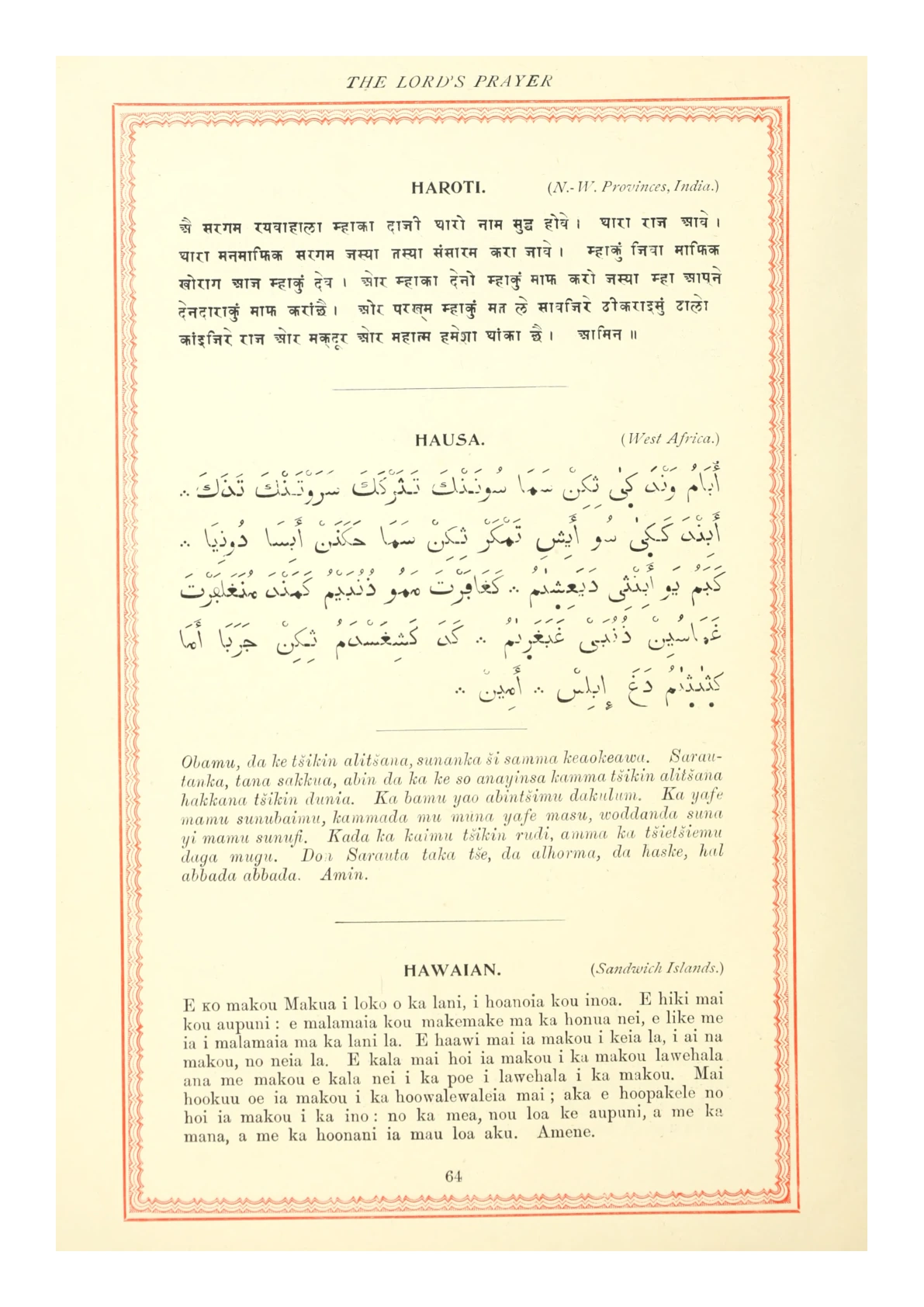
Historical printed prayer headed “HAUSA” in The Lord’s Prayer in Five Hundred Languages, printed page 64. The Commons record dates the compilation to 1905; this copy also contains a publisher note dated June 1908. Orthography and translation reflect the historical source, not a modern usage standard. Other languages appear on the same page. The source includes period terminology and editorial annotations; these are historical evidence, not Babelbook’s current terminology or claims.
Saved in Babelbook · resized display copy. Select the image to open it independently of its source.
Reinhold Rost (compiler); Gilbert & Rivington / Wm. Clowes & Sons (publishers); Internet Archive scan · Source ↗Public domain ↗View the local visual field note
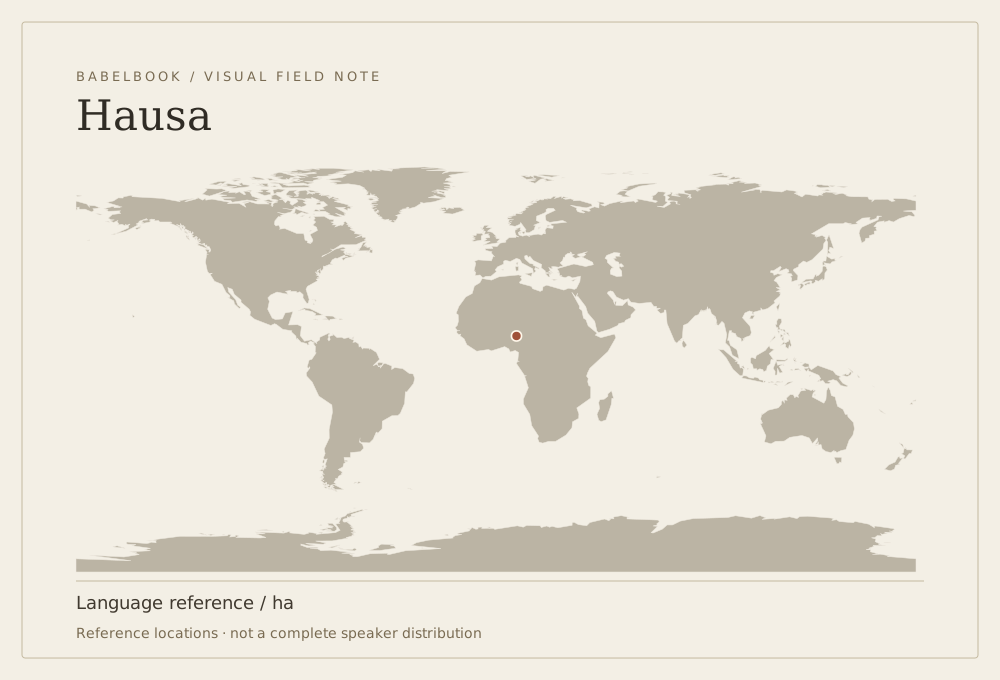
Representative reference points from Glottolog. Historical entries show reference locations, not current speakers. 1 point.
Reference & context ↗Babelbook · original editorial illustration · CC BY 4.0 · Glottolog locations; public-domain Natural Earth land
Source excerpts, selected, shortened and where noted editorially corrected from Hausa language by Wikipedia contributors. Retrieved 2026-10-05. CC BY-SA 4.0. These excerpts are not an independently verified scholarly history; missing accounts are identified above.
Read further in the source
Geographic distribution
Native speakers of Hausa, the Hausa people, are mostly found in southern Niger and northern Nigeria. The language is used as a lingua franca by non-native speakers in most of northern Nigeria, southern Niger, northern Cameroon, northern Ghana, northern Benin, northern Togo, southern Chad and parts of Sudan.
Speakers by country
Hausa is widely used as a lingua franca across much of West Africa and is spoken by people from various ethnic and cultural backgrounds across Northern Nigeria and Niger.
Dialects
Hausa presents a wide uniformity wherever it is spoken. However, linguists have identified dialect areas with a cluster of features characteristic of each one.
Traditional dialects
Eastern Hausa dialects include Dauranci in Daura; Kananci in Kano; Bausanci in Bauchi; Gudduranci and Katagumci in Katagum, Misau, and part of Borno; Hadejanci in Hadejiya. Western Hausa dialects include Sakkwatanci in Sokoto; Katsinanci in Katsina; Arewanci (also a Northern dialect) and Gobiranci in Dogondoutchi; Adaranci in Ader; Kabanci in Kebbi; Zanhwaranci in Zamfara; Kurfayanci in Kourfeye; Damagaranci in Damagaram; Tibiranci in Madari. Katsinanci is transitional between Eastern and Western dialects. Sakkwatanci is used in a variety of classical Hausa literature, and is often known as Classical Hausa. Zazzaganci in Zazzau is the major Southern dialect. The Daura (Dauranci) and Kano (Kananci) dialects are the standard. The BBC, Deutsche Welle, Radio France Internationale and Voice of America offer Hausa services on their international news web sites using Dauranci and Kananci. In recent language development Zazzaganci took over the innovation of writing and speaking the current Hausa language use.
Northernmost dialects and loss of tonality
The western to eastern Hausa dialects of Kurhwayanci, Damagaranci and Adaranci, represent the traditional northernmost limit of native Hausa communities. These are spoken in the northernmost sahel and mid-Saharan regions in west and central Niger in the Tillaberi, Tahoua, Dosso, Maradi, Agadez and Zinder regions. While mutually comprehensible with other dialects (especially Sakkwatanci, and to a lesser extent Gaananci), the northernmost dialects have slight grammatical and lexical differences owing to frequent contact with the Zarma, Fula, and Tuareg groups and cultural changes owing to the geographical differences between the grassland and desert zones. These dialects also have the quality of bordering on non-tonal pitch accent dialects. This link between non-tonality and geographic location is not limited to Hausa alone, but is exhibited in other northern dialects of neighbouring languages; example includes differences within the Songhay language (between the non-tonal northernmost dialects of Koyra Chiini in Timbuktu and Koyraboro Senni in Gao; and the tonal southern Zarma dialect, spoken from western Niger to northern Ghana), and within the Soninke language (between the non-tonal northernmost dialects of Imraguen and Nemadi spoken in east-central Mauritania; and the tonal southern dialects of Senegal, Mali and the Sahel).
Ghanaian Hausa dialect
The Ghanaian Hausa dialect (Gaananci), spoken in Ghana and Togo, is a distinct western native Hausa dialect-bloc with adequate linguistic and media resources available. Separate smaller Hausa dialects are spoken by an unknown number of Hausa further west in parts of Burkina Faso, and in the Haoussa Foulane, Badji Haoussa, Guezou Haoussa, and Ansongo districts of northeastern Mali (where it is designated as a minority language by the Malian government), but there are very little linguistic resources and research done on these particular dialects at this time. Gaananci forms a separate group from other Western Hausa dialects, as it now falls outside the contiguous Hausa-dominant area, and is usually identified by the use of c for ky, and j for gy. This is attributed to the fact that Ghana's Hausa population descend from Hausa-Fulani traders settled in the zongo districts of major trade-towns up and down the previous Asante, Gonja and Dagomba kingdoms stretching from the sahel to coastal regions, in particular the cities of Accra (Sabon Zango, Nima), Takoradi and Cape Coast. Gaananci exhibits noted inflected influences from Zarma, Gur, Jula-Bambara, Akan, and Soninke, as Ghana is the westernmost area in which the Hausa language is a major lingua-franca among sahelian/Muslim West Africans, including both Ghanaian and non-Ghanaian zango migrants primarily from the northern regions, or Mali and Burkina Faso. Ghana also marks the westernmost boundary in which the Hausa people inhabit in any considerable number. Immediately west and north of Ghana (in Côte d'Ivoire, and Burkina Faso), Hausa is abruptly replaced with Dioula–Bambara as the main sahelian/Muslim lingua-franca of what become predominantly Manding areas, and native Hausa-speakers plummet to a very small urban minority. Because of this, and the presence of surrounding Akan, Gbe, Gur and Mande languages, Gaananci was historically isolated from the other Hausa dialects. Despite this difference, grammatical similarities between Sakkwatanci and Ghanaian Hausa determine that the dialect, and the origin of the Ghanaian Hausa people themselves, are derived from the northwestern Hausa area surrounding Sokoto. Hausa is also widely spoken by non-native Gur, and Mandé Ghanaian Muslims, but differs from Gaananci, and rather has features consistent with non-native Hausa dialects.
Other native dialects
Hausa is also spoken in various parts of Cameroon and Chad, which combined the mixed dialects of Northern Nigeria and Niger. In addition, Arabic has had a great influence in the way Hausa is spoken by the native Hausa speakers in these areas.