Hebrew
Hebrew is a Northwest Semitic language within the Afroasiatic language family. A regional dialect of the Canaanite languages, it was natively spoken by the Israelites and remained in regular use as a first language until after 200 CE and as the liturgical language of Judaism (since the Second Temple period) and Samaritanism. The language was revived as a spoken language in the 19th century, and is the only successful large-scale example of linguistic revival. It is the only Canaanite language still spoken today. It is also one of the only two Northwest Semitic languages with contemporary speakers, the other being Aramaic. The earliest examples of written Paleo-Hebrew date to the 10th century BCE. Nearly all of the Hebrew Bible is written in Biblical Hebrew, with much of its present form in the dialect that scholars believe flourished around the 6th century BCE, during the time of the Babylonian captivity. For this reason, Hebrew has been referred to by Jews as Lashon Hakodesh (לְשׁוֹן הַקֹּדֶש, lit. 'the holy tongue' or 'the tongue [of] holiness') since ancient times. The language was not referred to by the name Hebrew in the Bible, but as Yehudit (transl. 'Judean') or Səpaṯ Kəna'an (transl. "the language of Canaan").
Translate in Hebrew ↗Modern Hebrew is the primary official language of the State of Israel. As of 2013, there are about 9 million Hebrew speakers worldwide, of whom 7 million speak it fluently. Currently, 90% of Israeli Jews are proficient in Hebrew, and 70% are highly proficient. Some 60% of Israeli Arabs are also proficient in Hebrew, and 30% report having a higher proficiency in Hebrew than in Arabic. In total, about 53% of the Israeli population speaks Hebrew as a native language, while most of the rest speak it fluently. In 2013 Hebrew was the native language of 49% of Israelis over the age of 20, with Russian, Arabic, French, English, Yiddish and Ladino being the native tongues of most of the rest. Some 26% of immigrants from the former Soviet Union and 12% of Arabs reported speaking Hebrew poorly or not at all. Steps have been taken to keep Hebrew the primary language of use, and to prevent large-scale incorporation of English words into the Hebrew vocabulary. The Academy of the Hebrew Language of the Hebrew University of Jerusalem currently invents about 2,000 new Hebrew words each year for modern words by finding an original Hebrew word that captures the meaning, as an alternative to incorporating more English words into Hebrew vocabulary. The Haifa municipality has banned officials from using English words in official documents, and is fighting to stop businesses from using only English signs to market their services. In 2012, a Knesset bill for the preservation of the Hebrew language was proposed, which includes the stipulation that all signage in Israel must first and foremost be in Hebrew, as with all speeches by Israeli officials abroad. The bill's author, MK Akram Hasson, stated that the bill was proposed as a response to Hebrew "losing its prestige" and children incorporating more English words into their vocabulary. Hebrew is one of several languages for which the constitution of South Africa calls to be respected in their use for religious purposes.
Middle East & North Africa
Present-day use
Hebrew has been revived several times as a literary language, most significantly by the Haskalah (Enlightenment) movement of early and mid-19th-century Germany. In the early 19th century, a form of spoken Hebrew had emerged in the markets of Jerusalem between Jews of different linguistic backgrounds to communicate for commercial purposes. This Hebrew dialect was to a certain extent a pidgin. Near the end of that century the Jewish activist Eliezer Ben-Yehuda, owing to the ideology of the national revival (שיבת ציון, Shivat Tziyon, later Zionism), began reviving Hebrew as a modern spoken language. Eventually, as a result of the local movement he created, but more significantly as a result of the new groups of immigrants known under the name of the Second Aliyah, it replaced a score of languages spoken by Jews at that time. Those languages were Jewish dialects of local languages, including Judaeo-Spanish (also called "Judezmo" and "Ladino"), Yiddish, Judeo-Arabic and Bukhori (Tajiki), or local languages spoken in the Jewish diaspora such as Russian, Persian and Arabic. The major result of the literary work of the Hebrew intellectuals along the 19th century was a lexical modernization of Hebrew. New words and expressions were adapted as neologisms from the large corpus of Hebrew writings since the Hebrew Bible, or borrowed from Arabic (mainly by Ben-Yehuda) and older Aramaic and Latin. Many new words were either borrowed from or coined after European languages, especially English, Russian, German, and French. Modern Hebrew became an official language in British-ruled Palestine in 1921 (along with English and Arabic), and then in 1948 became an official language of the newly declared State of Israel.
Origins
The modern English word Hebrew is derived from Old French Ebrau via Latin, from the Ancient Greek hebraîos (Ἑβραῖος) and Aramaic 'ibrāy, all ultimately derived from Biblical Hebrew Ivri (עברי), one of several names for the Israelite (Jewish and Samaritan) people – or the Hebrews. It is traditionally understood to be an adjective based on the name of Abraham's ancestor, Eber, mentioned in Genesis 10:21. The name is believed to be based on the Semitic root ʕ-b-r (ע־ב־ר), meaning 'beyond', 'other side', 'across'; interpretations of the term Hebrew generally render its meaning as roughly "from the other side [of the river/desert]"—i.e., an exonym for the inhabitants of the land of Israel and Judah, perhaps from the perspective of Mesopotamia, Phoenicia or Transjordan (with the river referred to being perhaps the Euphrates, Jordan or Litani; or maybe the northern Arabian Desert between Babylonia and Canaan). Compare the word Habiru or cognate Assyrian ebru, of identical meaning. One of the earliest references to the language's name as Ivrit is found in the prologue to the Book of Sirach, from the 2nd century BCE. The Hebrew Bible does not use the term Hebrew in reference to the language of the Hebrew people; its later historiography, in the Book of Kings, it is referred to as Yehudit (יְהוּדִית, lit. 'Judahite').
Development
Hebrew belongs to the Canaanite languages, a branch of the Northwest Semitic family. Hebrew was the spoken language in the Iron Age kingdoms of Israel and Judah during the period from about 1200 to 586 BCE. Epigraphic evidence from this period confirms the widely accepted view that the earlier layers of biblical literature reflect the language used in these kingdoms. Furthermore, the content of Hebrew inscriptions suggests that the written texts closely mirror the spoken language of that time. Scholars debate the degree to which Hebrew was a spoken vernacular in ancient times following the Babylonian exile when the predominant international language in the region was Old Aramaic. Hebrew was extinct as a colloquial language by late antiquity, but it continued to be used as a literary language, especially in Spain, as the language of commerce between Jews of different native languages, and as the liturgical language of Judaism, evolving various dialects of literary Medieval Hebrew, until its revival as a spoken language in the late 19th century.
Writing
In May 2023, Scott Stripling published the finding of what he claims to be the oldest known Hebrew inscription, a curse tablet found at Mount Ebal, dated from around 3200 years ago. The presence of the Hebrew name of god, Yahweh, as three letters, Yod-Heh-Vav (YHV), according to the author and his team meant that the tablet is Hebrew and not Canaanite. However, practically all professional archeologists and epigraphers apart from Stripling's team claim that there is no text on this object. In July 2008, Israeli archaeologist Yossi Garfinkel discovered a ceramic shard at Khirbet Qeiyafa that he claimed may be the earliest Hebrew writing yet discovered, dating from around 3,000 years ago. Hebrew University archaeologist Amihai Mazar said that the inscription was "proto-Canaanite" but cautioned that "[t]he differentiation between the scripts, and between the languages themselves in that period, remains unclear", and suggested that calling the text Hebrew might be going too far. The Gezer calendar also dates back to the 10th century BCE at the beginning of the Monarchic period, the traditional time of the reign of David and Solomon. Classified as Archaic Biblical Hebrew, the calendar presents a list of seasons and related agricultural activities. The Gezer calendar (named after the city in whose proximity it was found) is written in an old Semitic script, akin to the Phoenician one that, through the Greeks and Etruscans, later became the Latin alphabet of ancient Rome. The Gezer calendar is written without any vowels, and it does not use consonants to imply vowels even in the places in which later Hebrew spelling requires them. Numerous older tablets have been found in the region with similar scripts written in other Semitic languages, for example, Proto-Sinaitic. It is believed that the original shapes of the script go back to Egyptian hieroglyphs, though the phonetic values are instead inspired by the acrophonic principle.
Beyond the typeface.
Signs, manuscripts, published pages and contextual photographs, with their place, period, source and reuse terms. Captions identify historical spellings, regional examples, community references and character imagery.
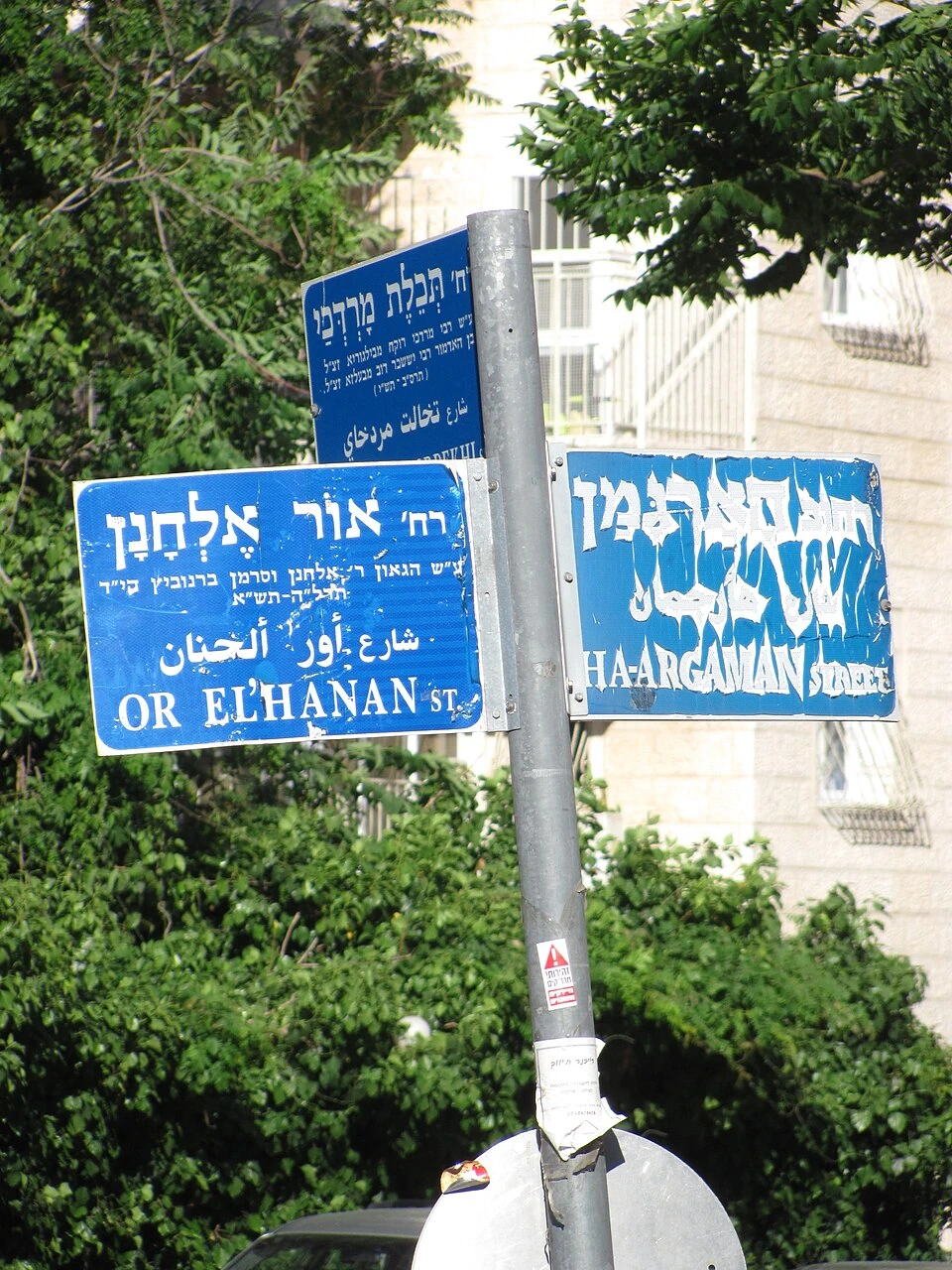
Modern Hebrew with Arabic and English on a street sign, photographed in 2016. Displayed at reduced size; no additional crop.
Saved in Babelbook · resized display copy. Select the image to open it independently of its source.
Yoninah · Source ↗CC BY-SA 4.0 ↗View the local visual field note
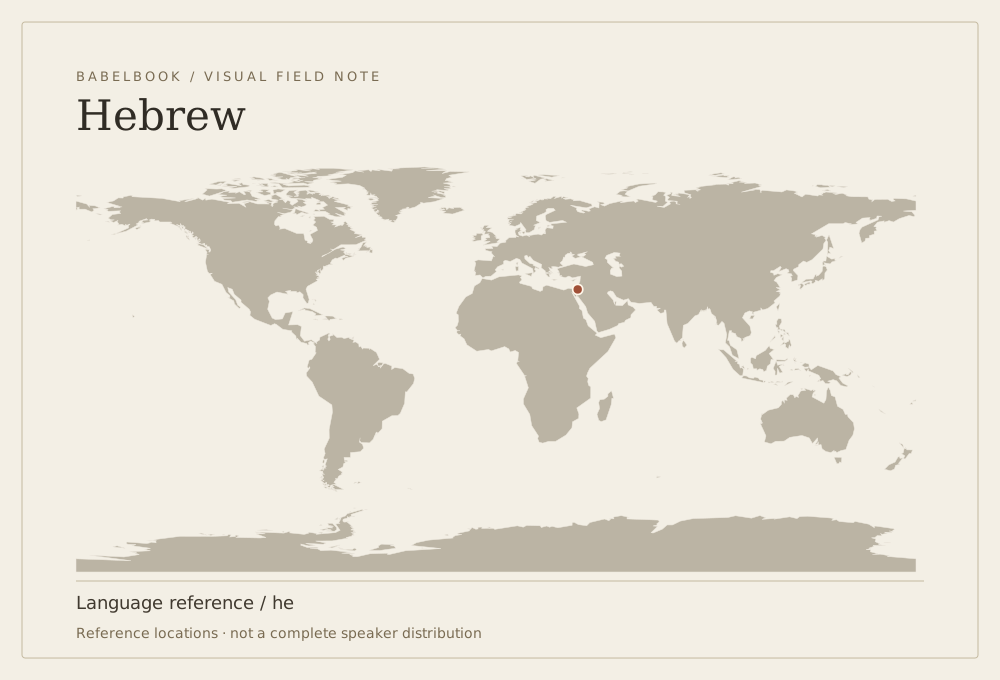
Representative reference points from Glottolog. Historical entries show reference locations, not current speakers. 1 point.
Reference & context ↗Babelbook · original editorial illustration · CC BY 4.0 · Glottolog locations; public-domain Natural Earth land
Source excerpts, selected, shortened and where noted editorially corrected from Hebrew language by Wikipedia contributors. Retrieved 2026-10-05. CC BY-SA 4.0. These excerpts are not an independently verified scholarly history; missing accounts are identified above.
Read further in the source
History
Hebrew belongs to the Canaanite languages, a branch of the Northwest Semitic family. Hebrew was the spoken language in the Iron Age kingdoms of Israel and Judah during the period from about 1200 to 586 BCE. Epigraphic evidence from this period confirms the widely accepted view that the earlier layers of biblical literature reflect the language used in these kingdoms. Furthermore, the content of Hebrew inscriptions suggests that the written texts closely mirror the spoken language of that time. Scholars debate the degree to which Hebrew was a spoken vernacular in ancient times following the Babylonian exile when the predominant international language in the region was Old Aramaic. Hebrew was extinct as a colloquial language by late antiquity, but it continued to be used as a literary language, especially in Spain, as the language of commerce between Jews of different native languages, and as the liturgical language of Judaism, evolving various dialects of literary Medieval Hebrew, until its revival as a spoken language in the late 19th century.
Revival
Hebrew has been revived several times as a literary language, most significantly by the Haskalah (Enlightenment) movement of early and mid-19th-century Germany. In the early 19th century, a form of spoken Hebrew had emerged in the markets of Jerusalem between Jews of different linguistic backgrounds to communicate for commercial purposes. This Hebrew dialect was to a certain extent a pidgin. Near the end of that century the Jewish activist Eliezer Ben-Yehuda, owing to the ideology of the national revival (שיבת ציון, Shivat Tziyon, later Zionism), began reviving Hebrew as a modern spoken language. Eventually, as a result of the local movement he created, but more significantly as a result of the new groups of immigrants known under the name of the Second Aliyah, it replaced a score of languages spoken by Jews at that time. Those languages were Jewish dialects of local languages, including Judaeo-Spanish (also called "Judezmo" and "Ladino"), Yiddish, Judeo-Arabic and Bukhori (Tajiki), or local languages spoken in the Jewish diaspora such as Russian, Persian and Arabic. The major result of the literary work of the Hebrew intellectuals along the 19th century was a lexical modernization of Hebrew. New words and expressions were adapted as neologisms from the large corpus of Hebrew writings since the Hebrew Bible, or borrowed from Arabic (mainly by Ben-Yehuda) and older Aramaic and Latin. Many new words were either borrowed from or coined after European languages, especially English, Russian, German, and French. Modern Hebrew became an official language in British-ruled Palestine in 1921 (along with English and Arabic), and then in 1948 became an official language of the newly declared State of Israel. Hebrew is the most widely spoken language in Israel today. In the Modern Period, from the 19th century onward, the literary Hebrew tradition revived as the spoken language of modern Israel, called variously Israeli Hebrew, Modern Israeli Hebrew, Modern Hebrew, New Hebrew, Israeli Standard Hebrew, Standard Hebrew and so on. Israeli Hebrew exhibits some features of Sephardic Hebrew from its local Jerusalemite tradition but adapts it with numerous neologisms, borrowed terms (often technical) from European languages and adopted terms (often colloquial) from Arabic. The literary and narrative use of Hebrew was revived beginning with the Haskalah movement. The first secular periodical in Hebrew, Ha-Me'assef (The Gatherer), was published by maskilim in Königsberg (today's Kaliningrad) from 1783 onwards. In the mid-19th century, publications of several Eastern European Hebrew-language newspapers (e.g. Hamagid, founded in Ełk in 1856) multiplied. Prominent poets were Hayim Nahman Bialik and Shaul Tchernichovsky; there were also novels written in the language. The revival of the Hebrew language as a mother tongue was initiated in the late 19th century by the efforts of Ben-Yehuda. He joined the Jewish national movement and in 1881 immigrated to Palestine, then a part of the Ottoman Empire. Motivated by the surrounding ideals of renovation and rejection of the diaspora "shtetl" lifestyle, Ben-Yehuda set out to develop tools for making the literary and liturgical language into everyday spoken language. However, his brand of Hebrew followed norms that had been replaced in Eastern Europe by different grammar and style, in the writings of people like Ahad Ha'am and others. His organizational efforts and involvement with the establishment of schools and the writing of textbooks pushed the vernacularization activity into a gradually accepted movement. It was not, however, until the 1904–1914 Second Aliyah that Hebrew had caught real momentum in Ottoman Palestine with the more highly organized enterprises set forth by the new group of immigrants. When the British Mandate of Palestine recognized Hebrew as one of the country's three official languages (English, Arabic, and Hebrew, in 1922), its new formal status contributed to its diffusion. A constructed modern language with a truly Semitic vocabulary and written appearance, although often European in phonology, was to take its place among the current languages of the nations. While many saw his work as fanciful or even blasphemous (because Hebrew was the holy language of the Torah and therefore some thought that it should not be used to discuss everyday matters), many soon understood the need for a common language amongst Jews of the British Mandate who at the turn of the 20th century were arriving in large numbers from diverse countries and speaking different languages. A Committee of the Hebrew Language was established. After the establishment of Israel, it became the Academy of the Hebrew Language. The results of Ben-Yehuda's lexicographical work were published in a dictionary (The Complete Dictionary of Ancient and Modern Hebrew, Ben-Yehuda Dictionary). The seeds of Ben-Yehuda's work fell on fertile ground, and by the beginning of the 20th century, Hebrew was well on its way to becoming the main language of the Jewish population of both Ottoman and British Palestine. At the time, members of the Old Yishuv and a very few Hasidic sects, most notably those under the auspices of Satmar, refused to speak Hebrew and spoke only Yiddish. In the Soviet Union, the use of Hebrew, along with other Jewish cultural and religious activities, was suppressed. Soviet authorities considered the use of Hebrew "reactionary" since it was associated with Zionism, and the teaching of Hebrew at primary and secondary schools was officially banned by the People's Commissariat for Education as early as 1919, as part of an overall agenda aiming to secularize education (the language itself did not cease to be studied at universities for historical and linguistic purposes). The official ordinance stated that Yiddish, being the spoken language of the Russian Jews, should be treated as their only national language, while Hebrew was to be treated as a foreign language. Hebrew books and periodicals ceased to be published and were seized from the libraries, although liturgical texts were still published until the 1930s. Despite numerous protests, a policy of suppression of the teaching of Hebrew operated from the 1930s on. Later in the 1980s in the USSR, Hebrew studies reappeared due to people struggling for permission to go to Israel (refuseniks). Several of the teachers were imprisoned, e.g. Yosef Begun, Ephraim Kholmyansky, Yevgeny Korostyshevsky and others responsible for a Hebrew learning network connecting many cities of the USSR.
Current status
Modern Hebrew is the primary official language of the State of Israel. As of 2013, there are about 9 million Hebrew speakers worldwide, of whom 7 million speak it fluently. Currently, 90% of Israeli Jews are proficient in Hebrew, and 70% are highly proficient. Some 60% of Israeli Arabs are also proficient in Hebrew, and 30% report having a higher proficiency in Hebrew than in Arabic. In total, about 53% of the Israeli population speaks Hebrew as a native language, while most of the rest speak it fluently. In 2013 Hebrew was the native language of 49% of Israelis over the age of 20, with Russian, Arabic, French, English, Yiddish and Ladino being the native tongues of most of the rest. Some 26% of immigrants from the former Soviet Union and 12% of Arabs reported speaking Hebrew poorly or not at all. Steps have been taken to keep Hebrew the primary language of use, and to prevent large-scale incorporation of English words into the Hebrew vocabulary. The Academy of the Hebrew Language of the Hebrew University of Jerusalem currently invents about 2,000 new Hebrew words each year for modern words by finding an original Hebrew word that captures the meaning, as an alternative to incorporating more English words into Hebrew vocabulary. The Haifa municipality has banned officials from using English words in official documents, and is fighting to stop businesses from using only English signs to market their services. In 2012, a Knesset bill for the preservation of the Hebrew language was proposed, which includes the stipulation that all signage in Israel must first and foremost be in Hebrew, as with all speeches by Israeli officials abroad. The bill's author, MK Akram Hasson, stated that the bill was proposed as a response to Hebrew "losing its prestige" and children incorporating more English words into their vocabulary. Hebrew is one of several languages for which the constitution of South Africa calls to be respected in their use for religious purposes. It has also been an official national minority language in Poland since 6 January 2005. In 2013, Hamas made Hebrew a compulsory language taught in schools in the Gaza Strip.
Writing system
Users of the language write Modern Hebrew from right to left using the Hebrew alphabet – an "impure" abjad, or consonant-only script, of 22 letters. The ancient Paleo-Hebrew alphabet resembles those used for Canaanite and Phoenician. Modern scripts derive from the "square" letter form, known as Ashurit (Assyrian), which developed from the Aramaic script. A cursive Hebrew script is used in handwriting: the letters tend to appear more circular in form when written in cursive, and sometimes vary markedly from their printed equivalents. The medieval version of the cursive script forms the basis of another style, known as Rashi script. When necessary, vowels are indicated by diacritic marks above or below the letter representing the syllabic onset, or by use of matres lectionis, which are consonantal letters used as vowels. Further diacritics may serve to indicate variations in the pronunciation of the consonants (e.g. bet/vet, shin/sin); and, in some contexts, to indicate the punctuation, accentuation and musical rendition of Biblical texts (see Hebrew cantillation).