Hindi
Modern Standard Hindi (Hindi: आधुनिक मानक हिन्दी, romanised: Ādhunik Mānak Hindī), commonly referred to as Hindi, is an Indo-Aryan language written in the Devanagari script. It is an official language of the government of India, and is the lingua franca for most of the northern half of India. Hindi is an official language in ten states (Bihar, Chhattisgarh, Gujarat, Haryana, Himachal Pradesh, Jharkhand, Madhya Pradesh, Rajasthan, Uttar Pradesh, and Uttarakhand), and six union territories (Andaman and Nicobar Islands, Delhi, Chandigarh, Dadra and Nagar Haveli and Daman and Diu, Ladakh and Jammu and Kashmir) and an additional official language in the state of West Bengal. Hindi is also one of the 22 scheduled languages of the Republic of India. Apart from the script and formal vocabulary, Modern Standard Hindi is mutually intelligible with standard Urdu. The common base of the two languages is sometimes referred to as Hindi–Urdu or Hindustani, and Hindi is considered a Sanskritised register of Hindustani. Hindi is also spoken, to a lesser extent, in other parts of India (usually in a simplified or pidginised variety such as Bazaar Hindustani or Haflong Hindi). Outside India, several other languages are recognised officially as "Hindi" but do not refer to the Standard Hindi language described here and instead descend from other nearby languages, such as Awadhi and Bhojpuri.
Translate in Hindi ↗Hindi is the lingua franca of northern India (which contains the Hindi Belt), as well as an official language of the Government of India, along with English. In Northeast India a pidgin known as Haflong Hindi has developed as a lingua franca for the people living in Haflong, Assam who speak other languages natively. In Arunachal Pradesh, Hindi emerged as a lingua franca among locals who speak over 50 dialects natively. Hindi is quite easy to understand for many Pakistanis, who speak Urdu, which, like Hindi, is a standard register of the Hindustani language; additionally, Indian media are widely viewed in Pakistan. A sizeable population in Afghanistan, especially in Kabul, can also speak and understand Hindi-Urdu due to the popularity and influence of Bollywood films, songs and actors in the region. Hindi is also spoken by a large population of Madheshis (people having roots in north-India but having migrated to Nepal over hundreds of years) of Nepal. Apart from this, Hindi is spoken by the large Indian diaspora which hails from, or has its origin from the "Hindi Belt" of India. A substantially large North Indian diaspora lives in countries like the United States of America, the United Kingdom, the United Arab Emirates, Trinidad and Tobago, Guyana, Suriname, South Africa, Fiji and Mauritius, where it is natively spoken at home and among their own Hindustani-speaking communities. Outside India, Hindi speakers are 8 million in Nepal; 863,077 in the United States of America; 450,170 in Mauritius; 380,000 in Fiji; 250,292 in South Africa; 150,000 in Suriname; 100,000 in Uganda; 45,800 in the United Kingdom; 20,000 in New Zealand; 20,000 in Germany; 26,000 in Trinidad and Tobago; 3,000 in Singapore.
South Asia
Present-day use
The captured source does not contain a separate current-use account.
Origins
The captured article does not contain a separate origins section. See the historical account and linked source.
Development
The captured article does not contain a distinct historical account. No chronology has been invented.
Writing
Hindi is written in the Devanagari script, an abugida. Devanagari consists of 11 vowels and 33 consonants and is written from left to right. Unlike Sanskrit, Devanagari is not entirely phonetic for Hindi, especially failing to mark schwa deletion in spoken Standard Hindi.
Beyond the typeface.
Signs, manuscripts, published pages and contextual photographs, with their place, period, source and reuse terms. Captions identify historical spellings, regional examples, community references and character imagery.

Hindi station name on the trilingual Ghum railway station sign, 2018, alongside Bengali and English. Source-identified language; displayed without additional cropping.
Saved in Babelbook · resized display copy. Select the image to open it independently of its source.
Bernard Gagnon · Source ↗CC BY-SA 4.0 ↗View the local visual field note
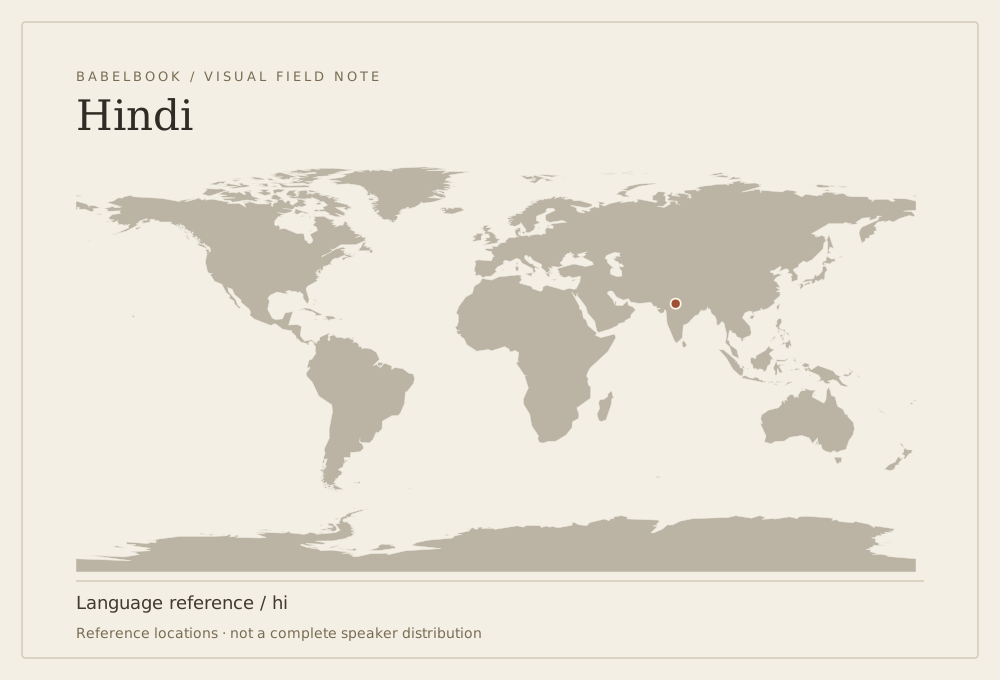
Representative reference points from Glottolog. Historical entries show reference locations, not current speakers. 1 point.
Reference & context ↗Babelbook · original editorial illustration · CC BY 4.0 · Glottolog locations; public-domain Natural Earth land
Source excerpts, selected, shortened and where noted editorially corrected from Hindi by Wikipedia contributors. Retrieved 2026-10-05. CC BY-SA 4.0. These excerpts are not an independently verified scholarly history; missing accounts are identified above.
Read further in the source
Geographical distribution
Hindi is the lingua franca of northern India (which contains the Hindi Belt), as well as an official language of the Government of India, along with English. In Northeast India a pidgin known as Haflong Hindi has developed as a lingua franca for the people living in Haflong, Assam who speak other languages natively. In Arunachal Pradesh, Hindi emerged as a lingua franca among locals who speak over 50 dialects natively. Hindi is quite easy to understand for many Pakistanis, who speak Urdu, which, like Hindi, is a standard register of the Hindustani language; additionally, Indian media are widely viewed in Pakistan. A sizeable population in Afghanistan, especially in Kabul, can also speak and understand Hindi-Urdu due to the popularity and influence of Bollywood films, songs and actors in the region. Hindi is also spoken by a large population of Madheshis (people having roots in north-India but having migrated to Nepal over hundreds of years) of Nepal. Apart from this, Hindi is spoken by the large Indian diaspora which hails from, or has its origin from the "Hindi Belt" of India. A substantially large North Indian diaspora lives in countries like the United States of America, the United Kingdom, the United Arab Emirates, Trinidad and Tobago, Guyana, Suriname, South Africa, Fiji and Mauritius, where it is natively spoken at home and among their own Hindustani-speaking communities. Outside India, Hindi speakers are 8 million in Nepal; 863,077 in the United States of America; 450,170 in Mauritius; 380,000 in Fiji; 250,292 in South Africa; 150,000 in Suriname; 100,000 in Uganda; 45,800 in the United Kingdom; 20,000 in New Zealand; 20,000 in Germany; 26,000 in Trinidad and Tobago; 3,000 in Singapore.
Comparison with Standard Urdu
Linguistically, Hindi and Urdu are two registers of the same language and are mutually intelligible. Both Hindi and Urdu share a core vocabulary of native Prakrit and Sanskrit-derived words. However, Hindi is written in the Devanagari script and contains more direct tatsama Sanskrit-derived words than Urdu, whereas Urdu is written in the Perso-Arabic script and uses more Arabic and Persian loanwords compared to Hindi. Because of this, as well as the fact that the two registers share an identical grammar, a consensus of linguists consider them to be two standardised forms of the same language, Hindustani or Hindi-Urdu. Hindi is the most commonly used scheduled language in India and is one of the two official languages of the union, the other being English. Urdu is the national language and lingua franca of Pakistan and is one of 22 scheduled languages of India, also having official status in Uttar Pradesh, Jammu and Kashmir, Delhi, Telangana, Andhra Pradesh and Bihar.