Hittite
Hittite, also known as Nesite, is an extinct Indo-European language formerly spoken in Anatolia during the Bronze Age. The language is attested in cuneiform texts, primarily from the archives of the city of Hattusa, between the 17th century BC to the 13th century BC. Isolated Hittite words and personal names appear in Old Assyrian documents in Kanesh from as early as the 20th century BC, making it the earliest attested use of the Indo-European languages. By the Late Bronze Age, Hittite had started losing ground to its close relative Luwian. It appears that Luwian was the most widely spoken language in the Hittite capital of Hattusa during the 13th century BC. After the collapse of the Hittite New Kingdom during the more general Late Bronze Age collapse, Luwian emerged in the early Iron Age as the main language of the so-called Syro-Hittite states, in southwestern Anatolia and northern Syria.
Translate in Hittite ↗Hittite, also known as Nesite, is an extinct Indo-European language formerly spoken in Anatolia during the Bronze Age. The language is attested in cuneiform texts, primarily from the archives of the city of Hattusa, between the 17th century BC to the 13th century BC. Isolated Hittite words and personal names appear in Old Assyrian documents in Kanesh from as early as the 20th century BC, making it the earliest attested use of the Indo-European languages. By the Late Bronze Age, Hittite had started losing ground to its close relative Luwian. It appears that Luwian was the most widely spoken language in the Hittite capital of Hattusa during the 13th century BC. After the collapse of the Hittite New Kingdom during the more general Late Bronze Age collapse, Luwian emerged in the early Iron Age as the main language of the so-called Syro-Hittite states, in southwestern Anatolia and northern Syria.
Global / other
Present-day use
The captured source does not contain a separate current-use account.
Origins
The captured article does not contain a separate origins section. See the historical account and linked source.
Development
The Hittite language has traditionally been stratified into Old Hittite (OH), Middle Hittite (MH) and New Hittite or Neo-Hittite (NH, not to be confused with the polysemic use of "Neo-Hittite" label as a designation for the later period, which is actually post-Hittite), corresponding to the Old, Middle and New Kingdoms of the Hittite history (c. 1750–1500 BC, 1500–1430 BC and 1430–1180 BC, respectively). The stages are differentiated on both linguistic and paleographic grounds. The Dutch Hittitologist Alwin Kloekhorst (2019) recognizes two dialectal variants of Hittite: one he calls "Kanišite Hittite", and a second he named "Ḫattuša Hittite" (or Hittite proper). The first is attested in clay tablets from Kaniš/Neša (Kültepe), and is dated earlier than the findings from Ḫattuša.
Writing
Hittite was written in an adapted form of Peripheral Akkadian cuneiform orthography from Northern Syria. The predominantly syllabic nature of the script makes it difficult to ascertain the precise phonetic qualities of some of the Hittite sound inventory. The syllabary distinguishes the following consonants (notably, the Akkadian s series is dropped), b, d, g, ḫ, k, l, m, n, p, r, š, t, z, combined with the vowels a, e, i, u. Additionally, ya (= I.A : 𒄿𒀀), wa (= PI : 𒉿) and wi (= wi5 = GEŠTIN : 𒃾) signs are introduced. The Akkadian unvoiced/voiced series (k/g, p/b, t/d) do not express the voiced/unvoiced contrast in writing, but double spellings in intervocalic positions represent voiceless consonants in Indo-European (Sturtevant's law).
Beyond the typeface.
Signs, manuscripts, published pages and contextual photographs, with their place, period, source and reuse terms. Captions identify historical spellings, regional examples, community references and character imagery.
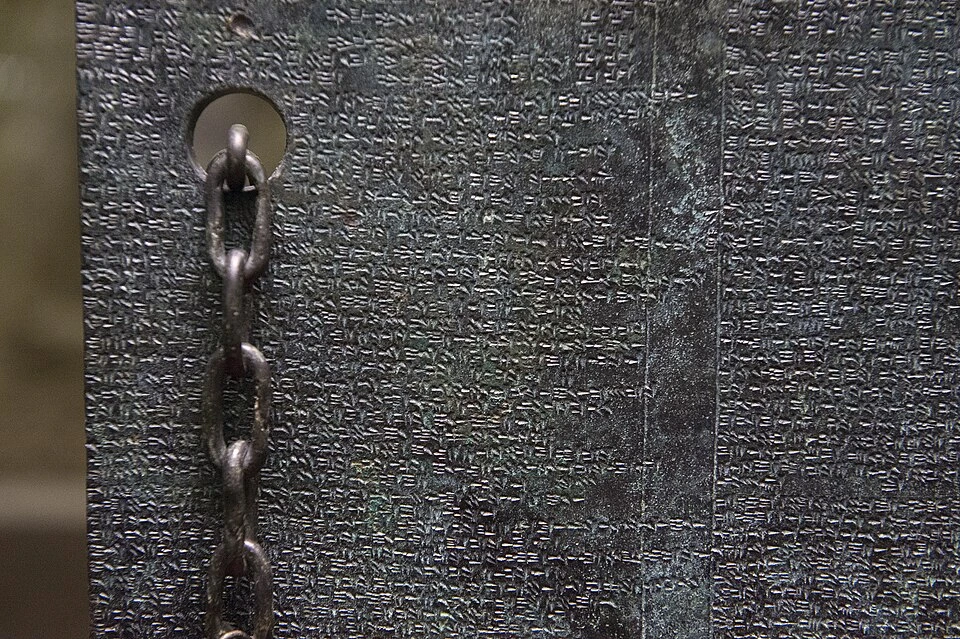
Bronze treaty between Tudhaliya IV and Kurunta of Tarhuntassa. Commons identifies the writing as Hittite cuneiform and the findspot as Hattusa. Not independently transcribed.
Saved in Babelbook · resized display copy. Select the image to open it independently of its source.
Dosseman (Dick Osseman) · Source ↗CC BY-SA 4.0 ↗View the local visual field note
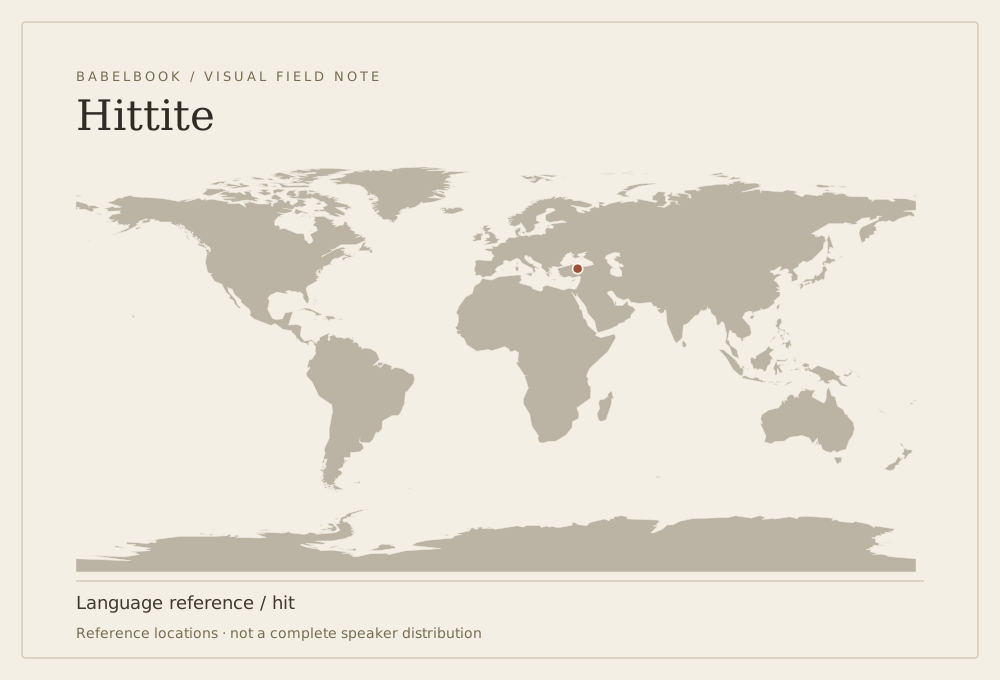
Representative reference points from Glottolog. Historical entries show reference locations, not current speakers. 1 point.
Reference & context ↗Babelbook · original editorial illustration · CC BY 4.0 · Glottolog locations; public-domain Natural Earth land
Source excerpts, selected, shortened and where noted editorially corrected from Hittite language by Wikipedia contributors. Retrieved 2026-10-05. CC BY-SA 4.0. These excerpts are not an independently verified scholarly history; missing accounts are identified above.
Read further in the source
History
The Hittite language has traditionally been stratified into Old Hittite (OH), Middle Hittite (MH) and New Hittite or Neo-Hittite (NH, not to be confused with the polysemic use of "Neo-Hittite" label as a designation for the later period, which is actually post-Hittite), corresponding to the Old, Middle and New Kingdoms of the Hittite history (c. 1750–1500 BC, 1500–1430 BC and 1430–1180 BC, respectively). The stages are differentiated on both linguistic and paleographic grounds. The Dutch Hittitologist Alwin Kloekhorst (2019) recognizes two dialectal variants of Hittite: one he calls "Kanišite Hittite", and a second he named "Ḫattuša Hittite" (or Hittite proper). The first is attested in clay tablets from Kaniš/Neša (Kültepe), and is dated earlier than the findings from Ḫattuša.