Hiri Motu
Hiri Motu, also known as Police Motu, Pidgin Motu, or just Hiri, is a language of Papua New Guinea, which is spoken in surrounding areas of its capital city, Port Moresby. It is a simplified version of Motu, from the Austronesian language family. Although it is strictly neither a pidgin nor a creole, it possesses some features from both language types. Phonological and grammatical differences make Hiri Motu not mutually intelligible with Motu. The languages are lexically very similar, and retain a common, albeit simplified, Austronesian syntactical basis. It has also been influenced to some degree by Tok Pisin. Even in the areas where it was once well established as a lingua franca, the use of Hiri Motu has been declining in favour of Tok Pisin and English for many years. The language has some statutory recognition.
Translate in Hiri Motu ↗Hiri Motu, also known as Police Motu, Pidgin Motu, or just Hiri, is a language of Papua New Guinea, which is spoken in surrounding areas of its capital city, Port Moresby. It is a simplified version of Motu, from the Austronesian language family. Although it is strictly neither a pidgin nor a creole, it possesses some features from both language types. Phonological and grammatical differences make Hiri Motu not mutually intelligible with Motu. The languages are lexically very similar, and retain a common, albeit simplified, Austronesian syntactical basis. It has also been influenced to some degree by Tok Pisin. Even in the areas where it was once well established as a lingua franca, the use of Hiri Motu has been declining in favour of Tok Pisin and English for many years. The language has some statutory recognition.
Oceania
Present-day use
The captured source does not contain a separate current-use account.
Origins
The term hiri is the name for the traditional trade voyages that created a culture and style of living for the Motu people. Hiri Motu became a common language for a police force known as Police Motu. The name Hiri Motu was conceptualised in the early 1970s during a conference held by the Department of Information and Extension Services. During the conference, the committee recommended the name Hiri Motu for several reasons. The language's history is older than the name Police Motu implies. That was recommended because it was simplified from the language of the Motu people, which was the language used when they traded goods with their customers. Police Motu was then never used as a language of trade or social contact. Since the unity of New Guinea Police Force in 1946, Police Motu had lost most of its functions in police work. Pidgin was adopted at the time and was used with the majority of the police force. The committee thought that the new name should have some meaning behind it. Instead of associating a language with the police, they thought the language should reflect the legacy of the language and how it is used in everyday life.
Development
The language has a history pre-dating European contact; it developed among members of the Hiri trade cycle (mainly in sago and clay pots) between the Motu people and their neighbours on the southeast coast of the island of New Guinea. In early European colonial days, the use of Hiri Motu was spread due to its adoption by the Royal Papuan Constabulary (hence the name Police Motu). By the early 1960s, Hiri Motu was the lingua franca of a large part of the country. It was the first language for many people whose parents came from different language groups (typically the children of policemen and other public servants). Since the early 1970s, if not earlier, the use of Hiri Motu as a day-to-day lingua franca in its old "range" has been gradually declining in favour of English and Tok Pisin. Today its speakers tend to be elderly and concentrated in Central and Gulf provinces. Younger speakers of the "parent language" (Motu proper) tend to be unfamiliar with Hiri Motu, and few of them understand or speak it well.
Writing
Latin or customary script (catalog classification; see the source for context).
Beyond the typeface.
Signs, manuscripts, published pages and contextual photographs, with their place, period, source and reuse terms. Captions identify historical spellings, regional examples, community references and character imagery.
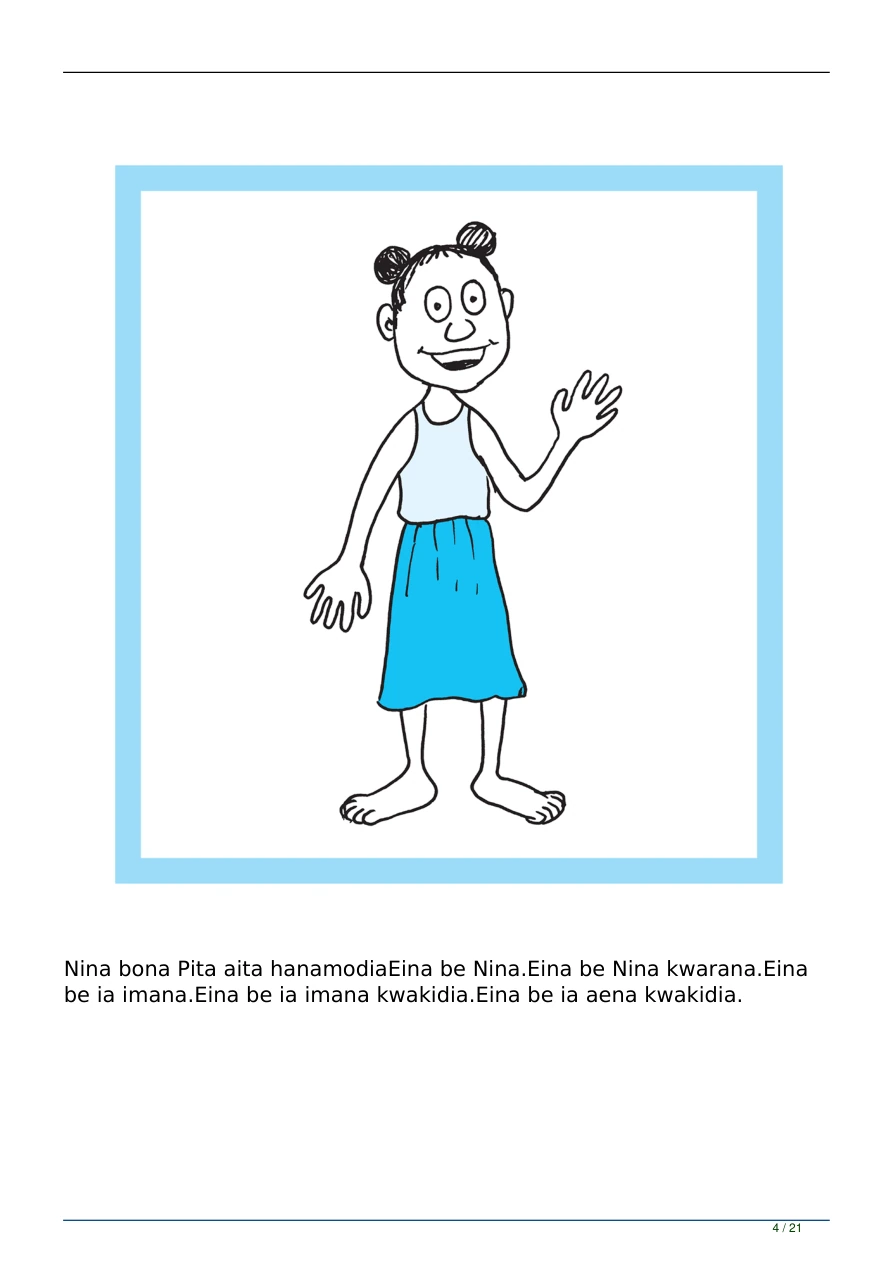
A page from Pita Bona Nina, a Hiri Motu beginning reader published by Bilum Books and adapted by The Asia Foundation. The page introduces Nina using complete Hiri Motu reading sentences. This is a rendered page of the publisher-distributed digital book, not a photograph or historical manuscript.
Saved in Babelbook · resized display copy. Select the image to open it independently of its source.
Tandi Jackson (author); Michael Mape (illustrator); Andrew Solien (translator); Bilum Books and The Asia Foundation (publishers) · Source ↗CC BY 4.0 ↗View the local visual field note
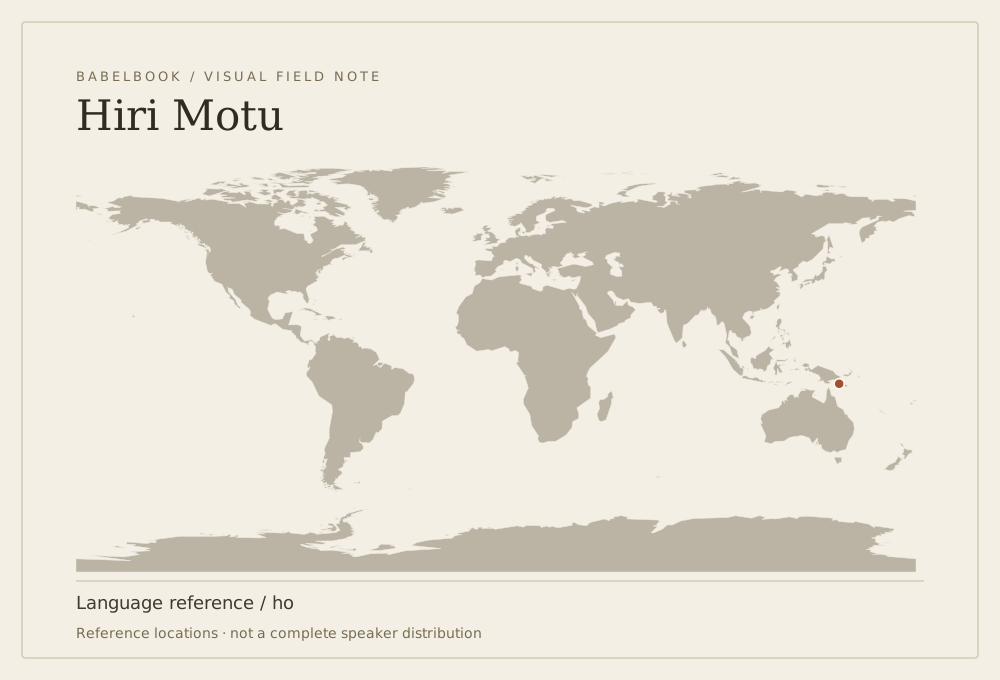
Representative reference points from Glottolog. Historical entries show reference locations, not current speakers. 1 point.
Reference & context ↗Babelbook · original editorial illustration · CC BY 4.0 · Glottolog locations; public-domain Natural Earth land
Source excerpts, selected, shortened and where noted editorially corrected from Hiri Motu by Wikipedia contributors. Retrieved 2026-10-05. CC BY-SA 4.0. These excerpts are not an independently verified scholarly history; missing accounts are identified above.
Read further in the source
Origins
The term hiri is the name for the traditional trade voyages that created a culture and style of living for the Motu people. Hiri Motu became a common language for a police force known as Police Motu. The name Hiri Motu was conceptualised in the early 1970s during a conference held by the Department of Information and Extension Services. During the conference, the committee recommended the name Hiri Motu for several reasons.
The language's history is older than the name Police Motu implies. That was recommended because it was simplified from the language of the Motu people, which was the language used when they traded goods with their customers. Police Motu was then never used as a language of trade or social contact. Since the unity of New Guinea Police Force in 1946, Police Motu had lost most of its functions in police work. Pidgin was adopted at the time and was used with the majority of the police force. The committee thought that the new name should have some meaning behind it. Instead of associating a language with the police, they thought the language should reflect the legacy of the language and how it is used in everyday life.
Dialects
Hiri Motu has two dialects: "Austronesian" and "Papuan". Both dialects are Austronesian in both grammar and vocabulary due to their derivation from Motu; the dialect names refer to the first languages spoken by users of this lingua franca. The "Papuan" dialect (also called "non-central") was more widely spoken and was used as the standard for official publications since around 1964. The "Austronesian" (or "central") dialect is closer to Motu in grammar and phonology, and its vocabulary is both more extensive and closer to the original language. It was the prestige dialect, which was regarded by speakers as being more "correct". The distinction between Motu and its "pidgin" dialects has been described as blurred. They form a continuum from the original "pure" language, through the established creoles, to what some writers have suggested constitutes a form of "Hiri Motu–based pidgin" used as a contact language with people who had not fully acquired Hiri Motu, such as Eleman and Koriki speakers.
History
The language has a history pre-dating European contact; it developed among members of the Hiri trade cycle (mainly in sago and clay pots) between the Motu people and their neighbours on the southeast coast of the island of New Guinea. In early European colonial days, the use of Hiri Motu was spread due to its adoption by the Royal Papuan Constabulary (hence the name Police Motu). By the early 1960s, Hiri Motu was the lingua franca of a large part of the country. It was the first language for many people whose parents came from different language groups (typically the children of policemen and other public servants). Since the early 1970s, if not earlier, the use of Hiri Motu as a day-to-day lingua franca in its old "range" has been gradually declining in favour of English and Tok Pisin. Today its speakers tend to be elderly and concentrated in Central and Gulf provinces. Younger speakers of the "parent language" (Motu proper) tend to be unfamiliar with Hiri Motu, and few of them understand or speak it well.