Croatian
Croatian is the standard variety of the Serbo-Croatian language mainly used by Croats. It is the national official language and literary standard of Croatia, one of the official languages of Bosnia and Herzegovina, Montenegro, the Serbian province of Vojvodina, the European Union and a recognized minority language elsewhere in Serbia and other neighbouring countries. In the mid-18th century, the first attempts to provide a Croatian literary standard began on the basis of the Neo-Shtokavian dialect that served as a supraregional lingua franca – pushing back regional Chakavian, Kajkavian, and Shtokavian vernaculars. The decisive role was played by Croatian Vukovians, who cemented the usage of Ijekavian Neo-Shtokavian as the literary standard in the late 19th and the beginning of the 20th century, in addition to designing a phonological orthography. Croatian is written in Gaj's Latin alphabet. Besides the Shtokavian dialect, on which Standard Croatian is based, there are two other main supradialects spoken in Croatia, Chakavian and Kajkavian. These supradialects, and the four national standards – Bosnian, Croatian, Montenegrin and Serbian – are usually subsumed under the term "Serbo-Croatian" in English; this term is controversial for native speakers, and names such as "Bosnian-Croatian-Montenegrin-Serbian" (BCMS) are used by linguists and philologists in the 21st century.
Translate in Croatian ↗Standard Croatian is the official language of the Republic of Croatia and, along with Standard Bosnian and Standard Serbian, one of three official languages of Bosnia and Herzegovina. It is also official in the regions of Burgenland (Austria), Molise (Italy) and Vojvodina (Serbia). Additionally, it has co-official status alongside Romanian in the communes of Carașova and Lupac, Romania. In these localities, Croats or Krashovani make up the majority of the population, and education, signage and access to public administration and the justice system are provided in Croatian, alongside Romanian.
Europe
Present-day use
In the late medieval period up to the 17th century, the majority of semi-autonomous Croatia was ruled by two domestic dynasties of princes (banovi), the Zrinski and the Frankopan, which were linked by inter-marriage. Toward the 17th century, both of them attempted to unify Croatia both culturally and linguistically, writing in a mixture of all three principal dialects (Chakavian, Kajkavian and Shtokavian), and calling it "Croatian", "Dalmatian", or "Slavonian". Historically, several other names were used as synonyms for Croatian, in addition to Dalmatian and Slavonian, and these were Illyrian (ilirski) and Slavic (slovinski). It is still used now in parts of Istria, which became a crossroads of various mixtures of Chakavian with Ekavian, Ijekavian and Ikavian isoglosses. The most standardised form (Kajkavian–Ikavian) became the cultivated language of administration and intellectuals from the Istrian peninsula along the Croatian coast, across central Croatia up into the northern valleys of the Drava and the Mura. The cultural apex of this 17th century idiom is represented by the editions of "Adrianskoga mora sirena" ("The Siren of the Adriatic Sea") by Petar Zrinski and "Putni tovaruš" ("Traveling escort") by Katarina Zrinska. However, this first linguistic renaissance in Croatia was halted by the political execution of Petar Zrinski and Fran Krsto Frankopan by the Holy Roman Emperor Leopold I in Vienna in 1671. Subsequently, the Croatian elite in the 18th century gradually abandoned this combined Croatian standard. Standard Croatian is the official language of the Republic of Croatia and, along with Standard Bosnian and Standard Serbian, one of three official languages of Bosnia and Herzegovina. It is also official in the regions of Burgenland (Austria), Molise (Italy) and Vojvodina (Serbia). Additionally, it has co-official status alongside Romanian in the communes of Carașova and Lupac, Romania.
Origins
The captured article does not contain a separate origins section. See the historical account and linked source.
Development
The Croatian Language Today, a lecture given by dr. Branko Franolić
Writing
Latin or customary script (catalog classification; see the source for context).
Beyond the typeface.
Signs, manuscripts, published pages and contextual photographs, with their place, period, source and reuse terms. Captions identify historical spellings, regional examples, community references and character imagery.
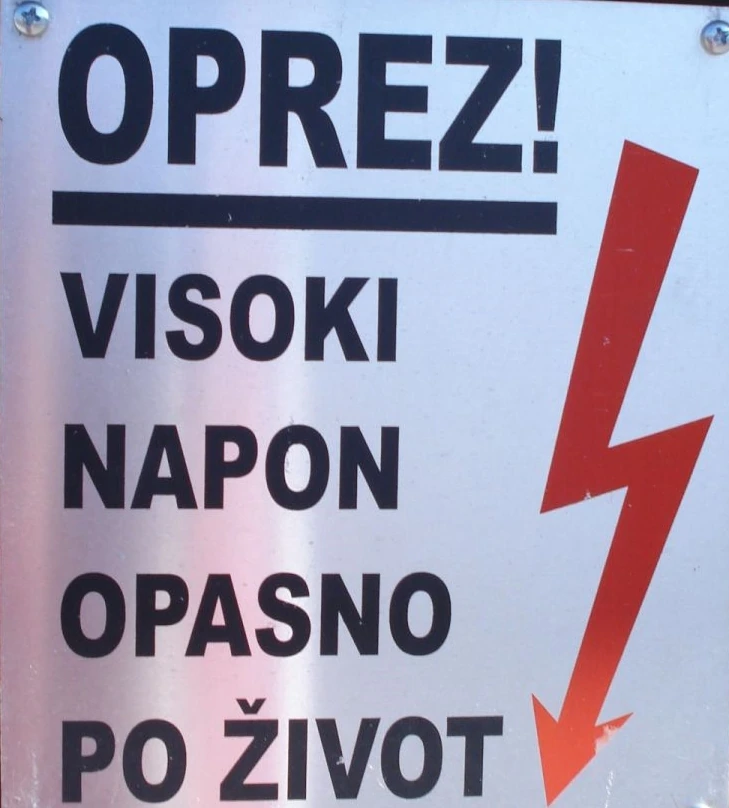
Croatian high-voltage warning sign; crop of an original photograph. Language identification follows the source description; not independently transcribed.
Saved in Babelbook · resized display copy. Select the image to open it independently of its source.
Mario Žamić · Source ↗CC BY-SA 3.0 ↗View the local visual field note
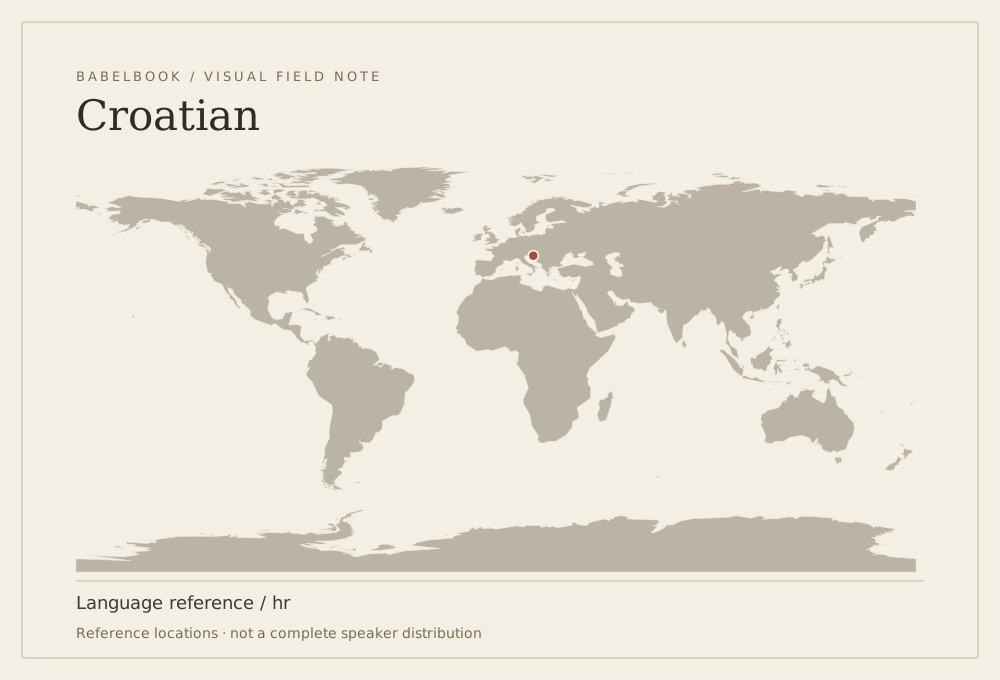
Representative reference points from Glottolog. Historical entries show reference locations, not current speakers. 1 point.
Reference & context ↗Babelbook · original editorial illustration · CC BY 4.0 · Glottolog locations; public-domain Natural Earth land
Source excerpts, selected, shortened and where noted editorially corrected from Croatian language by Wikipedia contributors. Retrieved 2026-10-05. CC BY-SA 4.0. These excerpts are not an independently verified scholarly history; missing accounts are identified above.
Read further in the source
Modern language and standardization
In the late medieval period up to the 17th century, the majority of semi-autonomous Croatia was ruled by two domestic dynasties of princes (banovi), the Zrinski and the Frankopan, which were linked by inter-marriage. Toward the 17th century, both of them attempted to unify Croatia both culturally and linguistically, writing in a mixture of all three principal dialects (Chakavian, Kajkavian and Shtokavian), and calling it "Croatian", "Dalmatian", or "Slavonian". Historically, several other names were used as synonyms for Croatian, in addition to Dalmatian and Slavonian, and these were Illyrian (ilirski) and Slavic (slovinski). It is still used now in parts of Istria, which became a crossroads of various mixtures of Chakavian with Ekavian, Ijekavian and Ikavian isoglosses. The most standardised form (Kajkavian–Ikavian) became the cultivated language of administration and intellectuals from the Istrian peninsula along the Croatian coast, across central Croatia up into the northern valleys of the Drava and the Mura. The cultural apex of this 17th century idiom is represented by the editions of "Adrianskoga mora sirena" ("The Siren of the Adriatic Sea") by Petar Zrinski and "Putni tovaruš" ("Traveling escort") by Katarina Zrinska. However, this first linguistic renaissance in Croatia was halted by the political execution of Petar Zrinski and Fran Krsto Frankopan by the Holy Roman Emperor Leopold I in Vienna in 1671. Subsequently, the Croatian elite in the 18th century gradually abandoned this combined Croatian standard.
Distinguishing features and differences between standards
Croatian is commonly characterized by the ijekavian pronunciation (see an explanation of yat reflexes), the sole use of the Latin alphabet, and a number of lexical differences in common words that set it apart from standard Serbian. Some differences are absolute, while some appear mainly in the frequency of use. However, as professor John F. Bailyn states, "an examination of all the major 'levels' of language shows that BCS is clearly a single language with a single grammatical system."
Official status
Standard Croatian is the official language of the Republic of Croatia and, along with Standard Bosnian and Standard Serbian, one of three official languages of Bosnia and Herzegovina. It is also official in the regions of Burgenland (Austria), Molise (Italy) and Vojvodina (Serbia). Additionally, it has co-official status alongside Romanian in the communes of Carașova and Lupac, Romania. In these localities, Croats or Krashovani make up the majority of the population, and education, signage and access to public administration and the justice system are provided in Croatian, alongside Romanian.
Language history
The Croatian Language Today, a lecture given by dr. Branko Franolić