Haitian Creole
Haitian Creole (Haitian Creole: kreyòl ayisyen, [kɣejɔl ajisjɛ̃]), or simply Creole (kreyòl), is a French-based creole language. It is spoken by over 13 million people worldwide, primarily Haitian citizens and the Haitian diaspora. It is one of the two official languages of Haiti (the other being French), where it is the native language of the vast majority of the population. It is also the most widely spoken creole language in the world. The three main dialects of Haitian Creole are the Northern, Central, and Southern dialects; the Northern dialect is predominantly spoken in Cap-Haïtien, the Central in Port-au-Prince, and the Southern in Les Cayes. The language emerged from contact between French settlers and enslaved Africans during the Atlantic slave trade in the French colony of Saint-Domingue (now Haiti) in the 17th and 18th centuries. Although its vocabulary largely derives from 17th- and 18th-century French, its grammar reflects a blend of West African languages (particularly Fongbe and Igbo), regional French dialects (such as Norman and Gallo), and internal creole innovations. It also has influences from Spanish, English, Portuguese and Taíno. It is not mutually intelligible with standard French. Some estimate that Haitians are the largest community in the world to speak a modern creole language; others estimate that more people speak Nigerian Pidgin. Haitian Creole's use in communities and schools has been contentious since at least the 19th century.
Translate in Haitian Creole ↗Haitian Creole (Haitian Creole: kreyòl ayisyen, [kɣejɔl ajisjɛ̃]), or simply Creole (kreyòl), is a French-based creole language. It is spoken by over 13 million people worldwide, primarily Haitian citizens and the Haitian diaspora. It is one of the two official languages of Haiti (the other being French), where it is the native language of the vast majority of the population. It is also the most widely spoken creole language in the world. The three main dialects of Haitian Creole are the Northern, Central, and Southern dialects; the Northern dialect is predominantly spoken in Cap-Haïtien, the Central in Port-au-Prince, and the Southern in Les Cayes. The language emerged from contact between French settlers and enslaved Africans during the Atlantic slave trade in the French colony of Saint-Domingue (now Haiti) in the 17th and 18th centuries. Although its vocabulary largely derives from 17th- and 18th-century French, its grammar reflects a blend of West African languages (particularly Fongbe and Igbo), regional French dialects (such as Norman and Gallo), and internal creole innovations. It also has influences from Spanish, English, Portuguese and Taíno. It is not mutually intelligible with standard French. Some estimate that Haitians are the largest community in the world to speak a modern creole language; others estimate that more people speak Nigerian Pidgin. Haitian Creole's use in communities and schools has been contentious since at least the 19th century. Some Haitians view French as inextricably linked to the legacy of colonialism and a language compelled on the population by conquerors, while Haitian Creole has been maligned by Francophones as an undereducated person's French.
North America
Present-day use
The captured source does not contain a separate current-use account.
Origins
The word creole comes from the Portuguese term crioulo, which means "a person raised in one's house" and from the Latin creare, which means "to create, make, bring forth, produce, beget". In the New World, the term originally referred to Europeans born and raised in overseas colonies (as opposed to the European-born peninsulares). To be "as rich as a Creole" at one time was a popular saying boasted in Paris during the colonial years of Haiti (then named Saint-Domingue), for being the most lucrative colony in the world. The noun Creole, soon began to refer to the language spoken there as well, as it still is today. Haitian Creole contains elements from both the Romance group of Indo-European languages through its superstrate, French, as well as significant influences from African languages. There are many theories on the formation of the Haitian Creole language. One theory estimates that Haitian Creole developed between 1680 and 1740. During the 17th century, French and Spanish colonizers produced tobacco, cotton, and sugar cane on the island. Throughout this period, the population was made of roughly equal numbers of engagés (white workers), gens de couleur libres (free people of colour) and slaves. The economy shifted more decisively into sugar production about 1690, just before the French colony of Saint-Domingue was officially recognized in 1697. The sugar crops needed a much larger labor force, which led to an increase in slave trafficking. In the 18th century an estimated 800,000 West Africans were enslaved and brought to Saint-Domingue. As the slave population increased, the proportion of French-speaking colonists decreased. Many African slaves in the colony had come from Niger-Congo-speaking territory, and particularly speakers of Kwa languages, such as Gbe from West Africa and the Central Tano languages, and Bantu languages from Central Africa.
Development
Haitian Creole developed in the 17th and 18th centuries in the colony of Saint-Domingue, in a setting that mixed speakers of various Niger–Congo languages with French colonists. In the early 1940s under President Élie Lescot, attempts were made to standardize the language. American linguistic expert Frank Laubach and Irish Methodist missionary H. Ormonde McConnell developed a standardized Haitian Creole orthography. Although some regarded the orthography highly, it was generally not well received. Its orthography was standardized in 1979. That same year Haitian Creole was elevated in status by the Act of 18 September 1979. The Institut Pédagogique National established an official orthography for Creole, and slight modifications were made over the next two decades. For example, the hyphen (-) is no longer used, nor is the apostrophe. The only accent mark retained is the grave accent in ⟨è⟩ and ⟨ò⟩. Even without government recognition, by the end of the 19th century, there were already literary texts written in Haitian Creole such as Oswald Durand's Choucoune and Georges Sylvain's Cric? Crac!. Félix Morisseau-Leroy was another influential author of Haitian Creole work. Since the 1980s, many educators, writers, and activists have written literature in Haitian Creole. In 2001, Open Gate: An Anthology of Haitian Creole Poetry was published. It was the first time a collection of Haitian Creole poetry was published in both Haitian Creole and English. On 28 October 2004, the Haitian daily Le Matin first published an entire edition in Haitian Creole in observance of the country's newly instated "Creole Day". Haitian Creole writers often use different literary strategies throughout their works, such as code-switching, to increase the audience's knowledge on the language. Literature in Haitian Creole is also used to educate the public on the dictatorial social and political forces in Haiti.
Writing
Louis-Philippe Dalembert (b. 1962), poet and novelist Frankétienne (1936–2025), poet, playwright, painter, musician, activist Ady Jean-Gardy (b. 1967), international press activist Josaphat-Robert Large (1942–2017), poet, novelist and art critic Félix Morisseau-Leroy (1912–1998), poet and playwright Elsie Suréna (b. 1956), writer and visual artist Lyonel Trouillot (b. 1956), poet and novelist Haitian Creole has a phonemic orthography with highly regular spelling, except for proper nouns and foreign words. According to the official standardized orthography, Haitian Creole is composed of the following 32 symbols: ⟨a⟩, ⟨an⟩, ⟨b⟩, ⟨ch⟩, ⟨d⟩, ⟨e⟩, ⟨è⟩, ⟨en⟩, ⟨f⟩, ⟨g⟩, ⟨h⟩, ⟨i⟩, ⟨j⟩, ⟨k⟩, ⟨l⟩, ⟨m⟩, ⟨n⟩, ⟨ng⟩, ⟨o⟩, ⟨ò⟩, ⟨on⟩, ⟨ou⟩, ⟨oun⟩, ⟨p⟩, ⟨r⟩, ⟨s⟩, ⟨t⟩, ⟨ui⟩, ⟨v⟩, ⟨w⟩, ⟨y⟩, and ⟨z⟩. The letters ⟨c⟩ and ⟨u⟩ are always associated with another letter (in the multigraphs ⟨ch⟩, ⟨ou⟩, ⟨oun⟩, and ⟨ui⟩). The Haitian Creole alphabet has no ⟨q⟩ or ⟨x⟩; when ⟨x⟩ is used in loanwords and proper nouns, it represents the sounds /ks/, /kz/, or /gz/. There are no silent letters in the Haitian Creole orthography. All sounds are always spelled the same, except when a vowel carries a grave accent ⟨`⟩ before ⟨n⟩, which makes it an oral vowel instead of a nasal vowel: ⟨en⟩ for /ɛ̃/ and ⟨èn⟩ for /ɛn/; ⟨on⟩ for /ɔ̃/ and ⟨òn⟩ for /ɔn/; and ⟨an⟩ for /ã/ and ⟨àn⟩ for /an/. When immediately followed by a vowel in a word, the digraphs denoting the nasal vowels (⟨an⟩, ⟨en⟩, ⟨on⟩, and sometimes ⟨oun⟩) are pronounced as an oral vowel followed by /n/. There is some ambiguity in the pronunciation of the high vowels of the letters ⟨i⟩ and ⟨ou⟩ when followed in spelling by ⟨n⟩. Common words such as moun ("person") and machin ("car") end with consonantal /n/, while very few words, mostly adopted from African languages, contain nasalized high vowels, as in oungan ("vodou priest"). The diphthong /ɥi/ is extremely rare, and maybe only exists in the common word uit (← French huit) "eight".
Beyond the typeface.
Signs, manuscripts, published pages and contextual photographs, with their place, period, source and reuse terms. Captions identify historical spellings, regional examples, community references and character imagery.
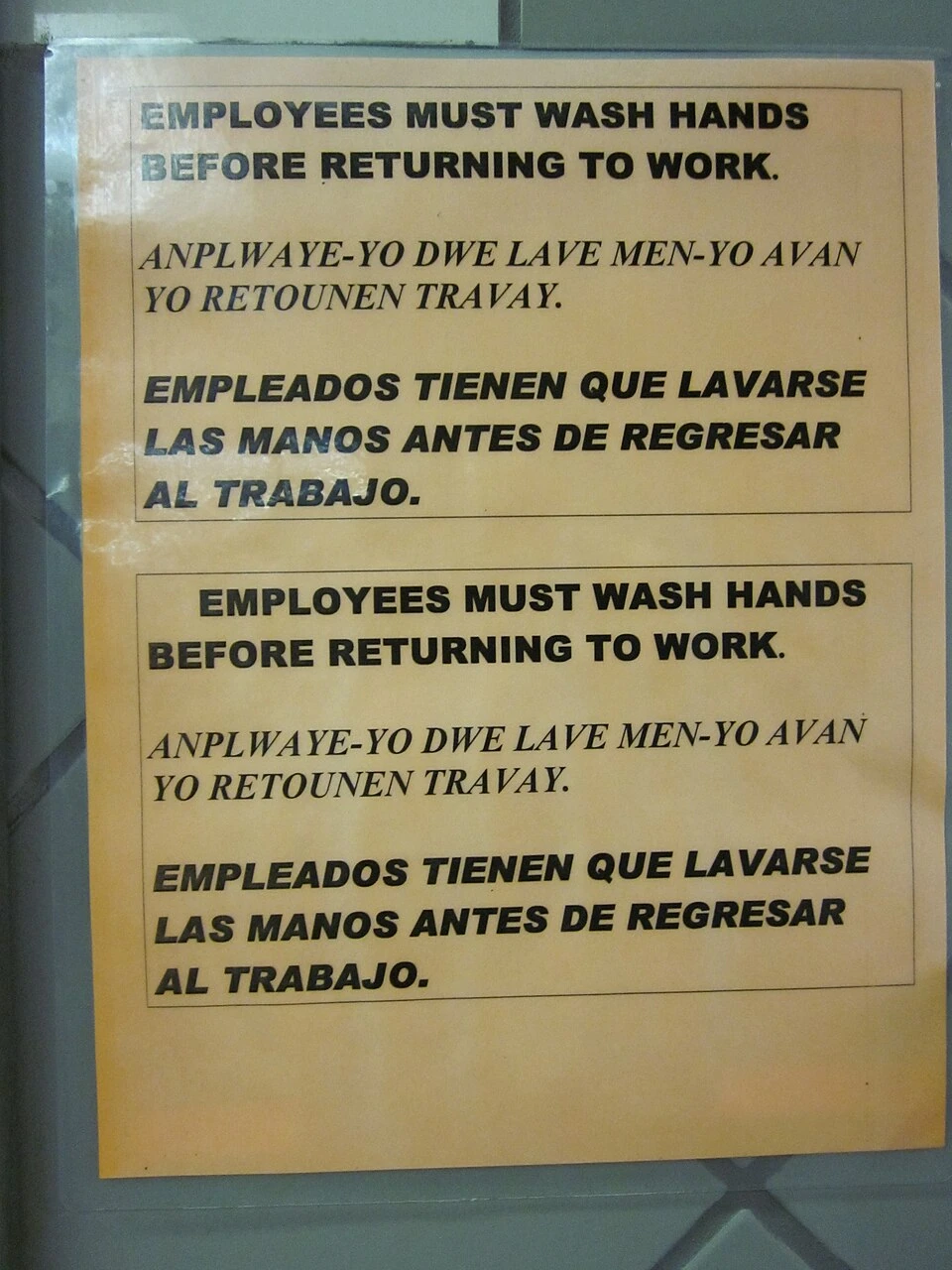
Public notice in Haitian Creole, English and Spanish in Miami Beach. Language identification follows Commons metadata; not independently transcribed.
Saved in Babelbook · resized display copy. Select the image to open it independently of its source.
Infrogmation of New Orleans · Source ↗CC BY 3.0 ↗View the local visual field note
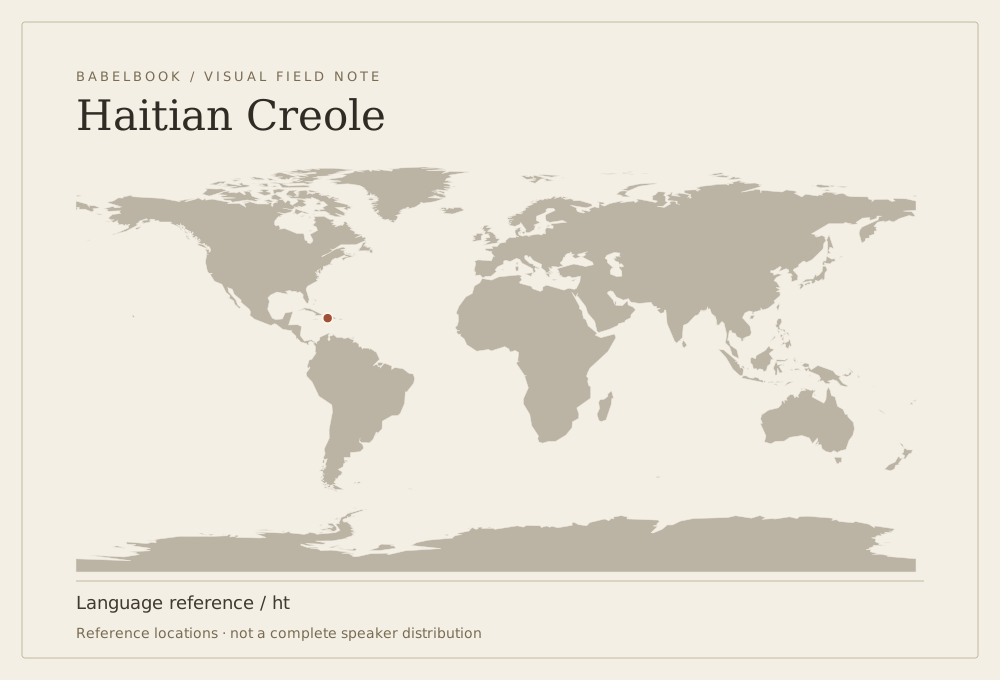
Representative reference points from Glottolog. Historical entries show reference locations, not current speakers. 1 point.
Reference & context ↗Babelbook · original editorial illustration · CC BY 4.0 · Glottolog locations; public-domain Natural Earth land
Source excerpts, selected, shortened and where noted editorially corrected from Haitian Creole by Wikipedia contributors. Retrieved 2026-10-05. CC BY-SA 4.0. These excerpts are not an independently verified scholarly history; missing accounts are identified above.
Read further in the source
Origins
Haitian Creole contains elements from both the Romance group of Indo-European languages through its superstrate, French, as well as significant influences from African languages. There are many theories on the formation of the Haitian Creole language. One theory estimates that Haitian Creole developed between 1680 and 1740. During the 17th century, French and Spanish colonizers produced tobacco, cotton, and sugar cane on the island. Throughout this period, the population was made of roughly equal numbers of engagés (white workers), gens de couleur libres (free people of colour) and slaves. The economy shifted more decisively into sugar production about 1690, just before the French colony of Saint-Domingue was officially recognized in 1697. The sugar crops needed a much larger labor force, which led to an increase in slave trafficking. In the 18th century an estimated 800,000 West Africans were enslaved and brought to Saint-Domingue. As the slave population increased, the proportion of French-speaking colonists decreased. Many African slaves in the colony had come from Niger-Congo-speaking territory, and particularly speakers of Kwa languages, such as Gbe from West Africa and the Central Tano languages, and Bantu languages from Central Africa. Singler suggests that the number of Bantu speakers decreased while the number of Kwa speakers increased, with Gbe being the most dominant group. The first fifty years of Saint‑Domingue's sugar boom coincided with emergent Gbe predominance in the French Caribbean. In the interval during which Singler hypothesizes the language evolved, the Gbe population was around 50% of the kidnapped enslaved population. Classical French (français classique) and langues d'oïl (Norman, Poitevin and Saintongeais dialects, Gallo and Picard) were spoken during the 17th and 18th centuries in Saint‑Domingue, as well as in New France and French West Africa. Slaves lacked a common means of communication and as a result would try to learn French to communicate with one another, though most were denied a formal education. With the constant trafficking and enslavement of Africans, the language became increasingly distinct from French. The language was also picked up by other members of the community and became used by the majority of those born in what is now Haiti.
Notable Haitian Creole–language writers
Louis-Philippe Dalembert (b. 1962), poet and novelist Frankétienne (1936–2025), poet, playwright, painter, musician, activist Ady Jean-Gardy (b. 1967), international press activist Josaphat-Robert Large (1942–2017), poet, novelist and art critic Félix Morisseau-Leroy (1912–1998), poet and playwright Elsie Suréna (b. 1956), writer and visual artist Lyonel Trouillot (b. 1956), poet and novelist
Orthography
Haitian Creole has a phonemic orthography with highly regular spelling, except for proper nouns and foreign words. According to the official standardized orthography, Haitian Creole is composed of the following 32 symbols: ⟨a⟩, ⟨an⟩, ⟨b⟩, ⟨ch⟩, ⟨d⟩, ⟨e⟩, ⟨è⟩, ⟨en⟩, ⟨f⟩, ⟨g⟩, ⟨h⟩, ⟨i⟩, ⟨j⟩, ⟨k⟩, ⟨l⟩, ⟨m⟩, ⟨n⟩, ⟨ng⟩, ⟨o⟩, ⟨ò⟩, ⟨on⟩, ⟨ou⟩, ⟨oun⟩, ⟨p⟩, ⟨r⟩, ⟨s⟩, ⟨t⟩, ⟨ui⟩, ⟨v⟩, ⟨w⟩, ⟨y⟩, and ⟨z⟩. The letters ⟨c⟩ and ⟨u⟩ are always associated with another letter (in the multigraphs ⟨ch⟩, ⟨ou⟩, ⟨oun⟩, and ⟨ui⟩). The Haitian Creole alphabet has no ⟨q⟩ or ⟨x⟩; when ⟨x⟩ is used in loanwords and proper nouns, it represents the sounds /ks/, /kz/, or /gz/.
There are no silent letters in the Haitian Creole orthography. All sounds are always spelled the same, except when a vowel carries a grave accent ⟨`⟩ before ⟨n⟩, which makes it an oral vowel instead of a nasal vowel: ⟨en⟩ for /ɛ̃/ and ⟨èn⟩ for /ɛn/; ⟨on⟩ for /ɔ̃/ and ⟨òn⟩ for /ɔn/; and ⟨an⟩ for /ã/ and ⟨àn⟩ for /an/. When immediately followed by a vowel in a word, the digraphs denoting the nasal vowels (⟨an⟩, ⟨en⟩, ⟨on⟩, and sometimes ⟨oun⟩) are pronounced as an oral vowel followed by /n/. There is some ambiguity in the pronunciation of the high vowels of the letters ⟨i⟩ and ⟨ou⟩ when followed in spelling by ⟨n⟩. Common words such as moun ("person") and machin ("car") end with consonantal /n/, while very few words, mostly adopted from African languages, contain nasalized high vowels, as in oungan ("vodou priest"). The diphthong /ɥi/ is extremely rare, and maybe only exists in the common word uit (← French huit) "eight". Most other instances of this diphthong have been replaced by /wi/, e.g. fwi (← fruit) "fruit", nwit (← nuit) "night".
Haitian orthography debate
The first technical orthography for Haitian Creole was developed in 1940 by H. Ormonde McConnell and Primrose McConnell, Irish Methodist missionaries. It was later revised with the help of Frank Laubach, resulting in the creation of what is known as the McConnell–Laubach orthography. The McConnell–Laubach orthography received substantial criticism from members of the Haitian elite. Haitian scholar Charles Pressoir critiqued the McConnell–Laubach orthography for its lack of codified front rounded vowels, which are typically used only by francophone elites. Another criticism was of the broad use of the letters ⟨k⟩, ⟨w⟩, and ⟨y⟩, which Pressoir argued looked "too American". This criticism of the "American look" of the orthography was shared by many educated Haitians, who also criticized its association with Protestantism. The last of Pressoir's criticisms was that "the use of the circumflex to mark nasalized vowels" treated nasal sounds differently from the way they are represented in French, which he feared would inhibit the learning of French. The creation of the orthography was essentially an articulation of the language ideologies of those involved and brought out political and social tensions between competing groups. A large portion of this tension lay in the ideology held by many that the French language is superior, which led to resentment of the language by some Haitians and an admiration for it from others. This orthographical controversy boiled down to an attempt to unify a conception of Haitian national identity. Where ⟨k⟩ and ⟨w⟩ seemed too Anglo-Saxon and American imperialistic, ⟨c⟩ and ⟨ou⟩ were symbolic of French colonialism.
French-based orthography
When Haiti was still a colony of France, edicts by the French government were often written in a French-lexicon creole and read aloud to the slave population. The first written text of Haitian Creole was composed in the French-lexicon in a poem called Lisette quitté la plaine in 1757 by Duvivier de la Mahautière, a white Creole planter. Before Haitian Creole orthography was standardized in the late 20th century, spelling varied, but was based on subjecting spoken Haitian Creole to written French, a language whose spelling has a complicated relation to pronunciation. Unlike the phonetic orthography, French orthography of Haitian Creole is not standardized and varies according to the writer; some use exact French spelling, others adjust the spelling of certain words to represent pronunciation of the cognate in Haitian Creole, removing the silent letters. For example:Li ale travay nan maten (lit. "He goes to work in the morning") could be transcribed as:
Li ale travay nan maten, Lui aller travail nans matin, or Li aller travail nans matin.