Hungarian
Hungarian, or Magyar (Magyar nyelv, pronounced [ˈmɒɟɒr ˈɲɛlv] ), is a Ugric language of the Uralic language family spoken in Hungary and parts of several neighboring countries. It is the official language of Hungary and one of the 24 official languages of the European Union. Outside Hungary, it is also spoken by Hungarian communities in southern Slovakia, western Ukraine (Transcarpathia), central and western Romania (Transylvania), northern Serbia (Vojvodina), northern Croatia, northeastern Slovenia (Prekmurje), and eastern Austria (Burgenland). It is also spoken by Hungarian diaspora communities worldwide, especially in North America (particularly the United States and Canada) and Israel. With 14 million speakers, it is the Uralic family's most widely spoken language.
Translate in Hungarian ↗Source: National censuses, Ethnologue Hungarian has about 13 million native speakers, of whom more than 9.8 million live in Hungary. According to the 2011 Hungarian census, 9,896,333 people (99.6% of the total population) speak Hungarian, of whom 9,827,875 people (98.9%) speak it as a first language, while 68,458 people (0.7%) speak it as a second language. About 2.2 million speakers live in other areas that were part of the Kingdom of Hungary before the Treaty of Trianon (1920). Of these, the largest group lives in Transylvania, the western half of present-day Romania, where there are approximately 1.25 million Hungarians. There are large Hungarian communities also in Slovakia, Serbia and Ukraine, and Hungarians can also be found in Austria, Croatia, and Slovenia, as well as about a million additional people scattered in other parts of the world. For example, there are more than one hundred thousand Hungarian speakers in the Hungarian American community and 1.5 million with Hungarian ancestry in the United States. Hungarian is the official language of Hungary, and thus an official language of the European Union. Hungarian is also one of the official languages of Serbian province of Vojvodina and an official language of three municipalities in Slovenia: Hodoš, Dobrovnik and Lendava, along with Slovene. Hungarian is officially recognized as a minority or regional language in Austria, Croatia, Romania, Zakarpattia in Ukraine, and Slovakia. In Romania it is a recognized minority language used at local level in communes, towns and municipalities with an ethnic Hungarian population of over 20%.
Europe
Present-day use
In 1533, Kraków printer Benedek Komjáti published Letters of St. Paul in Hungarian (modern orthography: A Szent Pál levelei magyar nyelven), the first Hungarian-language book set in movable type. By the 17th century, the language already closely resembled its present-day form, although two of the past tenses remained in use. German, Italian and French loans also began to appear. Further Turkish words were borrowed during the period of Ottoman rule (1541 to 1699). In the 19th century, a group of writers, most notably Ferenc Kazinczy, spearheaded a process of nyelvújítás (language revitalization). Some words were shortened (győzedelem > győzelem, 'victory' or 'triumph'); a number of dialectal words spread nationally (e.g., cselleng 'dawdle'); extinct words were reintroduced (dísz, 'décor'); a wide range of expressions were coined using the various derivative suffixes; and some other, less frequently used methods of expanding the language were utilized. This movement produced more than ten thousand words, most of which are used actively today. The 19th and 20th centuries saw further standardization of the language, and differences between mutually comprehensible dialects gradually diminished. In 1920, Hungary signed the Treaty of Trianon, losing 71 percent of its territory and one-third of the ethnic Hungarian population along with it. Today, the language holds official status nationally in Hungary and regionally in Romania, Slovakia, Serbia, Austria and Slovenia. In 2014 the proportion of Transylvanian students studying Hungarian exceeded the proportion of Hungarian students, which shows that the effects of Romanianization are slowly getting reversed and regaining popularity. The Dictate of Trianon resulted in a high proportion of Hungarians in the surrounding 7 countries, so it is widely spoken or understood. Although host countries are not always considerate of Hungarian language users, communities are strong.
Origins
Today, the consensus among linguists is that Hungarian is a member of the Uralic family of languages. The Uralic language family is among the most firmly established and best-studied language families in the world. Nevertheless, a number of alternative views have been proposed which do not have any currency among present-day linguists. The classification of Hungarian as a Uralic/Finno-Ugric rather than a Turkic language continued to be a matter of impassioned political controversy throughout the 18th and into the 19th centuries. During the latter half of the 19th century, a competing hypothesis proposed a Turkic affinity of Hungarian, or, alternatively, that both the Uralic and the Turkic families formed part of a superfamily of Ural–Altaic languages. Following an academic debate known as Az ugor-török háború ("the Ugric-Turkic war"), the Finno-Ugric hypothesis was concluded the sounder of the two, mainly based on work by the German linguist Josef Budenz. Hungarians did, in fact, absorb some Turkic influences during several centuries of cohabitation. The influence on Hungarians was mainly from the Turkic Oghur speakers such as Sabirs, Bulgars of Atil, Kabars and Khazars. The Oghur tribes are often connected with the Hungarians whose exoethnonym is usually derived from Onogurs (> (H)ungars), a Turkic tribal confederation. The similarity between customs of Hungarians and the Chuvash people, the only surviving member of the Oghur tribes, is visible. For example, the Hungarians appear to have learned animal husbandry techniques from the Oghur speaking Chuvash people (or historically Suvar people), as a high proportion of words specific to agriculture and livestock are of Chuvash origin. A strong Chuvash influence was also apparent in Hungarian burial customs.
Development
The captured article does not contain a distinct historical account. No chronology has been invented.
Writing
The Hungarian language was originally written in right-to-left Old Hungarian runes, superficially similar in appearance to the better-known futhark runes but unrelated. After Stephen I of Hungary established the Kingdom of Hungary in the year 1000, the old system was gradually discarded in favour of the Latin alphabet and left-to-right order. Although now not used at all in everyday life, the old script is still known and practised by some enthusiasts. Modern Hungarian is written using an expanded Latin alphabet and has a phonemic orthography, i.e. pronunciation can generally be predicted from the written language. In addition to the standard letters of the Latin alphabet, Hungarian uses several modified Latin characters to represent the additional vowel sounds of the language. These include letters with acute accents (á, é, í, ó, ú) to represent long vowels, and umlauts (ö and ü) and their long counterparts ő and ű to represent front vowels. Sometimes (usually as a result of a technical glitch on a computer) ⟨ô⟩ or ⟨õ⟩ is used for ⟨ő⟩, and ⟨û⟩ for ⟨ű⟩. This is often due to the limitations of the Latin-1 / ISO-8859-1 code page. These letters are not part of the Hungarian language and are considered misprints. Hungarian can be properly represented with the Latin-2 / ISO-8859-2 code page, but this code page is not always available. (Hungarian is the only language using both ⟨ő⟩ and ⟨ű⟩.) Unicode includes them, and so they can be used on the Internet. Additionally, the digraphs (letter pairs) ⟨ny⟩, ⟨ty⟩, and ⟨gy⟩ are used to represent the palatal consonants /ɲ/, /c/, and /ɟ/ (roughly analogous to the "d+y" sounds in British "duke" or American "would you")—produced using a similar mechanism as the letter "d" when pronounced with the tongue pointing to the palate. Hungarian uses ⟨s⟩ for /ʃ/ and ⟨sz⟩ for /s/, which is the reverse of Polish usage. The letter ⟨zs⟩ is /ʒ/ and ⟨cs⟩ is /t͡ʃ/. These digraphs are considered single letters in the alphabet.
Beyond the typeface.
Signs, manuscripts, published pages and contextual photographs, with their place, period, source and reuse terms. Captions identify historical spellings, regional examples, community references and character imagery.
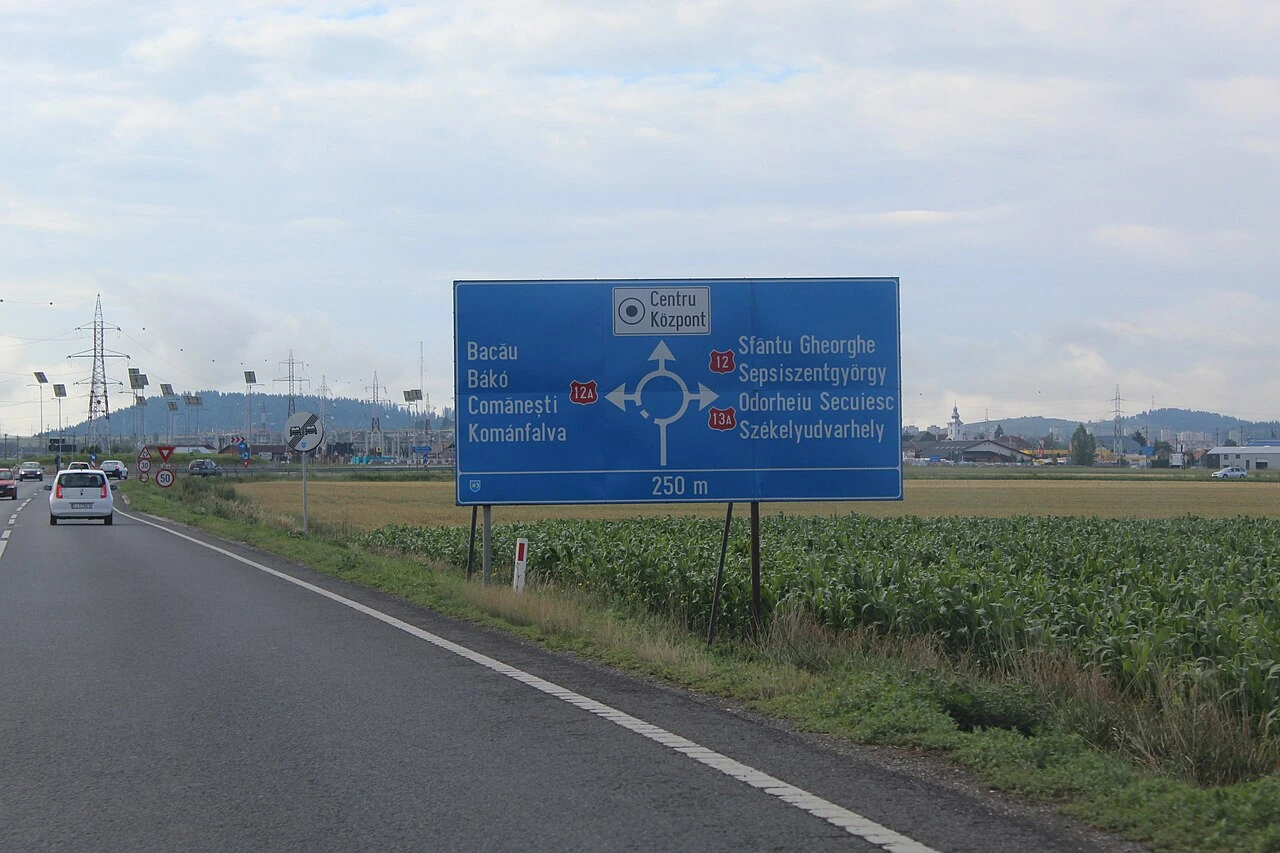
Romanian and Hungarian road sign north of Miercurea Ciuc, Romania. Language identification follows the source description; not independently transcribed.
Saved in Babelbook · resized display copy. Select the image to open it independently of its source.
TrainSimFan · Source ↗CC BY-SA 4.0 ↗View the local visual field note
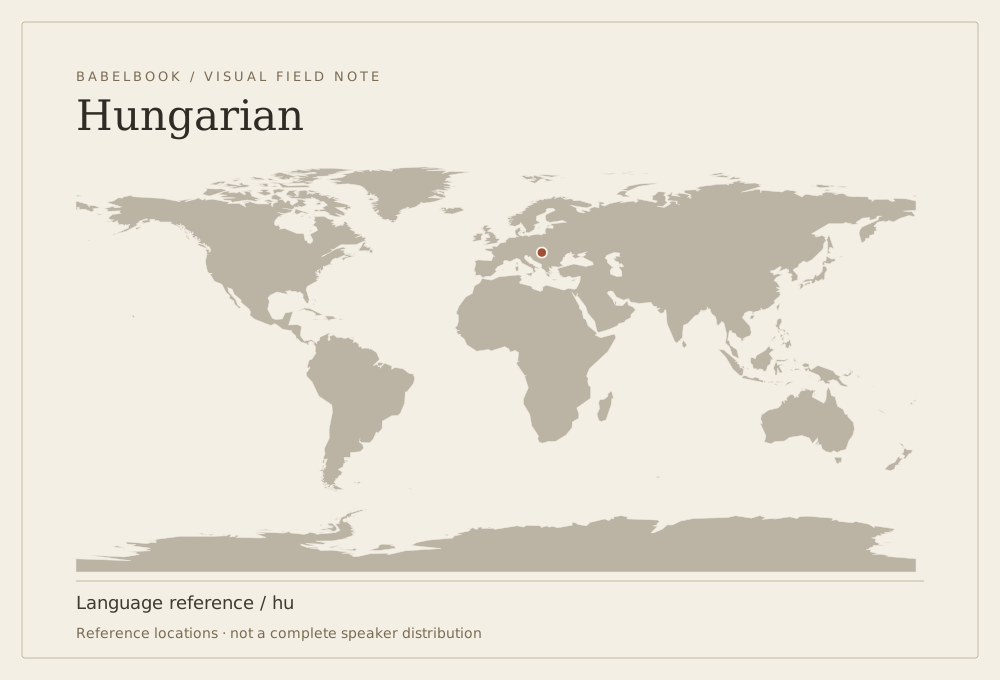
Representative reference points from Glottolog. Historical entries show reference locations, not current speakers. 1 point.
Reference & context ↗Babelbook · original editorial illustration · CC BY 4.0 · Glottolog locations; public-domain Natural Earth land
Source excerpts, selected, shortened and where noted editorially corrected from Hungarian language by Wikipedia contributors. Retrieved 2026-10-05. CC BY-SA 4.0. These excerpts are not an independently verified scholarly history; missing accounts are identified above.
Read further in the source
Historical controversy over origins
Today, the consensus among linguists is that Hungarian is a member of the Uralic family of languages. The Uralic language family is among the most firmly established and best-studied language families in the world. Nevertheless, a number of alternative views have been proposed which do not have any currency among present-day linguists. The classification of Hungarian as a Uralic/Finno-Ugric rather than a Turkic language continued to be a matter of impassioned political controversy throughout the 18th and into the 19th centuries. During the latter half of the 19th century, a competing hypothesis proposed a Turkic affinity of Hungarian, or, alternatively, that both the Uralic and the Turkic families formed part of a superfamily of Ural–Altaic languages. Following an academic debate known as Az ugor-török háború ("the Ugric-Turkic war"), the Finno-Ugric hypothesis was concluded the sounder of the two, mainly based on work by the German linguist Josef Budenz. Hungarians did, in fact, absorb some Turkic influences during several centuries of cohabitation. The influence on Hungarians was mainly from the Turkic Oghur speakers such as Sabirs, Bulgars of Atil, Kabars and Khazars. The Oghur tribes are often connected with the Hungarians whose exoethnonym is usually derived from Onogurs (> (H)ungars), a Turkic tribal confederation. The similarity between customs of Hungarians and the Chuvash people, the only surviving member of the Oghur tribes, is visible. For example, the Hungarians appear to have learned animal husbandry techniques from the Oghur speaking Chuvash people (or historically Suvar people), as a high proportion of words specific to agriculture and livestock are of Chuvash origin. A strong Chuvash influence was also apparent in Hungarian burial customs.
Geographic distribution
Source: National censuses, Ethnologue Hungarian has about 13 million native speakers, of whom more than 9.8 million live in Hungary. According to the 2011 Hungarian census, 9,896,333 people (99.6% of the total population) speak Hungarian, of whom 9,827,875 people (98.9%) speak it as a first language, while 68,458 people (0.7%) speak it as a second language. About 2.2 million speakers live in other areas that were part of the Kingdom of Hungary before the Treaty of Trianon (1920). Of these, the largest group lives in Transylvania, the western half of present-day Romania, where there are approximately 1.25 million Hungarians. There are large Hungarian communities also in Slovakia, Serbia and Ukraine, and Hungarians can also be found in Austria, Croatia, and Slovenia, as well as about a million additional people scattered in other parts of the world. For example, there are more than one hundred thousand Hungarian speakers in the Hungarian American community and 1.5 million with Hungarian ancestry in the United States.
Official status
Hungarian is the official language of Hungary, and thus an official language of the European Union. Hungarian is also one of the official languages of Serbian province of Vojvodina and an official language of three municipalities in Slovenia: Hodoš, Dobrovnik and Lendava, along with Slovene. Hungarian is officially recognized as a minority or regional language in Austria, Croatia, Romania, Zakarpattia in Ukraine, and Slovakia. In Romania it is a recognized minority language used at local level in communes, towns and municipalities with an ethnic Hungarian population of over 20%.
Dialects
The dialects of Hungarian identified by Ethnologue are: Alföld, West Danube, Danube-Tisza, King's Pass Hungarian, Northeast Hungarian, Northwest Hungarian, Székely and West Hungarian. These dialects are, for the most part, mutually intelligible. The Hungarian Csángó dialect, which is mentioned but not listed separately by Ethnologue, is spoken primarily in Bacău County in eastern Romania. The Csángó Hungarian group has been largely isolated from other Hungarian people, and therefore preserved features that closely resemble earlier forms of Hungarian.
Writing system
The Hungarian language was originally written in right-to-left Old Hungarian runes, superficially similar in appearance to the better-known futhark runes but unrelated. After Stephen I of Hungary established the Kingdom of Hungary in the year 1000, the old system was gradually discarded in favour of the Latin alphabet and left-to-right order. Although now not used at all in everyday life, the old script is still known and practised by some enthusiasts. Modern Hungarian is written using an expanded Latin alphabet and has a phonemic orthography, i.e. pronunciation can generally be predicted from the written language. In addition to the standard letters of the Latin alphabet, Hungarian uses several modified Latin characters to represent the additional vowel sounds of the language. These include letters with acute accents (á, é, í, ó, ú) to represent long vowels, and umlauts (ö and ü) and their long counterparts ő and ű to represent front vowels. Sometimes (usually as a result of a technical glitch on a computer) ⟨ô⟩ or ⟨õ⟩ is used for ⟨ő⟩, and ⟨û⟩ for ⟨ű⟩. This is often due to the limitations of the Latin-1 / ISO-8859-1 code page. These letters are not part of the Hungarian language and are considered misprints. Hungarian can be properly represented with the Latin-2 / ISO-8859-2 code page, but this code page is not always available. (Hungarian is the only language using both ⟨ő⟩ and ⟨ű⟩.) Unicode includes them, and so they can be used on the Internet. Additionally, the digraphs (letter pairs) ⟨ny⟩, ⟨ty⟩, and ⟨gy⟩ are used to represent the palatal consonants /ɲ/, /c/, and /ɟ/ (roughly analogous to the "d+y" sounds in British "duke" or American "would you")—produced using a similar mechanism as the letter "d" when pronounced with the tongue pointing to the palate. Hungarian uses ⟨s⟩ for /ʃ/ and ⟨sz⟩ for /s/, which is the reverse of Polish usage. The letter ⟨zs⟩ is /ʒ/ and ⟨cs⟩ is /t͡ʃ/. These digraphs are considered single letters in the alphabet. The letter ⟨ly⟩ is also a "single letter digraph", but is pronounced like /j/ (English ⟨y⟩) and appears mostly in old words. The letters ⟨dz⟩ and ⟨dzs⟩ /d͡ʒ/ are exotic remnants and are hard to find even in longer texts. Some examples still in common use are madzag ("string"), edzeni ("to train (athletically)") and dzsungel ("jungle"). Sometimes additional information is required for partitioning words with digraphs: házszám ("street number") = ház ("house") + szám ("number"), not an unintelligible házs + zám. Hungarian distinguishes between long and short vowels, with long vowels written with acutes. It also distinguishes between long and short consonants, with long consonants being doubled. For example, lenni ("to be"), hozzászólás ("comment"). The digraphs, when pronounced as long consonants, are written as trigraphs: ⟨sz⟩ + ⟨sz⟩ = ⟨ssz⟩, e.g. művésszel ("with an artist"). But when a word is hyphenated at such a doubled digraph, the digraph is written out in full both before and after the hyphen. For example, ("with a bus"):
... busz- szal... When the first lexeme of a compound ends in a digraph and the second lexeme starts with the same digraph, both digraphs are written out: jegy + gyűrű = jegygyűrű ("engagement/wedding ring", jegy means "sign", "mark". The term jegyben lenni/járni means "to be engaged"; gyűrű means "ring"). Almost all trigraphs found in Hungarian text are the result of doubled digraphs, but there are a few exceptions: tizennyolc ("eighteen") is a concatenation of tizen + nyolc. Hungarian has minimal pairs of single vs. double consonants, for example tol ("push") vs. toll ("feather" or "pen"). While to English speakers they may seem unusual at first, once the new orthography and pronunciation are learned, written Hungarian is almost completely phonemic (except for etymological spellings and "ly, j" representing /j/).