Armenian
Armenian (endonym: հայերեն, hayeren, pronounced [hɑjɛˈɾɛn] ) is the sole member of an independent branch in the Indo-European language family. It is the native language of the Armenian people and the official language of Armenia. Historically spoken in the Armenian highlands, today Armenian is also widely spoken throughout the Armenian diaspora. Armenian is written in its own writing system, the Armenian alphabet, introduced in 405 AD by Mesrop Mashtots. The estimated number of Armenian speakers worldwide is between five and seven million.
Translate in Armenian ↗In addition to Armenia and Turkey, where it is indigenous, Armenian is spoken among the diaspora. According to Ethnologue, globally there are 1.6 million Western Armenian speakers and 3.7 million Eastern Armenian speakers, totalling 5.3 million Armenian speakers. In Georgia, Armenian speakers are concentrated in Ninotsminda and Akhalkalaki districts where they represent over 90% of the population. The short-lived First Republic of Armenia declared Armenian its official language. Eastern Armenian was then dominating in institutions and among the population. When Armenia was incorporated into the USSR, the Armenian Soviet Socialist Republic made Eastern Armenian the language of the courts, government institutions and schools. Armenia was also russified. After regaining independence Armenia upholds the official status of the Armenian language. Eastern Armenian is the official variant used, making it the prestige variety while other variants have been excluded from national institutions. Indeed, Western Armenian is perceived by some as a mere dialect. Armenian was also official in the Republic of Artsakh. It is recognized as an official language of the Eurasian Economic Union although Russian is the working language. Armenian (without reference to a specific variety) is officially recognized as a minority language in Cyprus, Hungary, Iraq, Poland, and Romania. It is recognized as a minority language and protected in Turkey by the 1923 Treaty of Lausanne. Western Armenian is the main language of the Armenian diaspora, and is the medium of instruction in the majority of Armenian-language schools outside Armenia. In particular, although Armenian has no legal status in Georgia, as of 2010 Armenian was the main language of instruction in 144 state-funded schools in the Samtskhe-Javakheti region. The curriculum in Lebanon allows Armenian schools to teach Armenian as a basic language.
Europe
Present-day use
The short-lived First Republic of Armenia declared Armenian its official language. Eastern Armenian was then dominating in institutions and among the population. When Armenia was incorporated into the USSR, the Armenian Soviet Socialist Republic made Eastern Armenian the language of the courts, government institutions and schools. Armenia was also russified. After regaining independence Armenia upholds the official status of the Armenian language. Eastern Armenian is the official variant used, making it the prestige variety while other variants have been excluded from national institutions. Indeed, Western Armenian is perceived by some as a mere dialect. Armenian was also official in the Republic of Artsakh. It is recognized as an official language of the Eurasian Economic Union although Russian is the working language. Armenian (without reference to a specific variety) is officially recognized as a minority language in Cyprus, Hungary, Iraq, Poland, and Romania. It is recognized as a minority language and protected in Turkey by the 1923 Treaty of Lausanne. Western Armenian is the main language of the Armenian diaspora, and is the medium of instruction in the majority of Armenian-language schools outside Armenia. In particular, although Armenian has no legal status in Georgia, as of 2010 Armenian was the main language of instruction in 144 state-funded schools in the Samtskhe-Javakheti region. The curriculum in Lebanon allows Armenian schools to teach Armenian as a basic language. In California, home to a large Armenian American community, various state government agencies provide Armenian translations of their documents, including the California Department of Social Services, California Department of Motor Vehicles, and California superior courts. In the city of Glendale, there are some street signs in Armenian. In Lebanon, Syria and Iran, Armenian communities were given greater autonomy than Assyrian, Kurdish, and other communities.
Origins
Armenian is an independent branch of the Indo-European languages. It is of interest to linguists because of its distinctive phonological changes within the Indo-European family. Armenian exhibits more satemization than centumization, although it is not classified as belonging to either of these subgroups. Some linguists have proposed that Armenian, Greek (and Phrygian), Albanian, and the Indo-Iranian languages were dialectally close to one another. Within this hypothetical dialect continuum, Proto-Armenian has been situated between Proto-Greek, traditionally classified as a centum language, and Proto-Indo-Iranian, traditionally classified as a satem language. The relationship between Armenian and Greek has been the subject of particular attention. Armenian and Greek share phonological, morphological, and lexical features, although scholars differ over whether these similarities reflect a common Graeco-Armenian subgroup, prolonged contact, or a combination of shared inheritance and areal influence. Using computational methods adapted from evolutionary biology, Donald Ringe and Tandy Warnow proposed a phylogenetic model in which Pre-Armenian and Pre-Greek formed a closely related subgroup after 2500 BC. David W. Anthony has likewise suggested that Pre-Armenian may have begun to diverge by approximately 2800 BC. Recent archaeogenetic research has contributed to discussions of Armenian prehistory. Steppe-related ancestry appeared in the South Caucasus during the Middle Bronze Age, coinciding with the emergence of the Trialeti-Vanadzor culture, and has been linked to a western Yamnaya-related source also found in contemporaneous Aegean populations. Several scholars have associated the Trialeti-Vanadzor culture with Indo-European populations, and some recent studies have proposed it as an early Proto-Armenian cultural horizon.
Development
Classical Armenian (Arm: grabar), attested from the 5th century to the 19th century as the literary standard (up to the 11th century also as a spoken language with different varieties), was partially superseded by Middle Armenian, attested from the 12th century to the 18th century. Specialized literature prefers "Old Armenian" for grabar as a whole, and designates as "Classical" the language used in the 5th century literature, "Post-Classical" from the late 5th to 8th centuries, and "Late Grabar" that of the period covering the 8th to 11th centuries. Later, it was used mainly in religious and specialized literature, with the exception of a revival during the early modern period, when attempts were made to establish it as the language of a literary renaissance, with neoclassical inclinations, through the creation and dissemination of literature in varied genres, especially by the Mekhitarists. The first Armenian periodical, Azdarar, was published in grabar in 1794. The classical form borrowed numerous words from Middle Iranian languages, primarily Parthian, and contains smaller inventories of loanwords from Greek, Syriac, Aramaic, Arabic, Mongol, Persian, and indigenous languages such as Urartian. An effort to modernize the language in Bagratid Armenia and the Armenian Kingdom of Cilicia (11–14th centuries) resulted in the addition of two more characters to the alphabet ("օ" and "ֆ"), bringing the total number to 38. The Book of Lamentations by Gregory of Narek (951–1003) is an example of the development of a literature and writing style of Old Armenian by the 10th century. In addition to elevating the literary style and vocabulary of the Armenian language by adding well above a thousand new words, through his other hymns and poems Gregory paved the way for his successors to include secular themes and vernacular language in their writings. The thematic shift from mainly religious texts to writings with secular outlooks further enhanced and enriched the vocabulary.
Writing
The Armenian alphabet (Armenian: Հայոց գրեր, romanized: Hayots grer or Armenian: Հայոց այբուբեն, romanized: Hayots aybuben) is a graphically unique alphabetical writing system that is used to write the Armenian language. It was introduced around 405 AD by Mesrop Mashtots, an Armenian linguist and ecclesiastical leader, and originally contained 36 letters. Two more letters, օ (ō) and ֆ (f), were added in the Middle Ages. During the 1920s orthography reform in Soviet Armenia, a new letter և (capital ԵՎ) was added, which was a ligature before ե+ւ, whereas the letter Ւ ւ was discarded and reintroduced as part of a new letter ՈՒ ու (which was a digraph before). This alphabet and associated orthography is used by most Armenian speakers of Armenia and the countries of the former Soviet Union. Neither the alphabet nor the orthography has been adopted by Diaspora Armenians, including Eastern Armenian speakers of Iran and all Western Armenian speakers, who keep using the traditional alphabet and spelling.
Beyond the typeface.
Signs, manuscripts, published pages and contextual photographs, with their place, period, source and reuse terms. Captions identify historical spellings, regional examples, community references and character imagery.
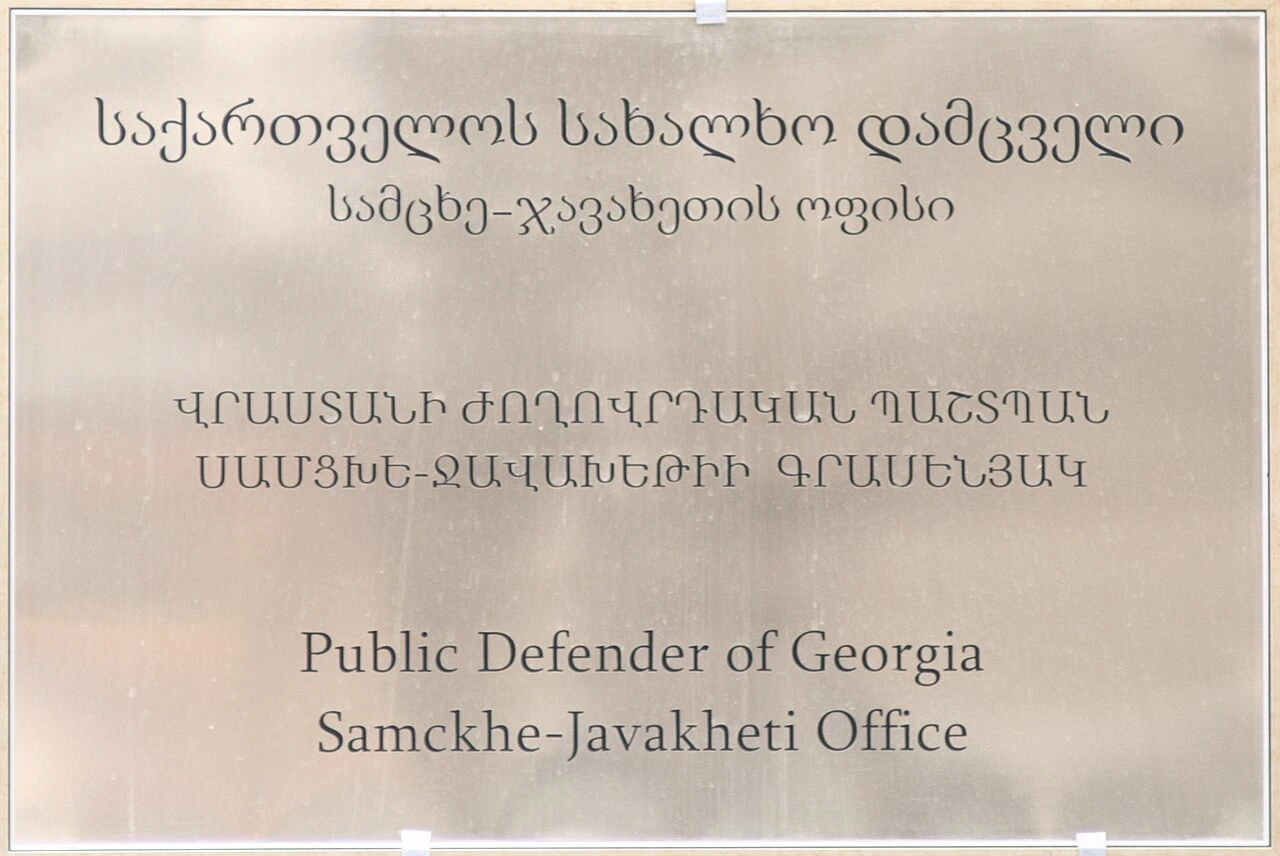
Armenian text on an office sign for the Public Defender of Georgia, alongside Georgian and English. Source-identified language; displayed without additional cropping.
Saved in Babelbook · resized display copy. Select the image to open it independently of its source.
Jan.CIVICS · Source ↗CC BY-SA 3.0 ↗View the local visual field note
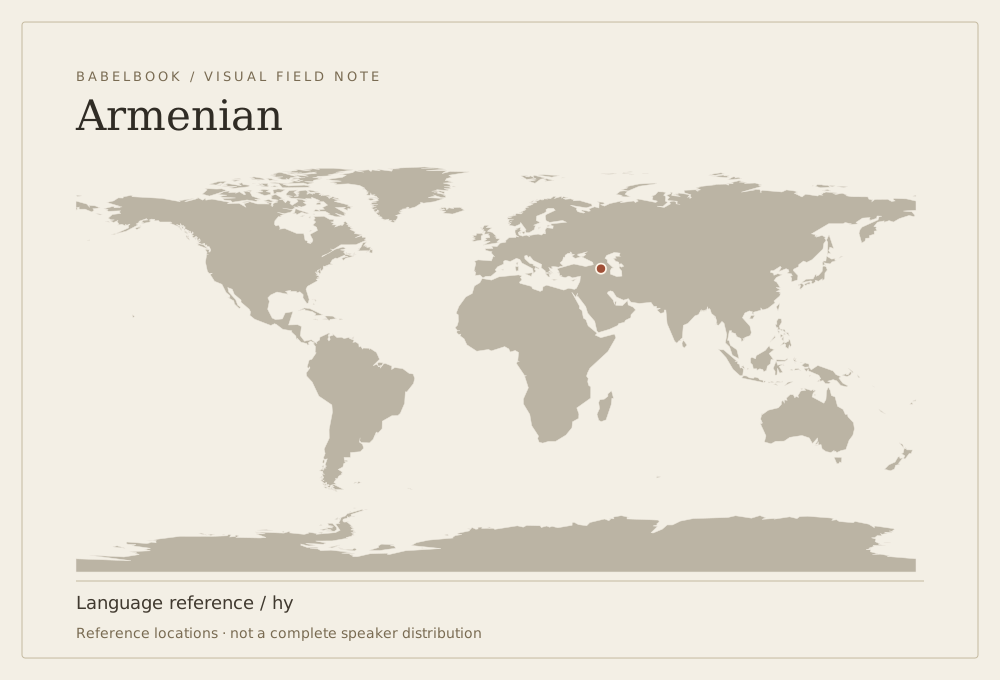
Representative reference points from Glottolog. Historical entries show reference locations, not current speakers. 1 point.
Reference & context ↗Babelbook · original editorial illustration · CC BY 4.0 · Glottolog locations; public-domain Natural Earth land
Source excerpts, selected, shortened and where noted editorially corrected from Armenian language by Wikipedia contributors. Retrieved 2026-10-05. CC BY-SA 4.0. These excerpts are not an independently verified scholarly history; missing accounts are identified above.
Read further in the source
Classification and origins
Armenian is an independent branch of the Indo-European languages. It is of interest to linguists because of its distinctive phonological changes within the Indo-European family. Armenian exhibits more satemization than centumization, although it is not classified as belonging to either of these subgroups. Some linguists have proposed that Armenian, Greek (and Phrygian), Albanian, and the Indo-Iranian languages were dialectally close to one another. Within this hypothetical dialect continuum, Proto-Armenian has been situated between Proto-Greek, traditionally classified as a centum language, and Proto-Indo-Iranian, traditionally classified as a satem language. The relationship between Armenian and Greek has been the subject of particular attention. Armenian and Greek share phonological, morphological, and lexical features, although scholars differ over whether these similarities reflect a common Graeco-Armenian subgroup, prolonged contact, or a combination of shared inheritance and areal influence. Using computational methods adapted from evolutionary biology, Donald Ringe and Tandy Warnow proposed a phylogenetic model in which Pre-Armenian and Pre-Greek formed a closely related subgroup after 2500 BC. David W. Anthony has likewise suggested that Pre-Armenian may have begun to diverge by approximately 2800 BC. Recent archaeogenetic research has contributed to discussions of Armenian prehistory. Steppe-related ancestry appeared in the South Caucasus during the Middle Bronze Age, coinciding with the emergence of the Trialeti-Vanadzor culture, and has been linked to a western Yamnaya-related source also found in contemporaneous Aegean populations. Several scholars have associated the Trialeti-Vanadzor culture with Indo-European populations, and some recent studies have proposed it as an early Proto-Armenian cultural horizon. These findings have also been interpreted as supporting the Graeco-Armenian hypothesis and the emergence of Proto-Armenian in the Armenian Highlands during the Bronze Age. Ronald I. Kim has noted unique morphological developments connecting Armenian to the Balto-Slavic languages. The Armenian language has a long literary history, with a 5th-century Bible translation as its oldest surviving text. Another text translated into Armenian early on, and also in the 5th-century, was the Armenian Alexander Romance. The vocabulary of the language has historically been influenced by Western Middle Iranian languages, particularly Parthian; its derivational morphology and syntax were also affected by language contact with Parthian, but to a lesser extent. Contact with Greek, Persian, and Syriac also resulted in a number of loanwords. There are two standardized modern literary forms, Eastern Armenian (spoken mainly in Armenia) and Western Armenian (spoken originally mainly in modern-day Turkey and, since the Armenian genocide, mostly in the diaspora). The differences between them are considerable but they are mutually intelligible after significant exposure. Some subdialects, such as Homshetsi, are not mutually intelligible with other varieties. Although Armenians were known to history much earlier (for example, they were mentioned in the 6th-century BC Behistun Inscription and in Xenophon's 4th century BC history, The Anabasis), the oldest surviving Armenian-language writing is etched in stone on Armenian temples and is called Mehenagir. The Armenian alphabet was created by Mesrop Mashtots in 405, at which time it had 36 letters. He is also credited by some with the creation of the Georgian alphabet and the Caucasian Albanian alphabet. While Armenian constitutes the sole member of the Armenian branch of the Indo-European family, Aram Kossian has suggested that the hypothetical Mushki language may have been a (now extinct) Armenic language.
Evolution
Classical Armenian (Arm: grabar), attested from the 5th century to the 19th century as the literary standard (up to the 11th century also as a spoken language with different varieties), was partially superseded by Middle Armenian, attested from the 12th century to the 18th century. Specialized literature prefers "Old Armenian" for grabar as a whole, and designates as "Classical" the language used in the 5th century literature, "Post-Classical" from the late 5th to 8th centuries, and "Late Grabar" that of the period covering the 8th to 11th centuries. Later, it was used mainly in religious and specialized literature, with the exception of a revival during the early modern period, when attempts were made to establish it as the language of a literary renaissance, with neoclassical inclinations, through the creation and dissemination of literature in varied genres, especially by the Mekhitarists. The first Armenian periodical, Azdarar, was published in grabar in 1794. The classical form borrowed numerous words from Middle Iranian languages, primarily Parthian, and contains smaller inventories of loanwords from Greek, Syriac, Aramaic, Arabic, Mongol, Persian, and indigenous languages such as Urartian. An effort to modernize the language in Bagratid Armenia and the Armenian Kingdom of Cilicia (11–14th centuries) resulted in the addition of two more characters to the alphabet ("օ" and "ֆ"), bringing the total number to 38. The Book of Lamentations by Gregory of Narek (951–1003) is an example of the development of a literature and writing style of Old Armenian by the 10th century. In addition to elevating the literary style and vocabulary of the Armenian language by adding well above a thousand new words, through his other hymns and poems Gregory paved the way for his successors to include secular themes and vernacular language in their writings. The thematic shift from mainly religious texts to writings with secular outlooks further enhanced and enriched the vocabulary. "A Word of Wisdom", a poem by Hovhannes Sargavak devoted to a starling, legitimizes poetry devoted to nature, love, or female beauty. Gradually, the interests of the population at large were reflected in other literary works as well. Konsdantin Yerzinkatsi and several others took the unusual step of criticizing the ecclesiastic establishment and addressing the social issues of the Armenian homeland. These changes represented the nature of the literary style and syntax, but they did not constitute immense changes to the fundamentals of the grammar or the morphology of the language. Often, when writers codify a spoken dialect, other language users are then encouraged to imitate that structure through the literary device known as parallelism. In the 19th century, the traditional Armenian homeland was once again divided. This time Eastern Armenia was conquered from Qajar Iran by the Russian Empire, while Western Armenia, containing two thirds of historical Armenia, remained under Ottoman control. The antagonistic relationship between the Russian and Ottoman empires led to creation of two separate and different environments under which Armenians lived. Halfway through the 19th century, two important concentrations of Armenian communities were further consolidated. Because of persecutions or the search for better economic opportunities, many Armenians living under Ottoman rule gradually moved to Istanbul, whereas Tbilisi became the center of Armenians living under Russian rule. These two cosmopolitan cities very soon became the primary poles of Armenian intellectual and cultural life. The introduction of new literary forms and styles, as well as many new ideas sweeping Europe, reached Armenians living in both regions. This created an ever-growing need to elevate the vernacular, Ashkharhabar, to the dignity of a modern literary language, in contrast to the now-anachronistic Grabar. Numerous dialects existed in the traditional Armenian regions, which, different as they were, had certain morphological and phonetic features in common. On the basis of these features two major standards emerged:
Western standard: The influx of immigrants from different parts of the traditional Armenian homeland to Istanbul crystallized the common elements of the regional dialects, paving the way for a style of writing that required a shorter and more flexible learning curve than Grabar. Eastern standard: The Yerevan dialect provided the primary elements of Eastern Armenian, centered in Tbilisi, Georgia. Similar to the Western Armenian variant, the Modern Eastern was in many ways more practical and accessible to the masses than Grabar. Both centers vigorously pursued the promotion of Ashkharhabar. The proliferation of newspapers in both versions (Eastern & Western) and the development of a network of schools where modern Armenian was taught, dramatically increased the rate of literacy (in spite of the obstacles by the colonial administrators), even in remote rural areas. The emergence of literary works entirely written in the modern versions increasingly legitimized the language's existence. By the turn of the 20th century both varieties of the one modern Armenian language prevailed over Grabar and opened the path to a new and simplified grammatical structure of the language in the two different cultural spheres. Apart from several morphological, phonetic, and grammatical differences, the largely common vocabulary and generally analogous rules of grammatical fundamentals allows users of one variant to understand the other as long as they are fluent in one of the literary standards. After World War I, the existence of the two modern versions of the same language was sanctioned even more clearly. The Armenian Soviet Socialist Republic (1920–1990) used Eastern Armenian as its official language, whereas the diaspora created after the Armenian genocide preserved the Western Armenian dialect. The two modern literary dialects, Western (originally associated with writers in the Ottoman Empire) and Eastern (originally associated with writers in the Russian Empire), removed almost all of their Turkish lexical influences in the 20th century, primarily following the Armenian genocide.
Geographic distribution
In addition to Armenia and Turkey, where it is indigenous, Armenian is spoken among the diaspora. According to Ethnologue, globally there are 1.6 million Western Armenian speakers and 3.7 million Eastern Armenian speakers, totalling 5.3 million Armenian speakers.
In Georgia, Armenian speakers are concentrated in Ninotsminda and Akhalkalaki districts where they represent over 90% of the population.
Status and usage
The short-lived First Republic of Armenia declared Armenian its official language. Eastern Armenian was then dominating in institutions and among the population. When Armenia was incorporated into the USSR, the Armenian Soviet Socialist Republic made Eastern Armenian the language of the courts, government institutions and schools. Armenia was also russified. After regaining independence Armenia upholds the official status of the Armenian language. Eastern Armenian is the official variant used, making it the prestige variety while other variants have been excluded from national institutions. Indeed, Western Armenian is perceived by some as a mere dialect. Armenian was also official in the Republic of Artsakh. It is recognized as an official language of the Eurasian Economic Union although Russian is the working language. Armenian (without reference to a specific variety) is officially recognized as a minority language in Cyprus, Hungary, Iraq, Poland, and Romania. It is recognized as a minority language and protected in Turkey by the 1923 Treaty of Lausanne. Western Armenian is the main language of the Armenian diaspora, and is the medium of instruction in the majority of Armenian-language schools outside Armenia. In particular, although Armenian has no legal status in Georgia, as of 2010 Armenian was the main language of instruction in 144 state-funded schools in the Samtskhe-Javakheti region. The curriculum in Lebanon allows Armenian schools to teach Armenian as a basic language. In California, home to a large Armenian American community, various state government agencies provide Armenian translations of their documents, including the California Department of Social Services, California Department of Motor Vehicles, and California superior courts. In the city of Glendale, there are some street signs in Armenian. In Lebanon, Syria and Iran, Armenian communities were given greater autonomy than Assyrian, Kurdish, and other communities. In practice, Armenians were the only ethnic minority group in these countries allowed to teach their language in schools. In Iran, article 15 of the constitution allows the use of "regional and tribal languages" in the mass media as well as within the schools. However, these languages do not receive formal status and are not officially regulated by the authorities. Iranian Armenians are de facto the only non-Persian ethnic group in Iran enjoying this right, with private schools where Armenian is the medium of instruction.
Dialects
Armenian is a pluricentric language, having two modern standardized forms: Eastern Armenian and Western Armenian. There are also numerous other non-standard dialects, many of which are extinct. The most distinctive feature of Western Armenian is that it has undergone several phonetic mergers; these may be due to proximity to Arabic- and Turkish-speaking communities.
Classical Armenian (Grabar), which remained the standard until the 18th century, was quite homogeneous across the different regions that works in it were written; it may have been a cross-regional standard. The Middle Armenian variety used in the court of Cilician Armenia (1080–1375) provides a window into the development of Western Armenian, which came to be based on what became the dialect of Istanbul, while the standard for Eastern Armenian was based on the dialect around Mount Ararat and Yerevan. Although the Armenian language is often divided into "east" and "west", the two standards are actually relatively close to each other in light of wealth of the diversity present among regional non-standard Armenian dialects. The different dialects have experienced different degrees of language contact effects, often with Turkic and Caucasian languages; for some, the result has been significant phonological and syntactic changes. Fortson notes that the modern standard as well has now attained a subordinate clausal structure that greatly resembles a Turkic language. Eastern Armenian speakers pronounce (թ) as [tʰ], (դ) as [d], and (տ) as a tenuis occlusive [t˭]. Western Armenian has simplified the occlusive system into a simple division between voiced occlusives and aspirated ones; the first series corresponds to the tenuis series of Eastern Armenian, and the second corresponds to the Eastern voiced and aspirated series. Thus, the Western dialect pronounces both (թ) and (դ) as [tʰ], and the (տ) letter as [d]. There is no precise linguistic border between one dialect and another because there is nearly always a dialect transition zone of some size between pairs of geographically identified dialects. Armenian can be divided into two major dialectal blocks and those blocks into individual dialects, though many of the Western Armenian dialects have become extinct due to the effects of the Armenian genocide. In addition, neither dialect is completely homogeneous: any dialect can be subdivided into several subdialects. Although Western and Eastern Armenian are often described as different dialects of the same language, many subdialects are not readily mutually intelligible. Nevertheless, a fluent speaker of one of two greatly varying dialects who is also literate in one of the standards, when exposed to the other dialect for a period of time will be able to understand the other with relative ease. Distinct Western Armenian varieties currently in use include Homshetsi, spoken by the Hemshin peoples; the dialects of Armenians of Kessab (Քեսապի բարբառ), Latakia and Jisr al-Shughur (Syria), Anjar, Lebanon, and Vakıflı, Samandağ (Turkey), part of the "Sueidia" dialect (Սուէտիայի բարբառ). Forms of the Karin dialect of Western Armenian are spoken by several hundred thousand people in Northern Armenia, mostly in Gyumri, Artik, Akhuryan, and around 130 villages in Shirak Province, and by Armenians in Samtskhe–Javakheti province of Georgia (Akhalkalaki, Akhaltsikhe). Nakhichevan-on-Don Armenians speak another Western Armenian variety based on the dialect of Armenians in Crimea, where they came from in order to establish the town and surrounding villages in 1779 (Նոր Նախիջևանի բարբառ). Western Armenian dialects are currently spoken also in Gavar (formerly Nor Bayazet and Kamo, on the western shore of Lake Sevan), Aparan, and Talin in Armenia (Mush dialect), and by the large Armenian population residing in Abkhazia, where they are considered to be the first or second ethnic minority, or even equal in number to the local Abkhaz population.
Orthography
The Armenian alphabet (Armenian: Հայոց գրեր, romanized: Hayots grer or Armenian: Հայոց այբուբեն, romanized: Hayots aybuben) is a graphically unique alphabetical writing system that is used to write the Armenian language. It was introduced around 405 AD by Mesrop Mashtots, an Armenian linguist and ecclesiastical leader, and originally contained 36 letters. Two more letters, օ (ō) and ֆ (f), were added in the Middle Ages. During the 1920s orthography reform in Soviet Armenia, a new letter և (capital ԵՎ) was added, which was a ligature before ե+ւ, whereas the letter Ւ ւ was discarded and reintroduced as part of a new letter ՈՒ ու (which was a digraph before). This alphabet and associated orthography is used by most Armenian speakers of Armenia and the countries of the former Soviet Union. Neither the alphabet nor the orthography has been adopted by Diaspora Armenians, including Eastern Armenian speakers of Iran and all Western Armenian speakers, who keep using the traditional alphabet and spelling.