Herero
Herero (Otjiherero) is a Bantu language spoken by the Herero and Mbanderu peoples in Namibia and Botswana, as well as by small communities of people in southwestern Angola. There were 250,000 speakers in these countries between 2015 and 2018.
Translate in Herero ↗Its linguistic distribution covers a zone called Hereroland, which is constituted of the region of Omaheke along with the Otjozondjupa and Kunene Regions. The Himba people, who are related to the Herero and Mbanderu, speak a dialect very close to Otjiherero. Many Herero-speakers live in Windhoek, the capital of Namibia.
Sub-Saharan Africa
Present-day use
The captured source does not contain a separate current-use account.
Origins
The captured article does not contain a separate origins section. See the historical account and linked source.
Development
The captured article does not contain a distinct historical account. No chronology has been invented.
Writing
Because of the translation of missionary Gottlieb Viehe (1839–1901) of the Bible into Herero, at the end of the 19th century, the spoken language was transcribed to an alphabet based on the Latin script. Father Peter Heinrich Brincker (1836–1904) translated several theological works and songs.
Beyond the typeface.
Signs, manuscripts, published pages and contextual photographs, with their place, period, source and reuse terms. Captions identify historical spellings, regional examples, community references and character imagery.
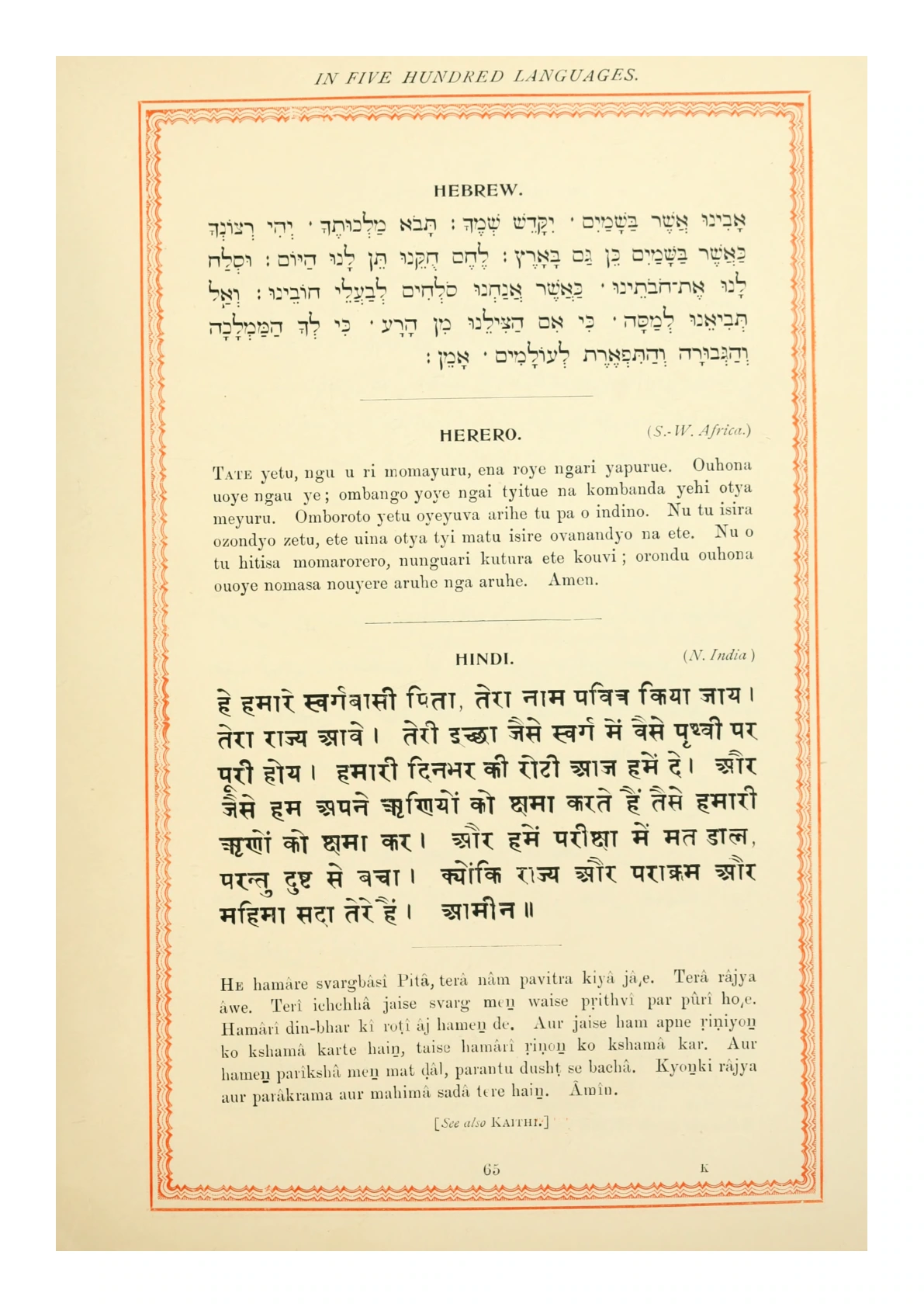
Historical printed prayer headed “HERERO” in The Lord’s Prayer in Five Hundred Languages, printed page 65. The Commons record dates the compilation to 1905; this copy also contains a publisher note dated June 1908. Orthography and translation reflect the historical source, not a modern usage standard. Other languages appear on the same page. The source includes period terminology and editorial annotations; these are historical evidence, not Babelbook’s current terminology or claims.
Saved in Babelbook · resized display copy. Select the image to open it independently of its source.
Reinhold Rost (compiler); Gilbert & Rivington / Wm. Clowes & Sons (publishers); Internet Archive scan · Source ↗Public domain ↗View the local visual field note
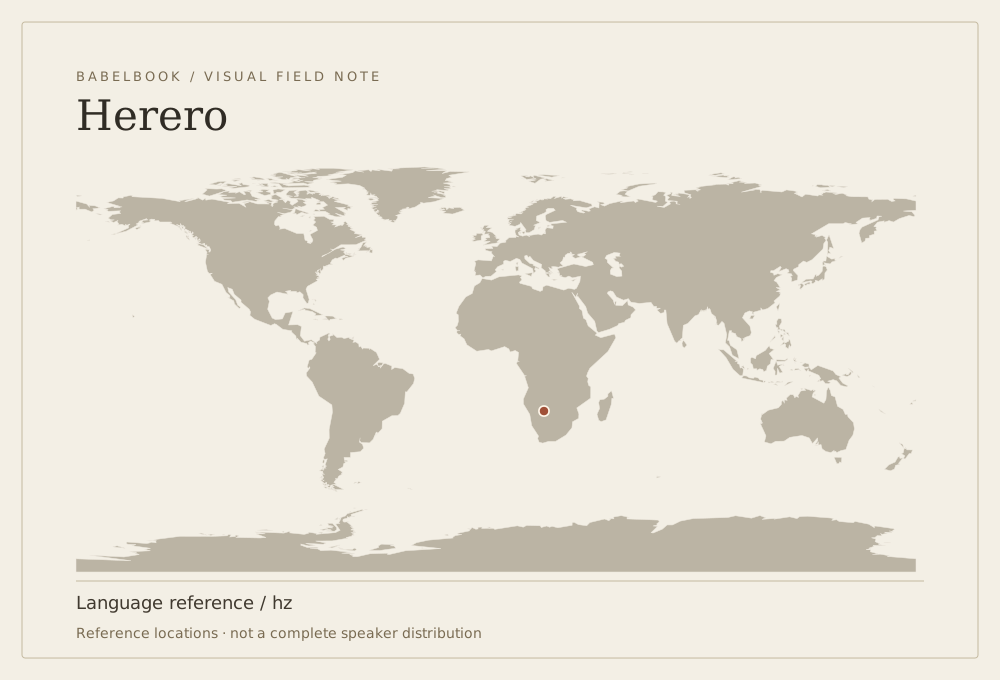
Representative reference points from Glottolog. Historical entries show reference locations, not current speakers. 1 point.
Reference & context ↗Babelbook · original editorial illustration · CC BY 4.0 · Glottolog locations; public-domain Natural Earth land
Source excerpts, selected, shortened and where noted editorially corrected from Herero language by Wikipedia contributors. Retrieved 2026-10-05. CC BY-SA 4.0. These excerpts are not an independently verified scholarly history; missing accounts are identified above.
Read further in the source
Distribution
Its linguistic distribution covers a zone called Hereroland, which is constituted of the region of Omaheke along with the Otjozondjupa and Kunene Regions. The Himba people, who are related to the Herero and Mbanderu, speak a dialect very close to Otjiherero. Many Herero-speakers live in Windhoek, the capital of Namibia.