Interlingua
Interlingua (, Interlingua: [inteɾˈliŋɡwa]) is an international auxiliary language (IAL) developed between 1937 and 1951 by the American International Auxiliary Language Association (IALA). It is a constructed language of the "naturalistic" variety, whose vocabulary, grammar, and other characteristics are derived from natural languages. Interlingua proponents maintain that (written) Interlingua is comprehensible to the over 900 million native speakers of Romance languages, though it is actively spoken by only a few hundred. Interlingua was developed to combine a simple, mostly regular grammar with a vocabulary common to a wide range of western European languages, making it easy to learn for those whose native languages were sources of Interlingua's vocabulary and grammar. The name Interlingua comes from the Latin words inter, meaning 'between', and lingua, meaning 'tongue' or 'language'. These morphemes are the same in Interlingua; thus, Interlingua means 'between language'.
Translate in Interlingua ↗Interlingua (, Interlingua: [inteɾˈliŋɡwa]) is an international auxiliary language (IAL) developed between 1937 and 1951 by the American International Auxiliary Language Association (IALA). It is a constructed language of the "naturalistic" variety, whose vocabulary, grammar, and other characteristics are derived from natural languages. Interlingua proponents maintain that (written) Interlingua is comprehensible to the over 900 million native speakers of Romance languages, though it is actively spoken by only a few hundred. Interlingua was developed to combine a simple, mostly regular grammar with a vocabulary common to a wide range of western European languages, making it easy to learn for those whose native languages were sources of Interlingua's vocabulary and grammar. The name Interlingua comes from the Latin words inter, meaning 'between', and lingua, meaning 'tongue' or 'language'. These morphemes are the same in Interlingua; thus, Interlingua means 'between language'.
Global / other
Present-day use
The captured source does not contain a separate current-use account.
Origins
The captured article does not contain a separate origins section. See the historical account and linked source.
Development
The American heiress Alice Vanderbilt Morris (1874–1950) became interested in linguistics and the international auxiliary language movement in the early 1920s. In 1924, Morris and her husband, Dave Hennen Morris, established the non-profit International Auxiliary Language Association (IALA) in New York City. Their aim was to place the study of IALs on a more complex and scientific basis. Morris developed the research programme of IALA in consultation with Edward Sapir, William Edward Collinson, and Otto Jespersen. Investigations of the auxiliary language problem were in progress at the International Research Council, the American Council on Education, the American Council of Learned Societies, the British, French, Italian, and American Associations for the advancement of science, and other groups of specialists. Morris created IALA as a continuation of this work. Originally, the association had not intended to create its own language. Its goal was to identify which auxiliary language already available was best suited for international communication, and how to promote it more effectively. However, after ten years of research, many members of IALA concluded that none of the existing interlanguages were up to the task. By 1937, the members had made the decision to create a new language, to the surprise of the world's interlanguage community. To that point, much of the debate had been equivocal on the decision to use naturalistic (e.g., Peano's Interlingua, Novial and Occidental) or systematic (e.g., Esperanto and Ido) words. During the war years, proponents of a naturalistic interlanguage won out. The first support was Thorndike's paper; the second was a concession by proponents of the systematic languages that thousands of words were already present in many, or even a majority, of the European languages.
Writing
Interlingua has a largely phonemic orthography. The book Grammar of Interlingua defines in §15 a "collateral orthography" that defines how a word is spelt in Interlingua once assimilated regardless of etymology.
Beyond the typeface.
Signs, manuscripts, published pages and contextual photographs, with their place, period, source and reuse terms. Captions identify historical spellings, regional examples, community references and character imagery.
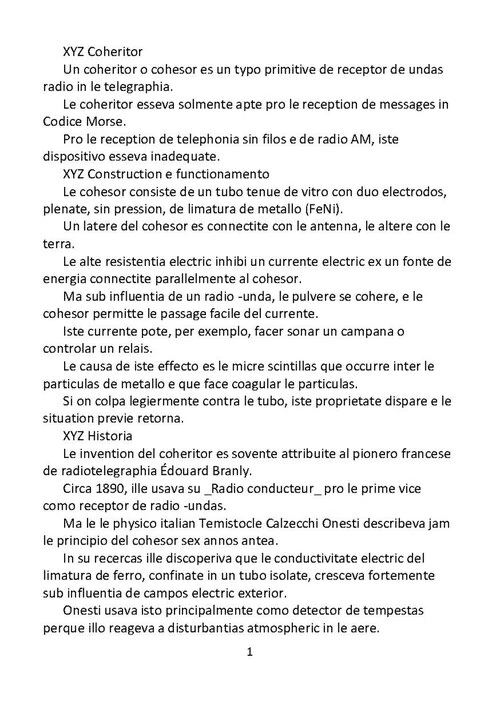
Page 1 of a published corpus of Interlingua Wikipedia prose, discussing a radio coherer. The actual image was visually checked as Interlingua; the corresponding unproofread Wikisource transcription is English and does not match the current image. This is a digitally typeset corpus page, not a historical scan.
Saved in Babelbook · resized display copy. Select the image to open it independently of its source.
Contributors to ia.wikipedia.org; compilation uploaded by Smilauer · Source ↗CC BY-SA 4.0 ↗View the local visual field note
This constructed-language or category entry has no geographic reference points in the collection.
Reference & context ↗Babelbook · original editorial illustration · Babelbook original illustration
Source excerpts, selected, shortened and where noted editorially corrected from Interlingua by Wikipedia contributors. Retrieved 2026-10-05. CC BY-SA 4.0. These excerpts are not an independently verified scholarly history; missing accounts are identified above.
Read further in the source
History
The American heiress Alice Vanderbilt Morris (1874–1950) became interested in linguistics and the international auxiliary language movement in the early 1920s. In 1924, Morris and her husband, Dave Hennen Morris, established the non-profit International Auxiliary Language Association (IALA) in New York City. Their aim was to place the study of IALs on a more complex and scientific basis. Morris developed the research programme of IALA in consultation with Edward Sapir, William Edward Collinson, and Otto Jespersen. Investigations of the auxiliary language problem were in progress at the International Research Council, the American Council on Education, the American Council of Learned Societies, the British, French, Italian, and American Associations for the advancement of science, and other groups of specialists. Morris created IALA as a continuation of this work.
Collateral orthography
The book Grammar of Interlingua defines in §15 a "collateral orthography" that defines how a word is spelt in Interlingua once assimilated regardless of etymology.