Indonesian
Indonesian (bahasa Indonesia) is the official and national language of Indonesia. It is a standardized variety of Malay, an Austronesian pluricentric macrolanguage that has been used as a lingua franca in the multilingual Indonesian archipelago for centuries. With over 280 million inhabitants, Indonesia ranks as the fourth-most populous nation globally. According to the 2020 census, over 97% of Indonesians are fluent in Indonesian, making it the largest language by number of speakers in Southeast Asia and one of the most widely spoken languages in the world. Indonesian vocabulary has been influenced by various native regional languages such as Javanese, Sundanese, Minangkabau, Balinese, Banjarese, and Buginese, as well as by foreign languages such as Arabic, Dutch, Hokkien, Portuguese, Sanskrit, and English. Most Indonesians, aside from speaking the national language, are fluent in at least one of the more than 700 indigenous local languages; examples include Javanese and Sundanese, which are commonly used at home and within the local community. However, most formal education and nearly all national mass media, governance, administration, and judiciary and other forms of communication are conducted in Indonesian. Under Indonesian rule from 1976 to 1999, Indonesian was designated as the official language of East Timor. It has the status of a working language under the country's constitution along with English.
Translate in Indonesian ↗According to the 2025 census, Indonesian had 80 million native speakers and 180 million second-language speakers, who speak it alongside their local mother tongue, giving a total number of speakers in Indonesia of 260 million. It is common as a first language in urban areas, and as a second language by those residing in more rural parts of Indonesia. Globally, Ethnologue (2025) estimates about 80 million native speakers and 180.2 million second-language speakers, for a total of 260 million. The VOA and BBC use Indonesian as one of their standard language for broadcasting. In Australia, Indonesian is one of three Asian target languages, together with Japanese and Mandarin, taught in some schools as part of the Languages Other Than English programme. Indonesian has been taught in Australian schools and universities since the 1950s. In East Timor, which was occupied by Indonesia between 1975 and 1999, Indonesian is recognized by the constitution as one of the two working languages (the other being English), alongside the official languages of Tetum and Portuguese. Indonesian is the official language of Indonesia, and its use is encouraged throughout the Indonesian archipelago. It is regulated in Chapter XV, 1945 Constitution of Indonesia about the flag, official language, coat of arms, and national anthem of Indonesia. Also, in Chapter III, Section 25 to 45, Government regulation No. 24/ 2009 mentions explicitly the status of the Indonesian language. The national language is Indonesian. Indonesian functions as a symbol of national identity and pride, and is a lingua franca among the diverse ethnic groups in Indonesia and the speakers of vernacular Malay dialects and Malay creoles. The Indonesian language serves as the national and official language, the language of education, communication, transaction and trade documentation, the development of national culture, science, technology, and mass media.
Southeast Asia
Present-day use
Indonesian is spoken as a mother tongue and national language. Over 200 million people regularly make use of the national language, with varying degrees of proficiency. In a nation that is home to more than 700 native languages and a vast array of ethnic groups, it plays an important unifying and cross-archipelagic role for the country. Use of the national language is abundant in the media, government bodies, schools, universities, workplaces, among members of the upper-class or nobility and also in formal situations, despite the 2010 census showing only 19.94% of over-five-year-olds speak mainly Indonesian at home. Indonesian continues to function as the language of national identity as the Congress of Indonesian Youth envisioned, and also serves as the language of education, literacy, modernization, and social mobility. Standard Indonesian is used in books and newspapers and on television/radio news broadcasts. The standard dialect, however, is rarely used in daily conversations, being confined mostly to formal settings. While this is a phenomenon common to most languages in the world (for example, spoken English does not always correspond to its written standards), the proximity of spoken Indonesian (in terms of grammar and vocabulary) to its normative form is noticeably low, hence fits into the Charles Ferguson's diglossia, although there is a continuum between the standard Indonesian and colloquial Indonesian. This is mostly due to Indonesians combining aspects of their own local languages (e.g., Javanese, Sundanese, and Balinese) with Indonesian. This results in various vernacular varieties of Indonesian, the very types that a foreigner is most likely to hear upon arriving in any Indonesian city or town.
Origins
The Sanskrit influence came from contacts with India since ancient times. The words were either borrowed directly from India or with the intermediary of the Old Javanese language. Although Hinduism and Buddhism are no longer the major religions of Indonesia, Sanskrit, which was the language vehicle for these religions, is still held in high esteem and is comparable with the status of Latin in English and other Western European languages. Sanskrit is also the main source for neologisms, which are usually formed from Sanskrit roots. The loanwords from Sanskrit cover many aspects of religion, art and everyday life. From Sanskrit came such words as स्वर्ग surga (heaven), भाषा bahasa (language), काच kaca (glass, mirror), राज- raja (king), मनुष्य manusia (mankind), चिन्ता cinta (love), भूमि bumi (earth), भुवन buana (world), आगम agama (religion), स्त्री Istri (wife/woman), जय Jaya (victory/victorious), पुर Pura (city/temple/place) राक्षस Raksasa (giant/monster), धर्म Dharma (rule/regulations), मन्त्र Mantra (words/poet/spiritual prayers), क्षत्रिय Satria (warrior/brave/soldier), विजय Wijaya (greatly victorious/great victory), etc. Sanskrit words and sentences are also used in names, titles, and mottos of the Indonesian National Police and Indonesian Armed Forces such as: Bhayangkara, Laksamana, Jatayu, Garuda, Dharmakerta Marga Reksyaka, Jalesveva Jayamahe, Kartika Eka Paksi, Swa Bhuwana Paksa, Rastra Sewakottama, Yudha Siaga, etc. Because Sanskrit has long been known in the Indonesian archipelago, Sanskrit loanwords, unlike those from other languages, have entered the basic vocabulary of Indonesian to such an extent that, for many, they are no longer perceived to be foreign. Therefore, one could write a short story using mostly Sanskrit-derived words.
Development
Standard Indonesian is a standard language of "Riau Malay", which despite its common name is not based on the vernacular Malay dialects of the Riau Islands, but rather represents a form of Classical Malay as used in the 19th and early 20th centuries in the Riau-Lingga Sultanate. Classical Malay had emerged as a literary language in the royal courts along both shores of the Strait of Malacca, including the Johor Sultanate and Malacca Sultanate. Originally spoken in Northeast Sumatra, Malay has been used as a lingua franca in the Indonesian archipelago for half a millennium. It might be attributed to its ancestor, the Old Malay language (which can be traced back to the 7th century). The Kedukan Bukit inscription is the oldest surviving specimen of Old Malay, the language used by the Srivijayan empire. Since the 7th century, the Old Malay language has been used in Nusantara (the Indonesian archipelago), evidenced by Srivijaya inscriptions and by other inscriptions from coastal areas of the archipelago, such as Sojomerto inscription. Indonesian (in its standard form) has essentially the same material basis as the Malaysian standard of Malay and is therefore considered to be a variety of the pluricentric Malay language. However, it does differ from Malaysian Malay in several respects, with differences in pronunciation and vocabulary, especially within technical and administrative contexts. These differences are due mainly to the Dutch and Javanese influences on Indonesian. Indonesian was also influenced by the Melayu pasar (lit. 'market Malay'), which was the lingua franca of the archipelago in colonial times, and thus indirectly by other spoken languages of the islands. Malaysian Malay claims to be closer to the classical Malay of earlier centuries, even though modern Malaysian has been heavily influenced, in lexicon as well as in syntax, by English.
Writing
Indonesian is written with the Latin script. It was originally based on the Dutch spelling and still bears some similarities to it. Consonants are represented in a way similar to Italian, although ⟨c⟩ is always /tʃ/ (like English ⟨ch⟩), ⟨g⟩ is always /ɡ/ ("hard") and ⟨j⟩ represents /dʒ/ as it does in English. In addition, ⟨ny⟩ represents the palatal nasal /ɲ/, ⟨ng⟩ is used for the velar nasal /ŋ/ (which can occur word-initially), ⟨sy⟩ for /ʃ/ (English ⟨sh⟩) and ⟨kh⟩ for the voiceless velar fricative /x/. Both /e/ and /ə/ are represented with ⟨e⟩. Spelling changes in the language that have occurred since Indonesian independence include: Introduced in 1901, the van Ophuijsen system (named from the advisor of the system, Charles Adriaan van Ophuijsen) was the first standardization of romanized spelling. It was most influenced by the then current Dutch spelling system and based on the dialect of Malay spoken in Johor. In 1947, the spelling was changed into Republican Spelling or Soewandi Spelling (named by at the time Minister of Education, Soewandi). This spelling changed formerly spelled oe into u (however, the spelling influenced other aspects in orthography, for example writing reduplicated words). All of the other changes were a part of the Perfected Spelling System, an officially mandated spelling reform in 1972. Some of the old spellings (which were derived from Dutch orthography) do survive in proper names; for example, the name of a former president of Indonesia is still sometimes written Soeharto, and the central Java city of Yogyakarta is sometimes written Jogjakarta. In time, the spelling system is further updated and the latest update of Indonesian spelling system issued on 16 August 2022 by Head of Language Development and Fostering Agency decree No 0424/I/BS.00.01/2022.
Beyond the typeface.
Signs, manuscripts, published pages and contextual photographs, with their place, period, source and reuse terms. Captions identify historical spellings, regional examples, community references and character imagery.
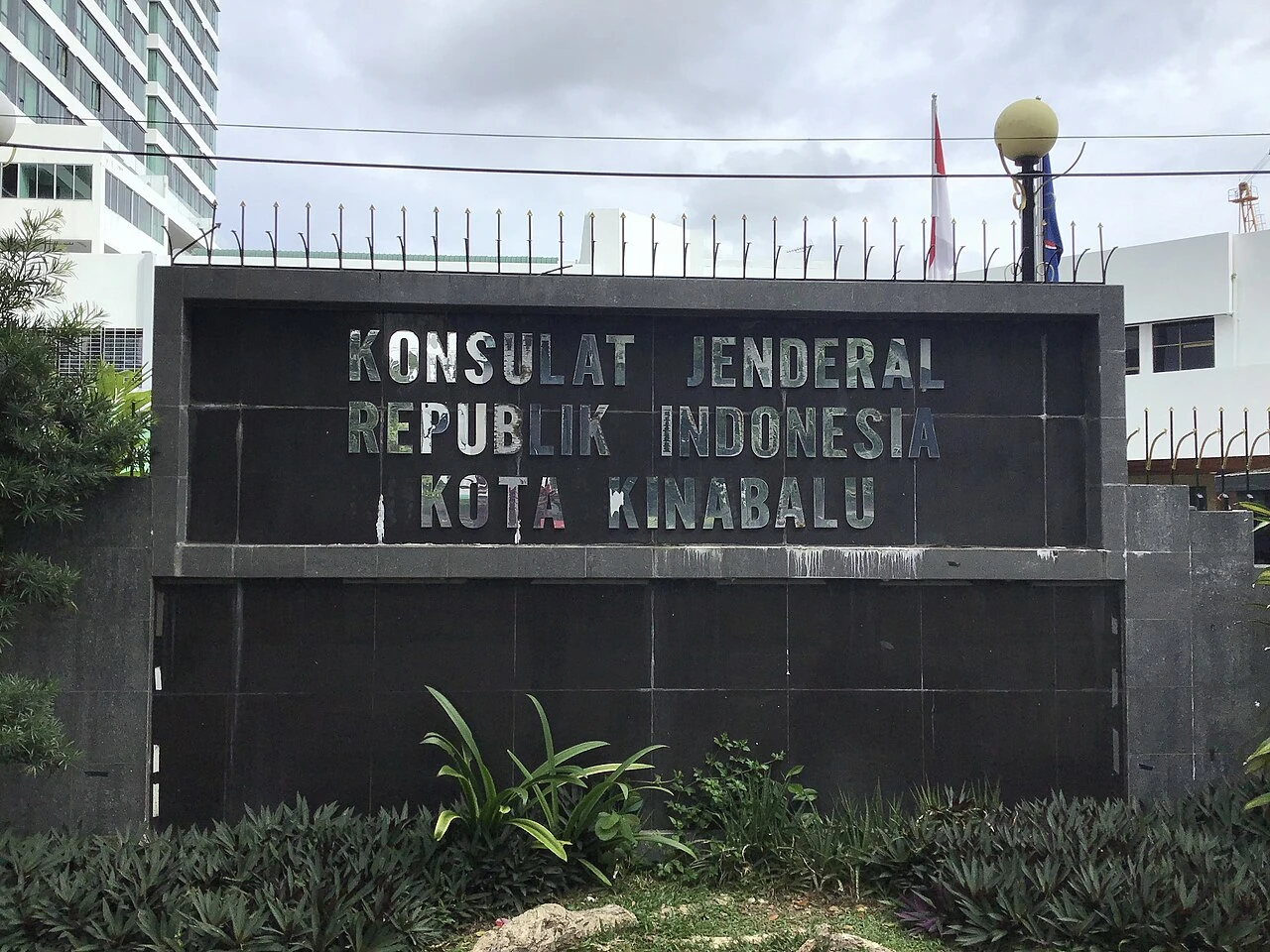
Indonesian-language sign for the Consulate General of Indonesia in Kota Kinabalu, photographed in 2022. Source-identified language; displayed without additional cropping.
Saved in Babelbook · resized display copy. Select the image to open it independently of its source.
Taufik · Source ↗CC BY-SA 4.0 ↗View the local visual field note
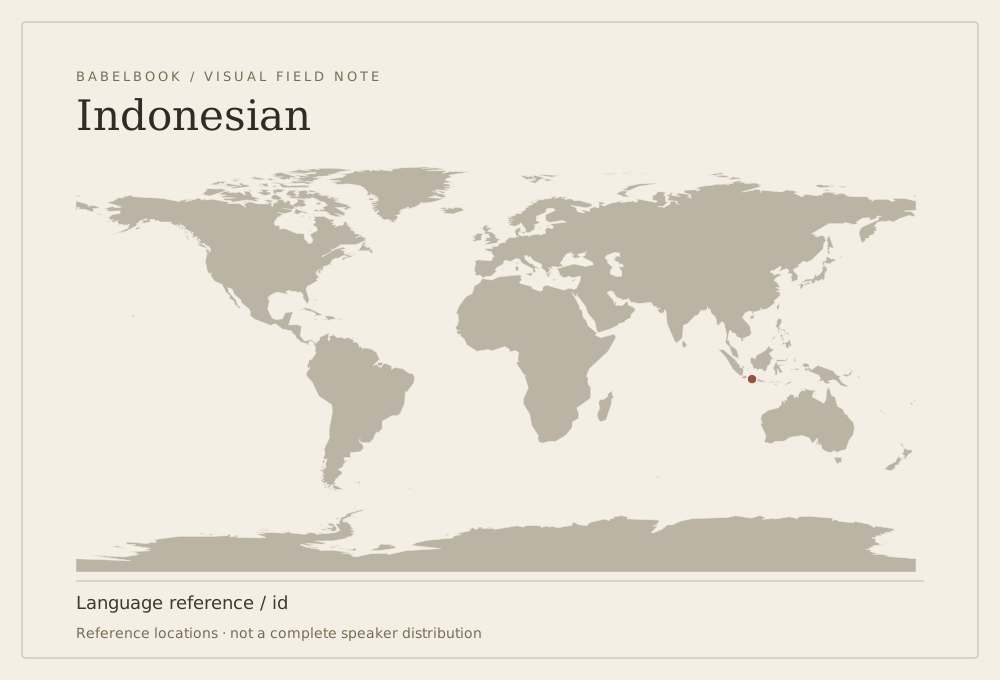
Representative reference points from Glottolog. Historical entries show reference locations, not current speakers. 1 point.
Reference & context ↗Babelbook · original editorial illustration · CC BY 4.0 · Glottolog locations; public-domain Natural Earth land
Source excerpts, selected, shortened and where noted editorially corrected from Indonesian language by Wikipedia contributors. Retrieved 2026-10-05. CC BY-SA 4.0. These excerpts are not an independently verified scholarly history; missing accounts are identified above.
Read further in the source
History
Standard Indonesian is a standard language of "Riau Malay", which despite its common name is not based on the vernacular Malay dialects of the Riau Islands, but rather represents a form of Classical Malay as used in the 19th and early 20th centuries in the Riau-Lingga Sultanate. Classical Malay had emerged as a literary language in the royal courts along both shores of the Strait of Malacca, including the Johor Sultanate and Malacca Sultanate. Originally spoken in Northeast Sumatra, Malay has been used as a lingua franca in the Indonesian archipelago for half a millennium. It might be attributed to its ancestor, the Old Malay language (which can be traced back to the 7th century). The Kedukan Bukit inscription is the oldest surviving specimen of Old Malay, the language used by the Srivijayan empire. Since the 7th century, the Old Malay language has been used in Nusantara (the Indonesian archipelago), evidenced by Srivijaya inscriptions and by other inscriptions from coastal areas of the archipelago, such as Sojomerto inscription. Indonesian (in its standard form) has essentially the same material basis as the Malaysian standard of Malay and is therefore considered to be a variety of the pluricentric Malay language. However, it does differ from Malaysian Malay in several respects, with differences in pronunciation and vocabulary, especially within technical and administrative contexts. These differences are due mainly to the Dutch and Javanese influences on Indonesian. Indonesian was also influenced by the Melayu pasar (lit. 'market Malay'), which was the lingua franca of the archipelago in colonial times, and thus indirectly by other spoken languages of the islands. Malaysian Malay claims to be closer to the classical Malay of earlier centuries, even though modern Malaysian has been heavily influenced, in lexicon as well as in syntax, by English. The question of whether High Malay (Court Malay) or Low Malay (Bazaar Malay) was the true parent of the Indonesian language is still debated. High Malay was the official language used in the court of the Johor Sultanate and continued by the Dutch-administered territory of Riau-Lingga, while Low Malay was commonly used in marketplaces and ports of the archipelago. Some linguists have argued that it was the more common Low Malay that formed the base of the Indonesian language.
Modern standard and colloquial contemporary Indonesian
Indonesian is spoken as a mother tongue and national language. Over 200 million people regularly make use of the national language, with varying degrees of proficiency. In a nation that is home to more than 700 native languages and a vast array of ethnic groups, it plays an important unifying and cross-archipelagic role for the country. Use of the national language is abundant in the media, government bodies, schools, universities, workplaces, among members of the upper-class or nobility and also in formal situations, despite the 2010 census showing only 19.94% of over-five-year-olds speak mainly Indonesian at home. Indonesian continues to function as the language of national identity as the Congress of Indonesian Youth envisioned, and also serves as the language of education, literacy, modernization, and social mobility. Standard Indonesian is used in books and newspapers and on television/radio news broadcasts. The standard dialect, however, is rarely used in daily conversations, being confined mostly to formal settings. While this is a phenomenon common to most languages in the world (for example, spoken English does not always correspond to its written standards), the proximity of spoken Indonesian (in terms of grammar and vocabulary) to its normative form is noticeably low, hence fits into the Charles Ferguson's diglossia, although there is a continuum between the standard Indonesian and colloquial Indonesian. This is mostly due to Indonesians combining aspects of their own local languages (e.g., Javanese, Sundanese, and Balinese) with Indonesian. This results in various vernacular varieties of Indonesian, the very types that a foreigner is most likely to hear upon arriving in any Indonesian city or town. Javanese influence will have more lasting effect on the future development of Indonesian as the coinage of new terms from a language of Indonesia is preferred, Javanese is immediately acceptable for around half of Indonesian, Javan [educational] infrastructure has always been better, and the number of influential Javanese officials in government and military. Javanese has impacted on the lexicon of Jakartanese specifically from ngoko register of Javanese and which flows later into colloquial Indonesian, while nothing come from krama register of Javanese. Meanwhile, Sanskrit–Old Javanese language (beside Western European languages) —instead of Arabic such in Malaysian Malay— become new major source of new words in standard Indonesia, such as bhayangkara (police), purnawirawan (military–police retiree), dwiwarna (literally bicolor, refers to the national flag), which acts such as krama inggil register of Javanese which serves an honorofic function and confers prestige on referents and linked to esoteric knowledge and social power of traditional Javanese conception of krama inggil register of Javanese which usage of older prestigious codes to exhibit extraordinary esoteric knowledge and hence legitimizing elite with access into it, which was detested by some for feudality as it impedes construction of simple and efficient language and modern democratic idea. Another criticism for Indonesian development is abundant use of acronyms as nobody really knows all of them. This phenomenon is amplified by the use of Indonesian slang, particularly in the cities. Unlike the relatively uniform standard variety, Vernacular Indonesian exhibits a high degree of geographical variation, though Jakartan Colloquial Indonesian functions as the de facto norm of informal language and is a major source of influence throughout the archipelago. Meanwhile, there is language shift of first language among Indonesian into Indonesian from other languages in Indonesia caused by ethnic diversity and urbanicity. The most common and widely used colloquial Indonesian is heavily influenced by the Betawi language, a Malay-based creole of Jakarta, amplified by its popularity in Indonesian popular culture in mass media and Jakarta's status as the national capital. In informal spoken Indonesian, various words are replaced with those of a less formal nature. For example, tidak (no) is often replaced with the Betawi form nggak or the even simpler gak/ga, while seperti (like, similar to) is often replaced with kayak [kajaʔ]. Sangat or amat (very), the term to express intensity, is often replaced with the Javanese-influenced banget. As for pronunciation, the diphthongs ai and au on the end of base words are typically pronounced as /e/ and /o/. In informal writing, the spelling of words is modified to reflect the actual pronunciation in a way that can be produced with less effort. For example, capai becomes cape or capek, pakai becomes pake, kalau becomes kalo. In verbs, the prefix me- is often dropped, although an initial nasal consonant is often retained, as when mengangkat becomes ngangkat (the base word is angkat). The suffixes -kan and -i are often replaced by -in. For example, mencarikan becomes nyariin, menuruti becomes nurutin. The latter grammatical aspect is one often closely related to the Indonesian spoken in Jakarta and its surrounding areas.
Western European languages (such as Dutch and English) become new major source of new words in standard Indonesian, which allows Indonesian to refer things more precisely and economical. The usage of Dutch words in Malay became a symbol of high social status which remain until years after independence despite heavy critic against it. As American education has gained highest status value, Amran Halim warns against excessive and unnecessary use of English which cause superfluous borrowing such as mengakselerasikan instead of mempercepat (to accelerate) hence resulted in Salim's Indo-Saxonization as it connotes prestige and status. Despite such warning, there is Indonesian attitude to use foreign words while there are available Indonesian words because the usage of foreign words is seen as sign of social achievement, unlike English postcolonial linguistic xenophobia in Malaysian Malay of 1950–60s, and more pronounced than laissez-faire of Thais. Heavy influence of Western European languages can be linked to esoteric knowledge and social power of traditional Javanese conception of krama inggil register of Javanese which usage of older prestigious codes to exhibit extraordinary esoteric knowledge and hence legitimizing elite with access into it. Further encroachment of English words in Indonesian raises a form of code mixing between Indonesian and English known as bahasa Jaksel (Jaksel means Jakarta Selatan, South Jakarta), which is also known as Indoglish.
Geographical distribution
According to the 2025 census, Indonesian had 80 million native speakers and 180 million second-language speakers, who speak it alongside their local mother tongue, giving a total number of speakers in Indonesia of 260 million. It is common as a first language in urban areas, and as a second language by those residing in more rural parts of Indonesia. Globally, Ethnologue (2025) estimates about 80 million native speakers and 180.2 million second-language speakers, for a total of 260 million. The VOA and BBC use Indonesian as one of their standard language for broadcasting. In Australia, Indonesian is one of three Asian target languages, together with Japanese and Mandarin, taught in some schools as part of the Languages Other Than English programme. Indonesian has been taught in Australian schools and universities since the 1950s. In East Timor, which was occupied by Indonesia between 1975 and 1999, Indonesian is recognized by the constitution as one of the two working languages (the other being English), alongside the official languages of Tetum and Portuguese.
Status and policy
Indonesian is the official language of Indonesia, and its use is encouraged throughout the Indonesian archipelago. It is regulated in Chapter XV, 1945 Constitution of Indonesia about the flag, official language, coat of arms, and national anthem of Indonesia. Also, in Chapter III, Section 25 to 45, Government regulation No. 24/ 2009 mentions explicitly the status of the Indonesian language.
The national language is Indonesian. Indonesian functions as a symbol of national identity and pride, and is a lingua franca among the diverse ethnic groups in Indonesia and the speakers of vernacular Malay dialects and Malay creoles. The Indonesian language serves as the national and official language, the language of education, communication, transaction and trade documentation, the development of national culture, science, technology, and mass media. It also serves as a vehicle of communication among the provinces and different regional cultures in the country.
According to Indonesian law, the Indonesian language was proclaimed as the unifying language during the Youth Pledge on 28 October 1928 and developed further to accommodate the dynamics of Indonesian civilization. As mentioned previously, the language was based on Riau Malay, though linguists note that this is not the local dialect of Riau, but the Malaccan dialect that was used in the Riau court. Since its conception in 1928 and its official recognition in the 1945 Constitution, the Indonesian language has been loaded with a nationalist political agenda to unify Indonesia (former Dutch East Indies). This status has made it relatively open to accommodate influences from other Indonesian ethnic languages, most notably Javanese as the majority ethnic group, and Dutch as the previous coloniser. Compared to the indigenous dialects of Malay spoken in Sumatra and Malay peninsula or the normative Malaysian standard, the Indonesian language differs profoundly by a large number of Javanese loanwords incorporated into its already-rich vocabulary. As a result, Indonesian has more extensive sources of loanwords than Malaysian Malay. The disparate evolution of Indonesian and Malaysian has led to a rift between the two standardized varieties. This has been based more upon political nuance and the history of their standardization than cultural reasons, and as a result, there are asymmetrical views regarding each other's variety among Malaysians and Indonesians. Malaysians tend to assert that Malaysian and Indonesian are merely different normative varieties of the same language, while Indonesians tend to treat them as separate, albeit closely related, languages. Consequently, Indonesians feel little need to harmonise their language with Malaysia and Brunei, whereas Malaysians are keener to coordinate the evolution of the language with Indonesians, although the 1972 Indonesian alphabet reform was seen mainly as a concession of Dutch-based Indonesian to the English-based spelling of Malaysian. In November 2023, the Indonesian language was recognised as one of the official languages of the UNESCO General Conference. Currently there are 10 official languages of the UNESCO General Conference, consisting of the six United Nations languages, namely English, French, Arabic, Chinese, Russian, and Spanish, as well as four other languages of UNESCO member countries, namely Hindi, Italian, Portuguese, and Indonesian. As regulated by Indonesian state law UU No 24/2009, other than state official speeches and documents between or issued to Indonesian government, Indonesian language is required by law to be used in:
Official speeches by the president, vice president, and other state officials delivered within or outside Indonesia Agreements involving either government, private institutions, or individuals National or international forums held in Indonesia Scientific papers and publications in Indonesia Geographical names in Indonesia (name of buildings, roads, offices, complexes, institutions) Public signs, road signs, public facilities, banners, and other information of public services in public area. Information distributed through the mass media However, other languages may be used in dual-language setting to accompany but not to replace Indonesian language in: agreements, information regarding goods / services, scientific papers, information through the mass media, geographical names, public signs, road signs, public facilities, banners, and other information of public services in public area. While there are no sanctions of the uses of other languages, for Indonesian courts, any agreements made in Indonesia but not drafted in the Indonesian language, are null and void. In the case of divergent interpretations in dual-language agreements settings, the Indonesian language version shall prevail.
Writing system
Indonesian is written with the Latin script. It was originally based on the Dutch spelling and still bears some similarities to it. Consonants are represented in a way similar to Italian, although ⟨c⟩ is always /tʃ/ (like English ⟨ch⟩), ⟨g⟩ is always /ɡ/ ("hard") and ⟨j⟩ represents /dʒ/ as it does in English. In addition, ⟨ny⟩ represents the palatal nasal /ɲ/, ⟨ng⟩ is used for the velar nasal /ŋ/ (which can occur word-initially), ⟨sy⟩ for /ʃ/ (English ⟨sh⟩) and ⟨kh⟩ for the voiceless velar fricative /x/. Both /e/ and /ə/ are represented with ⟨e⟩. Spelling changes in the language that have occurred since Indonesian independence include:
Introduced in 1901, the van Ophuijsen system (named from the advisor of the system, Charles Adriaan van Ophuijsen) was the first standardization of romanized spelling. It was most influenced by the then current Dutch spelling system and based on the dialect of Malay spoken in Johor. In 1947, the spelling was changed into Republican Spelling or Soewandi Spelling (named by at the time Minister of Education, Soewandi). This spelling changed formerly spelled oe into u (however, the spelling influenced other aspects in orthography, for example writing reduplicated words). All of the other changes were a part of the Perfected Spelling System, an officially mandated spelling reform in 1972. Some of the old spellings (which were derived from Dutch orthography) do survive in proper names; for example, the name of a former president of Indonesia is still sometimes written Soeharto, and the central Java city of Yogyakarta is sometimes written Jogjakarta. In time, the spelling system is further updated and the latest update of Indonesian spelling system issued on 16 August 2022 by Head of Language Development and Fostering Agency decree No 0424/I/BS.00.01/2022.
Loan words of Sanskrit origin
The Sanskrit influence came from contacts with India since ancient times. The words were either borrowed directly from India or with the intermediary of the Old Javanese language. Although Hinduism and Buddhism are no longer the major religions of Indonesia, Sanskrit, which was the language vehicle for these religions, is still held in high esteem and is comparable with the status of Latin in English and other Western European languages. Sanskrit is also the main source for neologisms, which are usually formed from Sanskrit roots. The loanwords from Sanskrit cover many aspects of religion, art and everyday life. From Sanskrit came such words as स्वर्ग surga (heaven), भाषा bahasa (language), काच kaca (glass, mirror), राज- raja (king), मनुष्य manusia (mankind), चिन्ता cinta (love), भूमि bumi (earth), भुवन buana (world), आगम agama (religion), स्त्री Istri (wife/woman), जय Jaya (victory/victorious), पुर Pura (city/temple/place) राक्षस Raksasa (giant/monster), धर्म Dharma (rule/regulations), मन्त्र Mantra (words/poet/spiritual prayers), क्षत्रिय Satria (warrior/brave/soldier), विजय Wijaya (greatly victorious/great victory), etc. Sanskrit words and sentences are also used in names, titles, and mottos of the Indonesian National Police and Indonesian Armed Forces such as: Bhayangkara, Laksamana, Jatayu, Garuda, Dharmakerta Marga Reksyaka, Jalesveva Jayamahe, Kartika Eka Paksi, Swa Bhuwana Paksa, Rastra Sewakottama, Yudha Siaga, etc. Because Sanskrit has long been known in the Indonesian archipelago, Sanskrit loanwords, unlike those from other languages, have entered the basic vocabulary of Indonesian to such an extent that, for many, they are no longer perceived to be foreign. Therefore, one could write a short story using mostly Sanskrit-derived words. The short story below consists of approximately 80 words in Indonesian that are all derived from Sanskrit, as well as a few native function words and affixes.
Karena semua dibiayai menggunakan dana negara jutaan rupiah, baginda maharaja bijaksana, sang mahaguru sastra bahasa Kawi, mahasiswa-mahasiswi perguruan swasta, duta-duta negeri mitra dan suami/istrinya, Menteri Kebudayaan dan Pariwisata, karyawan-karyawati perusahaan ketenagakerjaan, bupati budiman, beserta anggota lembaga nirlaba kewanitaan segera berdarmawisata ke kawasan pedesaan di utara kota kabupaten Probolinggo antara candi-candi purba berarca dan berprasasti, berwahana pedati kuda dan keledai di kala senja, lalu bersama kepala, bendahara dan kerani desa menyaksikan para petani dan gembala yang berjiwa bersahaja serta berbudi nirmala secara sukacita dan berbahagia berupacara, seraya memerdukan suara gita-gita mantra, yang merupakan sarana pujian mereka memuja nama suci Dewi Pertiwi, atas kuasanya bersedia menganugerahi mereka karunia dan restu, cita dan cinta, sejahtera dan sentosa, menjaga jiwa raga dan harta dari segala bahaya, mala petaka dan bencana, seperti banjir dan gempa bumi.
Loan words of Chinese origin
The relationship with China has been going since the 7th century when Chinese merchants traded in some areas of the archipelago such as Riau, West Borneo, East Kalimantan, and North Maluku. As the kingdom of Srivijaya appeared and flourished, China opened diplomatic relations with the kingdom in order to secure trade and seafaring. In 922, Chinese travelers visited Kahuripan in East Java. Since the 11th century, hundreds of thousands of Chinese migrants left Mainland China and settled in many parts of Nusantara (now called Indonesia). The Chinese loanwords are usually concerned with cuisine, trade or often just things exclusively Chinese. Words of Chinese origin (presented here with accompanying Hokkien/ Mandarin pronunciation derivatives as well as traditional and simplified characters) include loteng, (樓/層 = lóu/céng – [upper] floor/ level), mie (麵 > 面 Hokkien mī – noodles), lumpia (潤餅 (Hokkien = lūn-piáⁿ) – springroll), cawan (茶碗 cháwǎn – teacup), teko (茶壺 > 茶壶 = cháhú [Mandarin], teh-ko [Hokkien] = teapot), 苦力 kuli (= 苦 khu (hard) and 力 li (energy) – coolie) and even the widely used slang terms gua and lu (from the Hokkien 'goa' 我 and 'lu/li' 汝 – meaning 'I/ me' and 'you').
Loan words of Arabic origin
Many Arabic words were brought and spread by merchants from Arab Peninsula like Arabian, Persian, and from the western part of India, Gujarat where many Muslims lived. As a result, many Indonesian words come from the Arabic language. Especially since the late 12th century, Old Malay was heavily influenced by the language and produced many great literary works such as Syair, Babad, Hikayat, and Suluk. This century is known as The Golden Age of Indonesian Literature. Many loanwords from Arabic are mainly concerned with religion, in particular with Islam, and by extension, with greetings such as the word, "selamat" (from Arabic: سلامة salāma = health, soundness) means "safe" or "lucky". Words of Arabic origin include dunia (from Arabic: دنيا dunyā = the present world), names of days (except Minggu), such as Sabtu (from Arabic: سبت sabt-u = Saturday), iklan (آعلان iʻlan = advertisement), kabar (خبر khabar = news), Kursi (كرسي kursī = a chair), ijazah (إجازة ijāza = 'permission', certificate of authority, e.g. a school diploma certificate), kitab (كتاب kitāb = book), tertib (ترتيب tartīb = order/arrangement) and kamus (قاموس qāmūs = dictionary). Allah (Arabic: الله), as is mostly the case for Arabic speakers, this is the word for God even in Christian Bible translations. Many early Bible translators, when they came across some unusual Hebrew words or proper names, used the Arabic cognates. In the newer translations this practice is discontinued. They now turn to Greek names or use the original Hebrew Word. For example, the name Jesus was initially translated as 'Isa (Arabic: عيسى), but is now spelt as Yesus. Several ecclesiastical terms derived from Arabic still exist in Indonesian language. Indonesian word for bishop is uskup (from Arabic: أسقف usquf = bishop). This in turn makes the Indonesian term for archbishop uskup agung (lit. 'great bishop'), which is combining the Arabic word with an Old Javanese word. The term imam (from Arabic: إمام imām = leader, prayer leader) is used to translate a Catholic priest, beside its more common association with an Islamic prayer leader. Some Protestant denominations refer to their congregation jemaat (from Arabic: جماعة jamāʻa = group, a community). Even the name of the Bible in Indonesian translation is Alkitab (from Arabic: الكتاب al-kitāb = the book), which literally means "the Book".
Loan words of Portuguese origin
Alongside Malay, Portuguese was the lingua franca for trade throughout the archipelago from the sixteenth century through to the early nineteenth century. The Portuguese were among the first westerners to sail eastwards to the "Spice Islands". Loanwords from Portuguese were mainly connected with articles that the early European traders and explorers brought to Southeast Asia. Indonesian words derived from Portuguese include meja (from mesa = table), bangku (from banco = bench), lemari/almari (from armário = closet), boneka (from boneca = doll), jendela (from janela = window), gereja (from igreja = church), misa (from missa = mass), Natal (from Natal = Christmas), Paskah (from Páscoa = Easter), pesta (from festa = party), dansa (from dança = dance), pesiar (from passear = cruise), bendera (from bandeira = flag), sepatu (from sapato = shoes), garpu (from garfo = fork), kemeja (from camisa = shirt), kereta (from carreta = chariot), pompa (from bomba hidráulica = pump), pigura (from figura = picture), roda (from roda = wheel), nona (from dona = young woman), sekolah (from escola = school), lentera (from lanterna = lantern), paderi (from padre = priest), Santo, Santa (from Santo, Santa = Saint), puisi (from poesia = poetry), keju (from queijo = cheese), mentega (from manteiga = butter), serdadu (from soldado = soldier), meski (from mas que = although), kamar (from câmara = room), laguna (from laguna = lagoon), lelang (from leilão = auction), persero (from parceiro = company), markisa (from maracujá = passion fruit), limau (from limão = lemon), kartu (from cartão = card), Inggris (from inglês = English), Sabtu (from sábado = Saturday), Minggu (from domingo = Sunday), etc.
Loan words of Dutch origin
The former colonial power, the Netherlands, left a sizeable amount of vocabulary that can be seen in words such as polisi (from politie = police), kualitas (from kwaliteit = quality), aktual (from actueel = current), rokok (from roken = smoking cigarettes), korupsi (from corruptie = corruption), kantor (from kantoor = office), resleting (from ritssluiting = zipper), pelopor (from voorloper = frontrunner), persneling (from versnelling = transmission gear), setrum (from stroom = electricity current), maskapai (from maatschappij = company), apotek (from apotheek = pharmacy), handuk (from handdoek = towel), setrika (from strijkijzer = clothes iron), bioskop (from bioscoop = movie theater), spanduk (from spandoeken = banner), korsleting (from kortsluiting = short circuit), om (from oom = uncle), tante (from tante = aunt), traktir (from trakteer = treat) and gratis (from gratis = free). These Dutch loanwords, and many other non-Ibero-Romance, European language loanwords that came via Dutch, cover all aspects of life. Some Dutch loanwords, having clusters of several consonants, pose difficulties to speakers of Indonesian. This problem is usually solved by insertion of the schwa. For example, Dutch schroef [ˈsxruf] > sekrup [səˈkrup] (screw (n.)). One scholar argues that 25% of Indonesian words are inspired by the Dutch language. Before the standardization of the language, many Indonesian words follow standard Dutch alphabet and pronunciation such as "oe" for vowel "u" or "dj" for consonant "j" [dʒ]. As a result, Malay words are written with that orthography such as: passer for the word Pasar or djalan for the word jalan, older Indonesian generation tend to have their name written in such order as well.
Loan words of English origin
Many English words were incorporated into Indonesian through globalization. Many Indonesians, however, mistake words already adopted from Dutch as words borrowed from English. Indonesian adopts English words with standardization. For example: aksesori from accessory. However, there are several words that directly borrowed without standardization that have same meanings in English such as: bus, data, domain, detail, internet, film, golf, lift, monitor, radio, radar, unit, safari, sonar, video, and riil as real.
As speakers of other languages
Over the past few years, interest in learning Indonesian has grown among non-Indonesians. Various universities have started to offer courses that emphasise the teaching of the language to non-Indonesians. In addition to national universities, private institutions have also started to offer courses, like the Indonesia Australia Language Foundation and the Lembaga Indonesia Amerika. As early as 1988, teachers of the language have expressed the importance of a standardized Bahasa Indonesia bagi Penutur Asing (also called BIPA, literally Indonesian Language for Foreign Speaker) materials (mostly books), and this need became more evident during the 4th International Congress on the Teaching of Indonesian to Speakers of Other Languages held in 2001. Since 2013, the Indonesian embassy in the Philippines has given basic Indonesian language courses to 16 batches of Filipino students, as well as training to members of the Armed Forces of the Philippines. In an interview, Department of Education Secretary Armin Luistro said that the country's government should promote Indonesian or Malay, which are related to Filipino. Thus, the possibility of offering it as an optional subject in public schools is being studied. The Indonesian embassy in Washington, D.C., United States, also began offering free Indonesian language courses at the beginner and intermediate level.