Interlingue
Interlingue ([interˈliŋɡwe] ), originally Occidental ([oktsidenˈtaːl] ), is an international auxiliary language created in 1922 and renamed in 1949. Its creator, Edgar de Wahl, sought to achieve maximal grammatical regularity and natural character. The vocabulary is based on pre-existing words from various languages and a derivational system which uses recognized prefixes and suffixes. Many of Interlingue's derived word forms reflect those common to certain Western European languages, primarily the Romance languages, along with some Germanic vocabulary. Many of its words are formed using de Wahl's rule, a set of rules for regular conversion of all but six verb infinitives into derived words including from Latin double-stem verbs (e.g. vider to see and its derivative vision). The result is a naturalistic and regular language that is easy to understand at first sight for individuals acquainted with certain Western European languages. Readability and simplified grammar, along with the regular appearance of the magazine Cosmoglotta, made Occidental popular in Europe during the years before World War II despite efforts by the Nazis to suppress international auxiliary languages. Occidental survived the war, but the community had been out of touch with the language's creator since 1939. A Baltic German naval officer and teacher from Estonia, de Wahl refused to leave his Tallinn home for Germany, even after his house was destroyed in the 1943 air raids on the city forcing him to take refuge in a psychiatric hospital.
Translate in Interlingue ↗Interlingue ([interˈliŋɡwe] ), originally Occidental ([oktsidenˈtaːl] ), is an international auxiliary language created in 1922 and renamed in 1949. Its creator, Edgar de Wahl, sought to achieve maximal grammatical regularity and natural character. The vocabulary is based on pre-existing words from various languages and a derivational system which uses recognized prefixes and suffixes. Many of Interlingue's derived word forms reflect those common to certain Western European languages, primarily the Romance languages, along with some Germanic vocabulary. Many of its words are formed using de Wahl's rule, a set of rules for regular conversion of all but six verb infinitives into derived words including from Latin double-stem verbs (e.g. vider to see and its derivative vision). The result is a naturalistic and regular language that is easy to understand at first sight for individuals acquainted with certain Western European languages. Readability and simplified grammar, along with the regular appearance of the magazine Cosmoglotta, made Occidental popular in Europe during the years before World War II despite efforts by the Nazis to suppress international auxiliary languages. Occidental survived the war, but the community had been out of touch with the language's creator since 1939. A Baltic German naval officer and teacher from Estonia, de Wahl refused to leave his Tallinn home for Germany, even after his house was destroyed in the 1943 air raids on the city forcing him to take refuge in a psychiatric hospital. Since most of his mail had been intercepted, he died in 1948 largely unaware of developments in the language.
Global / other
Present-day use
While the migration of so many users to Interlingua had severely weakened Interlingue, the ensuing drop in activity was gradual and took place over decades. Cosmoglotta B ceased publication after 1950, and the frequency of Cosmoglotta A began to gradually drop: once every second month from 1952, and then once per quarter from 1963. Other bulletins in Interlingue continued to appear during this time such as Cive del Munde (Switzerland), Voce de Praha (Czechoslovakia), Sved Interlinguist (Sweden), International Memorandum (United Kingdom), Interlinguistic Novas (France), Jurnale Scolari International (France), Buletine Pedagogic International (France), Super li Frontieras (France), Interlingue-Postillon (1958, Germany), Novas de Oriente (1958, Japan), Amicitie european (1959, Switzerland), Teorie e practica (Switzerland-Czechoslovakia, 1967), and Novas in Interlingue (Czechoslovakia, 1971). Barandovská-Frank believed that the ebb in interest in Occidental-Interlingue occurred in concert with the aging of the generation that was first drawn to it from other planned languages: Most of those interested in Interlingue belonged to the generation that became acquainted in turn with Volapük, Esperanto and Ido, later on finding the most aesthetic (essentially naturalistic) solution in Occidental-Interlingue. Many subsequently moved to IALA's Interlingua, which however did not prove to be much more successful despite the impression its scientific origin made, and those who remained loyal to Occidental-Interlingue did not succeed in imparting their enthusiasm to a new generation. Activity in Interlingue reached a low during the 1980s and early 1990s, when Cosmoglotta publication ceased for a few years. While issue 269 was published in 1972 after publishing once per season between 1963, issue 289 was not reached until summer 2000 for an average of less than one issue per year.
Origins
The captured article does not contain a separate origins section. See the historical account and linked source.
Development
The captured article does not contain a distinct historical account. No chronology has been invented.
Writing
Interlingue is written with 26 Latin letters: a, b, c, d, e, f, g, h, i, j, k, l, m, n, o, p, q, r, s, t, u, v, w, x, y, and z. The names of the letters are a, be, ce, de, e, ef, ge, ha, i, jot, ka, el, em, en, o, pe, qu, er, es, te, u, ve, duplic ve, ix, ypsilon, and zet. Accents are written on the five vowels to indicate irregular stress, with the acute accent (á é í ó ú) preferred, but others (è, ê, etc.) permitted.
Beyond the typeface.
Signs, manuscripts, published pages and contextual photographs, with their place, period, source and reuse terms. Captions identify historical spellings, regional examples, community references and character imagery.
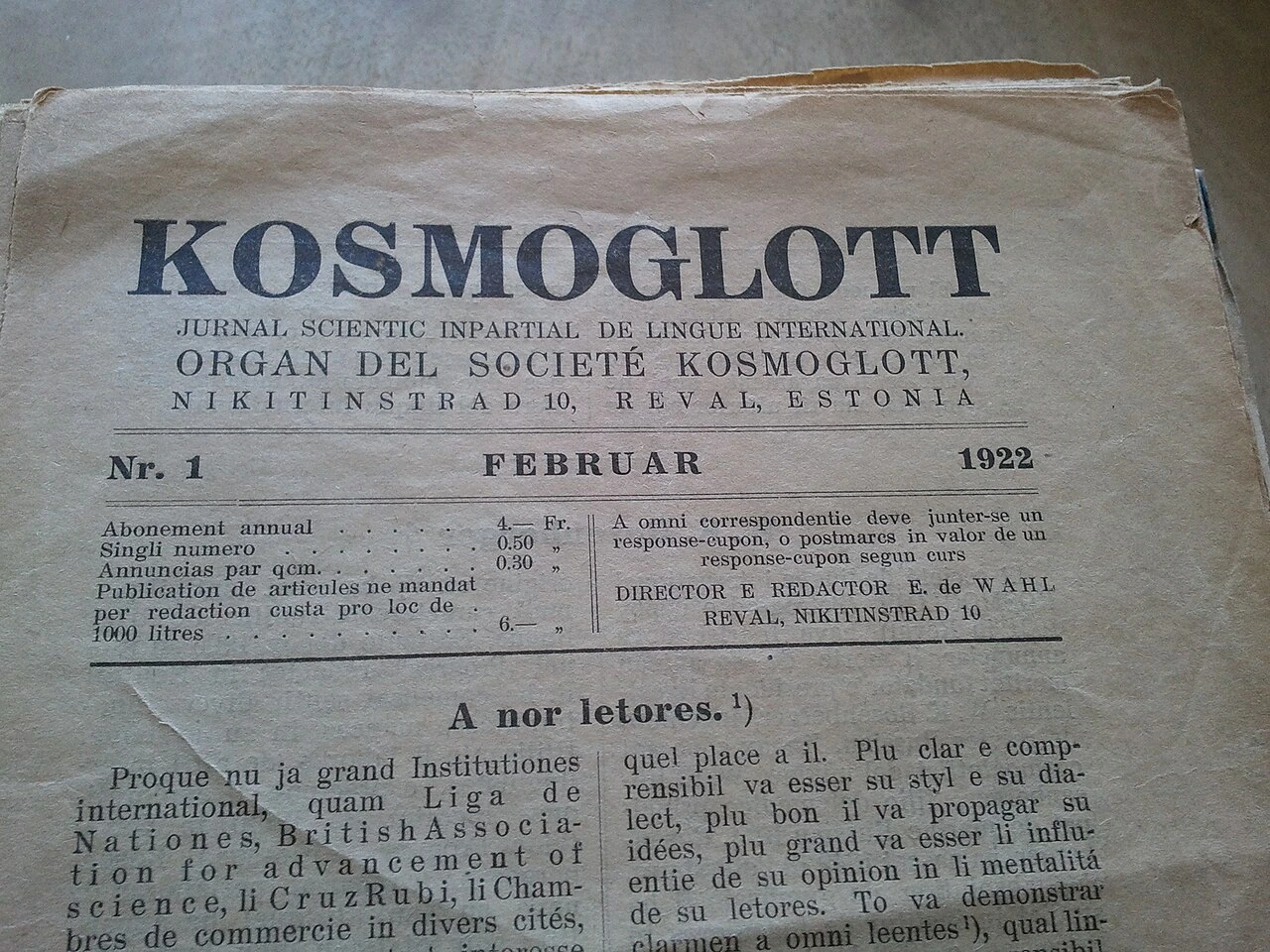
Photograph of the first issue of Kosmoglott, 1922, later renamed Cosmoglotta. Commons describes this as Edgar de Wahl’s publication announcing Occidental, later called Interlingue. Photographed in the CDELI archives in 2019.
Saved in Babelbook · resized display copy. Select the image to open it independently of its source.
David Droz (Milleuros) · Source ↗CC BY 4.0 ↗View the local visual field note
This constructed-language or category entry has no geographic reference points in the collection.
Reference & context ↗Babelbook · original editorial illustration · Babelbook original illustration
Source excerpts, selected, shortened and where noted editorially corrected from Interlingue by Wikipedia contributors. Retrieved 2026-10-05. CC BY-SA 4.0. These excerpts are not an independently verified scholarly history; missing accounts are identified above.
Read further in the source
Language standardization
During the war many Occidentalists took to standardizing the language. De Wahl had created Occidental with a number of unchangeable features, but believed that its following of the "laws of life" gave it a firm enough base that it could follow a "natural evolution" with a flexibility that would "allow time and practice to take care of modifications that would prove to be necessary". As a result, some words had more than one permissible form, which could not be resolved by decree alone, thus leaving the ultimate decision to the community by including both possible forms in the first Occidental dictionaries. One example concerned the verb scrir (to write) and a possible other form scripter, as both created internationally recognizable derivations: scritura and scritor from scrir, or scriptura and scriptor from scripter. De Wahl expressed a preference for scrir, finding scripter to be somewhat heavy, but commented that the latter was certainly permissible and that Occidental might take on a similar evolution to natural languages in which both forms come into common use, with the longer form having a heavier and formal character and the shorter form a lighter and more everyday tone (such as English story vs. history). Orthography was another area in which several possibilities existed, namely etymologic orthography (adtractiv, obpression), historic orthography (attractiv, oppression), or simplified orthography (atractiv, opression). The simplified orthography eventually became the standard by 1939. With questions still remaining about the official form of some words and a lack of general material destined for the general public, much time during World War II was spent on language standardization and course creation, and due to the continuing war, in August 1943 the decision was made to create an interim academy to officialize this process. This process had just about begun not long before the war, and the Swiss Occidentalists, finding themselves isolated from the rest of the continent, opted to concentrate on instructional materials to have ready by the end of the war.
Stagnation and revival
While the migration of so many users to Interlingua had severely weakened Interlingue, the ensuing drop in activity was gradual and took place over decades. Cosmoglotta B ceased publication after 1950, and the frequency of Cosmoglotta A began to gradually drop: once every second month from 1952, and then once per quarter from 1963. Other bulletins in Interlingue continued to appear during this time such as Cive del Munde (Switzerland), Voce de Praha (Czechoslovakia), Sved Interlinguist (Sweden), International Memorandum (United Kingdom), Interlinguistic Novas (France), Jurnale Scolari International (France), Buletine Pedagogic International (France), Super li Frontieras (France), Interlingue-Postillon (1958, Germany), Novas de Oriente (1958, Japan), Amicitie european (1959, Switzerland), Teorie e practica (Switzerland-Czechoslovakia, 1967), and Novas in Interlingue (Czechoslovakia, 1971). Barandovská-Frank believed that the ebb in interest in Occidental-Interlingue occurred in concert with the aging of the generation that was first drawn to it from other planned languages:
Most of those interested in Interlingue belonged to the generation that became acquainted in turn with Volapük, Esperanto and Ido, later on finding the most aesthetic (essentially naturalistic) solution in Occidental-Interlingue. Many subsequently moved to IALA's Interlingua, which however did not prove to be much more successful despite the impression its scientific origin made, and those who remained loyal to Occidental-Interlingue did not succeed in imparting their enthusiasm to a new generation. Activity in Interlingue reached a low during the 1980s and early 1990s, when Cosmoglotta publication ceased for a few years. While issue 269 was published in 1972 after publishing once per season between 1963, issue 289 was not reached until summer 2000 for an average of less than one issue per year. According to Harlow, "in 1985 Occidental's last periodical, Cosmoglotta, ceased publication, and its editor, Mr. Adrian Pilgrim, is quoted as having described Occidental as a 'dead language.'" A decade later, a documentary film in 1994 by Steve Hawley and Steyger on planned languages introduced Interlingue speaker Donald Gasper as "one of the last remaining speakers of the language Occidental". As was the case for other planned languages, the arrival of the Internet spurred Interlingue's revival. In the year 1999 the first Yahoo! Group in Occidental was founded, Cosmoglotta had begun publishing intermittently again, and the language became a subject of discussion in literature on auxiliary languages. One example is The Esperanto Book released in 1995 by Harlow, who wrote that Occidental had an intentional emphasis on European forms and that some of its leading followers espoused a Eurocentric philosophy, which may have hindered its spread. Still, the opposite view was also common in the community and Occidental gained adherents in many nations including Asian nations. An Interlingue Wikipedia was approved in 2004. In recent years official meetings of Interlingue speakers have resumed: one in Ulm in 2013, another in Munich in 2014 with three participants, and a third in Ulm the next year with five. The most recent edition of Cosmoglotta is volume 333, for the period from January to June 2024. Recent years have shown new books published in Interlingue such as The Little Prince, the Gospel of Mark, Salute, Jonathan!, and works including Li sercha in li castelle Dewahl e altri racontas, Antologie hispan, and Fabules, racontas e mites.
Orthography
Interlingue is written with 26 Latin letters: a, b, c, d, e, f, g, h, i, j, k, l, m, n, o, p, q, r, s, t, u, v, w, x, y, and z. The names of the letters are a, be, ce, de, e, ef, ge, ha, i, jot, ka, el, em, en, o, pe, qu, er, es, te, u, ve, duplic ve, ix, ypsilon, and zet. Accents are written on the five vowels to indicate irregular stress, with the acute accent (á é í ó ú) preferred, but others (è, ê, etc.) permitted.