Igbo
Igbo (English: EE-boh, US also IG-boh; Standard Igbo: Ásụ̀sụ́ Ìgbò [ásʊ̀sʊ̀ ìɡ͡bò] ) is the principal native language of the Igbo people, an ethnicity in the Southeastern part of Nigeria. Igbo languages are spoken by a total of 31 million people. The number of Igboid languages depends on how one classifies a language versus a dialect, so there could be around 35 different Igbo languages. The core Igbo cluster, or Igbo proper, is generally thought to be one language but there is limited mutual intelligibility between the different groupings (north, west, south and east). A standard literary language termed 'Igbo izugbe' (meaning "general igbo") was generically developed and later adopted around 1972, with its core foundation based on the Orlu (Isu dialects), Anambra (Awka dialects) and Umuahia (Ohuhu dialects), omitting the nasalization and aspiration of those varieties.
Translate in Igbo ↗Igbo (and its dialects) is the dominant language in the following Nigerian states: Abia State Anambra State Ebonyi State Enugu State Imo State Northern Delta State
Sub-Saharan Africa
Present-day use
The captured source does not contain a separate current-use account.
Origins
The captured article does not contain a separate origins section. See the historical account and linked source.
Development
The first book to publish Igbo terms was History of the Mission of the Evangelical Brothers in the Caribbean (German: Geschichte der Mission der Evangelischen Brüder auf den Carabischen Inseln), published in 1777. Shortly afterwards in 1789, The Interesting Narrative of the Life of Olaudah Equiano was published in London, England, written by Olaudah Equiano, who was a former slave, featuring 79 Igbo words. The narrative also illustrated various aspects of Igbo life in detail, based on Equiano's experiences in his hometown of Essaka. Following the British Niger Expeditions of 1854 and 1857, Samuel Ajayi Crowther, published an Igbo primer coded by a young Igbo missionary named Simon Jonas, who travelled with him to Aboh in 1857. The language was standardized in church usage by the Union Igbo Bible (1913). Central Igbo is based on the dialects of two members of the Ezinifite group of Igbo in Central Owerri Province between the towns of Owerri and Umuahia in Eastern Nigeria. From its proposal as a literary form in 1939 by Ida C. Ward, it was gradually accepted by missionaries, writers, and publishers across the region. Standard Igbo aims to cross-pollinate Central Igbo with words from other Igbo dialects, with the adoption of loan words. Chinua Achebe passionately denounced language standardization efforts, beginning with Union Igbo through to Central and finally Standard Igbo, in a 1999 lecture sponsored by the Roman Catholic Archdiocese in Owerri. Historically, the Igbo language was spoken by a large number of enslaved people trafficked to the Americas from the bight of biafra, during the Atlantic Slave Trade. Before the existence of any official system of orthography for the Igbo language, travelers and writers documented Igbo sounds by utilizing the orthographies of their own languages in transcribing them, though they encountered difficulty representing particular sounds, such as implosives, labialized velars, syllabic nasals, and non-expanded vowels.
Writing
The Igbo people adopted Nsibidi ideograms from neighbors such as the Ekoi or Ejegham people, which are symbolic but can also be used as proto-writing. Nsibidi is an ancient system of graphic communication indigenous to peoples in southeastern Nigeria and southwestern Cameroon in the Cross River region. It is also used by neighboring Ekoi, Ejegham, Efik, and Ibibio peoples. They have been used since at least the 16th century, under the Aro Confederacy, but died out publicly after they became popular amongst secret societies such as the Ekpe, who used them as a secret form of communication. Nsibidi, however, is not a full writing system, because it cannot transcribe the Igbo language specifically. In 1960, a rural land owner and dibia named Nwagu Aneke developed a syllabary for the Umuleri dialect of Igbo, the script, named after him as the Nwagu Aneke script, was used to write hundreds of diary entries until Aneke's death in 1991. The Nwagu Aneke Project is working on translating Nwagu's commentary and diary. Before the existence of any official system of orthography for the Igbo language, travelers and writers documented Igbo sounds by utilizing the orthographies of their own languages in transcribing them, though they encountered difficulty representing particular sounds, such as implosives, labialized velars, syllabic nasals, and non-expanded vowels. In the 1850s, German philologist Karl Richard Lepsius published the Standard Alphabet, which was universal to all languages of the world, and became the first Igbo orthography. It contained 34 letters and included digraphs and diacritical marks to transcribe sounds distinct to African languages. The Lepsius Standard Alphabet contained the following letters: a b d e f g h i k l m n o p r s t u v w y z gb gh gw kp kw ṅ nw ny ọ s ds ts The Lepsius orthography was replaced by the Practical Orthography of African Languages (Africa Orthography) in 1929 by the colonial government in Nigeria.
Beyond the typeface.
Signs, manuscripts, published pages and contextual photographs, with their place, period, source and reuse terms. Captions identify historical spellings, regional examples, community references and character imagery.
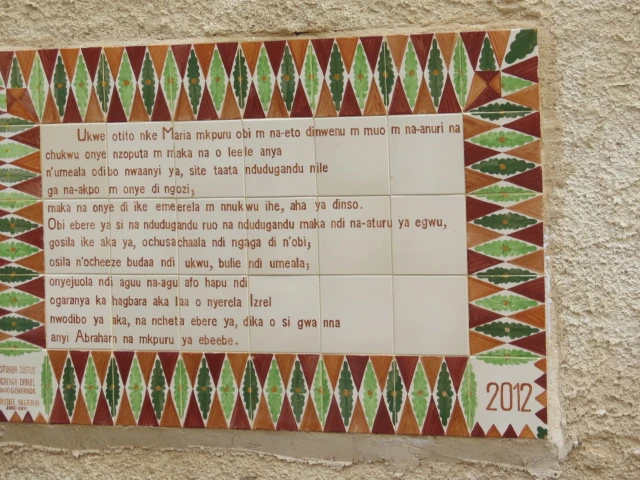
Igbo-text plaque at the Church of the Visitation in Jerusalem, photographed on 27 January 2015. Identification follows the explicit Commons Igbo text classification; not independently transcribed.
Saved in Babelbook · resized display copy. Select the image to open it independently of its source.
Hoshvilim · Source ↗CC BY-SA 4.0 ↗View the local visual field note
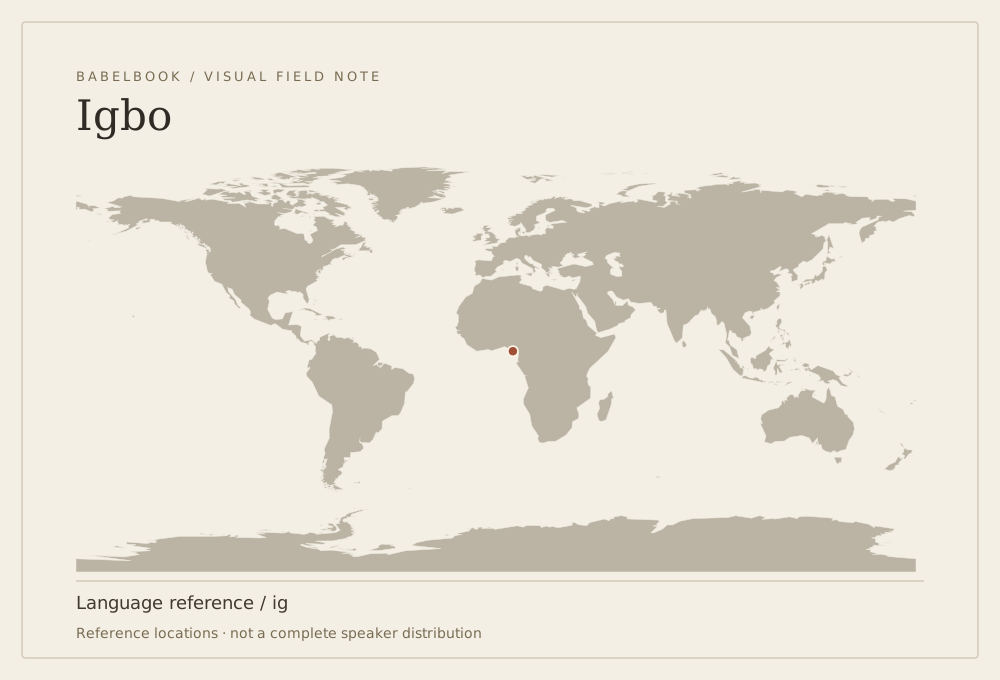
Representative reference points from Glottolog. Historical entries show reference locations, not current speakers. 1 point.
Reference & context ↗Babelbook · original editorial illustration · CC BY 4.0 · Glottolog locations; public-domain Natural Earth land
Source excerpts, selected, shortened and where noted editorially corrected from Igbo language by Wikipedia contributors. Retrieved 2026-10-05. CC BY-SA 4.0. These excerpts are not an independently verified scholarly history; missing accounts are identified above.
Read further in the source
History
The first book to publish Igbo terms was History of the Mission of the Evangelical Brothers in the Caribbean (German: Geschichte der Mission der Evangelischen Brüder auf den Carabischen Inseln), published in 1777. Shortly afterwards in 1789, The Interesting Narrative of the Life of Olaudah Equiano was published in London, England, written by Olaudah Equiano, who was a former slave, featuring 79 Igbo words. The narrative also illustrated various aspects of Igbo life in detail, based on Equiano's experiences in his hometown of Essaka. Following the British Niger Expeditions of 1854 and 1857, Samuel Ajayi Crowther, published an Igbo primer coded by a young Igbo missionary named Simon Jonas, who travelled with him to Aboh in 1857. The language was standardized in church usage by the Union Igbo Bible (1913). Central Igbo is based on the dialects of two members of the Ezinifite group of Igbo in Central Owerri Province between the towns of Owerri and Umuahia in Eastern Nigeria. From its proposal as a literary form in 1939 by Ida C. Ward, it was gradually accepted by missionaries, writers, and publishers across the region. Standard Igbo aims to cross-pollinate Central Igbo with words from other Igbo dialects, with the adoption of loan words. Chinua Achebe passionately denounced language standardization efforts, beginning with Union Igbo through to Central and finally Standard Igbo, in a 1999 lecture sponsored by the Roman Catholic Archdiocese in Owerri. Historically, the Igbo language was spoken by a large number of enslaved people trafficked to the Americas from the bight of biafra, during the Atlantic Slave Trade.
Distribution
Igbo (and its dialects) is the dominant language in the following Nigerian states:
Abia State Anambra State Ebonyi State Enugu State Imo State Northern Delta State
Writing system
The Igbo people adopted Nsibidi ideograms from neighbors such as the Ekoi or Ejegham people, which are symbolic but can also be used as proto-writing. Nsibidi is an ancient system of graphic communication indigenous to peoples in southeastern Nigeria and southwestern Cameroon in the Cross River region. It is also used by neighboring Ekoi, Ejegham, Efik, and Ibibio peoples. They have been used since at least the 16th century, under the Aro Confederacy, but died out publicly after they became popular amongst secret societies such as the Ekpe, who used them as a secret form of communication. Nsibidi, however, is not a full writing system, because it cannot transcribe the Igbo language specifically. In 1960, a rural land owner and dibia named Nwagu Aneke developed a syllabary for the Umuleri dialect of Igbo, the script, named after him as the Nwagu Aneke script, was used to write hundreds of diary entries until Aneke's death in 1991. The Nwagu Aneke Project is working on translating Nwagu's commentary and diary.
History of Igbo orthography
Before the existence of any official system of orthography for the Igbo language, travelers and writers documented Igbo sounds by utilizing the orthographies of their own languages in transcribing them, though they encountered difficulty representing particular sounds, such as implosives, labialized velars, syllabic nasals, and non-expanded vowels. In the 1850s, German philologist Karl Richard Lepsius published the Standard Alphabet, which was universal to all languages of the world, and became the first Igbo orthography. It contained 34 letters and included digraphs and diacritical marks to transcribe sounds distinct to African languages. The Lepsius Standard Alphabet contained the following letters:
a b d e f g h i k l m n o p r s t u v w y z gb gh gw kp kw ṅ nw ny ọ s ds ts The Lepsius orthography was replaced by the Practical Orthography of African Languages (Africa Orthography) in 1929 by the colonial government in Nigeria. The new orthography, created by the International Institute of African Languages and Cultures (IIALC), had 36 letters and disposed of diacritic marks. Numerous controversial issues with the new orthography eventually led to its replacement in the early 1960s. The Africa Orthography contained the following letters:
a b c d e f g gb gh h i j k kp l m n ŋ ny o ɔ ɵ p r s t u w y z gw kw nw
Other orthographies
A variety of issues have made agreement on a standardized orthography for the Igbo language difficult. In 1976, the Igbo Standardization Committee criticized the official orthography in light of the difficulty notating diacritic marks using typewriters and computers; difficulty in accurately representing tone with tone-marking conventions, as they are subject to change in different environments; and the inability to capture various sounds particular to certain Igbo dialects. The Committee produced a modified version of the Ọnwụ orthography, called the New Standard Orthography, which substituted ⟨ö⟩ and ⟨ü⟩ for ⟨ọ⟩ and ⟨ụ⟩, ⟨c⟩ for ⟨ch⟩, and ⟨ñ⟩ for ⟨ṅ⟩. The New Standard Orthography has not been widely adopted, although it was used, for example, in the 1998 Igbo English Dictionary by Michael Echeruo. More recent calls for reform have been based in part on the rogue use of alphabetic symbols, tonal notations, and spelling conventions that deviate from the standard orthography. There are also some modern movements to restore the use of and modernize nsibidi as a writing system, which mostly focus on Igbo as it is the most populous language that used to use nsibidi.