Sichuan Yi
Nuosu or Nosu (ꆈꌠꉙ or written in traditional script, transcribed as Nuo su hxop), also known as Northern Yi, Liangshan Yi, and Sichuan Yi, is the prestige language of the Yi people; it has been chosen by the Chinese government as the standard Yi language (Chinese: 彝语) and as such is the only one taught in schools in both oral and written forms. It is spoken by two million people and is increasing (as of PRC census); 60% were monolingual (1994 estimate). Nuosu is the native Nuosu name for their own language and is not used in Mandarin Chinese, though it may sometimes be translated as Nuòsūyǔ (simplified Chinese: 诺苏语; traditional Chinese: 諾蘇語). The occasional terms 'Black Yi' (黑彝; hēi Yí) and 'White Yi' (白彝; bái Yí) are castes of the Nuosu people, not dialects. Nuosu is one of several often mutually unintelligible varieties known as Yi, Lolo, Moso, or Noso. The six Yi languages recognized by the Chinese government have only 25% to 50% of their vocabulary in common. They share a common traditional writing system, but that is used for shamanism, rather than daily accounting. According to the Encyclopedia Britannica, it is one of the eight Tibeto-Burman languages with over 1,000,000 speakers (others being Burmese, Tibetan, Meitei, Bai, Karen, Hani, Jingpo).
Translate in Sichuan Yi ↗Nuosu is mainly spoken in the Liangshan Yi Autonomous Prefecture, Sichuan. There are other parts of Sichuan where Yi is spoken, including Panzhihua and Leshan. In Yunnan, Northern Yi (Nuosu) is spoken in the north.
East Asia
Present-day use
The captured source does not contain a separate current-use account.
Origins
The captured article does not contain a separate origins section. See the historical account and linked source.
Development
The captured article does not contain a distinct historical account. No chronology has been invented.
Writing
Classic Yi is a syllabic logographic system of 8,000–10,000 glyphs. Although similar to Chinese characters in function, the glyphs are independent in form, with little to suggest a direct relation. In 1958 the Chinese government had introduced a Roman-based alphabet based on the romanized script of Gladstone Porteous of Sayingpan. This was later replaced by the Modern Yi script. The Modern Yi script (ꆈꌠꁱꂷ nuosu bburma [nɔ̄sū bʙ̝̄mā] 'Nosu script') is a standardized syllabary derived from the classic script in 1974. It was made the official script of the Yi languages in 1980. There are 756 basic glyphs based on the Liangshan dialect, plus 63 for syllables only found in Chinese borrowings. The government requires the use of the script for signs in some designated public places.
Beyond the typeface.
Signs, manuscripts, published pages and contextual photographs, with their place, period, source and reuse terms. Captions identify historical spellings, regional examples, community references and character imagery.
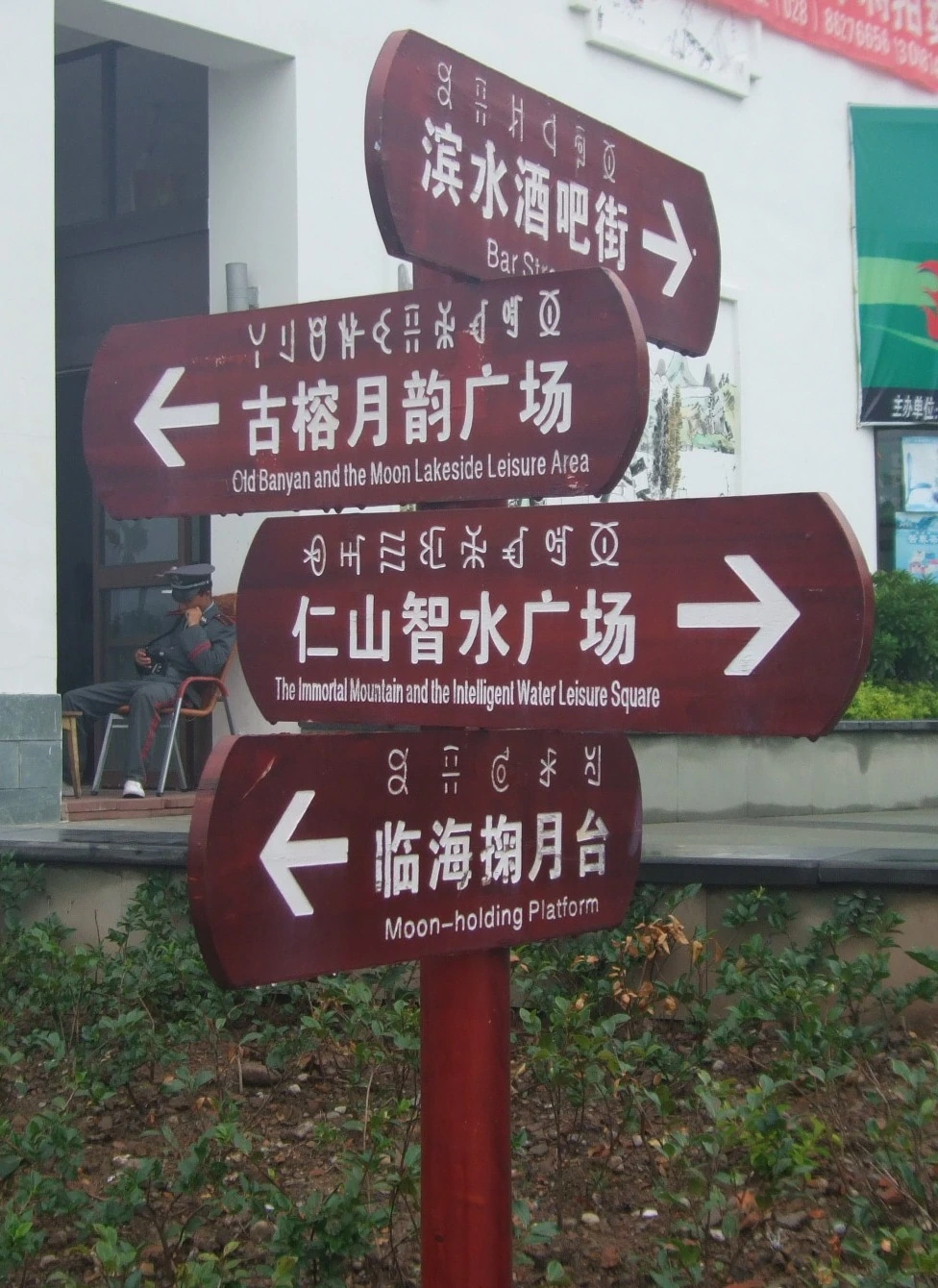
A park sign in Xichang with Nuosu (Sichuan Yi), Chinese and English writing; the source explicitly identifies Nuosu.
Saved in Babelbook · resized display copy. Select the image to open it independently of its source.
DGold · Source ↗Public domain ↗View the local visual field note
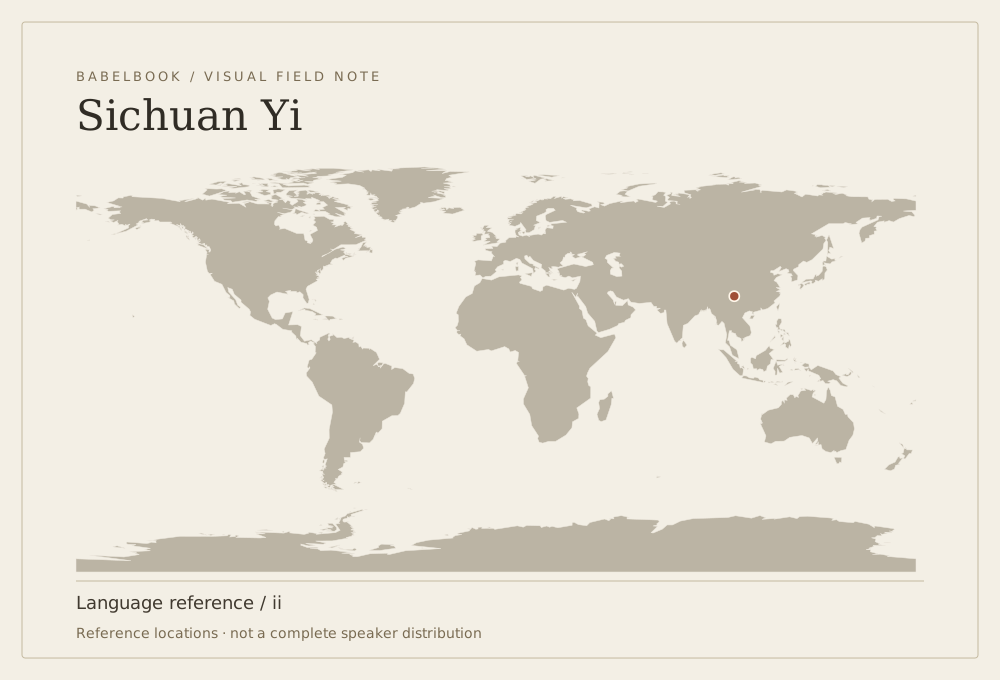
Representative reference points from Glottolog. Historical entries show reference locations, not current speakers. 1 point.
Reference & context ↗Babelbook · original editorial illustration · CC BY 4.0 · Glottolog locations; public-domain Natural Earth land
Source excerpts, selected, shortened and where noted editorially corrected from Nuosu language by Wikipedia contributors. Retrieved 2026-10-05. CC BY-SA 4.0. These excerpts are not an independently verified scholarly history; missing accounts are identified above.
Read further in the source
Distribution
Nuosu is mainly spoken in the Liangshan Yi Autonomous Prefecture, Sichuan. There are other parts of Sichuan where Yi is spoken, including Panzhihua and Leshan. In Yunnan, Northern Yi (Nuosu) is spoken in the north.
Writing system
Classic Yi is a syllabic logographic system of 8,000–10,000 glyphs. Although similar to Chinese characters in function, the glyphs are independent in form, with little to suggest a direct relation. In 1958 the Chinese government had introduced a Roman-based alphabet based on the romanized script of Gladstone Porteous of Sayingpan. This was later replaced by the Modern Yi script. The Modern Yi script (ꆈꌠꁱꂷ nuosu bburma [nɔ̄sū bʙ̝̄mā] 'Nosu script') is a standardized syllabary derived from the classic script in 1974. It was made the official script of the Yi languages in 1980. There are 756 basic glyphs based on the Liangshan dialect, plus 63 for syllables only found in Chinese borrowings. The government requires the use of the script for signs in some designated public places.