Inupiaq
Iñupiaq or Inupiaq ( ih-NOO-pee-ak, Inupiaq: [iɲupiaq]), also known as Iñupiat, Inupiat ( ih-NOO-pee-at), Iñupiatun or Alaskan Inuit, is an Inuit language, or perhaps group of languages, spoken by the Iñupiat people in northern and northwestern Alaska, as well as a small adjacent part of the Northwest Territories of Canada. The Iñupiat language is a member of the Inuit–Yupik–Unangan language family, and is closely related and, to varying degrees, mutually intelligible with other Inuit languages of Canada and Greenland. There are roughly 2,000 speakers. Iñupiaq is considered to be a threatened language, with most speakers at or above the age of 40. Iñupiaq is an official language of the State of Alaska, along with several other indigenous languages. The major varieties of the Iñupiaq language are the North Slope Iñupiaq and Seward Peninsula Iñupiaq dialects. The Iñupiaq language has been in decline since contact with English in the late 19th century. American territorial acquisition and the legacy of boarding schools have created a situation today where a small minority of Iñupiat speak the Iñupiaq language. There is, however, revitalization work underway today in several communities.
Translate in Inupiaq ↗Iñupiaq or Inupiaq ( ih-NOO-pee-ak, Inupiaq: [iɲupiaq]), also known as Iñupiat, Inupiat ( ih-NOO-pee-at), Iñupiatun or Alaskan Inuit, is an Inuit language, or perhaps group of languages, spoken by the Iñupiat people in northern and northwestern Alaska, as well as a small adjacent part of the Northwest Territories of Canada. The Iñupiat language is a member of the Inuit–Yupik–Unangan language family, and is closely related and, to varying degrees, mutually intelligible with other Inuit languages of Canada and Greenland. There are roughly 2,000 speakers. Iñupiaq is considered to be a threatened language, with most speakers at or above the age of 40. Iñupiaq is an official language of the State of Alaska, along with several other indigenous languages. The major varieties of the Iñupiaq language are the North Slope Iñupiaq and Seward Peninsula Iñupiaq dialects. The Iñupiaq language has been in decline since contact with English in the late 19th century. American territorial acquisition and the legacy of boarding schools have created a situation today where a small minority of Iñupiat speak the Iñupiaq language. There is, however, revitalization work underway today in several communities.
North America
Present-day use
The captured source does not contain a separate current-use account.
Origins
The numeral five, tallimat, is derived from the word for hand/arm. The word for 10, qulit, is derived from the word for "top", meaning the ten digits on the top part of the body. The numeral for 15, akimiaq, means something like "it goes across", and the numeral for 20, iñuiññaq means something like "entire person" or "complete person", indicating the 20 digits of all extremities.
Development
The Iñupiaq language is an Inuit language, the ancestors of which may have been spoken in the northern regions of Alaska for as long as 5,000 years. Between 1,000 and 800 years ago, Inuit migrated east from Alaska to Canada and Greenland, eventually occupying the entire Arctic coast and much of the surrounding inland areas. The Iñupiaq dialects are the most conservative forms of the Inuit language, with less linguistic change than the other Inuit languages. In the mid to late 19th century, Russian, British, and American colonists made contact with Iñupiat people. In 1885, the American territorial government appointed Rev. Sheldon Jackson as General Agent of Education. Under his administration, Iñupiat people (and all Alaska Natives) were educated in English-only environments, forbidding the use of Iñupiaq and other indigenous languages of Alaska. After decades of English-only education, with strict punishment if heard speaking Iñupiaq, after the 1970s, most Iñupiat did not pass the Iñupiaq language on to their children, for fear of them being punished for speaking their language. In 1972, the Alaska Legislature passed legislation mandating that if "a [school is attended] by at least 15 pupils whose primary language is other than English, [then the school] shall have at least one teacher who is fluent in the native language". Today, the University of Alaska Fairbanks offers bachelor's degrees in Iñupiaq language and culture, while a preschool/kindergarten-level Iñupiaq immersion school named Nikaitchuat Iḷisaġviat teaches grades PreK–1st grade in Kotzebue. In 2014, Iñupiaq became an official language of the State of Alaska, alongside English and nineteen other indigenous languages. In the same year, Iñupiat linguist and educator Edna Ahgeak MacLean published an Iñupiaq–English grammar and dictionary with over 19,000 entries. An online version was later released by her. In 2018, Facebook added Iñupiaq as a language option on their website.
Writing
Iñupiaq was first written when explorers first arrived in Alaska and began recording words in the native languages. They wrote by adapting the letters of their own language to writing the sounds they were recording. Spelling was often inconsistent, since the writers invented it as they wrote. Unfamiliar sounds were often confused with other sounds, so that, for example, 'q' was often not distinguished from 'k' and long consonants or vowels were not distinguished from short ones. Along with the Alaskan and Siberian Yupik, the Iñupiat eventually adopted the Latin script that Moravian missionaries developed in Greenland and Labrador. Native Alaskans also developed a system of pictographs, which, however, died with its creators. In 1946, Roy Ahmaogak, an Iñupiaq Presbyterian minister from Utqiaġvik, worked with Eugene Nida, a member of the Summer Institute of Linguistics, to develop the current Iñupiaq alphabet based on the Latin script. Although some changes have been made since its origin—most notably the change from 'ḳ' to 'q'—the essential system was accurate and is still in use. Extra letter for Kobuk dialect: ʼ /ʔ/ Extra letters for specific dialects: Diomede: e /ə/ Qawiaraq: ch /tʃ/
Beyond the typeface.
Signs, manuscripts, published pages and contextual photographs, with their place, period, source and reuse terms. Captions identify historical spellings, regional examples, community references and character imagery.
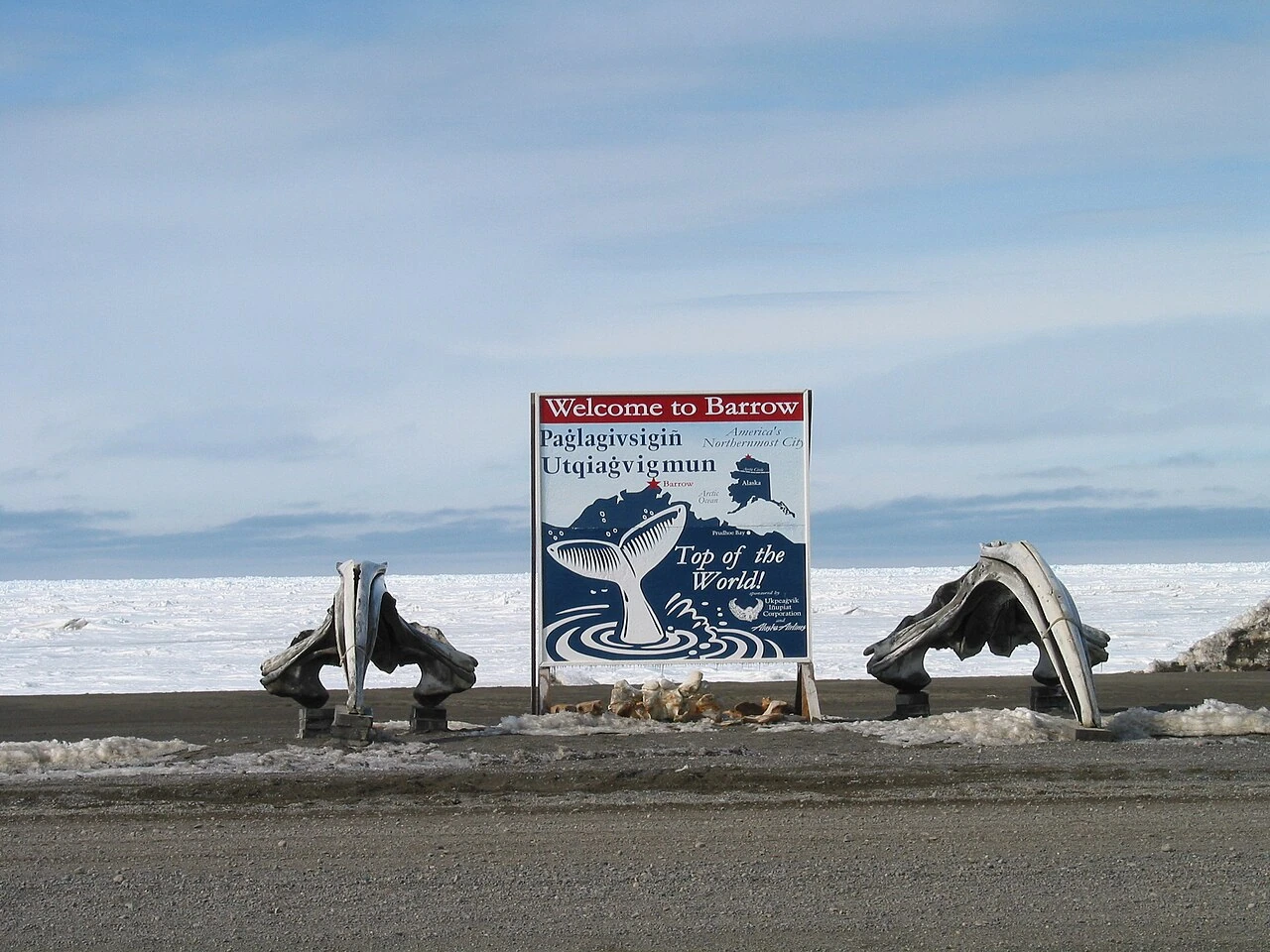
An English and Iñupiaq welcome sign in Utqiaġvik, photographed when the city was named Barrow.
Saved in Babelbook · resized display copy. Select the image to open it independently of its source.
Bob Johnston · Source ↗CC BY 2.0 ↗View the local visual field note
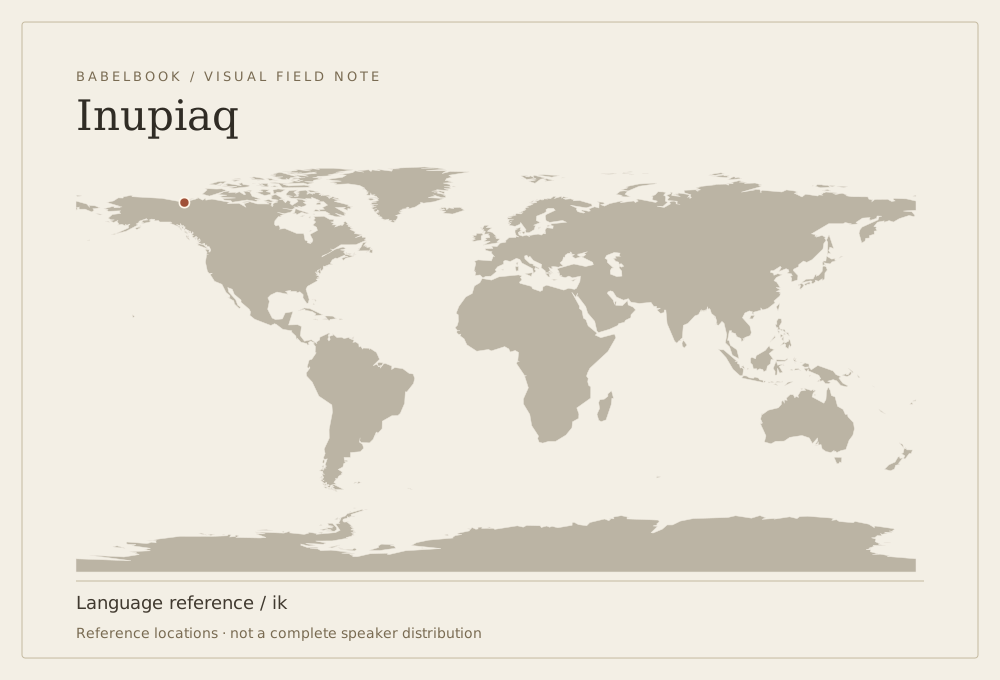
Representative reference points from Glottolog. Historical entries show reference locations, not current speakers. 1 point.
Reference & context ↗Babelbook · original editorial illustration · CC BY 4.0 · Glottolog locations; public-domain Natural Earth land
Source excerpts, selected, shortened and where noted editorially corrected from Iñupiaq language by Wikipedia contributors. Retrieved 2026-10-05. CC BY-SA 4.0. These excerpts are not an independently verified scholarly history; missing accounts are identified above.
Read further in the source
History
The Iñupiaq language is an Inuit language, the ancestors of which may have been spoken in the northern regions of Alaska for as long as 5,000 years. Between 1,000 and 800 years ago, Inuit migrated east from Alaska to Canada and Greenland, eventually occupying the entire Arctic coast and much of the surrounding inland areas. The Iñupiaq dialects are the most conservative forms of the Inuit language, with less linguistic change than the other Inuit languages. In the mid to late 19th century, Russian, British, and American colonists made contact with Iñupiat people. In 1885, the American territorial government appointed Rev. Sheldon Jackson as General Agent of Education. Under his administration, Iñupiat people (and all Alaska Natives) were educated in English-only environments, forbidding the use of Iñupiaq and other indigenous languages of Alaska. After decades of English-only education, with strict punishment if heard speaking Iñupiaq, after the 1970s, most Iñupiat did not pass the Iñupiaq language on to their children, for fear of them being punished for speaking their language. In 1972, the Alaska Legislature passed legislation mandating that if "a [school is attended] by at least 15 pupils whose primary language is other than English, [then the school] shall have at least one teacher who is fluent in the native language". Today, the University of Alaska Fairbanks offers bachelor's degrees in Iñupiaq language and culture, while a preschool/kindergarten-level Iñupiaq immersion school named Nikaitchuat Iḷisaġviat teaches grades PreK–1st grade in Kotzebue. In 2014, Iñupiaq became an official language of the State of Alaska, alongside English and nineteen other indigenous languages. In the same year, Iñupiat linguist and educator Edna Ahgeak MacLean published an Iñupiaq–English grammar and dictionary with over 19,000 entries. An online version was later released by her. In 2018, Facebook added Iñupiaq as a language option on their website. In 2022, an Iñupiaq version of Wordle was created.
Dialects
There are four main dialect divisions and these can be organized within two larger dialect collections:
Extra geographical information: Bering Strait dialect: The Native population of the Big Diomede Island was moved to the Siberian mainland after World War II. The following generation of the population spoke Central Siberian Yupik or Russian. The entire population of King Island moved to Nome in the early 1960s. The Bering Strait dialect might also be spoken in Teller on the Seward Peninsula. Qawiaraq dialect: A dialect of Qawiaraq is spoken in Nome. A dialect of Qawariaq may also be spoken in Koyuk, Mary's Igloo, Council, and Elim. The Teller sub-dialect may be spoken in Unalakleet. Malimiutun dialect: Both sub-dialects can be found in Buckland, Koyuk, Shaktoolik, and Unalakleet. A dialect of Malimiutun may be spoken in Deering, Kiana, Noorvik, Shungnak, and Ambler. The Malimiutun sub-dialects have also been classified as "Southern Malimiut" (found in Koyuk, Shaktoolik, and Unalakleet) and "Northern Malimiut" found in "other villages". North Slope dialect: Common North Slope is "a mix of the various speech forms formerly used in the area". The Point Barrow dialect was "spoken only by a few elders" in 2010. A dialect of North Slope is also spoken in Kivalina, Point Lay, Wainwright, Atqasuk, Utqiaġvik, Nuiqsut, and Barter Island.
Writing systems
Iñupiaq was first written when explorers first arrived in Alaska and began recording words in the native languages. They wrote by adapting the letters of their own language to writing the sounds they were recording. Spelling was often inconsistent, since the writers invented it as they wrote. Unfamiliar sounds were often confused with other sounds, so that, for example, 'q' was often not distinguished from 'k' and long consonants or vowels were not distinguished from short ones. Along with the Alaskan and Siberian Yupik, the Iñupiat eventually adopted the Latin script that Moravian missionaries developed in Greenland and Labrador. Native Alaskans also developed a system of pictographs, which, however, died with its creators. In 1946, Roy Ahmaogak, an Iñupiaq Presbyterian minister from Utqiaġvik, worked with Eugene Nida, a member of the Summer Institute of Linguistics, to develop the current Iñupiaq alphabet based on the Latin script. Although some changes have been made since its origin—most notably the change from 'ḳ' to 'q'—the essential system was accurate and is still in use.
Extra letter for Kobuk dialect: ʼ /ʔ/
Extra letters for specific dialects:
Diomede: e /ə/ Qawiaraq: ch /tʃ/