Icelandic
Icelandic ( ice-LAN-dick; endonym: íslenska, pronounced [ˈi(ː)stlɛnska] , íslensk tunga [ˈi(ː)stlɛnsk ˈtʰuŋka]) is a North Germanic language from the Indo-European language family spoken by about 390,000 people, the vast majority of whom live in Iceland, where it is the national language. Since it is a West Scandinavian language, it is most closely related to Faroese, western Norwegian dialects, and the extinct language Norn. It is not mutually intelligible with the continental Scandinavian languages (Danish, Norwegian, and Swedish) and is more distinct from the most widely spoken Germanic languages, English and German. The written forms of Icelandic and Faroese are very similar, but their spoken forms are not mutually intelligible. The Icelandic language is more conservative than most other Germanic languages. Most have greatly reduced levels of inflection (particularly noun declension), but Icelandic retains a four-case synthetic grammar (comparable to German, though considerably more conservative and synthetic) and is distinguished by a wide assortment of irregular declensions.
Translate in Icelandic ↗According to an act passed by the Parliament in 2011, Icelandic is "the national language of the Icelandic people and the official language in Iceland"; moreover, "[p]ublic authorities shall ensure that its use is possible in all areas of Icelandic society". Iceland is a member of the Nordic Council, a forum for co-operation between the Nordic countries, but the council uses only Danish, Norwegian, and Swedish as its working languages (although the council does publish material in Icelandic). Under the Nordic Language Convention, since 1987 Icelandic citizens have had the right to use Icelandic when interacting with official bodies in other Nordic countries, without becoming liable for any interpretation or translation costs. The convention covers visits to hospitals, job centres, the police, and social security offices. It does not have much effect since it is not very well known and because those Icelanders not proficient in the other Scandinavian languages often have a sufficient grasp of English to communicate with institutions in that language (although there is evidence that the general English skills of Icelanders have been somewhat overestimated). The Nordic countries have committed to providing services in various languages to each other's citizens, but this does not amount to any absolute rights being granted, except as regards criminal and court matters.
Europe
Present-day use
According to an act passed by the Parliament in 2011, Icelandic is "the national language of the Icelandic people and the official language in Iceland"; moreover, "[p]ublic authorities shall ensure that its use is possible in all areas of Icelandic society". Iceland is a member of the Nordic Council, a forum for co-operation between the Nordic countries, but the council uses only Danish, Norwegian, and Swedish as its working languages (although the council does publish material in Icelandic). Under the Nordic Language Convention, since 1987 Icelandic citizens have had the right to use Icelandic when interacting with official bodies in other Nordic countries, without becoming liable for any interpretation or translation costs. The convention covers visits to hospitals, job centres, the police, and social security offices. It does not have much effect since it is not very well known and because those Icelanders not proficient in the other Scandinavian languages often have a sufficient grasp of English to communicate with institutions in that language (although there is evidence that the general English skills of Icelanders have been somewhat overestimated). The Nordic countries have committed to providing services in various languages to each other's citizens, but this does not amount to any absolute rights being granted, except as regards criminal and court matters.
Origins
The captured article does not contain a separate origins section. See the historical account and linked source.
Development
Around 900 CE, the language spoken in the Faroes was Old Norse, which Norse settlers had brought with them during the time of the settlement of Faroe Islands (landnám) that began in 825. However, many of the settlers were not from Scandinavia, but descendants of Norse settlers in the Irish Sea region. In addition, women from Norse Ireland, Orkney, or Shetland often married native Scandinavian men before settling in the Faroe Islands and Iceland. The oldest preserved texts in Icelandic were written around 1100. Many of the texts are based on poetry and laws traditionally preserved orally. The most famous of the texts, which were written in Iceland from the 12th century onward, are the sagas of Icelanders, which encompass the historical works and the Poetic Edda. The language of the sagas is Old Icelandic, a western dialect of Old Norse. The Dano-Norwegian, then later Danish rule of Iceland from 1536 to 1918 had little effect on the evolution of Icelandic (in contrast to the Norwegian language), which remained in daily use among the general population. Though more archaic than the other living Germanic languages, Icelandic changed markedly in pronunciation from the 12th to the 16th century, especially in vowels (in particular, á, æ, au, and y/ý). The letters -ý & -y lost their original meaning and merged with -í & -i in the period 1400–1600. Around the same time or a little earlier the letter -æ originally signifying a simple vowel, a type of open -e, formed into the double vowel -ai, a double vowel absent in the original Icelandic. The modern Icelandic alphabet has developed from a standard established in the 19th century, primarily by the Danish linguist Rasmus Rask. It is based strongly on an orthography laid out in the early 12th century by a document referred to as the First Grammatical Treatise by an anonymous author, who has later been referred to as the First Grammarian.
Writing
The Icelandic alphabet is notable for its retention of three old letters that no longer exist in the English alphabet: Þ, þ (þorn, modern English "thorn"), Ð, ð (eð, anglicised as "eth" or "edh") and Æ, æ (æsc, anglicised as "ash" or "asc"), with þ and ð representing the voiceless and voiced "th" sounds (as in English thin and this), respectively, and æ representing the diphthong /ai/ (as in English ride). The complete Icelandic alphabet is: The letters with diacritics, such as á and ö, are for the most part treated as separate letters and not variants of their derivative vowels. The letter é officially replaced je in 1929, although it had been used in early manuscripts (until the 14th century) and again periodically from the 18th century. The letter z was originally in the Icelandic alphabet, but it was retired in 1973, and gradually stopped being used after the 1980s, except in foreign imports and people's names.
Beyond the typeface.
Signs, manuscripts, published pages and contextual photographs, with their place, period, source and reuse terms. Captions identify historical spellings, regional examples, community references and character imagery.
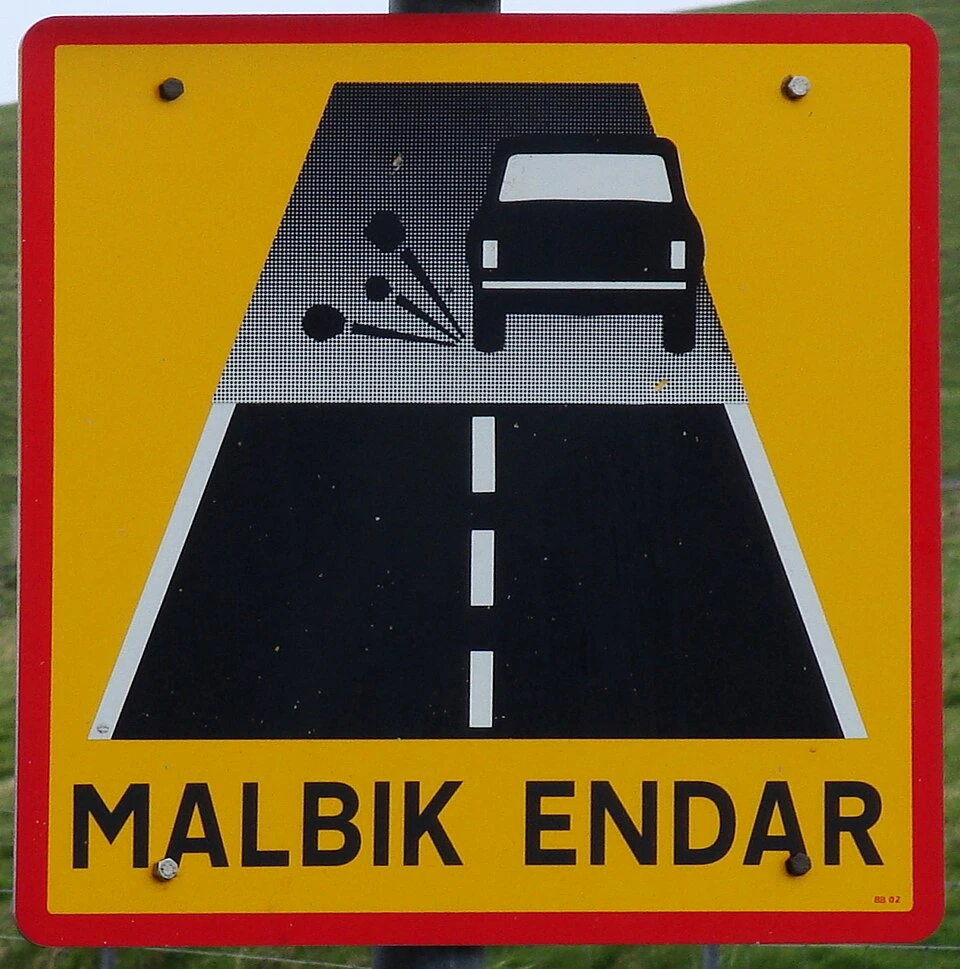
Icelandic “End of Paved Road” sign near Vík; perspective corrected photograph. Language identification follows the source description; not independently transcribed.
Saved in Babelbook · resized display copy. Select the image to open it independently of its source.
(WT-shared) Grunkhead · Source ↗CC BY-SA 3.0 ↗View the local visual field note
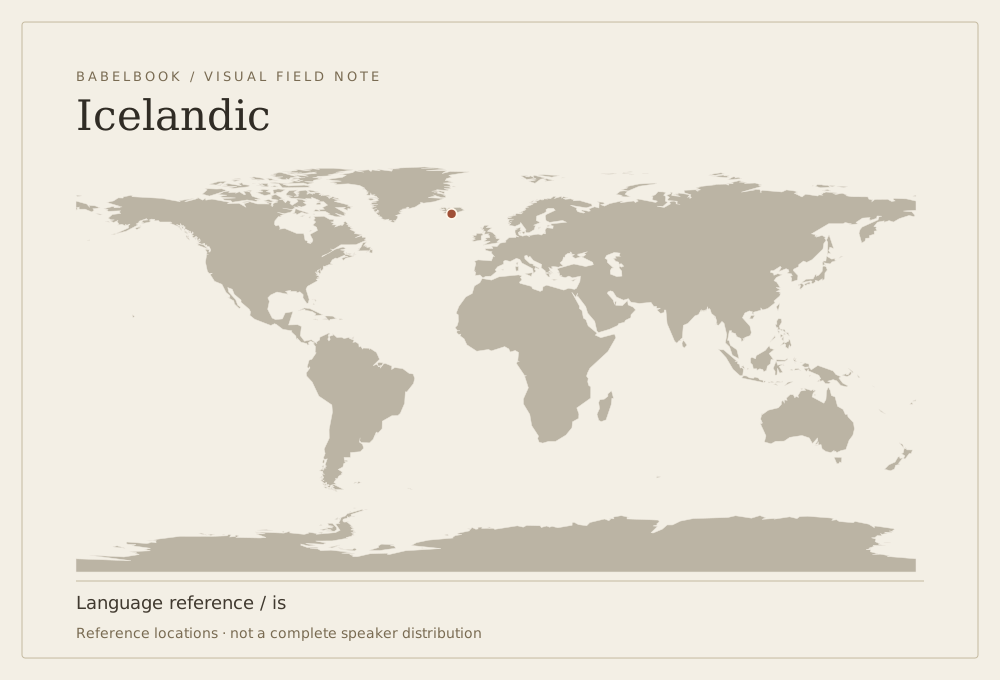
Representative reference points from Glottolog. Historical entries show reference locations, not current speakers. 1 point.
Reference & context ↗Babelbook · original editorial illustration · CC BY 4.0 · Glottolog locations; public-domain Natural Earth land
Source excerpts, selected, shortened and where noted editorially corrected from Icelandic language by Wikipedia contributors. Retrieved 2026-10-05. CC BY-SA 4.0. These excerpts are not an independently verified scholarly history; missing accounts are identified above.
Read further in the source
History
Around 900 CE, the language spoken in the Faroes was Old Norse, which Norse settlers had brought with them during the time of the settlement of Faroe Islands (landnám) that began in 825. However, many of the settlers were not from Scandinavia, but descendants of Norse settlers in the Irish Sea region. In addition, women from Norse Ireland, Orkney, or Shetland often married native Scandinavian men before settling in the Faroe Islands and Iceland. The oldest preserved texts in Icelandic were written around 1100. Many of the texts are based on poetry and laws traditionally preserved orally. The most famous of the texts, which were written in Iceland from the 12th century onward, are the sagas of Icelanders, which encompass the historical works and the Poetic Edda. The language of the sagas is Old Icelandic, a western dialect of Old Norse. The Dano-Norwegian, then later Danish rule of Iceland from 1536 to 1918 had little effect on the evolution of Icelandic (in contrast to the Norwegian language), which remained in daily use among the general population. Though more archaic than the other living Germanic languages, Icelandic changed markedly in pronunciation from the 12th to the 16th century, especially in vowels (in particular, á, æ, au, and y/ý). The letters -ý & -y lost their original meaning and merged with -í & -i in the period 1400–1600. Around the same time or a little earlier the letter -æ originally signifying a simple vowel, a type of open -e, formed into the double vowel -ai, a double vowel absent in the original Icelandic. The modern Icelandic alphabet has developed from a standard established in the 19th century, primarily by the Danish linguist Rasmus Rask. It is based strongly on an orthography laid out in the early 12th century by a document referred to as the First Grammatical Treatise by an anonymous author, who has later been referred to as the First Grammarian. The later Rasmus Rask standard was a re-creation of the old treatise, with some changes to fit concurrent Germanic conventions, such as the exclusive use of k rather than c. Various archaic features, such as the letter ð, had not been used much in later centuries. Rask's standard constituted a major change in practice. Later 20th-century changes include the use of é instead of je and the replacement of z with s in 1974. Apart from the addition of new vocabulary, written Icelandic has not changed substantially since the 11th century, when the first texts were written on vellum. Modern speakers can understand the original sagas and Eddas which were written about eight hundred years ago. The sagas are usually read with updated modern spelling and footnotes, but otherwise are intact (as with recent English editions of Shakespeare's works). With some effort, many Icelanders can also understand the original manuscripts.
Legal status and recognition
According to an act passed by the Parliament in 2011, Icelandic is "the national language of the Icelandic people and the official language in Iceland"; moreover, "[p]ublic authorities shall ensure that its use is possible in all areas of Icelandic society". Iceland is a member of the Nordic Council, a forum for co-operation between the Nordic countries, but the council uses only Danish, Norwegian, and Swedish as its working languages (although the council does publish material in Icelandic). Under the Nordic Language Convention, since 1987 Icelandic citizens have had the right to use Icelandic when interacting with official bodies in other Nordic countries, without becoming liable for any interpretation or translation costs. The convention covers visits to hospitals, job centres, the police, and social security offices. It does not have much effect since it is not very well known and because those Icelanders not proficient in the other Scandinavian languages often have a sufficient grasp of English to communicate with institutions in that language (although there is evidence that the general English skills of Icelanders have been somewhat overestimated). The Nordic countries have committed to providing services in various languages to each other's citizens, but this does not amount to any absolute rights being granted, except as regards criminal and court matters.
Writing system
The Icelandic alphabet is notable for its retention of three old letters that no longer exist in the English alphabet: Þ, þ (þorn, modern English "thorn"), Ð, ð (eð, anglicised as "eth" or "edh") and Æ, æ (æsc, anglicised as "ash" or "asc"), with þ and ð representing the voiceless and voiced "th" sounds (as in English thin and this), respectively, and æ representing the diphthong /ai/ (as in English ride). The complete Icelandic alphabet is:
The letters with diacritics, such as á and ö, are for the most part treated as separate letters and not variants of their derivative vowels. The letter é officially replaced je in 1929, although it had been used in early manuscripts (until the 14th century) and again periodically from the 18th century. The letter z was originally in the Icelandic alphabet, but it was retired in 1973, and gradually stopped being used after the 1980s, except in foreign imports and people's names.