Italian
Italian (italiano, pronounced [itaˈljaːno] , or lingua italiana, pronounced [ˈliŋɡwa itaˈljaːna]) is a Romance language of the Indo-European language family. It is a standardised form of literary Florentine Tuscan and, together with Sardinian, is the least differentiated language from Latin. Current estimates indicate that between 68 and 85 million people speak Italian, including approximately 64 million native speakers as of 2024. Italian is an official language in Italy, San Marino, Switzerland (Ticino and part of the Grisons), and Vatican City, and it has official minority status in Croatia, Slovenia (Istria), Romania, Bosnia and Herzegovina, and in 6 municipalities of Brazil. It is also spoken in other European and non-EU countries, most notably in Malta (by 66% of the population), Albania (upwards of 70%), and Monaco, as well as by large immigrant and expatriate communities in the Americas, Australia, and on other continents. Italian is a major language in Europe, being one of the official languages of the Organization for Security and Co-operation in Europe and one of the working languages of the Council of Europe. It is the third-most-widely spoken native language in the European Union (13% of the EU population) and it is spoken as a second language by 13 million EU citizens (3%). Italian is the main working language of the Holy See, serving as the lingua franca in the Roman Catholic hierarchy and the official language of the Sovereign Military Order of Malta. Italian influence led to the development of derivated languages and dialects worldwide.
Translate in Italian ↗Italian is the official language of Italy and San Marino and is spoken fluently by the majority of the countries' populations. Italian is the third most spoken language in Switzerland (after German and French; see Swiss Italian). It is official both on the national level and on regional level in two cantons: Ticino and Grisons. Ticino, which includes Lugano, the largest Italian-speaking city outside Italy, is the only canton where Italian is predominant. Italian is also used in administration and official documents in Vatican City. Italian is also spoken by a minority in Monaco and France, especially in the southeastern part of the country. Italian was the official language in Savoy and in Nice until 1860, when they were both annexed by France under the Treaty of Turin, a development that triggered the "Niçard exodus", or the emigration of a quarter of the Niçard Italians to Italy, and the Niçard Vespers. Giuseppe Garibaldi complained about the referendum that allowed France to annex Savoy and Nice, and a group of his followers (among the Italian Savoyards) took refuge in Italy in the following years. Corsica passed from the Republic of Genoa to France in 1769 after the Treaty of Versailles. Italian was the official language of Corsica until 1859. Giuseppe Garibaldi called for the inclusion of the "Corsican Italians" within Italy when Rome was annexed to the Kingdom of Italy, but King Victor Emmanuel II did not agree to it. Italian is generally understood in Corsica by the population resident therein who speak Corsican, which is an Italo-Romance language similar to Tuscan. Francization occurred in Nice case, and caused a near-disappearance of the Italian language as many of the Italian speakers in these areas migrated to Italy.
Europe
Present-day use
An important event that helped the diffusion of Italian was the conquest and occupation of Italy by Napoleon (himself of Italian-Corsican descent) in the early 19th century. This conquest propelled the unification of Italy some decades after and pushed the Italian language into the status of a lingua franca, used not only among clerks, nobility, and functionaries in the Italian courts, but also by the bourgeoisie. Today Italy has reached linguistic unity and an overwhelming majority of its 56 million citizens speak Italian. Many dialects are still alive, especially by the older generations. Today, Italian is one of the most studied foreign languages in the world.
Origins
The Italian language has developed through a long and slow process, which began after the Western Roman Empire's fall and the onset of the Middle Ages in the 5th century. Latin, the predominant language of the western Roman Empire, remained the established written language in Europe during the Middle Ages, although most people were illiterate. Over centuries, the Vulgar Latin popularly spoken in various areas of Europe—including the Italian peninsula—evolved into local varieties, or dialects, unaffected by formal standards and teachings. These varieties are not in any sense "dialects" of standard Italian, which itself started off as one of these local tongues, but sister languages of Italian. The Latin-speaking class referred to the collective Romance vernaculars of Europe as Romanz, Romance, or, in Italy, Romanzo or Volgare. The linguistic and historical demarcations between late Vulgar Latin and early Romance varieties in Italy are imprecise. The earliest surviving texts that can definitely be called vernacular (as distinct from its predecessor Vulgar Latin) are legal formulae known as the Placiti Cassinesi from the province of Benevento that date from 960 to 963, although the Veronese Riddle, probably from the 8th or early 9th century, contains a late form of Vulgar Latin that can be seen as a very early sample of a vernacular dialect of Italy. The Commodilla catacomb inscription likewise probably dates to the early 9th century and appears to reflect a language somewhere between late Vulgar Latin and early vernacular. The language that came to be thought of as Italian developed in central Tuscany and was first formalized in the early 14th century through the works of Tuscan writer Dante Alighieri, written in his native Florentine. Dante's epic poems, known collectively as the Commedia, to which another Tuscan poet Giovanni Boccaccio later affixed the title Divina, were read throughout the Italian peninsula.
Development
The conservative nature of Italian phonology is partly explained by its origin. Italian stems from a literary language that is derived from the 13th-century speech of the city of Florence in the region of Tuscany, and has changed little in the last 700 years or so. Furthermore, the Tuscan dialect is the most conservative of all Italian dialects, radically different from the Gallo-Italian languages less than 160 kilometres (100 mi) to the north (across the La Spezia–Rimini Line). The following are some of the conservative phonological features of Italian, as compared with the common Western Romance languages (French, Spanish, Portuguese, Galician, Catalan). Some of these features are also present in Romanian. Little or no phonemic lenition of consonants between vowels, e.g. vīta > vita 'life' (cf. Romanian viață, Spanish vida [ˈbiða], French vie), pedem > piede 'foot' (cf. Spanish pie, French pied /pje/). Words that are an exception to this rule exist, such as: scvtella > scodella 'bowl', recipere > ricevere 'receive', lacvs > lago 'lake', acvs > ago 'needle', (only in the Tuscan accent and historical standard Italian) vīsus > viso /vizo/ 'face'. Preservation of geminate consonants, e.g. annum > /ˈanːo/ anno 'year' (cf. Spanish año /ˈaɲo/, French an /ɑ̃/, Romanian an, Portuguese ano /ˈɐnu/). Preservation of all Proto-Romance final vowels, e.g. pacem > pace 'peace' (cf. Romanian pace, Spanish paz, French paix /pɛ/), octō > otto 'eight' (cf. Romanian opt, Spanish ocho, French huit /ɥi(t)/), fēcī > feci 'I did' (cf. Romanian dialectal feci, Spanish hice, French fis /fi/). Preservation of most intertonic vowels (those between the stressed syllable and either the beginning or ending syllable). This accounts for some of the most noticeable differences, as in the forms quattordici and settimana given above. Slower consonant development, e.g. folia > Italo-Western /fɔʎʎa/ > foglia /ˈfɔʎʎa/ 'leaf' (cf.
Writing
Italian has a shallow orthography, meaning very regular spelling with an almost one-to-one correspondence between letters and sounds. In linguistic terms, the writing system is close to being a phonemic orthography. The most important of the few exceptions are the following (see below for more details): The letter c represents the sound /k/ at the end of words and before the letters a, o, and u but represents the sound /tʃ/ (as the first sound in the English word chair) before the letters e and i. The letter g represents the sound /ɡ/ at the end of words and before the letters a, o, and u but represents the sound /dʒ/ (as the first sound in the English word gem) before the letters e and i. The letter n represents the phoneme /n/, which is pronounced [ŋ] (as in the English word sing) before the letters c and g when these represent velar plosives /k/ or /ɡ/, as in banco [ˈbaŋko], fungo [ˈfuŋɡo]. The letter q represents /k/ pronounced [k], thus n also represents [ŋ] in the position preceding it: cinque [ˈt͡ʃiŋkwe]. Elsewhere the letter n represents /n/ pronounced [n], including before the affricates /tʃ/ or /dʒ/ spelt with c or g before the letters i and e : mancia [ˈmant͡ʃa], mangia [ˈmand͡ʒa]. The letter h is always silent: hotel /oˈtɛl/; hanno 'they have' and anno 'year' both represent /ˈanno/. It is used to form a digraph with c or g to represent /k/ or /ɡ/ before i or e: chi /ki/ 'who', che /ke/ 'what'; aghi /ˈaɡi/ 'needles', ghetto /ˈɡetto/. The spellings ci and gi before another vowel represent only /tʃ/ or /dʒ/ with no /i/ sound (ciuccio /ˈtʃuttʃo/ 'pacifier', Giorgio /ˈdʒordʒo/) unless c or g precede stressed /i/ (farmacia /farmaˈtʃi.a/ 'pharmacy', biologia /bioloˈdʒi.a/ 'biology'). Elsewhere ci and gi represent /tʃ/ and /dʒ/ followed by /i/: cibo /ˈtʃibo/ 'food', baci /ˈbatʃi/ 'kisses'; gita /ˈdʒita/ 'trip', Tamigi /taˈmidʒi/ 'Thames'.* The Italian alphabet is typically considered to consist of 21 letters.
Beyond the typeface.
Signs, manuscripts, published pages and contextual photographs, with their place, period, source and reuse terms. Captions identify historical spellings, regional examples, community references and character imagery.
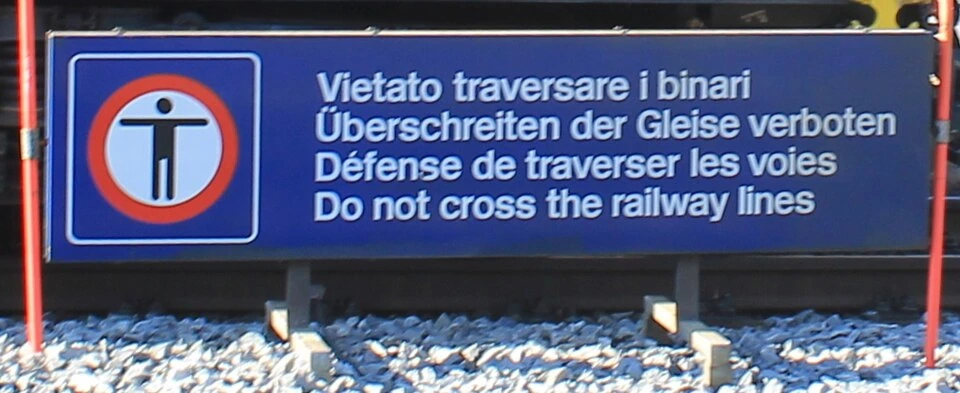
Railway warning at Airolo, 2019. Italian appears first on a quadrilingual sign: Vietato traversare i binari. Source-identified language; displayed without additional cropping.
Saved in Babelbook · resized display copy. Select the image to open it independently of its source.
Valanagut · Source ↗CC BY-SA 4.0 ↗View the local visual field note
Representative reference points from Glottolog. Historical entries show reference locations, not current speakers. 1 point.
Reference & context ↗Babelbook · original editorial illustration · CC BY 4.0 · Glottolog locations; public-domain Natural Earth land
Source excerpts, selected, shortened and where noted editorially corrected from Italian language by Wikipedia contributors. Retrieved 2026-10-05. CC BY-SA 4.0. These excerpts are not an independently verified scholarly history; missing accounts are identified above.
Read further in the source
Origins
The Italian language has developed through a long and slow process, which began after the Western Roman Empire's fall and the onset of the Middle Ages in the 5th century. Latin, the predominant language of the western Roman Empire, remained the established written language in Europe during the Middle Ages, although most people were illiterate. Over centuries, the Vulgar Latin popularly spoken in various areas of Europe—including the Italian peninsula—evolved into local varieties, or dialects, unaffected by formal standards and teachings. These varieties are not in any sense "dialects" of standard Italian, which itself started off as one of these local tongues, but sister languages of Italian. The Latin-speaking class referred to the collective Romance vernaculars of Europe as Romanz, Romance, or, in Italy, Romanzo or Volgare. The linguistic and historical demarcations between late Vulgar Latin and early Romance varieties in Italy are imprecise. The earliest surviving texts that can definitely be called vernacular (as distinct from its predecessor Vulgar Latin) are legal formulae known as the Placiti Cassinesi from the province of Benevento that date from 960 to 963, although the Veronese Riddle, probably from the 8th or early 9th century, contains a late form of Vulgar Latin that can be seen as a very early sample of a vernacular dialect of Italy. The Commodilla catacomb inscription likewise probably dates to the early 9th century and appears to reflect a language somewhere between late Vulgar Latin and early vernacular.
The language that came to be thought of as Italian developed in central Tuscany and was first formalized in the early 14th century through the works of Tuscan writer Dante Alighieri, written in his native Florentine. Dante's epic poems, known collectively as the Commedia, to which another Tuscan poet Giovanni Boccaccio later affixed the title Divina, were read throughout the Italian peninsula. His written vernacular became the touchstone for elaborating a "canonical standard" that all educated Italians could understand. The poetry of Petrarch was also widely admired and influential in the development of the literary language, and would be identified as a model for vernacular writing by Pietro Bembo in the 16th century. In addition to the widespread exposure gained through literature, Florentine also gained prestige due to the political and cultural significance of Florence at the time and the fact that it was linguistically a middle way between the northern and the southern Italian dialects. Italian was progressively made an official language of most of the Italian states predating unification, slowly replacing Latin, even when ruled by foreign powers (such as Spain in the Kingdom of Naples, or Austria in the Kingdom of Lombardy–Venetia), although the masses kept speaking primarily their local vernaculars. Italian was also one of the many recognised languages in the Austro-Hungarian Empire. Italy has always had a distinctive vernacular for each city because the cities, until recently, were thought of as city-states. Those local languages have considerable variety, and as Tuscan-derived Italian came to be used throughout Italy, features of local speech were naturally adopted, producing various versions of Regional Italian. The most characteristic differences, for instance, between Roman Italian and Milanese Italian are syntactic gemination of initial consonants in some contexts and the pronunciation of stressed "e", and of "s" between vowels in many words: e.g. va bene 'all right' is pronounced [vabˈbɛːne] by a Roman (and by any standard Italian speaker), [vaˈbeːne] by a Milanese (and by any speaker whose native dialect lies to the north of the La Spezia–Rimini Line); a casa 'at home' is [akˈkaːsa] for Roman, [akˈkaːsa] or [akˈkaːza] for standard, [aˈkaːza] for Milanese and generally northern. In contrast to the Gallo-Italic linguistic panorama of northern Italy, the Italo-Dalmatian, Neapolitan and its related dialects were largely unaffected by the Franco-Occitan influences introduced to Italy mainly by bards from France during the Middle Ages, but after the Norman conquest of southern Italy, Sicily became the first Italian land to adopt Occitan lyric moods (and words) in poetry. Even in the case of northern Italian languages, however, scholars are careful not to overstate the effects of outsiders on the natural indigenous developments of the languages. The economic might and relatively advanced development of Tuscany at the time (Late Middle Ages) gave its language weight, although Venetian remained widespread in medieval Italian commercial life, and Ligurian (or Genoese) remained in use in maritime trade alongside the Mediterranean. The increasing political and cultural relevance of Florence during the periods of the rise of the Medici Bank, humanism, and the Renaissance made its dialect, or rather a refined version of it, a standard in the arts.
Geographic distribution
Italian is the official language of Italy and San Marino and is spoken fluently by the majority of the countries' populations. Italian is the third most spoken language in Switzerland (after German and French; see Swiss Italian). It is official both on the national level and on regional level in two cantons: Ticino and Grisons. Ticino, which includes Lugano, the largest Italian-speaking city outside Italy, is the only canton where Italian is predominant. Italian is also used in administration and official documents in Vatican City. Italian is also spoken by a minority in Monaco and France, especially in the southeastern part of the country. Italian was the official language in Savoy and in Nice until 1860, when they were both annexed by France under the Treaty of Turin, a development that triggered the "Niçard exodus", or the emigration of a quarter of the Niçard Italians to Italy, and the Niçard Vespers. Giuseppe Garibaldi complained about the referendum that allowed France to annex Savoy and Nice, and a group of his followers (among the Italian Savoyards) took refuge in Italy in the following years. Corsica passed from the Republic of Genoa to France in 1769 after the Treaty of Versailles. Italian was the official language of Corsica until 1859. Giuseppe Garibaldi called for the inclusion of the "Corsican Italians" within Italy when Rome was annexed to the Kingdom of Italy, but King Victor Emmanuel II did not agree to it. Italian is generally understood in Corsica by the population resident therein who speak Corsican, which is an Italo-Romance language similar to Tuscan. Francization occurred in Nice case, and caused a near-disappearance of the Italian language as many of the Italian speakers in these areas migrated to Italy. In Corsica, on the other hand, almost everyone still speaks the Corsican language, which, due to its linguistic proximity to the Italian standard language, appears both linguistically as an Italian dialect and therefore as a carrier of Italian culture, despite the French government's decades-long efforts to cut Corsica off from the Italian motherland. Italian was the official language in Monaco until 1860, when it was replaced by the French. This was due to the annexation of the surrounding County of Nice to France following the Treaty of Turin (1860).
It formerly had official status in Montenegro (because of the Venetian Albania), parts of Slovenia and Croatia (because of the Venetian Istria and Venetian Dalmatia), parts of Greece (because of the Venetian rule in the Ionian Islands and by the Kingdom of Italy in the Dodecanese). Italian is widely spoken in Malta, where nearly two-thirds of the population can speak it fluently (see Maltese Italian). Italian served as Malta's official language until 1934, when it was abolished by the British colonial administration amid strong local opposition. Italian language in Slovenia is an officially recognised minority language in the country. The official census, carried out in 2002, reported 2,258 ethnic Italians (Istrian Italians) in Slovenia (0.11% of the total population). Italian language in Croatia is an official minority language in the country, with many schools and public announcements published in both languages. The 2001 census in Croatia reported 19,636 ethnic Italians (Istrian Italians and Dalmatian Italians) in the country (some 0.42% of the total population). Their numbers dropped dramatically after World War II following the Istrian–Dalmatian exodus, which caused the emigration of between 230,000 and 350,000 Istrian Italians and Dalmatian Italians. Italian was the official language of the Republic of Ragusa from 1492 to 1807.
It formerly had official status in Albania due to the annexation of the country to the Kingdom of Italy (1939–1943). Albania has a large population of non-native speakers, with over half of the population having some knowledge of the Italian language. The Albanian government has pushed to make Italian a compulsory second language in schools. The Italian language is well-known and studied in Albania, due to its historical ties and geographical proximity to Italy and to the diffusion of Italian television in the country. Due to heavy Italian influence during the Italian colonial period, Italian is still understood by some in former colonies such as Libya. Although it was the primary language in Libya since colonial rule, Italian greatly declined under the rule of Muammar Gaddafi, who expelled the Italian Libyan population and made Arabic the sole official language of the country. A few hundred Italian settlers returned to Libya in the 2000s. Italian was the official language of Eritrea during Italian colonisation. Italian is today used in commerce, and it is still spoken especially among elders; besides that, Italian words are incorporated as loan words in the main language spoken in the country (Tigrinya). The capital city of Eritrea, Asmara, still has several Italian schools, established during the colonial period. In the early 19th century, Eritrea was the country with the highest number of Italians abroad, and the Italian Eritreans grew from 4,000 during World War I to nearly 100,000 at the beginning of World War II. In Asmara there are two Italian schools, the Istituto Italiano Statale Omnicomprensivo di Asmara (Italian primary school with a Montessori department) and the Liceo Sperimentale "G. Marconi" (Italian international senior high school). Italian was also introduced to Somalia through colonialism and was the sole official language of administration and education during the colonial period but fell out of use after government, educational and economic infrastructure were destroyed in the Somali Civil War.
Italian is also spoken by large immigrant and expatriate communities in the Americas and Australia. Although over 17 million Americans are of Italian descent, only a little over one million people in the United States speak Italian at home. Nevertheless, an Italian language media market does exist in the country. In Canada, Italian is the second most spoken non-official language when varieties of Chinese are not grouped together, with 375,645 claiming Italian as their mother tongue in 2016. Italian immigrants to South America have also brought a presence of the language to that continent. According to some sources, Italian is the second most spoken language in Argentina after the official language of Spanish, although its number of speakers, mainly of the older generation, is decreasing. Italian bilingual speakers can be found scattered across the southeast of Brazil and in the south. In Venezuela, Italian is the most spoken language after Spanish and Portuguese, with around 200,000 speakers. In Uruguay, people who speak Italian as their home language are 1.1% of the total population of the country. In Australia, Italian is the second most spoken foreign language after Chinese, with 1.4% of the population speaking it as their home language. The main Italian-language newspapers published outside Italy are the L'Osservatore Romano (Vatican City), the L'Informazione di San Marino (San Marino), the Corriere del Ticino and the laRegione Ticino (Switzerland), the La Voce del Popolo (Croatia), the Corriere d'Italia (Germany), the L'italoeuropeo (United Kingdom), the Passaparola (Luxembourg), the America Oggi (United States), the Corriere Canadese and the Corriere Italiano (Canada), the Il punto d'incontro (Mexico), the L'Italia del Popolo (Argentina), the Fanfulla (Brazil), the Gente d'Italia (Uruguay), the La Voce d'Italia (Venezuela), the Il Globo (Australia) and the La gazzetta del Sud Africa (South Africa).
Languages and dialects
In Italy, almost all the other languages spoken as the vernacular—other than standard Italian and some languages spoken among immigrant communities—are often called "Italian dialects", a label that can be very misleading if it is understood to mean "dialects of Italian". The Romance dialects of Italy are local evolutions of spoken Latin that pre-date the establishment of Italian, and as such are sister languages to the Tuscan that was the historical source of Italian. They can be quite different from Italian and from each other, with some belonging to different linguistic branches of Romance. The only exceptions to this are twelve groups considered "historical language minorities", which are officially recognised as distinct minority languages by the law. On the other hand, Corsican (a language spoken on the French island of Corsica) is closely related to medieval Tuscan, from which standard Italian derives and evolved. The differences in the evolution of Latin in the different regions of Italy can be attributed to the natural changes that all languages in regular use are subject to, and to some extent to the presence of three other types of languages: substrata, superstrata, and adstrata. The most prevalent were substrata (the language of the original inhabitants), as the Italian dialects were most probably simply Latin as spoken by native cultural groups. Superstrata and adstrata were both less important. Foreign conquerors of Italy that dominated different regions at different times left behind little to no influence on the dialects. Foreign cultures with which Italy engaged in peaceful relations with, such as trade, had no significant influence either. Throughout Italy, regional varieties of standard Italian, called Regional Italian, are spoken. Regional differences can be recognised by various factors: the openness of vowels, the length of the consonants, and influence of the local language (for example, in informal situations andà, annà and nare replace the standard Italian andare in the area of Tuscany, Rome and Venice respectively for the infinitive 'to go'). There is no definitive date when the various Italian variants of Latin—including varieties that contributed to modern standard Italian—began to be distinct enough from Latin to be considered separate languages. One criterion for determining that two language variants are to be considered separate languages rather than variants of a single language is that they have evolved so that they are no longer mutually intelligible; this diagnostic is effective if mutual intelligibility is minimal or absent (e.g. in Romance, Romanian and Portuguese), but it fails in cases such as Spanish-Portuguese or Spanish-Italian, as educated native speakers of either pairing (particularly Spanish-Portuguese) can understand each other well if they choose to do so; however, the level of intelligibility is markedly lower between Italian-Spanish, and considerably higher between the Iberian sister languages of Portuguese-Spanish. Speakers of this latter pair can communicate with one another with remarkable ease, each speaking to the other in his own native language, without slang/jargon. Nevertheless, on the basis of accumulated differences in morphology, syntax, phonology, and to some extent lexicon, it is not difficult to identify that for the Romance varieties of Italy, the first extant written evidence of languages that can no longer be considered Latin comes from the 9th and 10th centuries CE. These written sources demonstrate certain vernacular characteristics and sometimes explicitly mention the use of the vernacular in Italy. Full literary manifestations of the vernacular began to surface around the 13th century in the form of various religious texts and poetry.Although these are the first written records of Italian varieties separate from Latin, the spoken language had probably diverged long before the first written records appeared since those who were literate generally wrote in Latin even if they spoke other Romance varieties in person. Throughout the 19th and 20th centuries, the use of standard Italian became increasingly widespread and was mirrored by a decline in the use of the dialects. An increase in literacy was one of the main driving factors (one can assume that only literates were capable of learning standard Italian, whereas those who were illiterate had access only to their native dialect). The percentage of literates rose from 25% in 1861 to 60% in 1911, and then on to 78.1% in 1951. Tullio De Mauro, an Italian linguist, has asserted that in 1861, only 2.5% of the population of Italy could speak standard Italian. He reports that in 1951, that percentage had risen to 87%. The ability to speak Italian did not necessarily mean that it was in everyday use, and most people (63.5%) still usually spoke their native dialects. In addition, other factors such as mass emigration, industrialization, and urbanization, and internal migrations after World War II, contributed to the proliferation of standard Italian. The Italians who emigrated during the Italian diaspora beginning in 1861 were often of the uneducated lower class, and thus the emigration had the effect of increasing the percentage of literates, who often knew and understood the importance of standard Italian back home in Italy. A large percentage of those who had emigrated also eventually returned to Italy, often more educated than when they had left. Although use of the Italian dialects has declined in the modern era, as Italy unified under standard Italian and continues to do so aided by mass media from newspapers to radio to television, diglossia is still frequently encountered in Italy and triglossia is not uncommon in emigrant communities among older speakers. Both situations normally involve some degree of code-switching and code-mixing.
Evolution from Latin
The conservative nature of Italian phonology is partly explained by its origin. Italian stems from a literary language that is derived from the 13th-century speech of the city of Florence in the region of Tuscany, and has changed little in the last 700 years or so. Furthermore, the Tuscan dialect is the most conservative of all Italian dialects, radically different from the Gallo-Italian languages less than 160 kilometres (100 mi) to the north (across the La Spezia–Rimini Line). The following are some of the conservative phonological features of Italian, as compared with the common Western Romance languages (French, Spanish, Portuguese, Galician, Catalan). Some of these features are also present in Romanian.
Little or no phonemic lenition of consonants between vowels, e.g. vīta > vita 'life' (cf. Romanian viață, Spanish vida [ˈbiða], French vie), pedem > piede 'foot' (cf. Spanish pie, French pied /pje/). Words that are an exception to this rule exist, such as: scvtella > scodella 'bowl', recipere > ricevere 'receive', lacvs > lago 'lake', acvs > ago 'needle', (only in the Tuscan accent and historical standard Italian) vīsus > viso /vizo/ 'face'. Preservation of geminate consonants, e.g. annum > /ˈanːo/ anno 'year' (cf. Spanish año /ˈaɲo/, French an /ɑ̃/, Romanian an, Portuguese ano /ˈɐnu/). Preservation of all Proto-Romance final vowels, e.g. pacem > pace 'peace' (cf. Romanian pace, Spanish paz, French paix /pɛ/), octō > otto 'eight' (cf. Romanian opt, Spanish ocho, French huit /ɥi(t)/), fēcī > feci 'I did' (cf. Romanian dialectal feci, Spanish hice, French fis /fi/). Preservation of most intertonic vowels (those between the stressed syllable and either the beginning or ending syllable). This accounts for some of the most noticeable differences, as in the forms quattordici and settimana given above. Slower consonant development, e.g. folia > Italo-Western /fɔʎʎa/ > foglia /ˈfɔʎʎa/ 'leaf' (cf. Romanian foaie /ˈfo̯aje/, Spanish hoja /ˈoxa/, French feuille /fœj/; but note Portuguese folha /ˈfoʎɐ/). Compared with most other Romance languages, Italian has many inconsistent outcomes, where the same underlying sound produces different results in different words, e.g. laxāre > lasciare and lassare, captiāre > cacciare and cazzare, (ex)dēroteolāre > sdrucciolare, druzzolare and ruzzolare, rēgīna > regina and reina. Although in all these examples the second form has fallen out of usage, the dimorphism is thought to reflect the several-hundred-year period during which Italian developed as a literary language divorced from any native-speaking population, with an origin in 12th/13th-century Tuscan but with many words borrowed from languages farther to the north, with different sound outcomes. (The La Spezia–Rimini Line, the most important isogloss in the entire Romance-language area, passes only about 30 kilometres or 20 miles north of Florence). Dual outcomes of Latin /p t k/ between vowels, such as lŏcvm > luogo but fŏcvm > fuoco, was once thought to be due to borrowing of northern voiced forms, but is now generally viewed as the result of early phonetic variation within Tuscany. Some other features that distinguish Italian from the Western Romance languages:
Latin ce-,ci- becomes /tʃe, tʃi/ rather than /(t)se, (t)si/. Latin -ct- becomes /tt/ rather than /jt/ or /tʃ/: octō > otto 'eight' (cf. Spanish ocho, French huit, Portuguese oito). Vulgar Latin -cl- becomes cchi /kkj/ rather than /ʎ/: oclum > occhio 'eye' (cf. Portuguese olho /ˈoʎu/, French œil /œj/ < /œʎ/); but Romanian ochi /okʲ/. Final /s/ is not preserved, and vowel changes rather than /s/ are used to mark the plural: amico, amici 'male friend(s)', amica, amiche 'female friend(s)' (cf. Romanian amic, amici and amică, amice; Spanish amigo(s) 'male friend(s)', amiga(s) 'female friend(s)'); trēs, sex → tre, sei 'three, six' (cf. Romanian trei, șase; Spanish tres, seis). Standard Italian also differs in some respects from most nearby Italian languages:
Perhaps most noticeable is the total lack of metaphony, although metaphony is a feature characterizing nearly every other Italian language. No simplification of original /nd/, /mb/ (which often became /nn/, /mm/ elsewhere).
Writing system
Italian has a shallow orthography, meaning very regular spelling with an almost one-to-one correspondence between letters and sounds. In linguistic terms, the writing system is close to being a phonemic orthography. The most important of the few exceptions are the following (see below for more details):
The letter c represents the sound /k/ at the end of words and before the letters a, o, and u but represents the sound /tʃ/ (as the first sound in the English word chair) before the letters e and i. The letter g represents the sound /ɡ/ at the end of words and before the letters a, o, and u but represents the sound /dʒ/ (as the first sound in the English word gem) before the letters e and i. The letter n represents the phoneme /n/, which is pronounced [ŋ] (as in the English word sing) before the letters c and g when these represent velar plosives /k/ or /ɡ/, as in banco [ˈbaŋko], fungo [ˈfuŋɡo]. The letter q represents /k/ pronounced [k], thus n also represents [ŋ] in the position preceding it: cinque [ˈt͡ʃiŋkwe]. Elsewhere the letter n represents /n/ pronounced [n], including before the affricates /tʃ/ or /dʒ/ spelt with c or g before the letters i and e : mancia [ˈmant͡ʃa], mangia [ˈmand͡ʒa]. The letter h is always silent: hotel /oˈtɛl/; hanno 'they have' and anno 'year' both represent /ˈanno/. It is used to form a digraph with c or g to represent /k/ or /ɡ/ before i or e: chi /ki/ 'who', che /ke/ 'what'; aghi /ˈaɡi/ 'needles', ghetto /ˈɡetto/. The spellings ci and gi before another vowel represent only /tʃ/ or /dʒ/ with no /i/ sound (ciuccio /ˈtʃuttʃo/ 'pacifier', Giorgio /ˈdʒordʒo/) unless c or g precede stressed /i/ (farmacia /farmaˈtʃi.a/ 'pharmacy', biologia /bioloˈdʒi.a/ 'biology'). Elsewhere ci and gi represent /tʃ/ and /dʒ/ followed by /i/: cibo /ˈtʃibo/ 'food', baci /ˈbatʃi/ 'kisses'; gita /ˈdʒita/ 'trip', Tamigi /taˈmidʒi/ 'Thames'.* The Italian alphabet is typically considered to consist of 21 letters. The letters j, k, w, x, y are traditionally excluded, although they appear in loanwords such as jeans, whisky, taxi, and xilofono. The letter ⟨x⟩ has become common in standard Italian with the prefix extra-, although (e)stra- is traditionally used; it is also common to use the Latin particle ex(-) to mean 'former(ly)' as in la mia ex ('my ex-girlfriend'), "Ex-Jugoslavia" ('Former Yugoslavia'). The letter ⟨j⟩ appears in the first name Jacopo and in some Italian place-names, such as Bajardo, Bojano, Joppolo, Jerzu, Jesolo, Jesi, Ajaccio, among others, and in Mar Jonio, an alternative spelling of Mar Ionio (the Ionian Sea). The letter ⟨j⟩ may appear in dialectal words, but its use is discouraged in contemporary standard Italian. Letters used in foreign words can be replaced with phonetically equivalent native Italian letters and digraphs: ⟨gi⟩, ⟨ge⟩, or ⟨i⟩ for ⟨j⟩; ⟨c⟩ or ⟨ch⟩ for ⟨k⟩ (including in the standard prefix kilo-); ⟨o⟩, ⟨u⟩ or ⟨v⟩ for ⟨w⟩; ⟨s⟩, ⟨ss⟩, ⟨z⟩, ⟨zz⟩ or ⟨cs⟩ for ⟨x⟩; and ⟨e⟩ or ⟨i⟩ for ⟨y⟩.
The acute accent is used over word-final ⟨e⟩ to indicate a stressed front close-mid vowel, as in perché 'why, because'. In dictionaries, it is also used over ⟨o⟩ to indicate a stressed back close-mid vowel (azióne). The grave accent is used over word-final ⟨e⟩ and ⟨o⟩ to indicate a front open-mid vowel and a back open-mid vowel respectively, as in tè 'tea', and può '(he) can'. The grave accent is used over any vowel to indicate word-final stress, as in gioventù 'youth'. Unlike ⟨é⟩, which is a close-mid vowel, a stressed final ⟨o⟩ is almost always a back open-mid vowel (andrò), with a few exceptions, such as metró, with a stressed final back close-mid vowel, making ⟨ó⟩ for the most part unnecessary outside of dictionaries. Most of the time, the penultimate syllable is stressed. But if the stressed vowel is the final letter of the word, the accent is mandatory, otherwise, it is virtually always omitted. Exceptions are typically either in dictionaries, where all or most stressed vowels are commonly marked. Accents can optionally be used to disambiguate words that differ only by stress, as for prìncipi 'princes' and princìpi 'principles', or àncora 'anchor' and ancóra 'still/yet'. For monosyllabic words, the rule is different: when two orthographically identical monosyllabic words with different meanings exist, one is accented and the other is not (example: è 'is', e 'and'). The letter ⟨h⟩ distinguishes ho, hai, ha, hanno (present indicative of avere 'to have') from o ('or'), ai ('to the'), a ('to'), anno ('year'). In the spoken language, the letter is always silent. The ⟨h⟩ in ho additionally marks the contrasting open pronunciation of the ⟨o⟩. The letter ⟨h⟩ is also used in combinations with other letters. No phoneme /h/ exists in Italian. In nativized foreign words, the ⟨h⟩ is silent. For example, hotel and hovercraft are pronounced /oˈtɛl/ and /ˈɔverkraft/ respectively. (Where ⟨h⟩ existed in Latin, it either disappeared or, in a few cases before a back vowel, changed to [ɡ]: traggo 'I pull' ← Lat. trahō.) The letters ⟨s⟩ and ⟨z⟩ can symbolize voiced or voiceless consonants. ⟨z⟩ symbolizes /dz/ or /ts/ depending on context, with few minimal pairs. For example: zanzara /dzanˈdzara/ 'mosquito' and nazione /natˈtsjone/ 'nation'. ⟨s⟩ symbolizes /s/ word-initially before a vowel, when clustered with a voiceless consonant (⟨p, f, c, ch⟩), and when doubled; it symbolizes /z/ when between vowels and when clustered with voiced consonants. Intervocalic ⟨s⟩ varies regionally between /s/ and /z/, with /z/ being more dominant in northern Italy and /s/ in the south. The letters ⟨c⟩ and ⟨g⟩ vary in pronunciation between plosives and affricates depending on following vowels. The letter ⟨c⟩ symbolizes /k/ when word-final and before the back vowels ⟨a, o, u⟩. It symbolizes /tʃ/ as in chair before the front vowels ⟨e, i⟩. The letter ⟨g⟩ symbolizes /ɡ/ when word-final and before the back vowels ⟨a, o, u⟩. It symbolizes /dʒ/ as in gem before the front vowels ⟨e, i⟩. Other Romance languages and, to an extent, English have similar variations for ⟨c, g⟩. Compare hard and soft C, hard and soft G. (See also palatalization.) The digraphs ⟨ch⟩ and ⟨gh⟩ indicate (/k/ and /ɡ/) before ⟨i, e⟩. The digraphs ⟨ci⟩ and ⟨gi⟩ indicate 'softness' (/tʃ/ and /dʒ/, the affricate consonants of English church and judge) before ⟨a, o, u⟩. For example:
Note: ⟨h⟩ is silent in the digraphs ⟨ch⟩, ⟨gh⟩; and ⟨i⟩ is silent in the digraphs ⟨ci⟩ and ⟨gi⟩ before ⟨a, o, u⟩ unless the ⟨i⟩ is stressed. For example, it is silent in ciao /ˈtʃa.o/ and cielo /ˈtʃɛ.lo/, but it is pronounced in farmacia /ˌfar.maˈtʃi.a/ and farmacie /ˌfar.maˈtʃi.e/. Italian has geminate, or double, consonants, which are distinguished by length and intensity. Length is distinctive for all consonants except for /ʃ/, /dz/, /ts/, /ʎ/, /ɲ/, which are always geminate when between vowels, and /z/, which is always single. Geminate plosives and affricates are realized as lengthened closures. Geminate fricatives, nasals, and /l/ are realized as lengthened continuants. There is only one vibrant phoneme /r/ but the actual pronunciation depends on the context and regional accent. Generally one can find a flap consonant [ɾ] in an unstressed position whereas [r] is more common in stressed syllables, but there may be exceptions. Especially people from the northern part of Italy (Parma, Aosta Valley, South Tyrol) may pronounce /r/ as [ʀ], [ʁ], or [ʋ]. Of special interest to the linguistic study of Regional Italian is the gorgia toscana, or "Tuscan throat", the weakening or lenition of intervocalic /p/, /t/, and /k/ in the Tuscan language. The voiced postalveolar fricative /ʒ/ is present as a phoneme only in loanwords: for example, garage [ɡaˈraːʒ]. Phonetic [ʒ] is common in central and southern Italy as an intervocalic allophone of /dʒ/: gente [ˈdʒɛnte] 'people' but la gente [laˈʒɛnte] 'the people', ragione [raˈʒoːne] 'reason'.