Japanese
Japanese (日本語, Nihongo; [ɲihoŋɡo] ) is the principal language of the Japonic language family spoken by the Japanese people. It has around 123 million speakers, primarily in Japan, the only country where it is the national language, and within the Japanese diaspora worldwide. The Japonic family also includes the Ryukyuan languages and the variously classified Hachijō language. There have been many attempts to group the Japonic languages with other families such as Ainu, Austronesian, Koreanic, and the now discredited Altaic, but none of these proposals have gained any widespread acceptance. Little is known of the language's prehistory, or when it first appeared in Japan. Chinese documents from the 3rd century AD recorded a few Japanese words, but substantial Old Japanese texts did not appear until the 8th century. From the Heian period (794–1185), extensive waves of Sino-Japanese vocabulary entered the language, affecting the phonology of Early Middle Japanese. Late Middle Japanese (1185–1600) saw extensive grammatical changes and the first appearance of European loanwords. The basis of the standard dialect moved from the Kansai region to the Edo region (modern Tokyo) in the Early Modern Japanese period (early 17th century–mid 19th century).
Translate in Japanese ↗Although Japanese is spoken almost exclusively in Japan, it has also been spoken outside of the country. Before and during World War II, through Japanese annexation of Taiwan and Korea, as well as partial occupation of China, the Philippines, and various Pacific islands, locals in those countries learned Japanese as the language of the empire. As a result, many elderly people in these countries can still speak Japanese. Japanese emigrant communities (the largest of which are to be found in Brazil, with 1.4 million to 1.5 million Japanese immigrants and descendants, according to Brazilian IBGE data, more than the 1.2 million of the United States) sometimes employ Japanese as their primary language. Approximately 12% of Hawaii residents speak Japanese, with an estimated 12.6% of the population of Japanese ancestry in 2008. Japanese emigrants can also be found in Peru, Argentina, Australia (especially in the eastern states), Canada (especially in Vancouver, where 1.4% of the population has Japanese ancestry), the United States (notably in Hawaii, where 16.7% of the population has Japanese ancestry, and California), and the Philippines (particularly in Davao Region and the Province of Laguna). Japanese has no official status in Japan, but is the de facto national language of the country. There is a form of the language considered standard: hyōjungo (標準語), meaning 'standard Japanese', or kyōtsūgo (共通語), 'common language', or even 'Tokyo dialect' at times. The meanings of the two terms (hyōjungo and kyōtsūgo) are almost the same. Hyōjungo or kyōtsūgo is a conception that forms the counterpart of dialect. This normative language was born after the Meiji Restoration (明治維新, meiji ishin; 1868) from the language spoken in the higher-class areas of Tokyo (see Yamanote). Hyōjungo is taught in schools and used on television and in official communications.
East Asia
Present-day use
Modern Japanese is considered to begin with the Edo period (which spanned from 1603 to 1867). Although the capital moved to Edo (now Tokyo) during the Edo period, standard Japanese continued from that of the elites of Kyoto, with only minor influence from the Edo dialect. Since the end of Japan's self-imposed isolation in 1853, the flow of loanwords from European languages has increased significantly. The period since 1945 has seen many words borrowed from other languages—such as German (e.g. arubaito 'temporary job', wakuchin 'vaccine'), Portuguese (kasutera 'sponge cake') and English. Many English loan words especially relate to technology—for example, pasokon 'personal computer', intānetto 'internet', and kamera 'camera'. Due to the large quantity of English loanwords, modern Japanese has developed a distinction between [tɕi] and [ti], and [dʑi] and [di], with the latter in each pair only found in loanwords, e.g. paati for party or dizunii for Disney. Japanese has no official status in Japan, but is the de facto national language of the country. There is a form of the language considered standard: hyōjungo (標準語), meaning 'standard Japanese', or kyōtsūgo (共通語), 'common language', or even 'Tokyo dialect' at times. The meanings of the two terms (hyōjungo and kyōtsūgo) are almost the same. Hyōjungo or kyōtsūgo is a conception that forms the counterpart of dialect. This normative language was born after the Meiji Restoration (明治維新, meiji ishin; 1868) from the language spoken in the higher-class areas of Tokyo (see Yamanote). Hyōjungo is taught in schools and used on television and in official communications. It is the version of Japanese discussed in this article. Bungo (文語; 'literary language') used in formal texts, is different compared to the colloquial language (口語, kōgo), used in everyday speech. The two systems have different rules of grammar and some variance in vocabulary.
Origins
The captured article does not contain a separate origins section. See the historical account and linked source.
Development
Proto-Japonic, the common ancestor of the Japanese and Ryukyuan languages, is thought to have been brought to Japan by settlers coming from the Korean peninsula sometime in the early- to mid-4th century BC (the Yayoi period), replacing the languages of the original Jōmon inhabitants, including the ancestor of the modern Ainu language. Because writing had yet to be introduced from China, there is no direct evidence, and anything that can be discerned about this period must be based on internal reconstruction from Old Japanese, or comparison with the Ryukyuan languages and Japanese dialects. Literacy was introduced to Japan in the form of the Chinese writing system, by way of Baekje before the 5th century AD. Using this script, the Japanese king Bu presented a petition to Emperor Shun of Song in AD 478. After the ruin of Baekje, Japan invited scholars from China to learn more of the Chinese writing system. Japanese emperors gave an official rank to Chinese scholars (続守言/薩弘恪/袁晋卿) and spread the use of Chinese characters during the 7th and 8th centuries. At first, the Japanese wrote in Classical Chinese, with Japanese names represented by characters used for their meanings and not their sounds. Later, during the 7th century AD, the Chinese-sounding phoneme principle was used to write pure Japanese poetry and prose, but some Japanese words were still written with characters for their meaning and not the original Chinese sound. This was the beginning of Japanese as a written language in its own right. By this time, the Japanese language was already very distinct from the Ryukyuan languages. An example of this mixed style is the Kojiki, which was written in AD 712. Japanese writers then started to use Chinese characters to write Japanese in a style known as man'yōgana, a syllabic script which used Chinese characters for their sounds in order to transcribe the words of Japanese speech mora by mora. Over time, a writing system evolved.
Writing
Japanese scripts (catalog classification; see the source for context).
Beyond the typeface.
Signs, manuscripts, published pages and contextual photographs, with their place, period, source and reuse terms. Captions identify historical spellings, regional examples, community references and character imagery.
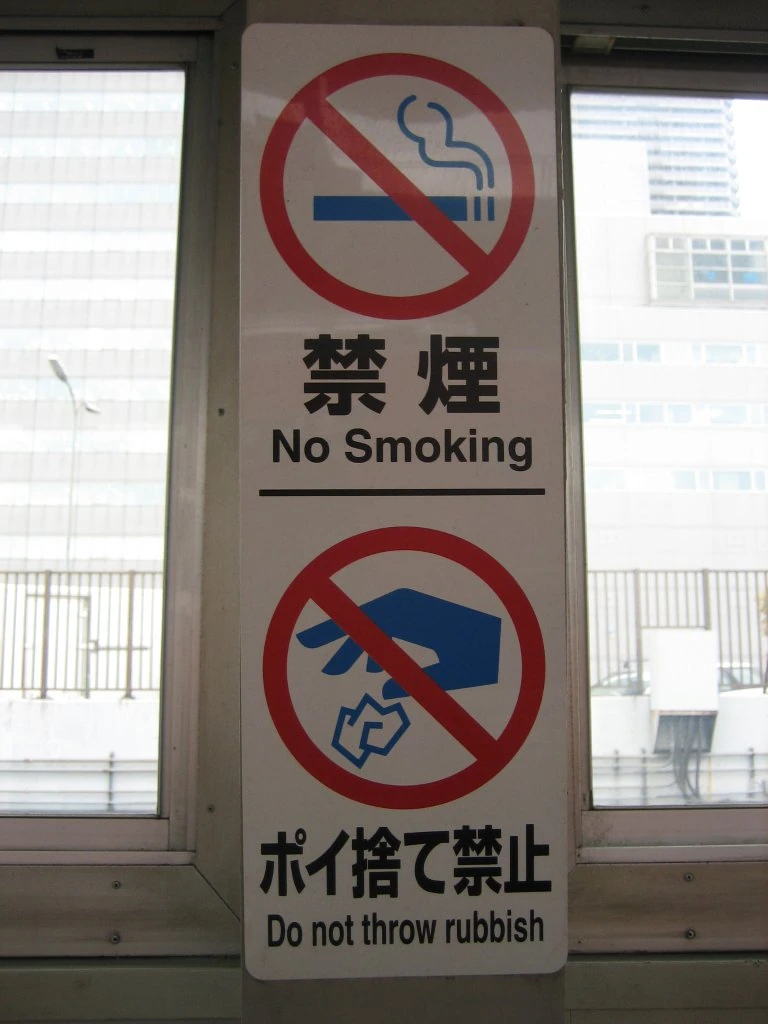
Japanese no-smoking and no-littering notices with English, photographed in 2006. Displayed at reduced size; no additional crop.
Saved in Babelbook · resized display copy. Select the image to open it independently of its source.
Geofrog · Source ↗CC BY-SA 2.5 ↗View the local visual field note
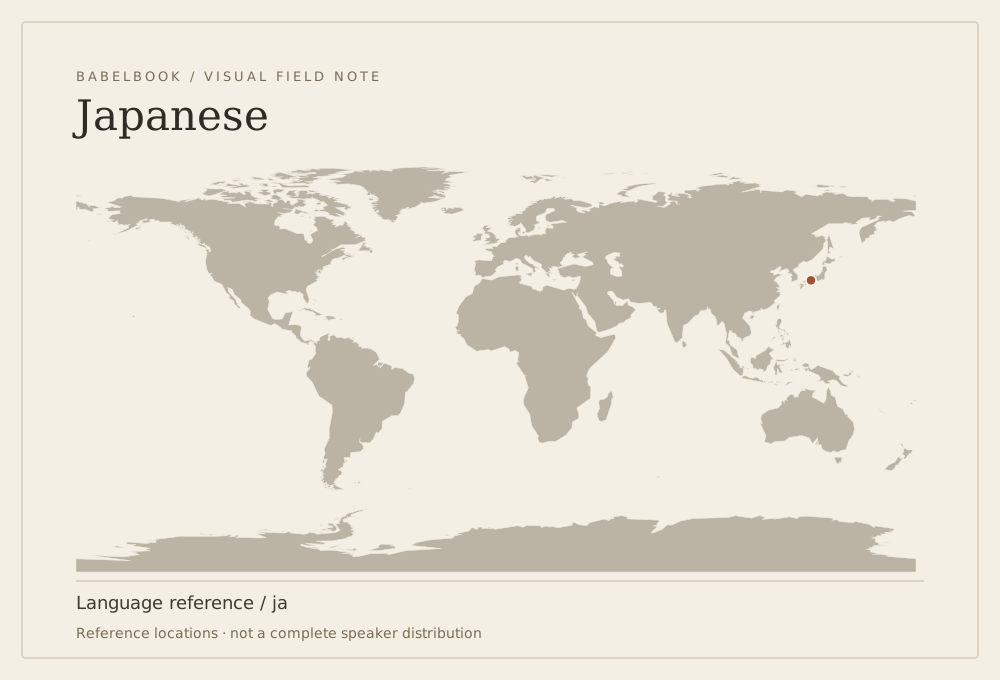
Representative reference points from Glottolog. Historical entries show reference locations, not current speakers. 1 point.
Reference & context ↗Babelbook · original editorial illustration · CC BY 4.0 · Glottolog locations; public-domain Natural Earth land
Source excerpts, selected, shortened and where noted editorially corrected from Japanese language by Wikipedia contributors. Retrieved 2026-10-05. CC BY-SA 4.0. These excerpts are not an independently verified scholarly history; missing accounts are identified above.
Read further in the source
Prehistory
Proto-Japonic, the common ancestor of the Japanese and Ryukyuan languages, is thought to have been brought to Japan by settlers coming from the Korean peninsula sometime in the early- to mid-4th century BC (the Yayoi period), replacing the languages of the original Jōmon inhabitants, including the ancestor of the modern Ainu language. Because writing had yet to be introduced from China, there is no direct evidence, and anything that can be discerned about this period must be based on internal reconstruction from Old Japanese, or comparison with the Ryukyuan languages and Japanese dialects.
Geographic distribution
Although Japanese is spoken almost exclusively in Japan, it has also been spoken outside of the country. Before and during World War II, through Japanese annexation of Taiwan and Korea, as well as partial occupation of China, the Philippines, and various Pacific islands, locals in those countries learned Japanese as the language of the empire. As a result, many elderly people in these countries can still speak Japanese. Japanese emigrant communities (the largest of which are to be found in Brazil, with 1.4 million to 1.5 million Japanese immigrants and descendants, according to Brazilian IBGE data, more than the 1.2 million of the United States) sometimes employ Japanese as their primary language. Approximately 12% of Hawaii residents speak Japanese, with an estimated 12.6% of the population of Japanese ancestry in 2008. Japanese emigrants can also be found in Peru, Argentina, Australia (especially in the eastern states), Canada (especially in Vancouver, where 1.4% of the population has Japanese ancestry), the United States (notably in Hawaii, where 16.7% of the population has Japanese ancestry, and California), and the Philippines (particularly in Davao Region and the Province of Laguna).
Official status
Japanese has no official status in Japan, but is the de facto national language of the country. There is a form of the language considered standard: hyōjungo (標準語), meaning 'standard Japanese', or kyōtsūgo (共通語), 'common language', or even 'Tokyo dialect' at times. The meanings of the two terms (hyōjungo and kyōtsūgo) are almost the same. Hyōjungo or kyōtsūgo is a conception that forms the counterpart of dialect. This normative language was born after the Meiji Restoration (明治維新, meiji ishin; 1868) from the language spoken in the higher-class areas of Tokyo (see Yamanote). Hyōjungo is taught in schools and used on television and in official communications. It is the version of Japanese discussed in this article. Bungo (文語; 'literary language') used in formal texts, is different compared to the colloquial language (口語, kōgo), used in everyday speech. The two systems have different rules of grammar and some variance in vocabulary. Bungo was the main method of writing Japanese until about 1900; since then kōgo gradually extended its influence and the two methods were both used in writing until the 1940s. Bungo still has some relevance for historians, literary scholars, and lawyers (many Japanese laws that survived World War II are still written in bungo, although there are ongoing efforts to modernize their language). Kōgo is the dominant method of both speaking and writing Japanese today, although bungo grammar and vocabulary are occasionally used in modern Japanese for effect. Japanese is, along with Palauan and English, an official language of Angaur, Palau according to the 1982 state constitution. At the time it was written, many of the elders participating in the process had been educated in Japanese during the South Seas Mandate over the island, as shown by the 1958 census of the Trust Territory of the Pacific which found that 89% of Palauans born between 1914 and 1933 could speak and read Japanese. However, as of the 2005 Palau census, no residents of Angaur were reported to speak Japanese at home.
Dialects and mutual intelligibility
Japanese dialects typically differ in terms of pitch accent, inflectional morphology, vocabulary, and particle usage. Some even differ in vowel and consonant inventories, although this is less common. In terms of mutual intelligibility, a survey in 1967 found that the four most unintelligible dialects (excluding Ryūkyūan languages and Tōhoku dialects) to students from Greater Tokyo were the Kiso dialect (in the deep mountains of Nagano Prefecture), the Himi dialect (in Toyama Prefecture), the Kagoshima dialect and the Maniwa dialect (in Okayama Prefecture). The survey was based on 12- to 20-second-long recordings of 135 to 244 phonemes, which 42 students listened to and translated word-for-word. The listeners were all Keio University students who grew up in the Kantō region.
There are some language islands in mountain villages or isolated islands such as Hachijō-jima island, whose dialects are descended from Eastern Old Japanese. Dialects of the Kansai region are spoken or known by many Japanese, and Osaka dialect in particular is associated with comedy (see Kansai dialect). Dialects of Tōhoku and North Kantō are associated with typical farmers. The Ryūkyūan languages, spoken in Okinawa and the Amami Islands (administratively part of Kagoshima), are distinct enough to be considered a separate branch of the Japonic family; not only is each language unintelligible to Japanese speakers, but most are unintelligible to those who speak other Ryūkyūan languages. However, in contrast to linguists, many ordinary Japanese people tend to consider the Ryūkyūan languages as dialects of Japanese. The imperial court also seems to have spoken an unusual variant of the Japanese of the time, most likely the spoken form of Classical Japanese, a writing style that was prevalent during the Heian period, but began to decline during the late Meiji period. The Ryūkyūan languages are classified by UNESCO as 'endangered', as young people mostly use Japanese and cannot understand the languages. Okinawan Japanese is a variant of Standard Japanese influenced by the Ryūkyūan languages, and is the primary dialect spoken among young people in the Ryukyu Islands. Modern Japanese has become prevalent nationwide (including the Ryūkyū islands) due to education, mass media, and an increase in mobility within Japan, as well as economic integration.
History
Literacy was introduced to Japan in the form of the Chinese writing system, by way of Baekje before the 5th century AD. Using this script, the Japanese king Bu presented a petition to Emperor Shun of Song in AD 478. After the ruin of Baekje, Japan invited scholars from China to learn more of the Chinese writing system. Japanese emperors gave an official rank to Chinese scholars (続守言/薩弘恪/袁晋卿) and spread the use of Chinese characters during the 7th and 8th centuries.
At first, the Japanese wrote in Classical Chinese, with Japanese names represented by characters used for their meanings and not their sounds. Later, during the 7th century AD, the Chinese-sounding phoneme principle was used to write pure Japanese poetry and prose, but some Japanese words were still written with characters for their meaning and not the original Chinese sound. This was the beginning of Japanese as a written language in its own right. By this time, the Japanese language was already very distinct from the Ryukyuan languages. An example of this mixed style is the Kojiki, which was written in AD 712. Japanese writers then started to use Chinese characters to write Japanese in a style known as man'yōgana, a syllabic script which used Chinese characters for their sounds in order to transcribe the words of Japanese speech mora by mora. Over time, a writing system evolved. Chinese characters (kanji) were used to write either words borrowed from Chinese, or Japanese words with the same or similar meanings. Chinese characters were also used to write grammatical elements; these were simplified, and eventually became two moraic scripts: hiragana and katakana which were developed based on Man'yōgana. Some scholars claim that Manyogana originated from Baekje, but this hypothesis is denied by mainstream Japanese scholars. Hiragana and katakana were first simplified from kanji. Hiragana, emerging somewhere around the 9th century, was mainly used by women. It was seen as an informal language, whereas katakana and kanji were considered more formal and were typically used by men and in official settings. However, because of hiragana's accessibility, more and more people began using it. Eventually, by the 10th century, hiragana was used by everyone. Modern Japanese is written in a mixture of three main systems: kanji, characters of Chinese origin used to represent both Chinese loanwords into Japanese and a number of native Japanese morphemes; and two syllabaries: hiragana and katakana. The Latin script (or rōmaji in Japanese) is used to a certain extent, such as for imported acronyms and to transcribe Japanese names and in other instances where non-Japanese speakers need to know how to pronounce a word (such as "ramen" at a restaurant). Arabic numerals are much more common than the kanji numerals when used in counting, but kanji numerals are still used in compounds, such as 統一 (tōitsu, "unification"). Historically, attempts to limit the number of kanji in use commenced in the mid-19th century, but government did not intervene until after Japan's defeat in the Second World War. During the post-war occupation (and influenced by the views of some U.S. officials), various schemes including the complete abolition of kanji and exclusive use of rōmaji were considered. The jōyō kanji ("common use kanji"), originally called tōyō kanji (kanji for general use) scheme arose as a compromise solution. Japanese students begin to learn kanji from their first year at elementary school. A guideline created by the Japanese Ministry of Education, the list of kyōiku kanji ("education kanji", a subset of jōyō kanji), specifies the 1,006 simple characters a child is to learn by the end of sixth grade. Children continue to study another 1,130 characters in junior high school, covering in total 2,136 jōyō kanji. The official list of jōyō kanji has been revised several times, but the total number of officially sanctioned characters has remained largely unchanged. As for kanji for personal names, the circumstances are somewhat complicated. Jōyō kanji and jinmeiyō kanji (an appendix of additional characters for names) are approved for registering personal names. Names containing unapproved characters are denied registration. However, as with the list of jōyō kanji, criteria for inclusion were often arbitrary and led to many common and popular characters being disapproved for use. Under popular pressure and following a court decision holding the exclusion of common characters unlawful, the list of jinmeiyō kanji was substantially extended from 92 in 1951 (the year it was first decreed) to 983 in 2004. Furthermore, families whose names are not on these lists were permitted to continue using the older forms.