Javanese
Javanese ( JAH-və-NEEZ, JAV-ə-, -NEESS; endonym: Basa Jawa, Javanese script: ꦧꦱꦗꦮ, Pegon: باسا جاوا, pronounced [bɔsɔ d͡ʒɔwɔ]) is an Austronesian language spoken primarily by the Javanese people from the central and eastern parts of the island of Java, Indonesia. There are also pockets of Javanese speakers on the northern coast of western Java. It is the native language of more than 68 million people. Javanese is the largest of the Austronesian languages in number of native speakers. It has several regional dialects and a number of clearly distinct status styles. Its closest relatives are the neighboring languages such as Sundanese, Madurese, and Balinese. Most speakers of Javanese also speak Indonesian for official and commercial purposes as well as a means to communicate with non-Javanese-speaking Indonesians. There are speakers of Javanese in Malaysia (concentrated in the West Coast part of the states of Selangor and Johor) and Singapore. Javanese is also spoken by traditional immigrant communities of Javanese descent in Suriname, Sri Lanka and New Caledonia. Along with Indonesian, Javanese is an official language in the Special Region of Yogyakarta, Indonesia.
Translate in Javanese ↗Javanese is spoken throughout Indonesia, neighboring Southeast Asian countries, the Netherlands, Suriname, New Caledonia, and other countries. The largest populations of speakers are found in the six provinces of Java itself, and in the neighboring Sumatran province of Lampung. The language is spoken in Yogyakarta, Central and East Java, and on the north coast of West Java and Banten. It is also spoken elsewhere by the Javanese people in other provinces of Indonesia, who are numerous due to the government-sanctioned transmigration program in the late 20th century, including Lampung, Jambi, and North Sumatra provinces. In Suriname, Javanese is spoken among descendants of plantation migrants brought by the Dutch during the 19th century. In Madura, Bali, Lombok, and the Sunda region of West Java, it is also used as a literary language. It was the court language in Palembang, South Sumatra, until the palace was sacked by the Dutch in the late 18th century. Javanese is written with the Latin script, Javanese script, and Arabic script. In the present day, the Latin script dominates writings, although the Javanese script is still taught as part of the compulsory Javanese language subject in elementary up to high school levels in Yogyakarta, Central and East Java. Javanese is the twenty-second largest language by native speakers and the seventh largest language without official status at the national level. It is spoken or understood by approximately 100 million people. At least 45% of the total population of Indonesia are of Javanese descent or live in an area where Javanese is the dominant language. All seven Indonesian presidents since 1945 have been of Javanese descent. It is therefore not surprising that Javanese has had a deep influence on the development of Indonesian, the national language of Indonesia. There are three main dialects of the modern language: Central Javanese, Eastern Javanese, and Western Javanese.
Southeast Asia
Present-day use
Modern Javanese emerged as the main literary form of the language in the 16th century. The change in the literary system happened as Islam started to gain influence in Java. In its early form, Modern Javanese literary form was based on the variety spoken in the north coast of Java, where Islam had already gained foothold among the local people. Many of the written works in this variety were Islamic in nature, and several of them were translation from works in Malay. The Arabic abjad was also adopted (as Pegon) to write Javanese. The rise of Mataram in the 17th century shifted the main literary form of Javanese to be based on the inland variety. This written tradition was preserved by writers of Surakarta and Yogyakarta, and later became the basis of the modern written standard of the language. Another linguistic development associated with the rise of Mataram is the stratification of Javanese into speech levels such as ngoko and krama, which were unknown in Old Javanese. Books in Javanese have been printed since 1830s, at first using the Javanese script, although the Latin alphabet started to be used later. Since mid-19th century, Javanese has been used in newspapers and travelogues, and later, also novels, short stories, as well as free verses. Today, it is used in media, ranging from books to TV programs, and the language is also taught at schools in primarily Javanese areas. Although Javanese is not a national language, it has recognized status as a regional language in the three Indonesian provinces with the biggest concentrations of Javanese people: Central Java, Yogyakarta, and East Java. Javanese is designated as the official language of the Special Region of Yogyakarta under Yogyakarta Special Region Regulation Number 2 of 2021.
Origins
The captured article does not contain a separate origins section. See the historical account and linked source.
Development
In general, the history of the Javanese language can be divided into two distinct phases: 1) Old Javanese and 2) New Javanese.
Writing
Javanese has been traditionally written with Javanese script. Javanese and the related Balinese script are modern variants of the old Kawi script, a Brahmic script introduced to Java along with Hinduism and Buddhism. Kawi is first attested in a legal document from 804 AD. It was widely used in literature and translations from Sanskrit from the 10th century; by the 17th, the script is identified as carakan. The Javanese script is an abugida. Each of the twenty letters represents a syllable with a consonant (or a "zero consonant") and the inherent vowel 'a' that is pronounced as /ɔ/ in open position. Various diacritics placed around the letter indicate a different vowel than [ɔ], a final consonant, or a foreign pronunciation. Letters have subscript forms used to transcribe consonant clusters, though the shapes are relatively straightforward, and not as distinct as conjunct forms of Devanagari. Some letters are only present in old Javanese and became obsolete in modern Javanese. Some of these letters became "capital" forms used in proper names. Punctuation includes a comma; period; a mark that covers the colon, quotations, and indicates numerals; and marks to introduce a chapter, poem, song, or letter. However, Javanese can also be written with the Arabic script (known as the Pegon script) and today generally uses Latin script instead of Javanese script for practical purposes. A Latin orthography based on Dutch was introduced in 1926, revised in 1972–1973; it has largely supplanted the carakan. The current Latin-based forms: The italic letters are used in loanwords from European languages and Arabic. Javanese script:
Beyond the typeface.
Signs, manuscripts, published pages and contextual photographs, with their place, period, source and reuse terms. Captions identify historical spellings, regional examples, community references and character imagery.
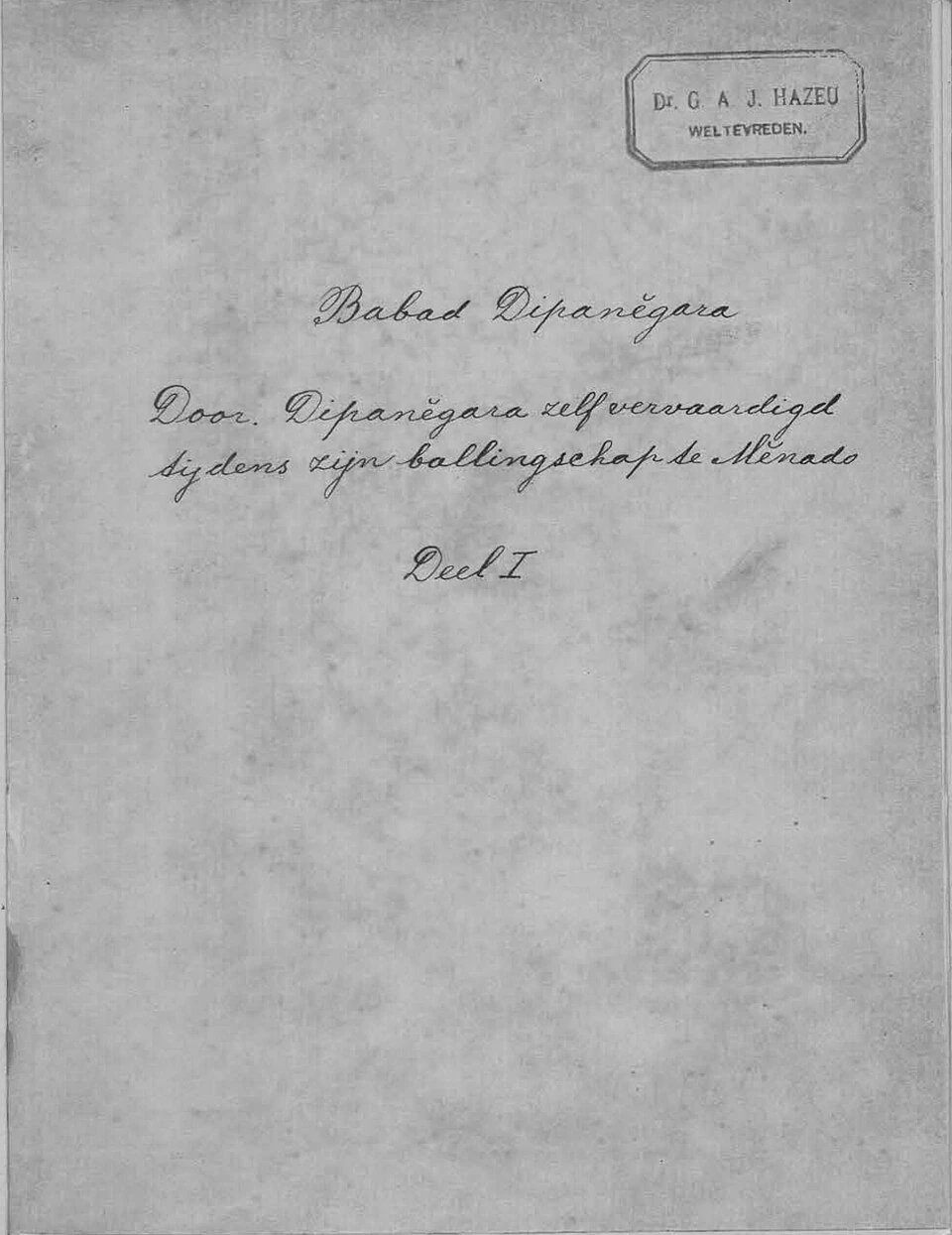
A title page from a historical Javanese copy of the Babad Diponegoro, Leiden University Library L.Or.6547. This is a later copy, not the lost original.
Saved in Babelbook · resized display copy. Select the image to open it independently of its source.
Raden Abdul Samsi (scribe/copyist, as credited by Commons) · Source ↗Public domain ↗View the local visual field note
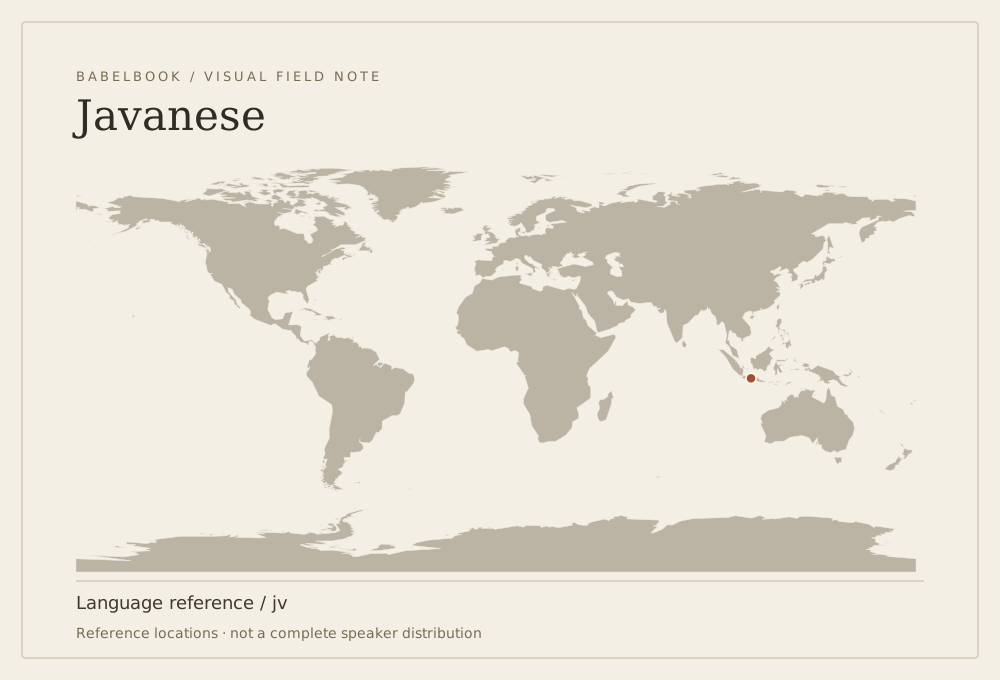
Representative reference points from Glottolog. Historical entries show reference locations, not current speakers. 1 point.
Reference & context ↗Babelbook · original editorial illustration · CC BY 4.0 · Glottolog locations; public-domain Natural Earth land
Source excerpts, selected, shortened and where noted editorially corrected from Javanese language by Wikipedia contributors. Retrieved 2026-10-05. CC BY-SA 4.0. These excerpts are not an independently verified scholarly history; missing accounts are identified above.
Read further in the source
Geographical distribution
Javanese is spoken throughout Indonesia, neighboring Southeast Asian countries, the Netherlands, Suriname, New Caledonia, and other countries. The largest populations of speakers are found in the six provinces of Java itself, and in the neighboring Sumatran province of Lampung. The language is spoken in Yogyakarta, Central and East Java, and on the north coast of West Java and Banten. It is also spoken elsewhere by the Javanese people in other provinces of Indonesia, who are numerous due to the government-sanctioned transmigration program in the late 20th century, including Lampung, Jambi, and North Sumatra provinces. In Suriname, Javanese is spoken among descendants of plantation migrants brought by the Dutch during the 19th century. In Madura, Bali, Lombok, and the Sunda region of West Java, it is also used as a literary language. It was the court language in Palembang, South Sumatra, until the palace was sacked by the Dutch in the late 18th century. Javanese is written with the Latin script, Javanese script, and Arabic script. In the present day, the Latin script dominates writings, although the Javanese script is still taught as part of the compulsory Javanese language subject in elementary up to high school levels in Yogyakarta, Central and East Java. Javanese is the twenty-second largest language by native speakers and the seventh largest language without official status at the national level. It is spoken or understood by approximately 100 million people. At least 45% of the total population of Indonesia are of Javanese descent or live in an area where Javanese is the dominant language. All seven Indonesian presidents since 1945 have been of Javanese descent. It is therefore not surprising that Javanese has had a deep influence on the development of Indonesian, the national language of Indonesia. There are three main dialects of the modern language: Central Javanese, Eastern Javanese, and Western Javanese. These three dialects form a dialect continuum from northern Banten in the extreme west of Java to Banyuwangi Regency in the eastern corner of the island. All Javanese dialects are more or less mutually intelligible. A table showing the number of native speakers in 1980, for the 22 Indonesian provinces (from the total of 27) in which more than 1% of the population spoke Javanese:
According to the 1980 census, Javanese was used daily in approximately 43% of Indonesian households. By this reckoning there were well over 60 million Javanese speakers, from a national population of 147,490,298.
In Banten, the descendants of the Central Javanese conquerors who founded the Islamic Sultanate there in the 16th century still speak an archaic form of Javanese. The rest of the population mainly speaks Sundanese and Indonesian, since this province borders directly on Jakarta. At least one third of the population of Jakarta are of Javanese descent. In the province of West Java, many people speak Javanese, especially those living in the areas bordering Central Java, the cultural homeland of the Javanese. Almost a quarter of the population of East Java province are Madurese (mostly on the Isle of Madura); many Madurese have some knowledge of colloquial Javanese. Since the 19th century, Madurese was also written in the Javanese script. The original inhabitants of Lampung, the Lampungese, make up only 15% of the provincial population. The rest are the so-called "transmigrants", settlers from other parts of Indonesia, many as a result of past government transmigration programs. Most of these transmigrants are Javanese who have settled there since the 19th century. In Suriname (the former Dutch colony of Surinam), South America, approximately 15% of the population of some 500,000 are of Javanese descent, among whom 75,000 speak Javanese. A local variant evolved: the Tyoro Jowo-Suriname or Suriname Javanese.
Dialects
There are three main groups of Javanese dialects, based on sub-regions: Western Javanese, Central Javanese, and Eastern Javanese. The differences are primarily in pronunciation, but with vocabulary differences also. Not all Javanese dialects are mutually intelligible; for example, a Javanese speaker from Surabaya might not be able to understand the Javanese spoken in Tegal, or the formal registers spoken in parts of Central Java. A preliminary general classification of Javanese dialects given by the Max Planck Institute for Evolutionary Anthropology's Department of Linguistics is as follows. Pesisir (Tegalan), Banyumas and Tengger are considered to be among the most conservative dialects. The Banten, Pesisir Lor, Banyumas and Tengger dialect do not have the vowel raising and vowel harmony features that are innovations of the "standard" Solo and Yogyakarta dialects.
Western Java Banten Cirebon Central Java Pesisir Lor dialects Tegal Pemalang Pekalongan Yogyakarta Surakarta/Solo Semarang Ngapak dialects Banyumas Cilacap Purwokerto Kebumen Eastern Java Surabaya Malang Mataraman dialects Madiun Kediri Blitar Lumajang Osing Tengger
Standard Javanese
Standard Javanese is the variety of the Javanese language that was developed at the Yogyakarta and Surakarta courts (the heirs to the Mataram Sultanate that once dominated the whole of Java and beyond), based on the Central Javanese dialect, and becomes the basis for the Javanese modern writings. It is marked with the strict usage of two speech levels for politeness, i.e. vernacular level called ngoko and high-register level called krama. Other dialects do not contrast the usage of the speech levels.
History
In general, the history of the Javanese language can be divided into two distinct phases: 1) Old Javanese and 2) New Javanese.
Writing system
Javanese has been traditionally written with Javanese script. Javanese and the related Balinese script are modern variants of the old Kawi script, a Brahmic script introduced to Java along with Hinduism and Buddhism. Kawi is first attested in a legal document from 804 AD. It was widely used in literature and translations from Sanskrit from the 10th century; by the 17th, the script is identified as carakan. The Javanese script is an abugida. Each of the twenty letters represents a syllable with a consonant (or a "zero consonant") and the inherent vowel 'a' that is pronounced as /ɔ/ in open position. Various diacritics placed around the letter indicate a different vowel than [ɔ], a final consonant, or a foreign pronunciation. Letters have subscript forms used to transcribe consonant clusters, though the shapes are relatively straightforward, and not as distinct as conjunct forms of Devanagari. Some letters are only present in old Javanese and became obsolete in modern Javanese. Some of these letters became "capital" forms used in proper names. Punctuation includes a comma; period; a mark that covers the colon, quotations, and indicates numerals; and marks to introduce a chapter, poem, song, or letter. However, Javanese can also be written with the Arabic script (known as the Pegon script) and today generally uses Latin script instead of Javanese script for practical purposes. A Latin orthography based on Dutch was introduced in 1926, revised in 1972–1973; it has largely supplanted the carakan. The current Latin-based forms:
The italic letters are used in loanwords from European languages and Arabic. Javanese script: