Georgian
Georgian (ქართული ენა, kartuli ena, pronounced [ˈkʰäɾt̪ʰuli ˈe̞n̪ä]) is the most widely spoken Kartvelian language. It is the official language of Georgia and the native or primary language of 88% of its population. It also serves as the literary language or lingua franca for speakers of related languages. Its speakers amount to approximately 3.8 million. Georgian is written with its own unique Georgian scripts, alphabetical systems of unclear origin. Georgian is not related to any of the world's major language families found outside of Georgia. It is most closely connected to other regional languages of Georgia, such as Mingrelian and, more distantly, Svan. Georgian has various dialects, with standard Georgian based on the Kartlian dialect, and all dialects are mutually intelligible. The history of Georgian spans from Early Old Georgian in the 5th century, to Modern Georgian. Its development as a written language began with the Christianization of Georgia in the 4th century. Georgian phonology features a rich consonant system, including aspirated, voiced, and ejective stops, affricates, and fricatives. Its vowel system consists of five vowels with varying realizations. Georgian prosody involves weak stress, with disagreements among linguists on its placement. The language's phonotactics include complex consonant clusters and harmonic clusters. The Mkhedruli script, dominant in modern usage, corresponds closely to Georgian phonemes and has no case distinction, though it employs a capital-like effect called Mtavruli for titles and inscriptions.
Translate in Georgian ↗Georgian (ქართული ენა, kartuli ena, pronounced [ˈkʰäɾt̪ʰuli ˈe̞n̪ä]) is the most widely spoken Kartvelian language. It is the official language of Georgia and the native or primary language of 88% of its population. It also serves as the literary language or lingua franca for speakers of related languages. Its speakers amount to approximately 3.8 million. Georgian is written with its own unique Georgian scripts, alphabetical systems of unclear origin. Georgian is not related to any of the world's major language families found outside of Georgia. It is most closely connected to other regional languages of Georgia, such as Mingrelian and, more distantly, Svan. Georgian has various dialects, with standard Georgian based on the Kartlian dialect, and all dialects are mutually intelligible. The history of Georgian spans from Early Old Georgian in the 5th century, to Modern Georgian. Its development as a written language began with the Christianization of Georgia in the 4th century. Georgian phonology features a rich consonant system, including aspirated, voiced, and ejective stops, affricates, and fricatives. Its vowel system consists of five vowels with varying realizations. Georgian prosody involves weak stress, with disagreements among linguists on its placement. The language's phonotactics include complex consonant clusters and harmonic clusters. The Mkhedruli script, dominant in modern usage, corresponds closely to Georgian phonemes and has no case distinction, though it employs a capital-like effect called Mtavruli for titles and inscriptions. Georgian is an agglutinative language with a complex verb structure that can include up to eight morphemes, exhibiting polypersonalism.
Europe
Present-day use
The captured source does not contain a separate current-use account.
Origins
The captured article does not contain a separate origins section. See the historical account and linked source.
Development
The history of the Georgian language is conventionally divided into the following phases: Early Old Georgian: 5th–8th centuries Classical Old Georgian: 9th–11th centuries Middle Georgian: 11th/12th–17th/18th centuries Modern Georgian: 17th/18th century–present The earliest extant references to Georgian are found in the writings of Marcus Cornelius Fronto, a Roman grammarian from the 2nd century AD. The first direct attestations of the language are inscriptions and palimpsests dating to the 5th century, and the oldest surviving literary work is the 5th-century Martyrdom of the Holy Queen Shushanik by Iakob Tsurtaveli. The emergence of Georgian as a written language appears to have been the result of the Christianization of the Kingdom of Iberia in the mid-4th century, which led to the replacement of Aramaic as the literary language. By the 11th century, Old Georgian had developed into Middle Georgian. The most famous work of this period is the epic poem The Knight in the Panther's Skin, written by Shota Rustaveli in the 12th century. In 1629, Nikoloz Cholokashvili authored the first printed books written (partially) in Georgian, the Alphabetum Ibericum sive Georgianum cum Oratione and the Dittionario giorgiano e italiano. These were meant to help western Catholic missionaries learn Georgian for evangelical purposes.
Writing
Georgian has been written in a variety of scripts over its history. Currently the Mkhedruli script is almost completely dominant; the others are used mostly in religious documents and architecture. Mkhedruli has 33 letters in common use; a half dozen more are obsolete in Georgian, though still used in other alphabets, like Mingrelian, Laz, and Svan. The letters of Mkhedruli correspond closely to the phonemes of the Georgian language. According to the traditional account written down by Leonti Mroveli in the 11th century, the first Georgian script was created by the first ruler of the Kingdom of Iberia, Pharnavaz, in the 3rd century BC. The first examples of a Georgian script date from the 5th century AD. There are now three Georgian scripts, called Asomtavruli 'capitals', Nuskhuri 'small letters', and Mkhedruli. The first two are used together as upper and lower case in the writings of the Georgian Orthodox Church and together are called Khutsuri 'priest alphabet'. In Mkhedruli, there is no case. Sometimes, however, a capital-like effect, called Mtavruli ('title' or 'heading'), is achieved by modifying the letters so that their vertical sizes are identical and they rest on the baseline with no descenders. These capital-like letters are often used in page headings, chapter titles, monumental inscriptions, and the like.
Beyond the typeface.
Signs, manuscripts, published pages and contextual photographs, with their place, period, source and reuse terms. Captions identify historical spellings, regional examples, community references and character imagery.
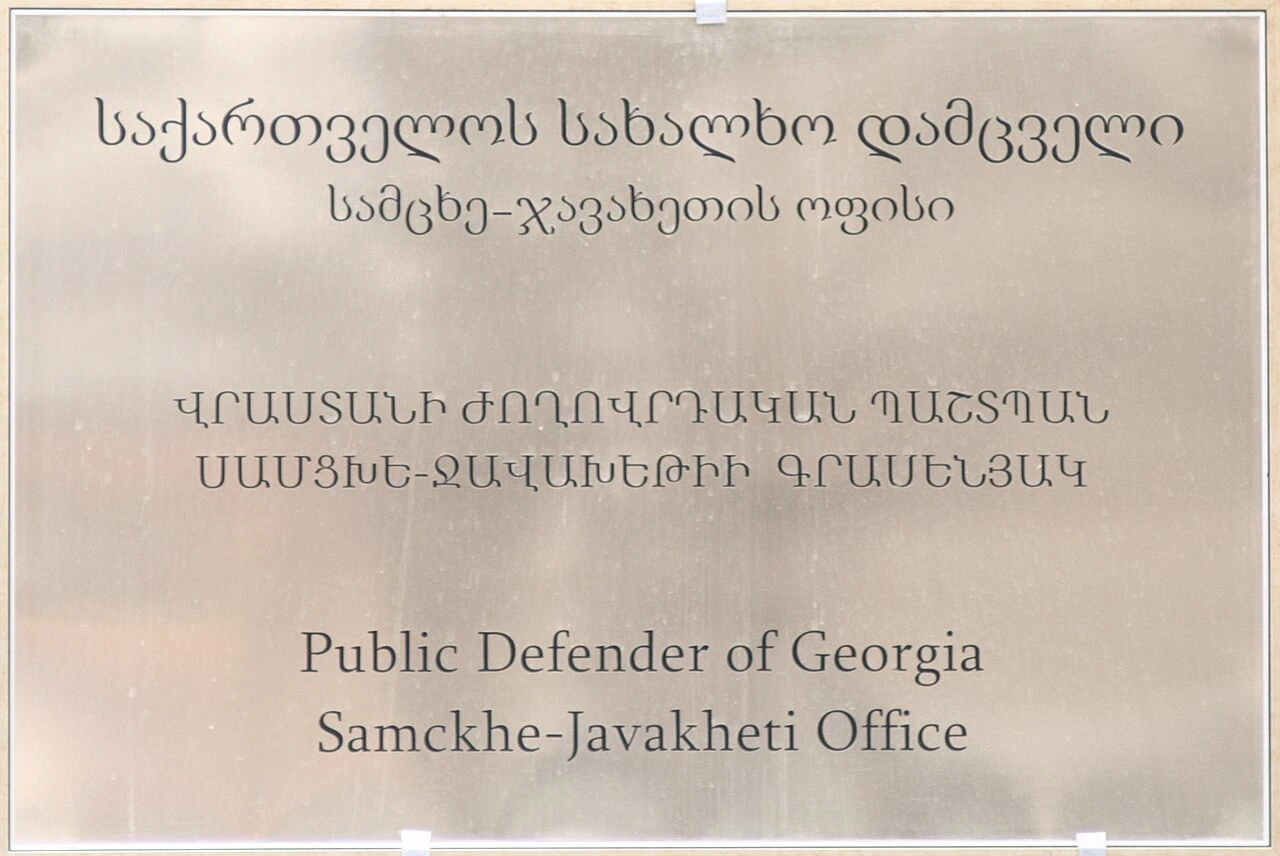
Georgian text on an office sign for the Public Defender of Georgia, alongside Armenian and English. Source-identified language; displayed without additional cropping.
Saved in Babelbook · resized display copy. Select the image to open it independently of its source.
Jan.CIVICS · Source ↗CC BY-SA 3.0 ↗View the local visual field note
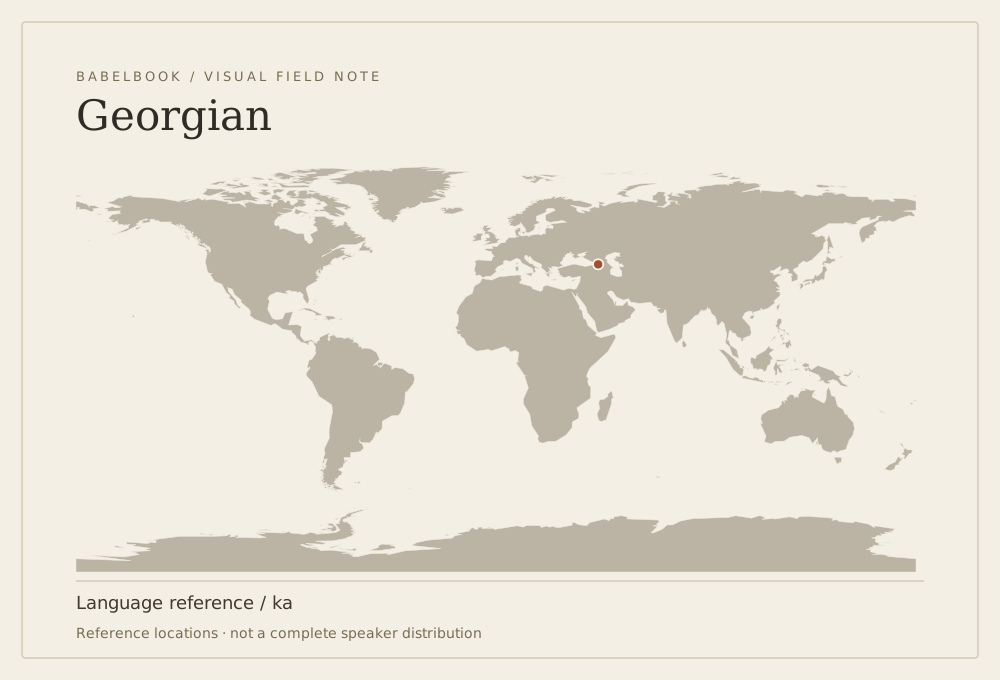
Representative reference points from Glottolog. Historical entries show reference locations, not current speakers. 1 point.
Reference & context ↗Babelbook · original editorial illustration · CC BY 4.0 · Glottolog locations; public-domain Natural Earth land
Source excerpts, selected, shortened and where noted editorially corrected from Georgian language by Wikipedia contributors. Retrieved 2026-10-05. CC BY-SA 4.0. These excerpts are not an independently verified scholarly history; missing accounts are identified above.
Read further in the source
Dialects
The Georgian language has at least 18 dialects, with Standard Georgian being largely based on the Kartlian dialect. Over the centuries, it has exerted a strong influence on the other dialects. As a result, they are all, generally, mutually intelligible with standard Georgian, and with one another.
History
The history of the Georgian language is conventionally divided into the following phases:
Early Old Georgian: 5th–8th centuries Classical Old Georgian: 9th–11th centuries Middle Georgian: 11th/12th–17th/18th centuries Modern Georgian: 17th/18th century–present The earliest extant references to Georgian are found in the writings of Marcus Cornelius Fronto, a Roman grammarian from the 2nd century AD. The first direct attestations of the language are inscriptions and palimpsests dating to the 5th century, and the oldest surviving literary work is the 5th-century Martyrdom of the Holy Queen Shushanik by Iakob Tsurtaveli. The emergence of Georgian as a written language appears to have been the result of the Christianization of the Kingdom of Iberia in the mid-4th century, which led to the replacement of Aramaic as the literary language. By the 11th century, Old Georgian had developed into Middle Georgian. The most famous work of this period is the epic poem The Knight in the Panther's Skin, written by Shota Rustaveli in the 12th century. In 1629, Nikoloz Cholokashvili authored the first printed books written (partially) in Georgian, the Alphabetum Ibericum sive Georgianum cum Oratione and the Dittionario giorgiano e italiano. These were meant to help western Catholic missionaries learn Georgian for evangelical purposes.
Writing system
Georgian has been written in a variety of scripts over its history. Currently the Mkhedruli script is almost completely dominant; the others are used mostly in religious documents and architecture. Mkhedruli has 33 letters in common use; a half dozen more are obsolete in Georgian, though still used in other alphabets, like Mingrelian, Laz, and Svan. The letters of Mkhedruli correspond closely to the phonemes of the Georgian language. According to the traditional account written down by Leonti Mroveli in the 11th century, the first Georgian script was created by the first ruler of the Kingdom of Iberia, Pharnavaz, in the 3rd century BC. The first examples of a Georgian script date from the 5th century AD. There are now three Georgian scripts, called Asomtavruli 'capitals', Nuskhuri 'small letters', and Mkhedruli. The first two are used together as upper and lower case in the writings of the Georgian Orthodox Church and together are called Khutsuri 'priest alphabet'. In Mkhedruli, there is no case. Sometimes, however, a capital-like effect, called Mtavruli ('title' or 'heading'), is achieved by modifying the letters so that their vertical sizes are identical and they rest on the baseline with no descenders. These capital-like letters are often used in page headings, chapter titles, monumental inscriptions, and the like.