Kongo
Kongo or Kikongo is a Bantu language spoken by the Kongo people living in the Democratic Republic of the Congo (DRC), the Republic of the Congo, Gabon, and Angola. It is a tonal language. The vast majority of present-day speakers live in Africa. There are roughly seven million native speakers of Kongo in the above-named countries. An estimated five million more speakers use it as a second language. Historically, it was spoken by many of those Africans who for centuries were taken captive, transported across the Atlantic, and sold as slaves in the Americas. For this reason, creolized forms of the language are found in ritual speech of Afro-American religions, especially in Brazil, Cuba, Puerto Rico, Dominican Republic, Haiti, and Suriname. It is also one of the sources of the Gullah language, which formed in the Low Country and Sea Islands of the United States Southeast, and a major source of the Palenquero language of Colombia.
Translate in Kongo ↗Kikongo was the language of the Kingdom of Kongo prior to the creation of Angola by the Portuguese Crown in 1575. The Berlin Conference (1884–1885) among major European powers divided the rest of the kingdom into three territories. These are now parts of the DRC (Kongo Central and Bandundu), the Republic of the Congo, and Gabon. Kikongo is the base for the Creole language Kituba, also called Kikongo de l'État and Kikongo ya Leta (French and Kituba, respectively, for "Kikongo of the state administration" or "Kikongo of the State"). The constitution of the Republic of the Congo uses the name Kituba, and Democratic Republic of the Congo uses the term Kikongo (i.e. Kikongo ya Leta). This can be explained by the fact that Kikongo ya Leta is often mistakenly called Kikongo (i.e. KiNtandu, KiManianga, KiNdibu, etc.). Kikongo and Kituba are spoken in: South of Republic of the Congo: Kikongo (Yombe, Vili, Ladi, Sundi, etc.) and Kituba: Kouilou, Niari, Bouenza, Lékoumou, south of Brazzaville, Pointe-Noire, Kikongo (Ladi, Kongo Boko, etc.): Pool; South-west of Democratic Republic of the Congo: Kikongo (Yombe, Ntandu, Ndibu, Manyanga, etc.) and Kikongo ya Leta: Kongo Central, a part of Kinshasa, Kikongo ya Leta: Kwilu, Kwango, Mai-Ndombe, far west Kasaï; North of Angola: Kikongo (Kisikongo, Zombo, Ibinda, etc.): Cabinda, Uíge, Zaire, north of Bengo and north of Cuanza Norte; South-West of Gabon. Kikongo (Vili): Nyanga, Ngounié
Sub-Saharan Africa
Present-day use
The captured source does not contain a separate current-use account.
Origins
The southern Black American English word "goober" comes from Kongo nguba, meaning "peanut". The southern Black American English word "finda", from the Hoodoo tradition, comes from the Kongo word mfinda, meaning "the great forest". The southern Black American English word "mojo", from the Hoodoo tradition, comes from the Kongo word mooyo, meaning "to the spirits that dwelt within magical charms". The Black American popular music terms "funk" and "funky" may be from the Kongo word lu-fuki.
Development
The captured article does not contain a distinct historical account. No chronology has been invented.
Writing
Kongo was the earliest Bantu language to be written in Latin characters. Portuguese created a dictionary in Kongo, the first of any Bantu language. A catechism was produced under the authority of Diogo Gomes, who was born in 1557 in Kongo to Portuguese parents and became a Jesuit priest. No version of that survives today. In 1624, Mateus Cardoso, another Portuguese Jesuit, edited and published a Kongo translation of the Portuguese catechism compiled by Marcos Jorge. The preface says that the translation was done by Kongo teachers from São Salvador (modern Mbanza Kongo) and was probably partially the work of Félix do Espírito Santo (also a Kongo). The dictionary was written in about 1648 for the use of Capuchin missionaries. The principal author was Manuel Robredo, a secular priest from Kongo (after he became a Capuchin, he was named Francisco de São Salvador). The back of this dictionary includes a two-page sermon written in Kongo. The dictionary has some 10,000 words. In the 1780s, French Catholic missionaries to the Loango coast created additional dictionaries. Bernardo da Canecattim published a word list in 1805. Baptist missionaries who arrived in Kongo in 1879 (from Great Britain) developed a modern orthography of the language. American missionary W. Holman Bentley arranged for his Dictionary and Grammar of the Kongo Language to be published by the University of Michigan in 1887. In the preface, Bentley gave credit to Nlemvo, an African, for his assistance. He described "the methods he used to compile the dictionary, which included sorting and correcting 25,000 slips of paper containing words and their definitions." Eventually W. Holman Bentley, with the special assistance of João Lemvo, produced a complete Christian Bible in 1905. The Office of the High Commissioner for Human Rights has published a translation of the Universal Declaration of Human Rights in Fiote.
Beyond the typeface.
Signs, manuscripts, published pages and contextual photographs, with their place, period, source and reuse terms. Captions identify historical spellings, regional examples, community references and character imagery.
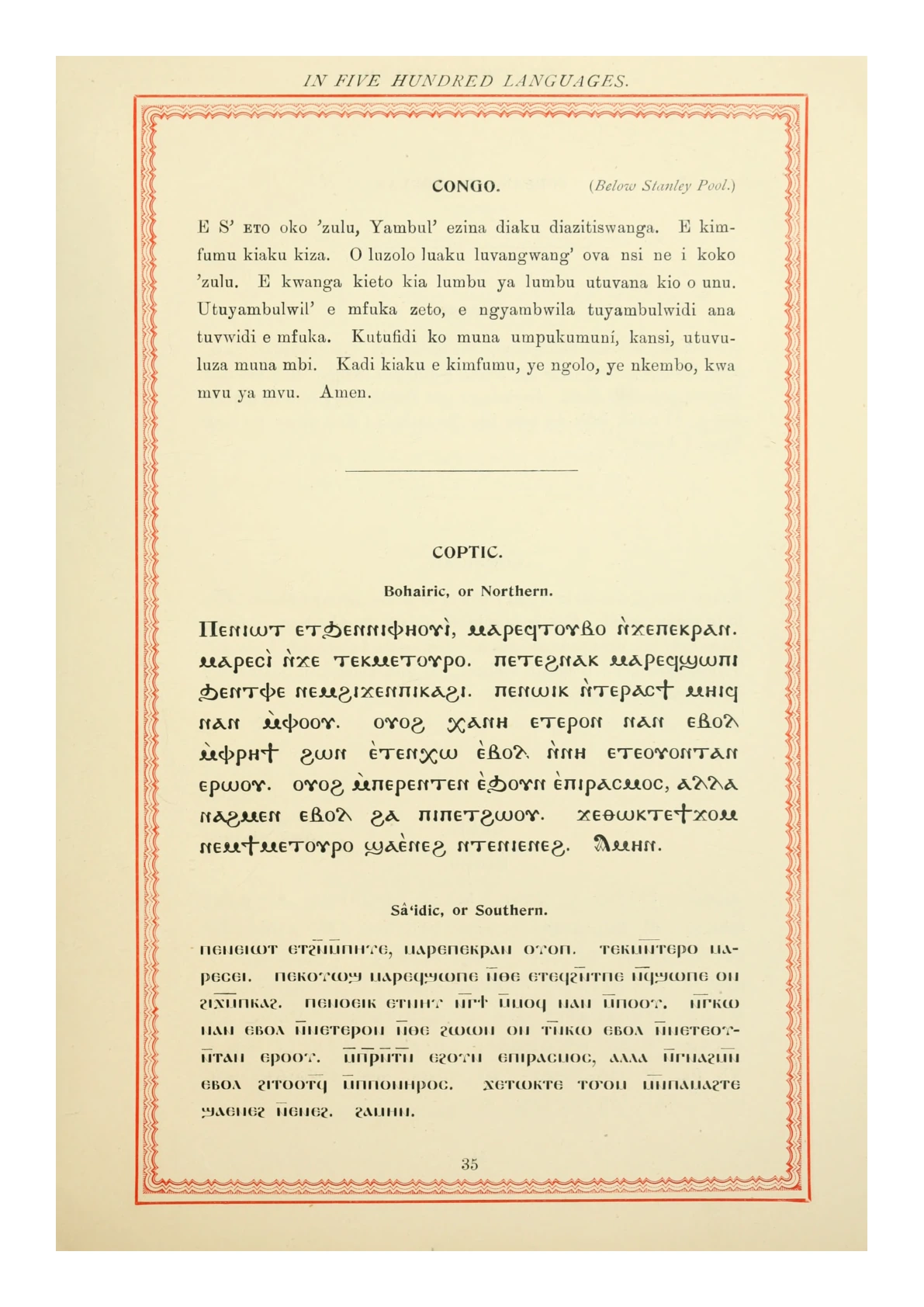
Historical printed prayer headed “CONGO” in The Lord’s Prayer in Five Hundred Languages, printed page 35. This older label is cross-referenced to Kongo by the linked language authority. The Commons record dates the compilation to 1905; this copy also contains a publisher note dated June 1908. Orthography and translation reflect the historical source, not a modern usage standard. Other languages appear on the same page. The source includes period terminology and editorial annotations; these are historical evidence, not Babelbook’s current terminology or claims.
Saved in Babelbook · resized display copy. Select the image to open it independently of its source.
Reinhold Rost (compiler); Gilbert & Rivington / Wm. Clowes & Sons (publishers); Internet Archive scan · Source ↗Public domain ↗View the local visual field note
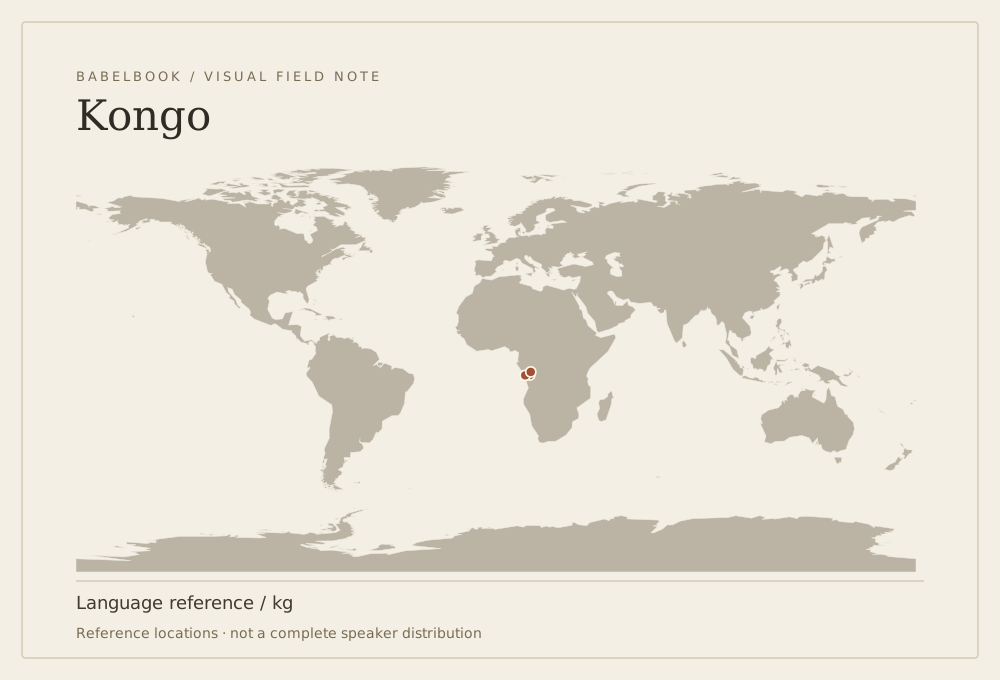
Representative reference points from Glottolog. Historical entries show reference locations, not current speakers. 3 points.
Reference & context ↗Babelbook · original editorial illustration · CC BY 4.0 · Glottolog locations; public-domain Natural Earth land
Source excerpts, selected, shortened and where noted editorially corrected from Kongo language by Wikipedia contributors. Retrieved 2026-10-05. CC BY-SA 4.0. These excerpts are not an independently verified scholarly history; missing accounts are identified above.
Read further in the source
Geographic distribution
Kikongo was the language of the Kingdom of Kongo prior to the creation of Angola by the Portuguese Crown in 1575. The Berlin Conference (1884–1885) among major European powers divided the rest of the kingdom into three territories. These are now parts of the DRC (Kongo Central and Bandundu), the Republic of the Congo, and Gabon. Kikongo is the base for the Creole language Kituba, also called Kikongo de l'État and Kikongo ya Leta (French and Kituba, respectively, for "Kikongo of the state administration" or "Kikongo of the State"). The constitution of the Republic of the Congo uses the name Kituba, and Democratic Republic of the Congo uses the term Kikongo (i.e. Kikongo ya Leta). This can be explained by the fact that Kikongo ya Leta is often mistakenly called Kikongo (i.e. KiNtandu, KiManianga, KiNdibu, etc.). Kikongo and Kituba are spoken in:
South of Republic of the Congo: Kikongo (Yombe, Vili, Ladi, Sundi, etc.) and Kituba: Kouilou, Niari, Bouenza, Lékoumou, south of Brazzaville, Pointe-Noire, Kikongo (Ladi, Kongo Boko, etc.): Pool; South-west of Democratic Republic of the Congo: Kikongo (Yombe, Ntandu, Ndibu, Manyanga, etc.) and Kikongo ya Leta: Kongo Central, a part of Kinshasa, Kikongo ya Leta: Kwilu, Kwango, Mai-Ndombe, far west Kasaï; North of Angola: Kikongo (Kisikongo, Zombo, Ibinda, etc.): Cabinda, Uíge, Zaire, north of Bengo and north of Cuanza Norte; South-West of Gabon. Kikongo (Vili): Nyanga, Ngounié
Writing
Kongo was the earliest Bantu language to be written in Latin characters. Portuguese created a dictionary in Kongo, the first of any Bantu language. A catechism was produced under the authority of Diogo Gomes, who was born in 1557 in Kongo to Portuguese parents and became a Jesuit priest. No version of that survives today. In 1624, Mateus Cardoso, another Portuguese Jesuit, edited and published a Kongo translation of the Portuguese catechism compiled by Marcos Jorge. The preface says that the translation was done by Kongo teachers from São Salvador (modern Mbanza Kongo) and was probably partially the work of Félix do Espírito Santo (also a Kongo). The dictionary was written in about 1648 for the use of Capuchin missionaries. The principal author was Manuel Robredo, a secular priest from Kongo (after he became a Capuchin, he was named Francisco de São Salvador). The back of this dictionary includes a two-page sermon written in Kongo. The dictionary has some 10,000 words. In the 1780s, French Catholic missionaries to the Loango coast created additional dictionaries. Bernardo da Canecattim published a word list in 1805. Baptist missionaries who arrived in Kongo in 1879 (from Great Britain) developed a modern orthography of the language. American missionary W. Holman Bentley arranged for his Dictionary and Grammar of the Kongo Language to be published by the University of Michigan in 1887. In the preface, Bentley gave credit to Nlemvo, an African, for his assistance. He described "the methods he used to compile the dictionary, which included sorting and correcting 25,000 slips of paper containing words and their definitions." Eventually W. Holman Bentley, with the special assistance of João Lemvo, produced a complete Christian Bible in 1905. The Office of the High Commissioner for Human Rights has published a translation of the Universal Declaration of Human Rights in Fiote.
Standardisation
The work of English, Swedish and other missionaries in the 19th and 20th centuries, in collaboration with Kongo linguists and evangelists such as Ndo Nzuawu Nlemvo (or Ndo Nzwawu Nlemvo; Dom João in Portuguese) and Miguel NeKaka, marked the standardisation of Kikongo.
A large proportion of the people at San Salvador, and in its neighbourhood, pronounce s and z before i as sh and j; for the sound sh, the letter x was adopted (as in Portuguese), while z before i was written as j. Our books are read over a much wider area than the district of San Salvador, and in those parts where s and z remain unchanged before i, the use of x and j has proved a difficulty; it has therefore been decided to use s and z only, and in those parts where the sound of these letters is softened before i they will be naturally softened in pronunciation, and where they remain unchanged they will be pronounced as written.
English words of Kongo origin
The southern Black American English word "goober" comes from Kongo nguba, meaning "peanut". The southern Black American English word "finda", from the Hoodoo tradition, comes from the Kongo word mfinda, meaning "the great forest". The southern Black American English word "mojo", from the Hoodoo tradition, comes from the Kongo word mooyo, meaning "to the spirits that dwelt within magical charms". The Black American popular music terms "funk" and "funky" may be from the Kongo word lu-fuki.