Kazakh
Kazakh is a Turkic language of the Kipchak branch, spoken in Central Asia by the Kazakhs. It is closely related to Nogai, Kyrgyz, and Karakalpak. It is the official language of Kazakhstan and has official status in the Altai Republic of Russia. It is also a minority language in the Ili Kazakh Autonomous Prefecture in Xinjiang, China, and in the Bayan-Ölgii Province of western Mongolia. The language is also spoken by many ethnic Kazakhs throughout the former Soviet Union (some 472,000 in Russia according to the 2010 Russian census), as well as in Germany and Turkey. Like other Turkic languages, Kazakh is an agglutinative language and employs vowel harmony. Kazakh builds words by adding suffixes one after another to the word stem, with each suffix expressing only one unique meaning and following a fixed sequence. Ethnologue recognises three mutually intelligible dialect groups: North-Eastern Kazakh—the most widely spoken variety, which also serves as the basis for the official language—Southern Kazakh, and Western Kazakh. The language shares a degree of mutual intelligibility with the closely related Karakalpak language, while its Western dialects maintain limited mutual intelligibility with the Altai languages. In October 2017, the then president, Nursultan Nazarbayev, decreed that the writing system would change from Cyrillic to Latin script by 2025.
Translate in Kazakh ↗Speakers of Kazakh are spread over a vast territory, from the Tian Shan to the western shore of the Caspian Sea. Kazakh is the official state language of Kazakhstan, with nearly 10 million speakers (based on information from the CIA World Factbook on population and proportion of Kazakh speakers). In China, nearly two million ethnic Kazakhs and Kazakh speakers reside in the Ili Kazakh Autonomous Prefecture of Xinjiang.
Central Asia
Present-day use
The captured source does not contain a separate current-use account.
Origins
The captured article does not contain a separate origins section. See the historical account and linked source.
Development
The Kipchak branch of Turkic languages, to which Kazakh belongs, was largely consolidated during the period of the Golden Horde. The modern Kazakh language is thought to have taken shape around 1465 AD, during the formation of the Kazakh Khanate. Modern Kazakh is likely a descendant of both Chagatay Turkic, as spoken by the Timurids, and Kipchak Turkic, as spoken in the Golden Horde. Kazakh contains a substantial number of loanwords from Persian and Arabic, owing to frequent historical interactions between Kazakhs and Iranian ethnic groups to the south. Furthermore, Persian served as a lingua franca in the Kazakh Khanate, enabling Kazakhs to incorporate Persian words into their spoken and written vernacular. Meanwhile, Arabic was used by Kazakhs in mosques and mausoleums, functioning as a language reserved for religious contexts—much as Latin served as a liturgical language in the Western European cultural sphere. The Kazakhs used the Arabic script to write their language until approximately 1929. In the early 1900s, the Kazakh activist Akhmet Baitursynuly reformed the Kazakh–Arabic alphabet, but his work was largely overshadowed by the Soviet presence in Central Asia. Subsequently, the new Soviet regime compelled the Kazakhs to adopt a Latin script and, later, a Cyrillic script in the 1940s. Today, Kazakhs use both the Cyrillic and Latin scripts to write their language, although a presidential decree issued in 2017 ordered the transition from Cyrillic to Latin by 2031. Although not classified as an endangered language, Kazakh was described in 2024 as being in a somewhat vulnerable position by Kazakhstan's Minister of Science and Higher Education, Sayasat Nurbek, falling into a category where the number of speakers is not increasing as rapidly as had been anticipated.
Writing
Kazakh exhibits tongue-root vowel harmony, with some words of recent foreign origin (e.g., from Russian, Persian, or Arabic) being exceptions. There is also a system of rounding harmony which resembles that of Kyrgyz, but which does not apply as strongly and is not reflected in the orthography. This system applies only to the mid vowels /e/, /ɘ/, /ə/ (and not /ɑ/), and operates in the following syllables. Thus, jūldyz 'star', bügın 'today', and ülken 'big' are actually pronounced as jūldūz, bügün, and ülkön, respectively. Nowadays, Kazakh is mostly written in the Cyrillic script, with an Arabic-based alphabet being used by Kazakh speakers in China. On 26 October 2017, by Presidential Decree 569, Kazakhstan announced that it would adopt the Latin script by 2025. However, this transition has since been delayed. Since the Cyrillic alphabet was originally designed for Slavic languages, it had to be modified to better fit the sounds of Turkic languages such as Kazakh. Several new letters were added, and some existing ones were modified: ә, ғ, қ, ң, ө, ұ, ү, һ, і. The Cyrillic letter у, when following a consonant, represents a combination of sounds /ɘ/, /ʉ/, ы /ə/, or /ʊ/ with the glide /w/, for example: кіру [kʰɘˈrɘw], су [sʊw], көру [kʰɵˈrʉw], and атысу [ɑtʰə̆ˈsəw]. The Cyrillic letter ю undergoes the same process but with /j/ at the beginning. The letter и represents a combination of sounds /ɘ/ (in front-vowel contexts) or /ə/ (in back vowel contexts) with the glide /j/, e.g., тиіс [tʰɘˈjɘ̆s], оқиды [woqʰəjˈdə]. In Russian loanwords, particularly in educated speech, it is often realised as /ʲi/ (when stressed) or /ʲɪ/ (when unstressed), e.g., изоморфизм [ɪzəmɐrˈfʲizm]. The letter я represents either /jɑ/ or /jæ/ depending on vowel harmony. The letter щ represents /ʃː/, e.g. ащы [ɑʃˈʃə]. Meanwhile, the letters в, ё, ф, х, һ, ц, ч, ъ, ь, and э are used only in loanwords—mostly those of Russian origin, but sometimes of Persian and Arabic origin as well.
Beyond the typeface.
Signs, manuscripts, published pages and contextual photographs, with their place, period, source and reuse terms. Captions identify historical spellings, regional examples, community references and character imagery.
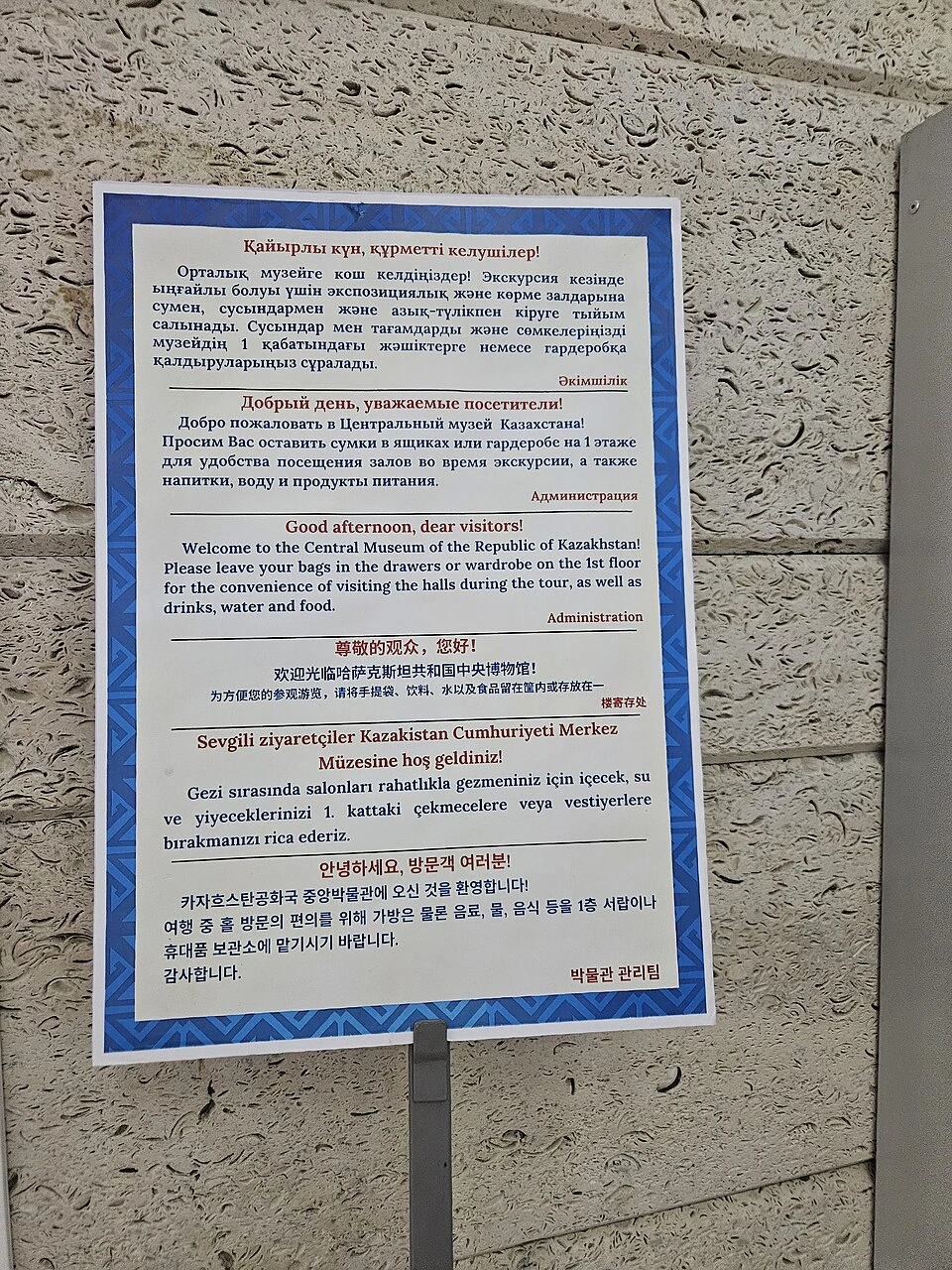
Kazakh among six languages on a notice in the Central State Museum of Kazakhstan, Almaty, photographed in July 2025. Language identification follows Commons descriptions or categories; not independently transcribed.
Saved in Babelbook · resized display copy. Select the image to open it independently of its source.
Nurken · Source ↗CC BY-SA 4.0 ↗View the local visual field note
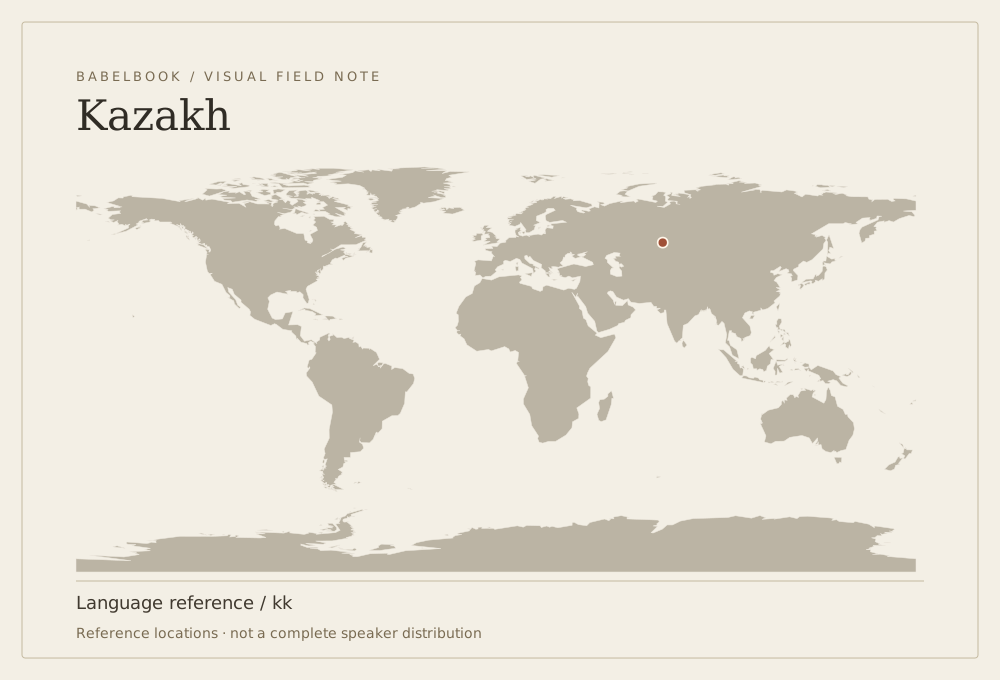
Representative reference points from Glottolog. Historical entries show reference locations, not current speakers. 1 point.
Reference & context ↗Babelbook · original editorial illustration · CC BY 4.0 · Glottolog locations; public-domain Natural Earth land
Source excerpts, selected, shortened and where noted editorially corrected from Kazakh language by Wikipedia contributors. Retrieved 2026-10-05. CC BY-SA 4.0. These excerpts are not an independently verified scholarly history; missing accounts are identified above.
Read further in the source
Geographic distribution
Speakers of Kazakh are spread over a vast territory, from the Tian Shan to the western shore of the Caspian Sea. Kazakh is the official state language of Kazakhstan, with nearly 10 million speakers (based on information from the CIA World Factbook on population and proportion of Kazakh speakers). In China, nearly two million ethnic Kazakhs and Kazakh speakers reside in the Ili Kazakh Autonomous Prefecture of Xinjiang.
History
The Kipchak branch of Turkic languages, to which Kazakh belongs, was largely consolidated during the period of the Golden Horde. The modern Kazakh language is thought to have taken shape around 1465 AD, during the formation of the Kazakh Khanate. Modern Kazakh is likely a descendant of both Chagatay Turkic, as spoken by the Timurids, and Kipchak Turkic, as spoken in the Golden Horde. Kazakh contains a substantial number of loanwords from Persian and Arabic, owing to frequent historical interactions between Kazakhs and Iranian ethnic groups to the south. Furthermore, Persian served as a lingua franca in the Kazakh Khanate, enabling Kazakhs to incorporate Persian words into their spoken and written vernacular. Meanwhile, Arabic was used by Kazakhs in mosques and mausoleums, functioning as a language reserved for religious contexts—much as Latin served as a liturgical language in the Western European cultural sphere. The Kazakhs used the Arabic script to write their language until approximately 1929. In the early 1900s, the Kazakh activist Akhmet Baitursynuly reformed the Kazakh–Arabic alphabet, but his work was largely overshadowed by the Soviet presence in Central Asia. Subsequently, the new Soviet regime compelled the Kazakhs to adopt a Latin script and, later, a Cyrillic script in the 1940s. Today, Kazakhs use both the Cyrillic and Latin scripts to write their language, although a presidential decree issued in 2017 ordered the transition from Cyrillic to Latin by 2031. Although not classified as an endangered language, Kazakh was described in 2024 as being in a somewhat vulnerable position by Kazakhstan's Minister of Science and Higher Education, Sayasat Nurbek, falling into a category where the number of speakers is not increasing as rapidly as had been anticipated.
Phonology and orthography
Kazakh exhibits tongue-root vowel harmony, with some words of recent foreign origin (e.g., from Russian, Persian, or Arabic) being exceptions. There is also a system of rounding harmony which resembles that of Kyrgyz, but which does not apply as strongly and is not reflected in the orthography. This system applies only to the mid vowels /e/, /ɘ/, /ə/ (and not /ɑ/), and operates in the following syllables. Thus, jūldyz 'star', bügın 'today', and ülken 'big' are actually pronounced as jūldūz, bügün, and ülkön, respectively.
Orthography
Nowadays, Kazakh is mostly written in the Cyrillic script, with an Arabic-based alphabet being used by Kazakh speakers in China. On 26 October 2017, by Presidential Decree 569, Kazakhstan announced that it would adopt the Latin script by 2025. However, this transition has since been delayed. Since the Cyrillic alphabet was originally designed for Slavic languages, it had to be modified to better fit the sounds of Turkic languages such as Kazakh. Several new letters were added, and some existing ones were modified: ә, ғ, қ, ң, ө, ұ, ү, һ, і. The Cyrillic letter у, when following a consonant, represents a combination of sounds /ɘ/, /ʉ/, ы /ə/, or /ʊ/ with the glide /w/, for example: кіру [kʰɘˈrɘw], су [sʊw], көру [kʰɵˈrʉw], and атысу [ɑtʰə̆ˈsəw]. The Cyrillic letter ю undergoes the same process but with /j/ at the beginning. The letter и represents a combination of sounds /ɘ/ (in front-vowel contexts) or /ə/ (in back vowel contexts) with the glide /j/, e.g., тиіс [tʰɘˈjɘ̆s], оқиды [woqʰəjˈdə]. In Russian loanwords, particularly in educated speech, it is often realised as /ʲi/ (when stressed) or /ʲɪ/ (when unstressed), e.g., изоморфизм [ɪzəmɐrˈfʲizm]. The letter я represents either /jɑ/ or /jæ/ depending on vowel harmony. The letter щ represents /ʃː/, e.g. ащы [ɑʃˈʃə]. Meanwhile, the letters в, ё, ф, х, һ, ц, ч, ъ, ь, and э are used only in loanwords—mostly those of Russian origin, but sometimes of Persian and Arabic origin as well. They are often substituted in spoken Kazakh. The table below compares the various scripts.