Khmer
Khmer ( kə-MAIR; ខ្មែរ, UNGEGN: Khmêr [kʰmae] ) is an Austroasiatic language spoken natively by the Khmer people and is an official language and national language of Cambodia. The language is also widely spoken by Khmer people in Eastern Thailand and Isan, Thailand, as well as in the Southeastern and Mekong regions of Vietnam. Khmer has been influenced considerably by Sanskrit and Pali especially in the royal and religious registers, through Hinduism and Buddhism, due to Old Khmer being the language of the historical empires of Chenla and Angkor. The vast majority of Khmer speakers speak Central Khmer, the dialect of the central plain where the Khmer are most heavily concentrated. Within Cambodia, regional accents exist in remote areas but these are regarded as varieties of Central Khmer. Two exceptions are the speech of the capital, Phnom Penh, and that of the Khmer Khe in Stung Treng province, both of which differ sufficiently enough from Central Khmer to be considered separate dialects of Khmer. Outside of Cambodia, three distinct dialects are spoken by ethnic Khmers native to areas that were historically part of the Khmer Empire. The Northern Khmer dialect is spoken by over a million Khmers in the southern regions of Northeast Thailand and is treated by some linguists as a separate language. Khmer Krom, or Southern Khmer, is the first language of the Khmer of Vietnam, while the Khmer living in the remote Cardamom Mountains speak a very conservative dialect that still displays features of the Middle Khmer language. Khmer is primarily an analytic, isolating language.
Translate in Khmer ↗Khmer is spoken by some 13 million people in Cambodia, where it is the official language. It is also a second language for most of the minority groups and indigenous hill tribes there. Additionally there are a million speakers of Khmer native to southern Vietnam (1999 census) and 1.4 million in east Thailand (2006). Khmer dialects, although mutually intelligible, are sometimes quite marked. Notable variations are found in speakers from Phnom Penh (Cambodia's capital city), the rural Battambang area, the areas of Northeast Thailand adjacent to Cambodia such as Surin province, the Cardamom Mountains, and southern Vietnam. The dialects form a continuum running roughly north to south. Standard Cambodian Khmer is mutually intelligible with the others but a Khmer Krom speaker from Vietnam, for instance, may have great difficulty communicating with a Khmer native of Sisaket Province in Thailand. The following is a classification scheme showing the development of the modern Khmer dialects. Standard Khmer, or Central Khmer, the language as taught in Cambodian schools and used by the media, is based on the dialect spoken throughout the Central Plain, a region encompassed by the northwest and central provinces. Northern Khmer (called Khmer Surin in Khmer) refers to the dialects spoken by many in several border provinces of present-day northeast Thailand. After the fall of the Khmer Empire in the early 15th century, the Dongrek Mountains served as a natural border leaving the Khmer north of the mountains under the sphere of influence of the Kingdom of Lan Xang.
Southeast Asia
Present-day use
The captured source does not contain a separate current-use account.
Origins
The captured article does not contain a separate origins section. See the historical account and linked source.
Development
The captured article does not contain a distinct historical account. No chronology has been invented.
Writing
Khmer is written with the Khmer script, an abugida developed from the Pallava script of India before the 7th century when the first known inscription appeared. Written left-to-right with vowel signs that can be placed after, before, above or below the consonant they follow, the Khmer script is similar in appearance and usage to Thai and Lao, both of which were based on the Khmer system. The Khmer script is also distantly related to the Mon–Burmese script. Within Cambodia, literacy in the Khmer alphabet is estimated at 77.6%. Consonant symbols in Khmer are divided into two groups, or series. The first series carries the inherent vowel [ɑː] while the second series carries the inherent vowel [ɔː]. The Khmer names of the series, [akʰoːsaʔ] ('voiceless') and [kʰoːsaʔ] ('voiced'), respectively, indicate that the second series consonants were used to represent the voiced phonemes of Old Khmer. As the voicing of stops was lost, however, the contrast shifted to the phonation of the attached vowels, which, in turn, evolved into a simple difference of vowel quality, often by diphthongisation. This process has resulted in the Khmer alphabet having two symbols for most consonant phonemes and each vowel symbol having two possible readings, depending on the series of the initial consonant:
Beyond the typeface.
Signs, manuscripts, published pages and contextual photographs, with their place, period, source and reuse terms. Captions identify historical spellings, regional examples, community references and character imagery.
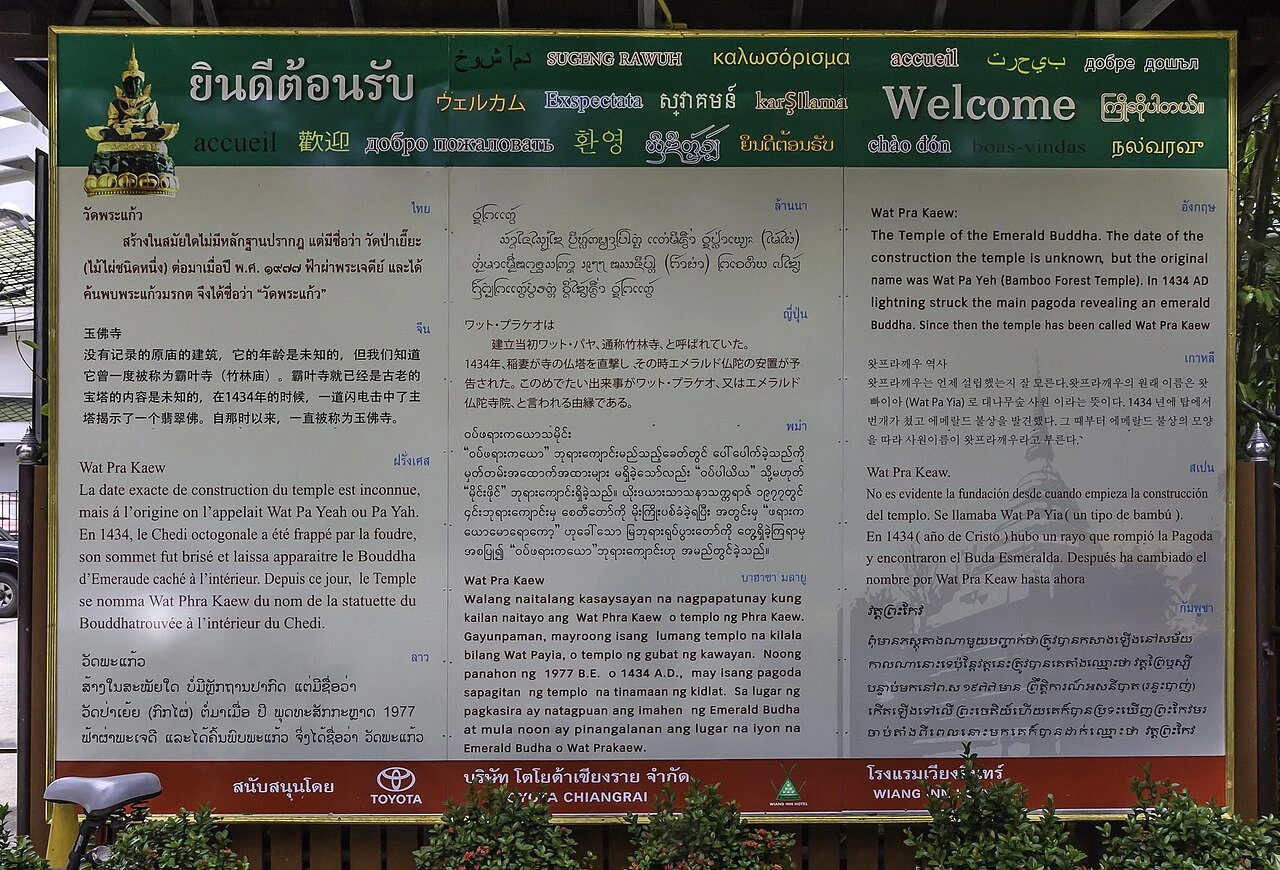
Multilingual information board at Wat Phra Kaeo, Chiang Rai. Commons explicitly lists Burmese, Khmer and Lao among its languages. Language identification follows Commons metadata; not independently transcribed.
Saved in Babelbook · resized display copy. Select the image to open it independently of its source.
Stefan Fussan · Source ↗CC BY-SA 3.0 ↗View the local visual field note
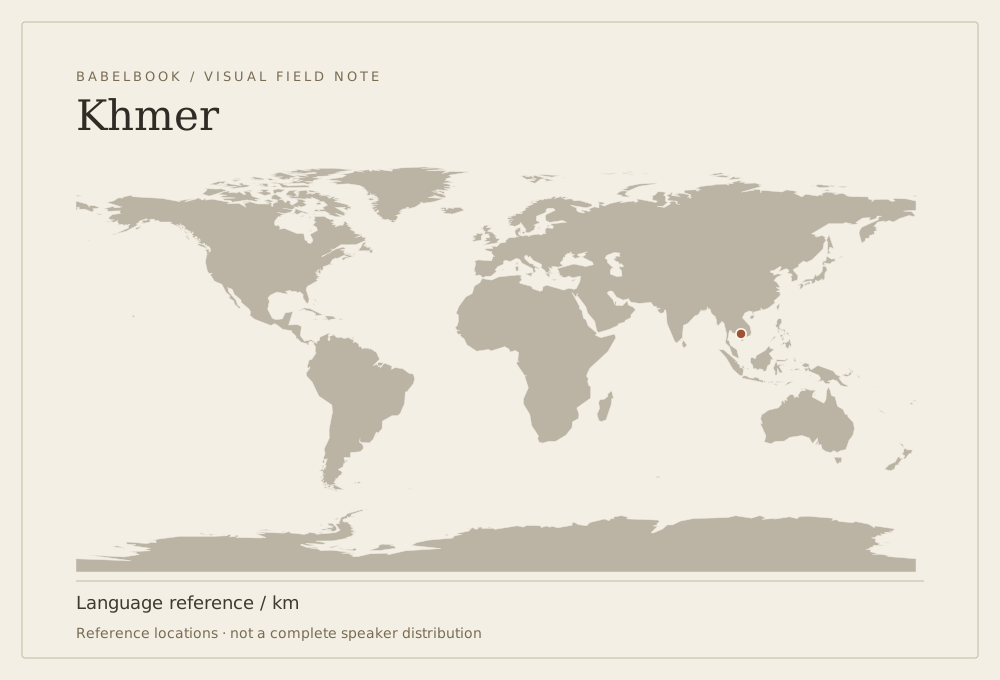
Representative reference points from Glottolog. Historical entries show reference locations, not current speakers. 1 point.
Reference & context ↗Babelbook · original editorial illustration · CC BY 4.0 · Glottolog locations; public-domain Natural Earth land
Source excerpts, selected, shortened and where noted editorially corrected from Khmer language by Wikipedia contributors. Retrieved 2026-10-05. CC BY-SA 4.0. These excerpts are not an independently verified scholarly history; missing accounts are identified above.
Read further in the source
Geographic distribution and dialects
Khmer is spoken by some 13 million people in Cambodia, where it is the official language. It is also a second language for most of the minority groups and indigenous hill tribes there. Additionally there are a million speakers of Khmer native to southern Vietnam (1999 census) and 1.4 million in east Thailand (2006). Khmer dialects, although mutually intelligible, are sometimes quite marked. Notable variations are found in speakers from Phnom Penh (Cambodia's capital city), the rural Battambang area, the areas of Northeast Thailand adjacent to Cambodia such as Surin province, the Cardamom Mountains, and southern Vietnam. The dialects form a continuum running roughly north to south. Standard Cambodian Khmer is mutually intelligible with the others but a Khmer Krom speaker from Vietnam, for instance, may have great difficulty communicating with a Khmer native of Sisaket Province in Thailand. The following is a classification scheme showing the development of the modern Khmer dialects.
Standard Khmer, or Central Khmer, the language as taught in Cambodian schools and used by the media, is based on the dialect spoken throughout the Central Plain, a region encompassed by the northwest and central provinces. Northern Khmer (called Khmer Surin in Khmer) refers to the dialects spoken by many in several border provinces of present-day northeast Thailand. After the fall of the Khmer Empire in the early 15th century, the Dongrek Mountains served as a natural border leaving the Khmer north of the mountains under the sphere of influence of the Kingdom of Lan Xang. The conquests of Cambodia by Naresuan the Great for Ayutthaya furthered their political and economic isolation from Cambodia proper, leading to a dialect that developed relatively independently from the midpoint of the Middle Khmer period. This has resulted in a distinct accent influenced by the surrounding tonal languages Lao and Thai, lexical differences, and phonemic differences in both vowels and distribution of consonants. Syllable-final /r/, which has become silent in other dialects of Khmer, is still pronounced in Northern Khmer. Some linguists classify Northern Khmer as a separate but closely related language rather than a dialect. Western Khmer, also called Cardamom Khmer or Chanthaburi Khmer, is spoken by a very small, isolated population in the Cardamom mountain range extending from western Cambodia into eastern Central Thailand. Although little studied, this variety is unique in that it maintains a definite system of vocal register that has all but disappeared in other dialects of modern Khmer. Phnom Penh Khmer is spoken in the capital and surrounding areas. This dialect is characterised by merging or complete elision of syllables, which speakers from other regions consider a "relaxed" pronunciation. For instance, "Phnom Penh" is sometimes shortened to "m'Penh". Another characteristic of Phnom Penh speech is observed in words with an "r" either as an initial consonant or as the second member of a consonant cluster (as in the English word "bread"). The "r", trilled or flapped in other dialects, is either pronounced as a uvular trill or not pronounced at all. This alters the quality of any preceding consonant, causing a harder, more emphasised pronunciation. Another unique result is that the syllable is spoken with a low-rising or "dipping" tone much like the "hỏi" tone in Vietnamese. For example, some people pronounce ត្រី [trəj] ('fish') as [tʰəj]: the [r] is dropped and the vowel begins by dipping much lower in tone than standard speech and then rises, effectively doubling its length. Another example is the word រៀន [riən] ('to study'), which is pronounced [ʀiən], with the uvular "r" and the same intonation described above. Khmer Krom or Southern Khmer is spoken by the indigenous Khmer population of the Mekong Delta, formerly controlled by the Khmer Empire but part of Vietnam since 1698. There have been reports of major restrictions by the Vietnamese government, as well as societal pressures, against usage of the Khmer language among the Khmer Krom, who, since the 1950s, have mostly (sometimes forcibly) taken on Vietnamese names. Consequently, very little research has been published regarding this dialect, although conservation efforts have been underway, both in the form of education and state television. Khmer Krom has been generally influenced by Vietnamese for three centuries and accordingly displays a pronounced accent, tendency toward monosyllabic words and lexical differences from Standard Khmer. Khmer Khe is spoken in the Se San, Srepok and Sekong river valleys of Sesan and Siem Pang districts in Stung Treng Province. Following the decline of Angkor, the Khmer abandoned their northern territories, which the Lao then settled. In the 17th century, Chey Chetha XI led a Khmer force into Stung Treng to retake the area. The Khmer Khe living in this area of Stung Treng in modern times are presumed to be the descendants of this group. Their dialect is thought to resemble that of pre-modern Siem Reap.
Writing system
Khmer is written with the Khmer script, an abugida developed from the Pallava script of India before the 7th century when the first known inscription appeared. Written left-to-right with vowel signs that can be placed after, before, above or below the consonant they follow, the Khmer script is similar in appearance and usage to Thai and Lao, both of which were based on the Khmer system. The Khmer script is also distantly related to the Mon–Burmese script. Within Cambodia, literacy in the Khmer alphabet is estimated at 77.6%. Consonant symbols in Khmer are divided into two groups, or series. The first series carries the inherent vowel [ɑː] while the second series carries the inherent vowel [ɔː]. The Khmer names of the series, [akʰoːsaʔ] ('voiceless') and [kʰoːsaʔ] ('voiced'), respectively, indicate that the second series consonants were used to represent the voiced phonemes of Old Khmer. As the voicing of stops was lost, however, the contrast shifted to the phonation of the attached vowels, which, in turn, evolved into a simple difference of vowel quality, often by diphthongisation. This process has resulted in the Khmer alphabet having two symbols for most consonant phonemes and each vowel symbol having two possible readings, depending on the series of the initial consonant: