Kannada
Kannada (Kannada: [ˈkənːəɖa] ) is a Dravidian language spoken predominantly in the state of Karnataka in southwestern India, and spoken by a minority of the population in all neighbouring states. It has 44 million native speakers, and is additionally a second or third language for 15 million speakers in Karnataka. It is the official and administrative language of Karnataka. It also has scheduled status in India and has been declared one of the Classical languages of India. Early Kannada literature was composed predominantly by Jaina court poets, and many texts from before the 12th century were religious narratives about the Jain Tīrthaṅkaras. Kannada was the court language of a number of dynasties and empires of South India, Central India and the Deccan Plateau, namely the Kadamba dynasty, Western Ganga dynasty, Nolamba dynasty, Chalukya dynasty, Rashtrakutas, Western Chalukya Empire, Seuna dynasty, Kingdom of Mysore, Nayakas of Keladi, Hoysala dynasty and the Vijayanagara Empire. Kannada is written using the Kannada script, which evolved from the 5th-century Kadamba script. Kannada is attested epigraphically for about one and a half millennia. Old Kannada Rashtrakuta literature flourished during the 8th-10th centuries CE. Kannada has an unbroken literary history of around 1500 years. In July 2011, a centre for the study of classical Kannada was established as part of the Central Institute of Indian Languages in Mysore to facilitate research related to the language.
Translate in Kannada ↗Kannada had 43.7 million native speakers in India at the time of the 2011 census. It is the main language of the state of Karnataka, where it is spoken natively by 40.6 million people, or about two-thirds of the state's population. There are native Kannada speakers in the neighbouring states of Tamil Nadu (1,140,000 speakers), Maharashtra (993,000), Andhra Pradesh and Telangana (533,000), Kerala (78,100), and Goa (67,800). It is also spoken as a second and third language by over 12.9 million non-native speakers in Karnataka. Kannadigas form Tamil Nadu's third-largest linguistic group; their population is roughly 1.23 million, which is 2.2% of Tamil Nadu's total population. In the United States, there were 35,900 speakers in 2006–2008, a number that had risen to 48,600 by 2015. There are 4,000 speakers in Canada (2016 census), 9,700 in Australia (2016 census), 22,000 in Singapore (2018 estimate), and 59,000 in Malaysia (2021 estimate).
South Asia
Present-day use
By the 19th century, Modern Kannada had emerged as its own literary idiom, shaped by the influences of colonial education and native literary practice. Kannada writers such as Vinayaka took to Western literary forms, including the novel and non-native metrical forms. The Navōdaya (modernist) poet Da Rā Bēndre wrote in 1940 that "individuality is the characteristic of the age", arguing for Kannada literature to speak about individuals rather than traditions or communities. Among Kannada's many renowned writers, Kuvempu is widely regarded as one of the greatest Kannada writers of his generation. Mamta Sagar writes that Kuvempu, along with other writers of "Kannada romanticism", were strongly influenced by the rise of English language education in colonial Mysore. Even as this modernist movement developed, a number of poets and scholars in the court of Mysore continued to write new works in classical style. One such writer was Siddhānti Śivaśaṅkara Śāstri, who belonged to a lineage of palace scholars going back to Kuṇigaḷa Rāmaśāstri. Women also began to publish more widely, exemplified by Nanjangud Tirumalamba, who wrote a number of plays and novels, and established her own publishing house, Sati Hitaiṣini. In the 1970s, the "Boosa" movement saw strong criticism of earlier Kannada writers (including Kuvempu) for ignoring the enduring reality of caste discrimination and other social issues. Contemporary Kannada literature has generally been characterised by an interest in social criticism. In the 20th century CE, there have been several distinct movements in Kannada literature, including the modernist Navodaya and Navya, the radical Dalita and the progressive Bandaya. Works of Kannada literature have received eight Jnanpith Awards, the highest number awarded to any Indian language.
Origins
The captured article does not contain a separate origins section. See the historical account and linked source.
Development
Kannada, like Malayalam and Tamil, is a South Dravidian language and a descendant of Tamil-Kannada, from which it derives its grammar and core vocabulary. Its history can be divided into three stages: Old Kannada, or Haḷegannaḍa from 450 to 1200 AD, Middle Kannada (Naḍugannaḍa) from 1200 to 1700 and Modern Kannada (Hosagannaḍa) from 1700 to the present. Kannada has been considerably influenced by Sanskrit and Prakrit—in morphology, phonetics, vocabulary, grammar, and syntax. The three principal sources of influence on literary Kannada grammar appear to be Pāṇini's grammar, non-Pāṇinian schools of Sanskrit grammar, particularly Kātantra and Śākaṭāyana schools, and, to a lesser extent, Prakrit grammar. Literary Prakrit seems to have prevailed in Karnataka since ancient times. Speakers of vernacular Prakrit may have come into contact with Kannada speakers, thus influencing their language, even before Kannada was used for administrative or liturgical purposes. The scholar K.V. Narayana claims that many tribal languages now designated as Kannada dialects could be nearer to the earlier form of the language, with lesser influence from other languages. Based on native Kannada words in Prakrit inscriptions of that period, Kannada must have been spoken by a broad and stable population. Kannada includes many loan words from Sanskrit. Some unaltered loan words (Sanskrit: तत्सम, romanized: tatsama, lit. 'same as that'') include dina, 'day', kōpa, 'anger', sūrya, 'sun', mukha, 'face', and nimiṣa, 'minute'. Some examples of naturalised Sanskrit words (Sanskrit: तद्भव, romanized: tadbhava, lit. 'arising from that') in Kannada are varṇa, 'colour', pūrṇime, and rāya from rāja, 'king'. Some naturalised words of Prakrit origin in Kannada are baṇṇa, 'colour' derived from vaṇṇa, huṇṇime, 'full moon' from puṇṇivā.
Writing
The language uses forty-nine phonemic letters, divided into three groups: swaragalu (vowels – thirteen letters); vyanjanagalu (consonants – thirty-four letters); and yogavaahakagalu (neither vowel nor consonant – two letters: anusvara ಂ and visarga ಃ). The character set is almost identical to that of other Indian languages. The Kannada script is almost entirely phonetic, but for the sound of a "half n" (which becomes a half m). The number of written symbols, however, is far more than the forty-nine characters in the alphabet, because different characters can be combined to form compound characters (ottakshara). Each written symbol in the Kannada script corresponds with one syllable, as opposed to one phoneme in languages like English—the Kannada script is syllabic.
Beyond the typeface.
Signs, manuscripts, published pages and contextual photographs, with their place, period, source and reuse terms. Captions identify historical spellings, regional examples, community references and character imagery.
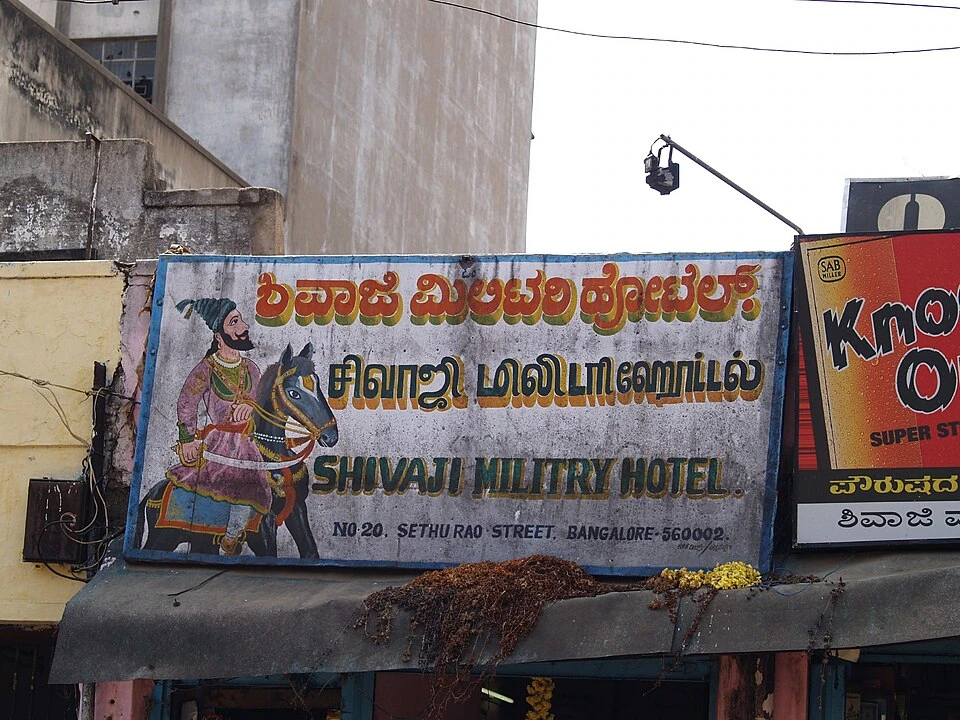
Shivaji hotel sign in Bangalore, written in Kannada, Tamil and English. Language identification follows Commons metadata; not independently transcribed.
Saved in Babelbook · resized display copy. Select the image to open it independently of its source.
Matthew Logelin · Source ↗CC BY 2.0 ↗View the local visual field note
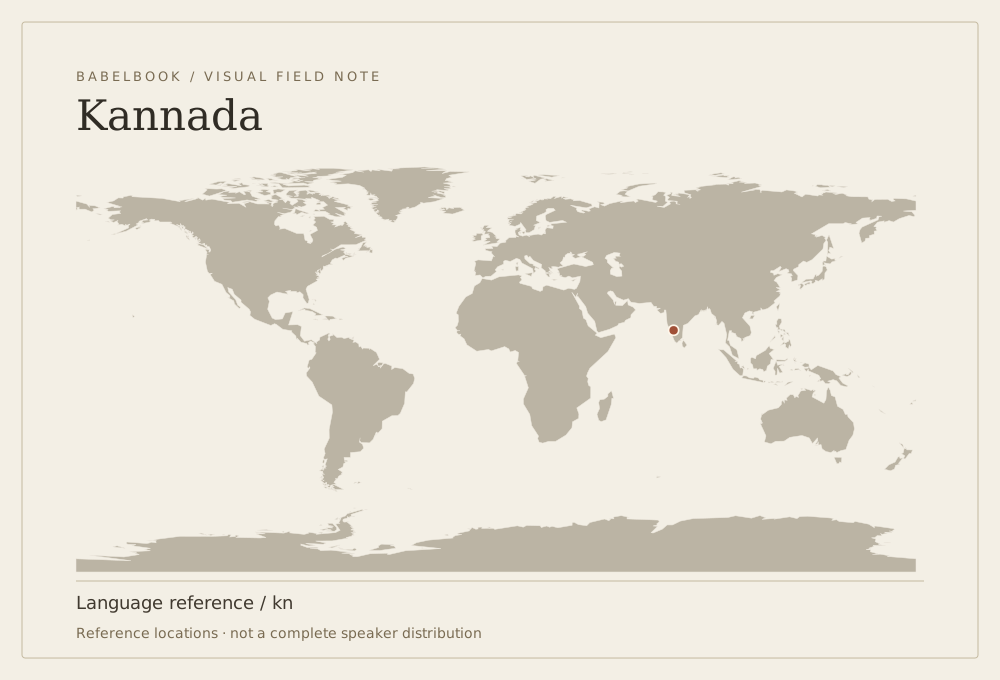
Representative reference points from Glottolog. Historical entries show reference locations, not current speakers. 1 point.
Reference & context ↗Babelbook · original editorial illustration · CC BY 4.0 · Glottolog locations; public-domain Natural Earth land
Source excerpts, selected, shortened and where noted editorially corrected from Kannada by Wikipedia contributors. Retrieved 2026-10-05. CC BY-SA 4.0. These excerpts are not an independently verified scholarly history; missing accounts are identified above.
Read further in the source
Geographic distribution
Kannada had 43.7 million native speakers in India at the time of the 2011 census. It is the main language of the state of Karnataka, where it is spoken natively by 40.6 million people, or about two-thirds of the state's population. There are native Kannada speakers in the neighbouring states of Tamil Nadu (1,140,000 speakers), Maharashtra (993,000), Andhra Pradesh and Telangana (533,000), Kerala (78,100), and Goa (67,800). It is also spoken as a second and third language by over 12.9 million non-native speakers in Karnataka. Kannadigas form Tamil Nadu's third-largest linguistic group; their population is roughly 1.23 million, which is 2.2% of Tamil Nadu's total population. In the United States, there were 35,900 speakers in 2006–2008, a number that had risen to 48,600 by 2015. There are 4,000 speakers in Canada (2016 census), 9,700 in Australia (2016 census), 22,000 in Singapore (2018 estimate), and 59,000 in Malaysia (2021 estimate).
Dialects
There is considerable difference between the spoken and written forms of the language. Modern standard Kannada and its written form, primarily based on the Mysore–Bangalore variety, is more or less consistent throughout Karnataka. Spoken Kannada tends to vary from region to region, though most dialects remain mutually intelligible. Linguists broadly group Kannada dialects into Southern, Northern, Central, and Coastal varieties, though the boundaries between them often overlap.. Northern Kannada dialects preserve older phonological features not found in southern dialects. Coastal dialects show lexical influence from Tulu and Konkani due to prolonged language contact. Dialects of Kannada language fall into include:
Coastal Mangalore Kannada Halakki Kannada (Halakki Vokkaligas of Uttara Kannada and Shimoga). Havigannada (used mainly by Havyaka Brahmins) Kundagannada (Kundapura, Brahmavara, Bynduru and Hebri) Nador-Kannada (used by Nador (caste)) Halegannada (spoken by Komarpant in Goa, Uttara Kannada and Khanapur, Karnataka. Hatkar - a conservative dialect that preserves many Old Kannada terms, spoken by Hatkars in the Nasik district, Maharashtra. Kannada speakers formed 0.12% of Nasik district's population as per 1961 census. Northern Dharwad (Dharwad, Belagavi, Haveri, and Gadag) - preserves some older phonological features not found in southern dialects. South-Western Arebhashe (Spoken in the Gowda community, mainly in Madikeri and Sullia) Southern Bengaluru Kannada Banakal Kannada
Writing system
The language uses forty-nine phonemic letters, divided into three groups: swaragalu (vowels – thirteen letters); vyanjanagalu (consonants – thirty-four letters); and yogavaahakagalu (neither vowel nor consonant – two letters: anusvara ಂ and visarga ಃ). The character set is almost identical to that of other Indian languages. The Kannada script is almost entirely phonetic, but for the sound of a "half n" (which becomes a half m). The number of written symbols, however, is far more than the forty-nine characters in the alphabet, because different characters can be combined to form compound characters (ottakshara). Each written symbol in the Kannada script corresponds with one syllable, as opposed to one phoneme in languages like English—the Kannada script is syllabic.