Korean
Korean is a Koreanic language native to Korea, which makes up the majority of the language's 81 million speakers. It is the official language of both North Korea and South Korea. In the south, the language is known as Hangugeo (South Korean: 한국어), and in the north, it is known as Chosŏnŏ (North Korean: 조선어). Since the turn of the 21st century, Korean popular culture has spread around the world through globalization and cultural exports. Korean uses the Hangul alphabet. Beyond Korea the language is recognized as a minority language in parts of China, namely Jilin, and specifically Yanbian Prefecture, and Changbai County. It is also spoken by Sakhalin Koreans in parts of Sakhalin, the Russian island just north of Japan, and by the Koryo-saram in parts of Central Asia. The Jeju language of Jeju Island is closely related but not mutually intelligible with Korean. Together with a few extinct relatives they form the compact Koreanic language family. The linguistic homeland of Korean is suggested to be somewhere in modern Manchuria. The hierarchy of the society from which the language originates deeply influences the language, leading to a system of speech levels and honorifics indicative of the formality of any given situation. Modern Korean is written in the Korean script (한글; Hangeul in South Korea, 조선글; Chosŏn'gŭl in North Korea), an alphabet system developed during the 15th century for that purpose, although it did not become the primary script until the mid 20th century.
Translate in Korean ↗Korean is spoken by the Korean people in both South Korea and North Korea, and by the Korean diaspora in many countries including the People's Republic of China, the United States, Japan, and Russia. In 2001, Korean was the fourth most popular foreign language in China, following English, Japanese, and Russian. Korean-speaking minorities exist in these states, but because of cultural assimilation into host countries, not all ethnic Koreans may speak it with native fluency. Korean is the official language of South Korea and North Korea. It, along with Mandarin Chinese, is also one of the two official languages of China's Yanbian Korean Autonomous Prefecture. In North Korea, the regulatory body is the Language Institute of the Academy of Social Sciences (사회과학원 어학연구소; 社會科學院語學硏究所). In South Korea, the regulatory body for Korean is the Seoul-based National Institute of Korean Language, which was created by presidential decree on 23 January 1991.
East Asia
Present-day use
Korean is the official language of South Korea and North Korea. It, along with Mandarin Chinese, is also one of the two official languages of China's Yanbian Korean Autonomous Prefecture. In North Korea, the regulatory body is the Language Institute of the Academy of Social Sciences (사회과학원 어학연구소; 社會科學院語學硏究所). In South Korea, the regulatory body for Korean is the Seoul-based National Institute of Korean Language, which was created by presidential decree on 23 January 1991.
Origins
The captured article does not contain a separate origins section. See the historical account and linked source.
Development
Modern Korean descends from Middle Korean, which in turn descends from Old Korean, which descends from the Proto-Koreanic language, which is generally suggested to have its linguistic homeland somewhere in Manchuria. Whitman (2012) suggests that the proto-Koreans, already present in northern Korea, expanded into the southern part of the Korean Peninsula in around 300 BC and coexisted with the descendants of the Japonic Mumun cultivators (or assimilated them). Both had influence on each other and a later founder effect diminished the internal variety of both language families. Since the establishment of two independent governments, North–South differences have developed in standard Korean, including variations in pronunciation and vocabulary chosen. While there tends to be strong political conflict between North and South Korea regarding these linguistic "differences", regional dialects within each country actually display greater linguistic variations than those found between North and South Korean standards. Nevertheless these dialects remain largely mutually intelligible.
Writing
The Chinese language, written with Chinese characters and read with Sino-Xenic pronunciations, was introduced to Korea in the 1st century BC and remained the medium of formal writing and government until the late 19th century. Korean scholars adapted Chinese characters (known in Korean as Hanja) to write their own language, creating scripts known as idu, hyangchal, gugyeol and gakpil. These systems were cumbersome owing to the fundamental disparities between the Korean and Chinese languages and accessible only to those educated in classical Chinese. Most of the population was illiterate. In the 15th century King Sejong the Great personally developed an alphabetic featural writing system, known today as Hangul, to promote literacy among the common people. Introduced in the document Hunminjeongeum, it was called eonmun ('colloquial script') and quickly spread nationwide to increase literacy in Korea. The Korean alphabet was denounced by the yangban aristocracy, who looked down upon it for being too easy to learn. However it gained widespread use among the common class and was widely used to print popular novels, which were enjoyed by the common class. Since few people could understand official documents written in classical Chinese, Korean kings sometimes released public notices written entirely in Hangul as early as the 16th century for all Korean classes, including uneducated peasants and slaves. By the 17th century the yangban had exchanged Hangul letters with slaves, which suggests a high literacy rate of Hangul during the Joseon era. In the context of growing Korean nationalism in the 19th century the Kabo Reform of 1894 abolished the Confucian examinations and decreed that government documents would be issued in Hangul instead of literary Chinese. Some newspapers were published in Hangul, but other publications used Korean mixed script, with Hanja for Sino-Korean vocabulary and Hangul for other elements.
Beyond the typeface.
Signs, manuscripts, published pages and contextual photographs, with their place, period, source and reuse terms. Captions identify historical spellings, regional examples, community references and character imagery.
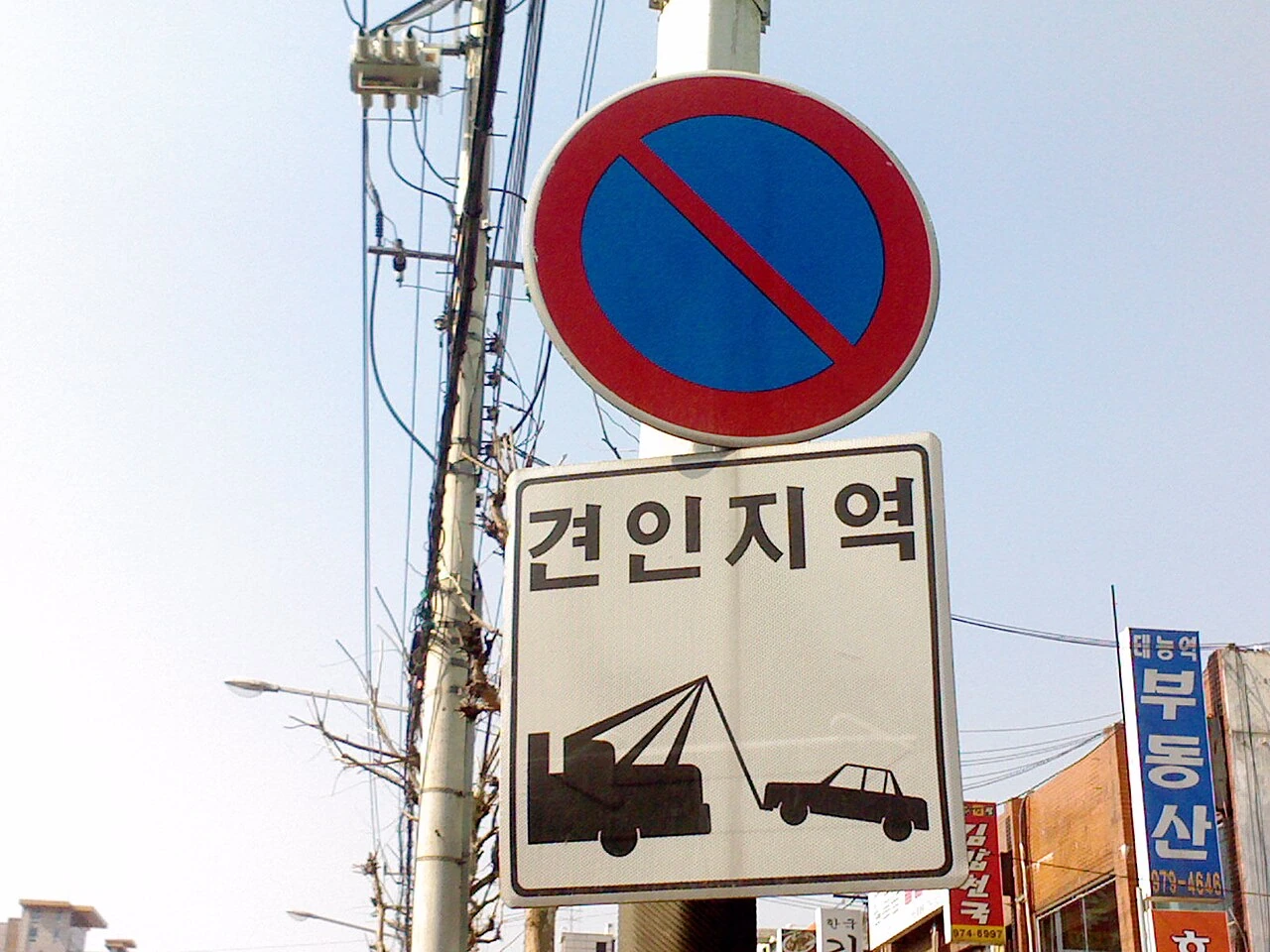
Photographed no-parking and tow-away notice in South Korea, 2011. Korean text identifies parking prohibition and towing. Displayed at reduced size; no additional crop.
Saved in Babelbook · resized display copy. Select the image to open it independently of its source.
P.Ctnt · Source ↗Public domain — author release ↗View the local visual field note
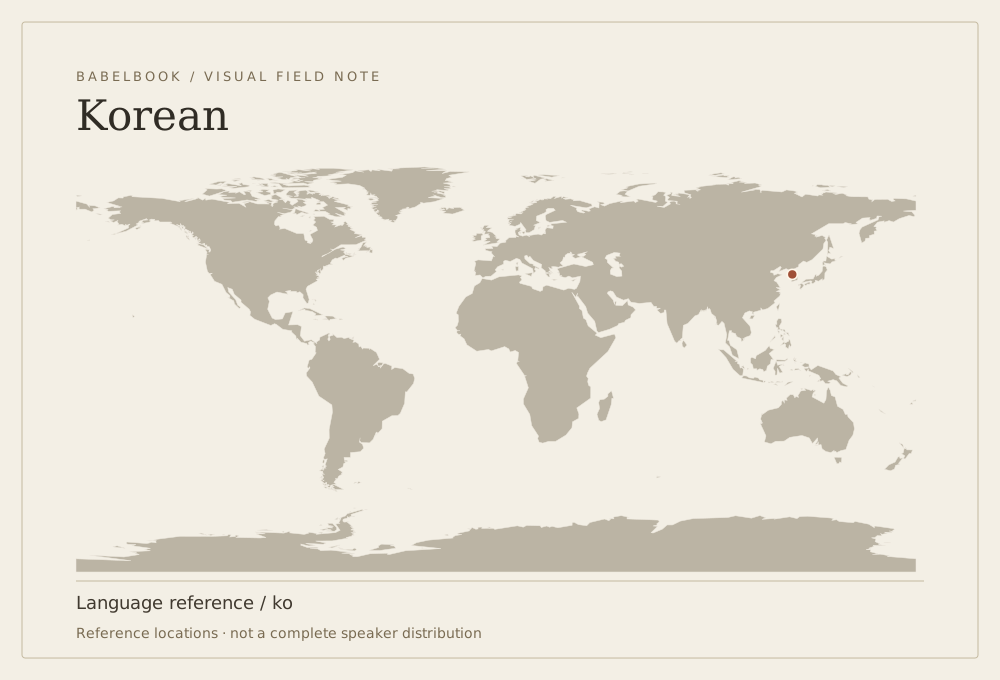
Representative reference points from Glottolog. Historical entries show reference locations, not current speakers. 1 point.
Reference & context ↗Babelbook · original editorial illustration · CC BY 4.0 · Glottolog locations; public-domain Natural Earth land
Source excerpts, selected, shortened and where noted editorially corrected from Korean language by Wikipedia contributors. Retrieved 2026-10-05. CC BY-SA 4.0. These excerpts are not an independently verified scholarly history; missing accounts are identified above.
Read further in the source
History
Modern Korean descends from Middle Korean, which in turn descends from Old Korean, which descends from the Proto-Koreanic language, which is generally suggested to have its linguistic homeland somewhere in Manchuria. Whitman (2012) suggests that the proto-Koreans, already present in northern Korea, expanded into the southern part of the Korean Peninsula in around 300 BC and coexisted with the descendants of the Japonic Mumun cultivators (or assimilated them). Both had influence on each other and a later founder effect diminished the internal variety of both language families. Since the establishment of two independent governments, North–South differences have developed in standard Korean, including variations in pronunciation and vocabulary chosen. While there tends to be strong political conflict between North and South Korea regarding these linguistic "differences", regional dialects within each country actually display greater linguistic variations than those found between North and South Korean standards. Nevertheless these dialects remain largely mutually intelligible.
Writing systems
The Chinese language, written with Chinese characters and read with Sino-Xenic pronunciations, was introduced to Korea in the 1st century BC and remained the medium of formal writing and government until the late 19th century. Korean scholars adapted Chinese characters (known in Korean as Hanja) to write their own language, creating scripts known as idu, hyangchal, gugyeol and gakpil. These systems were cumbersome owing to the fundamental disparities between the Korean and Chinese languages and accessible only to those educated in classical Chinese. Most of the population was illiterate. In the 15th century King Sejong the Great personally developed an alphabetic featural writing system, known today as Hangul, to promote literacy among the common people. Introduced in the document Hunminjeongeum, it was called eonmun ('colloquial script') and quickly spread nationwide to increase literacy in Korea. The Korean alphabet was denounced by the yangban aristocracy, who looked down upon it for being too easy to learn. However it gained widespread use among the common class and was widely used to print popular novels, which were enjoyed by the common class. Since few people could understand official documents written in classical Chinese, Korean kings sometimes released public notices written entirely in Hangul as early as the 16th century for all Korean classes, including uneducated peasants and slaves. By the 17th century the yangban had exchanged Hangul letters with slaves, which suggests a high literacy rate of Hangul during the Joseon era. In the context of growing Korean nationalism in the 19th century the Kabo Reform of 1894 abolished the Confucian examinations and decreed that government documents would be issued in Hangul instead of literary Chinese. Some newspapers were published in Hangul, but other publications used Korean mixed script, with Hanja for Sino-Korean vocabulary and Hangul for other elements. North Korea abolished Hanja in writing in 1949 but continues to teach it in schools. Its usage in South Korea is mainly reserved for specific circumstances such as newspapers, scholarly papers and disambiguation. Today Hanja is largely unused in everyday life but is still important for historical and linguistic studies.
Writing system
Modern Korean is written with an alphabet script, known as Hangul in South Korea and Chosŏn'gŭl in North Korea. The Korean mixed script, combining Hanja and Hangul, is still used to a certain extent in South Korea, but that method is slowly declining in use even though students learn Hanja in school. Below are charts of the letters of the Korean alphabet and their Revised Romanization (RR) and canonical International Phonetic Alphabet (IPA) values:
The letters of the Korean alphabet are not written linearly like most alphabets, but instead arranged into blocks that represent syllables. So, while the word bibimbap (Korean rice dish) is written as eight characters in a row in the Latin alphabet, in Korean it is written 비빔밥, as three "syllabic blocks" in a row. Mukbang (먹방 'eating show') is seven characters after romanization but only two "syllabic blocks" before. Modern Korean is written with spaces between words, a feature not found in Chinese or Japanese (except when Japanese is written exclusively in hiragana, as in children's books). The marks used for Korean punctuation are almost identical to Western ones. Traditionally, Korean was written in columns, from top to bottom, right to left, like traditional Chinese. However, the syllabic blocks are now usually written in rows, from left to right, top to bottom, like English.
Dialects
Korean has numerous small local dialects (called mal (말; lit. ''speech''), saturi (사투리), or bangeon (방언; 方言)). South Korean authors claim that the standard language (pyojuneo or pyojunmal) of both South Korea and North Korea is based on the dialect of the area around Seoul (which, as Hanyang, was the capital of Joseon-era Korea for 500 years), but since 1966, North Korea officially states that its standard is based on the Pyongyang speech. All dialects of Korean are similar to one another and largely are mutually intelligible (with the exception of dialect-specific phrases or nonstandard vocabulary unique to dialects) though the dialect of Jeju Island is divergent enough to be generally considered a separate language. The Yukjin dialect in the far northeast is also quite distinctive. One of the more salient differences between dialects is the use of tone: speakers of the Seoul dialect make use of vowel length, but speakers of the Gyeongsang dialect maintain the pitch accent of Middle Korean. Some dialects are conservative, maintaining Middle Korean sounds (such as z, β, ə), which have been lost from the standard language, and others are highly innovative. Kang Yoonjung & Han Sungwoo (2013), Kim Mi-Ryoung (2013), and Cho Sunghye (2017) suggest that the modern Seoul dialect is currently undergoing tonogenesis based on the finding that in recent years lenis consonants (ㅂㅈㄷㄱ), aspirated consonants (ㅍㅊㅌㅋ) and fortis consonants (ㅃㅉㄸㄲ) were shifting from a distinction via voice onset time to that of pitch change; however, Choi Jiyoun, Kim Sahyang & Cho Taehong (2020) disagree with the suggestion that the consonant distinction shifting away from voice onset time is due to the introduction of tonal features, and instead proposes that it is a prosodically conditioned change. There is substantial evidence for a history of extensive dialect levelling or even convergent evolution or intermixture of two or more originally-distinct linguistic stocks, within the Korean language and its dialects. Many Korean dialects have a basic vocabulary that is etymologically distinct from vocabulary of identical meaning in Standard Korean or other dialects. For example, "garlic chives" translated into Gyeongsang dialect is [t͡ɕʌŋ.ɡu.d͡ʑi] (정구지; jeongguji), but in Standard Korean, it is [puːt͡ɕʰu] (부추; buchu). This suggests that the Korean Peninsula may have at one time been much more linguistically diverse than it is today. See also the Japanese–Koreanic languages hypothesis.
Geographic distribution
Korean is spoken by the Korean people in both South Korea and North Korea, and by the Korean diaspora in many countries including the People's Republic of China, the United States, Japan, and Russia. In 2001, Korean was the fourth most popular foreign language in China, following English, Japanese, and Russian. Korean-speaking minorities exist in these states, but because of cultural assimilation into host countries, not all ethnic Koreans may speak it with native fluency.
Official status
Korean is the official language of South Korea and North Korea. It, along with Mandarin Chinese, is also one of the two official languages of China's Yanbian Korean Autonomous Prefecture. In North Korea, the regulatory body is the Language Institute of the Academy of Social Sciences (사회과학원 어학연구소; 社會科學院語學硏究所). In South Korea, the regulatory body for Korean is the Seoul-based National Institute of Korean Language, which was created by presidential decree on 23 January 1991.