Kashmiri
Kashmiri (English: kash-MEER-ee), also known by its endonym Koshur (Kashmiri: کٲشُر (Perso-Arabic, Official Script), pronounced [kəːʃur]), is an Indo-Aryan language of the Dardic branch spoken by around 7 million Kashmiris of the Kashmir region, primarily in the Kashmir Valley and surrounding hills of the Indian-administrated union territory of Jammu and Kashmir, over half the population of that territory. Kashmiri has split ergativity and the unusual verb-second word order. Since 2020, it has been made an official language of Jammu and Kashmir along with Dogri, Hindi, Urdu and English. Kashmiri is also among the 22 scheduled languages of India. Kashmiri is spoken by roughly five percent of Pakistani-administrated Azad Kashmir's population.
Translate in Kashmiri ↗There are about 6.8 million speakers of Kashmiri and related dialects in Jammu and Kashmir and amongst the Kashmiri diaspora in other states of India. Most Kashmiri speakers are located in the Kashmir Valley and other surrounding areas of Jammu and Kashmir. In the Kashmir Valley, Kashmiri speakers form the majority. The Kashmiri language is one of the 22 scheduled languages of India. It was a part of the Eighth Schedule in the former constitution of Jammu and Kashmir. Along with other regional languages mentioned in the Sixth Schedule, as well as Hindi and Urdu, the Kashmiri language was to be developed in the state. After Hindi, Kashmiri is the second fastest growing language of India, followed by Meitei (Manipuri) as well as Gujarati in the third place, and Bengali in the fourth place, according to the 2011 census of India. Persian began to be used as the court language in Kashmir during the 14th centuries, under the influence of Islam. It was replaced by Urdu in 1889 during the Dogra rule. In 2020, Kashmiri became an official language in the Union Territory of Jammu and Kashmir for the first time. Poguli and Kishtwari are closely related to Kashmiri, which are spoken in the mountains to the south of the Kashmir Valley and have sometimes been counted as dialects of Kashmiri. Kashmiri is spoken by roughly five percent of Azad Kashmir's population. According to the 1998 Pakistan Census, there were 132,450 Kashmiri speakers in Azad Kashmir. Native speakers of the language were dispersed in "pockets" throughout Azad Kashmir, particularly in the districts of Muzaffarabad (15%), Neelam (20%) and Hattian (15%), with very small minorities in Haveli (5%) and Bagh (2%). The Kashmiri spoken in Muzaffarabad is distinct from, although still intelligible with, the Kashmiri of the Neelam Valley to the north.
South Asia
Present-day use
There are about 6.8 million speakers of Kashmiri and related dialects in Jammu and Kashmir and amongst the Kashmiri diaspora in other states of India. Most Kashmiri speakers are located in the Kashmir Valley and other surrounding areas of Jammu and Kashmir. In the Kashmir Valley, Kashmiri speakers form the majority. The Kashmiri language is one of the 22 scheduled languages of India. It was a part of the Eighth Schedule in the former constitution of Jammu and Kashmir. Along with other regional languages mentioned in the Sixth Schedule, as well as Hindi and Urdu, the Kashmiri language was to be developed in the state. After Hindi, Kashmiri is the second fastest growing language of India, followed by Meitei (Manipuri) as well as Gujarati in the third place, and Bengali in the fourth place, according to the 2011 census of India. Persian began to be used as the court language in Kashmir during the 14th centuries, under the influence of Islam. It was replaced by Urdu in 1889 during the Dogra rule. In 2020, Kashmiri became an official language in the Union Territory of Jammu and Kashmir for the first time. Poguli and Kishtwari are closely related to Kashmiri, which are spoken in the mountains to the south of the Kashmir Valley and have sometimes been counted as dialects of Kashmiri. Kashmiri is spoken by roughly five percent of Azad Kashmir's population. According to the 1998 Pakistan Census, there were 132,450 Kashmiri speakers in Azad Kashmir. Native speakers of the language were dispersed in "pockets" throughout Azad Kashmir, particularly in the districts of Muzaffarabad (15%), Neelam (20%) and Hattian (15%), with very small minorities in Haveli (5%) and Bagh (2%). The Kashmiri spoken in Muzaffarabad is distinct from, although still intelligible with, the Kashmiri of the Neelam Valley to the north.
Origins
The captured article does not contain a separate origins section. See the historical account and linked source.
Development
The captured article does not contain a distinct historical account. No chronology has been invented.
Writing
There are three orthographical systems used to write the Kashmiri language: the Perso-Arabic script, the Devanagari script and the Sharada script. The Roman script is also sometimes informally used to write Kashmiri, especially online. The Kashmiri language was traditionally written in the Sharada script from the 8th Century AD onwards. Between the 8th and the first quarter of the 20th century AD, Sharada was the primary script of inscriptional and literary production in Kashmir. It was used to write Sanskrit, Kashmiri and other languages of northern South Asia. With increased use of Persian script for writing Kashmiri in the 19th century AD, and the growth of other brahmic scripts such as Devanagari and Takri, the use of Sharada declined. The Sharada script is inadequate for writing modern Kashmiri because it lacks sufficient signs to represent Kashmiri vowels. Modern usage of Sharada is limited to religious ceremonies and rituals of Kashmiri Pandits, and for horoscope-writing by them. Today Kashmiri is primarily written in Perso-Arabic (with some modifications, such as additions of new signs to represent Kashmiri vowels). Among languages written in the Perso-Arabic script, Kashmiri is one of the scripts that regularly indicates all vowel sounds. The Kashmiri Perso-Arabic script is recognized as the official script of Kashmiri language by the Jammu and Kashmir government and the Jammu and Kashmir Academy of Art, Culture and Languages. The Kashmiri Perso-Arabic script has been derived from Persian alphabet. The consonant inventory and their corresponding pronunciations of Kashmiri Perso-Arabic script doesn't differ from Perso-Arabic script, with the exception of the letter ژ, which is pronounced as /t͡s/ instead of /ʒ/. However, the vowel inventory of Kashmiri is significantly larger than other Perso-Arabic derived or influenced South Asian Perso-Arabic scripts. There are 17 vowels in Kashmiri, shown with diacritics, letters (alif, waw, ye), or both.
Beyond the typeface.
Signs, manuscripts, published pages and contextual photographs, with their place, period, source and reuse terms. Captions identify historical spellings, regional examples, community references and character imagery.
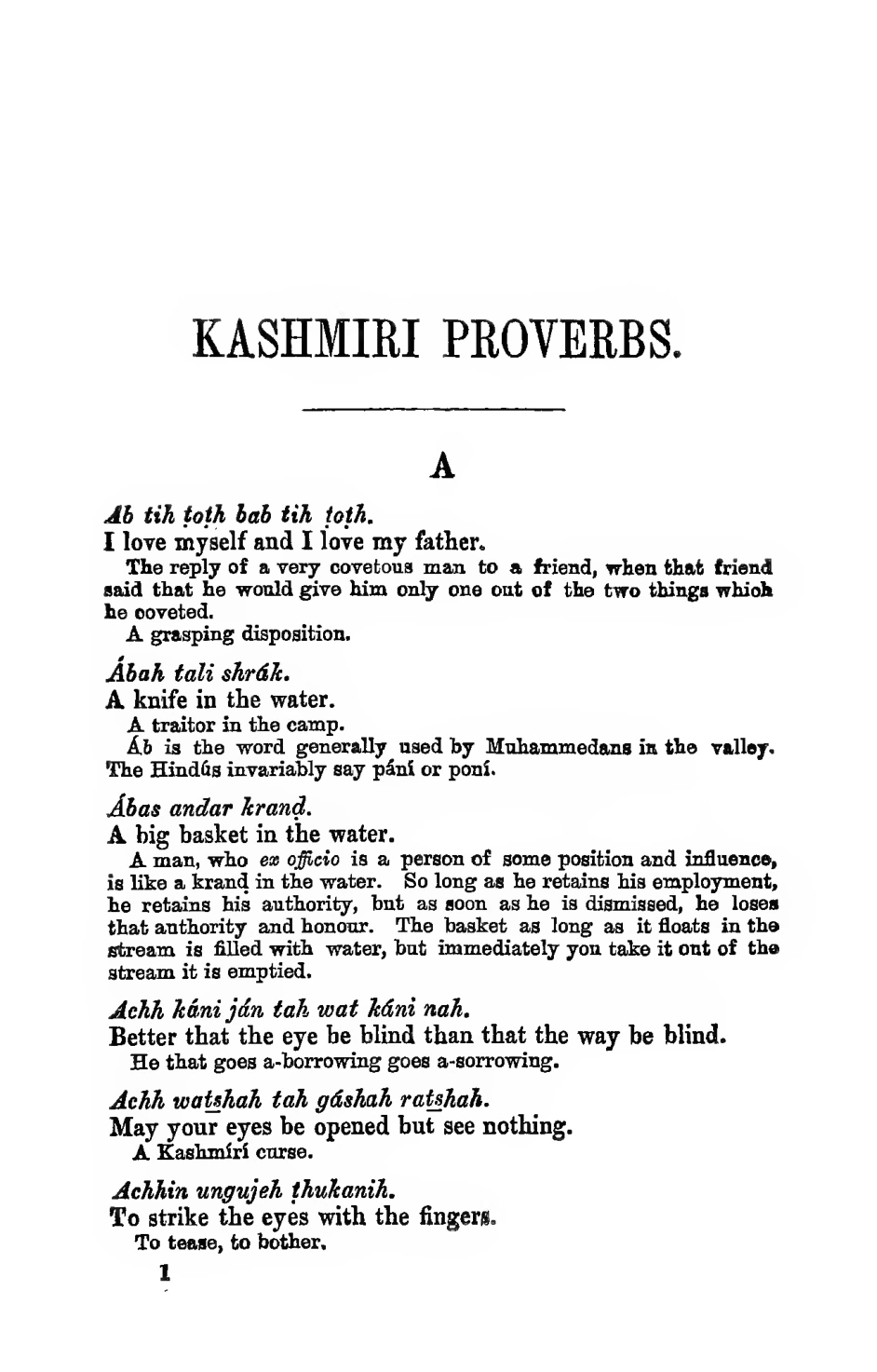
Printed page 1 of James Hinton Knowles’s 1885 collection of Kashmiri proverbs. It records complete proverbs in historical Roman transcription alongside English translations and commentary. This is a historical published record, not an example of present-day Kashmiri orthography.
Saved in Babelbook · resized display copy. Select the image to open it independently of its source.
James Hinton Knowles; Cornell University Library / Internet Archive digitization · Source ↗Public domain ↗View the local visual field note
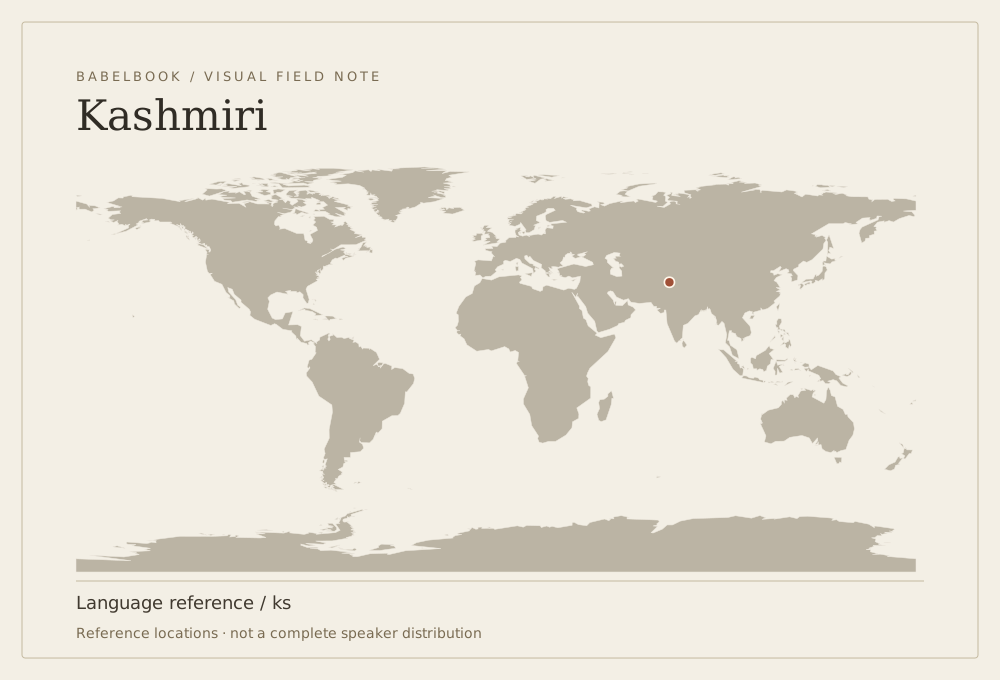
Representative reference points from Glottolog. Historical entries show reference locations, not current speakers. 1 point.
Reference & context ↗Babelbook · original editorial illustration · CC BY 4.0 · Glottolog locations; public-domain Natural Earth land
Source excerpts, selected, shortened and where noted editorially corrected from Kashmiri language by Wikipedia contributors. Retrieved 2026-10-05. CC BY-SA 4.0. These excerpts are not an independently verified scholarly history; missing accounts are identified above.
Read further in the source
Geographic distribution and status
There are about 6.8 million speakers of Kashmiri and related dialects in Jammu and Kashmir and amongst the Kashmiri diaspora in other states of India. Most Kashmiri speakers are located in the Kashmir Valley and other surrounding areas of Jammu and Kashmir. In the Kashmir Valley, Kashmiri speakers form the majority. The Kashmiri language is one of the 22 scheduled languages of India. It was a part of the Eighth Schedule in the former constitution of Jammu and Kashmir. Along with other regional languages mentioned in the Sixth Schedule, as well as Hindi and Urdu, the Kashmiri language was to be developed in the state. After Hindi, Kashmiri is the second fastest growing language of India, followed by Meitei (Manipuri) as well as Gujarati in the third place, and Bengali in the fourth place, according to the 2011 census of India. Persian began to be used as the court language in Kashmir during the 14th centuries, under the influence of Islam. It was replaced by Urdu in 1889 during the Dogra rule. In 2020, Kashmiri became an official language in the Union Territory of Jammu and Kashmir for the first time. Poguli and Kishtwari are closely related to Kashmiri, which are spoken in the mountains to the south of the Kashmir Valley and have sometimes been counted as dialects of Kashmiri. Kashmiri is spoken by roughly five percent of Azad Kashmir's population. According to the 1998 Pakistan Census, there were 132,450 Kashmiri speakers in Azad Kashmir. Native speakers of the language were dispersed in "pockets" throughout Azad Kashmir, particularly in the districts of Muzaffarabad (15%), Neelam (20%) and Hattian (15%), with very small minorities in Haveli (5%) and Bagh (2%). The Kashmiri spoken in Muzaffarabad is distinct from, although still intelligible with, the Kashmiri of the Neelam Valley to the north. In Neelam Valley, Kashmiri is the second most widely spoken language and the majority language in at least a dozen or so villages, where in about half of these, it is the sole mother tongue. The Kashmiri dialect of Neelum is closer to the variety spoken in northern Kashmir Valley, particularly Kupwara. At the 2017 Census of Pakistan, as many as 350,000 people declared their first language to be Kashmiri. A process of language shift is observable among Kashmiri-speakers in Azad Kashmir according to linguist Tariq Rahman, as they gradually adopt local languages such as Pahari-Pothwari, Hindko or move towards the lingua franca Urdu. This has resulted in these languages gaining ground at the expense of Kashmiri. There have been calls for the promotion of Kashmiri at an official level; in 1983, a Kashmiri Language Committee was set up by the government to patronise Kashmiri and impart it in school-level education. However, the limited attempts at introducing the language have not been successful, and it is Urdu, rather than Kashmiri, that Kashmiri Muslims of Azad Kashmir have seen as their identity symbol. Rahman notes that efforts to organise a Kashmiri language movement have been challenged by the scattered nature of the Kashmiri-speaking community in Azad Kashmir.
Writing system
There are three orthographical systems used to write the Kashmiri language: the Perso-Arabic script, the Devanagari script and the Sharada script. The Roman script is also sometimes informally used to write Kashmiri, especially online. The Kashmiri language was traditionally written in the Sharada script from the 8th Century AD onwards. Between the 8th and the first quarter of the 20th century AD, Sharada was the primary script of inscriptional and literary production in Kashmir. It was used to write Sanskrit, Kashmiri and other languages of northern South Asia. With increased use of Persian script for writing Kashmiri in the 19th century AD, and the growth of other brahmic scripts such as Devanagari and Takri, the use of Sharada declined. The Sharada script is inadequate for writing modern Kashmiri because it lacks sufficient signs to represent Kashmiri vowels. Modern usage of Sharada is limited to religious ceremonies and rituals of Kashmiri Pandits, and for horoscope-writing by them. Today Kashmiri is primarily written in Perso-Arabic (with some modifications, such as additions of new signs to represent Kashmiri vowels). Among languages written in the Perso-Arabic script, Kashmiri is one of the scripts that regularly indicates all vowel sounds. The Kashmiri Perso-Arabic script is recognized as the official script of Kashmiri language by the Jammu and Kashmir government and the Jammu and Kashmir Academy of Art, Culture and Languages. The Kashmiri Perso-Arabic script has been derived from Persian alphabet. The consonant inventory and their corresponding pronunciations of Kashmiri Perso-Arabic script doesn't differ from Perso-Arabic script, with the exception of the letter ژ, which is pronounced as /t͡s/ instead of /ʒ/. However, the vowel inventory of Kashmiri is significantly larger than other Perso-Arabic derived or influenced South Asian Perso-Arabic scripts. There are 17 vowels in Kashmiri, shown with diacritics, letters (alif, waw, ye), or both. In Kashmiri, the convention is that most vowel diacritics are written at all times. Despite Kashmiri Perso-Arabic script cutting across religious boundaries and being used by both the Kashmiri Hindus and the Kashmiri Muslims, some attempts have been made to give a religious outlook regarding the script and make Kashmiri Perso-Arabic script to be associated with Kashmiri Muslims, while the Kashmiri Devanagari script to be associated with some sections of Kashmiri Hindu community.