Kurdish
Kurdish (Kurdî, کوردی, pronounced [kʊrdiː] ) is a Northwestern Iranian language or group of languages spoken by Kurds in the region of Kurdistan, namely in southeast Turkey, northern Iraq, northwest Iran, and northern Syria. It is also spoken in northeast Iran, as well as in certain areas of Armenia and Azerbaijan. Kurdish varieties constitute a dialect continuum except for Zaza, with some mutually unintelligible varieties, and collectively have 29 million native speakers. The main varieties of Kurdish are Kurmanji, Sorani, and Southern Kurdish (Xwarîn). The majority of the Kurds speak Kurmanji, and most Kurdish texts are written in Kurmanji and Sorani. Kurmanji is written in the Hawar alphabet, a derivation of the Latin script, and Sorani is written in the Sorani alphabet, a derivation of the Arabic script. A separate group of non-Kurdish Northwestern Iranian languages, the Zaza–Gorani languages, are also spoken by several million ethnic Kurds. The literary output in Kurdish was mostly confined to poetry until the early 20th century, when more general literature became developed. Today, the two principal written Kurdish dialects are Kurmanji and Sorani. Sorani is, along with Arabic, one of the two official languages of Iraq and is in political documents simply referred to as "Kurdish".
Translate in Kurdish ↗Today, Sorani is an official language in Iraq, and Kurmanji is a recognized national language in Syria. Prior to the Fall of the Assad regime, publishing materials in Kurdish was forbidden in Syria, although this prohibition was not enforced since the Syrian civil war. Before August 2002, the Turkish government placed severe restrictions on the use of Kurdish, prohibiting the language in education and broadcast media. In March 2006, Turkey allowed private television channels to begin airing programming in Kurdish. However, the Turkish government said that they must avoid showing children's cartoons, or educational programs that teach Kurdish, and could broadcast only for 45 minutes a day or four hours a week. The state-run Turkish Radio and Television Corporation (TRT) started its 24-hour Kurdish television station on 1 January 2009 with the motto "we live under the same sky". The Turkish prime minister sent a video message in Kurdish to the opening ceremony, which was attended by Minister of Culture and other state officials. The channel uses the X, W, and Q letters during broadcasting. However, most of these restrictions on private Kurdish television channels were relaxed in September 2009. In 2010, Kurdish municipalities in the southeast began printing marriage certificates, water bills, construction and road signs, as well as emergency, social and cultural notices in Kurdish alongside Turkish. Also Imams began to deliver Friday sermons in Kurdish and Esnaf price tags in Kurdish. Many mayors were tried for issuing public documents in Kurdish language. The Kurdish alphabet is not recognized in Turkey, and prior to 2013 the use of Kurdish names containing the letters X, W, and Q, which do not exist in the Turkish alphabet, was not allowed. In 2012, Kurdish-language lessons became an elective subject in public schools.
Middle East & North Africa
Present-day use
Today, Sorani is an official language in Iraq, and Kurmanji is a recognized national language in Syria. Prior to the Fall of the Assad regime, publishing materials in Kurdish was forbidden in Syria, although this prohibition was not enforced since the Syrian civil war. Before August 2002, the Turkish government placed severe restrictions on the use of Kurdish, prohibiting the language in education and broadcast media. In March 2006, Turkey allowed private television channels to begin airing programming in Kurdish. However, the Turkish government said that they must avoid showing children's cartoons, or educational programs that teach Kurdish, and could broadcast only for 45 minutes a day or four hours a week. The state-run Turkish Radio and Television Corporation (TRT) started its 24-hour Kurdish television station on 1 January 2009 with the motto "we live under the same sky". The Turkish prime minister sent a video message in Kurdish to the opening ceremony, which was attended by Minister of Culture and other state officials. The channel uses the X, W, and Q letters during broadcasting. However, most of these restrictions on private Kurdish television channels were relaxed in September 2009. In 2010, Kurdish municipalities in the southeast began printing marriage certificates, water bills, construction and road signs, as well as emergency, social and cultural notices in Kurdish alongside Turkish. Also Imams began to deliver Friday sermons in Kurdish and Esnaf price tags in Kurdish. Many mayors were tried for issuing public documents in Kurdish language. The Kurdish alphabet is not recognized in Turkey, and prior to 2013 the use of Kurdish names containing the letters X, W, and Q, which do not exist in the Turkish alphabet, was not allowed. In 2012, Kurdish-language lessons became an elective subject in public schools.
Origins
The Kurdish varieties belong to the Iranian branch of the Indo-European family. They are generally classified as Northwestern Iranian languages, or by some scholars as intermediate between Northwestern and Southwestern Iranian. Martin van Bruinessen notes that "Kurdish has a strong South-Western Iranian element", whereas "Zaza and Gurani [...] do belong to the north-west Iranian group". Ludwig Paul concludes that Kurdish seems to be a Northwestern Iranian language in origin, but acknowledges that it shares many traits with Southwestern Iranian languages like Persian, apparently due to longstanding and intense historical contacts. Windfuhr identified Kurdish dialects as Parthian, albeit with a Median substratum. Windfuhr and Frye assume an eastern origin for Kurdish and consider it as related to eastern and central Iranian dialects. Vladimir Minorsky regarded Kurdish as a descendant of the Median language, describing it as an "ancient and powerful basic language." He argued that this origin explains why the fundamental structural and lexical characteristics of Kurdish are preserved in all dialects despite their wide geographical distribution, reflecting a shared historical foundation. The present state of knowledge about Kurdish allows, at least roughly, drawing the approximate borders of the areas where the main ethnic core of the speakers of the contemporary Kurdish dialects was formed. The most argued hypothesis on the localisation of the ethnic territory of the Kurds remains D.N. Mackenzie's theory, proposed in the early 1960s (Mackenzie 1961). Developing the ideas of P. Tedesco (1921: 255) and regarding the common phonetic isoglosses shared by Kurdish, Persian, and Baluchi, Mackenzie concluded that the speakers of these three languages may once have been in closer contact.
Development
During his stay in Damascus, historian Ibn Wahshiyya came across two books on agriculture written in Kurdish, one on the culture of the vine and the palm tree, and the other on water and the means of finding it out in unknown ground. He translated both from Kurdish into Arabic in the early 9th century AD. Among the earliest Kurdish religious texts is the Yazidi Black Book, the sacred book of Yazidi faith. It is considered to have been authored sometime in the 13th century AD by Hassan bin Adi (b. 1195 AD), the great-grandnephew of Sheikh Adi ibn Musafir (d. 1162), the founder of the faith. It contains the Yazidi account of the creation of the world, the origin of man, the story of Adam and Eve and the major prohibitions of the faith. According to The Cambridge History of the Kurds, "the first proper 'text'" written in Kurdish is a short Christian prayer. It was written in Armenian characters, and dates from the fifteenth century. From the 15th to 17th centuries, classical Kurdish poets and writers developed a literary language. The most notable classical Kurdish poets from this period were Ali Hariri, Ahmad Khani, Malaye Jaziri and Faqi Tayran. The Italian priest Maurizio Garzoni published the first Kurdish grammar titled Grammatica e Vocabolario della Lingua Kurda in Rome in 1787 after eighteen years of missionary work among the Kurds of Amadiya. This work is very important in Kurdish history as it is the first acknowledgment of the widespread use of a distinctive Kurdish language. Garzoni was given the title Father of Kurdology by later scholars. The Kurdish language was banned in a large portion of Kurdistan for some time. After the 1980 Turkish coup d'état until 1991 the use of the Kurdish language was illegal in Turkey.
Writing
Arabic (catalog classification; see the source for context).
Beyond the typeface.
Signs, manuscripts, published pages and contextual photographs, with their place, period, source and reuse terms. Captions identify historical spellings, regional examples, community references and character imagery.
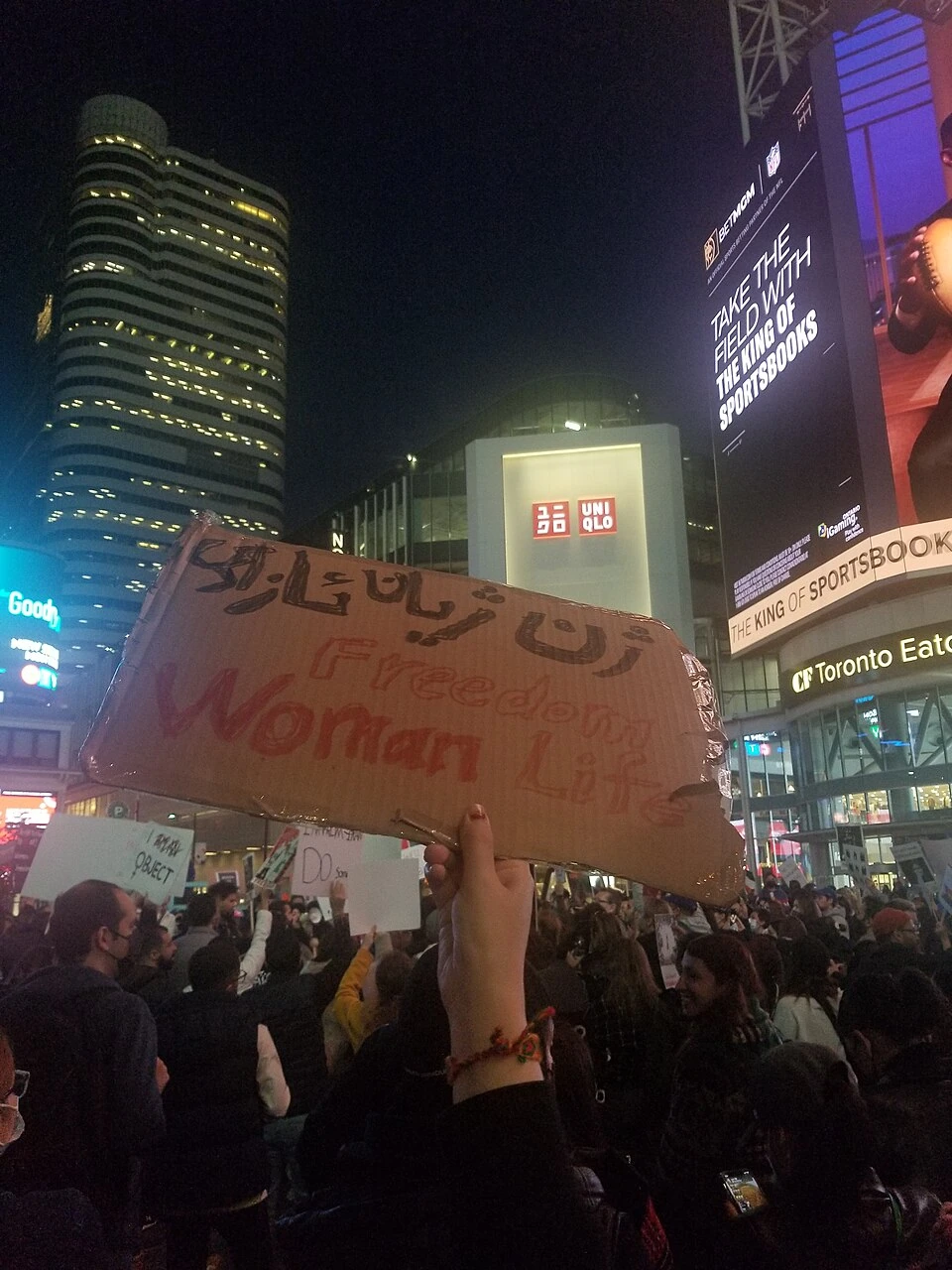
Kurdish and English on a Woman, Life, Freedom protest sign, photographed in 2022. Language identification follows Commons descriptions or categories; not independently transcribed.
Saved in Babelbook · resized display copy. Select the image to open it independently of its source.
Pirehelokan · Source ↗CC BY-SA 4.0 ↗View the local visual field note
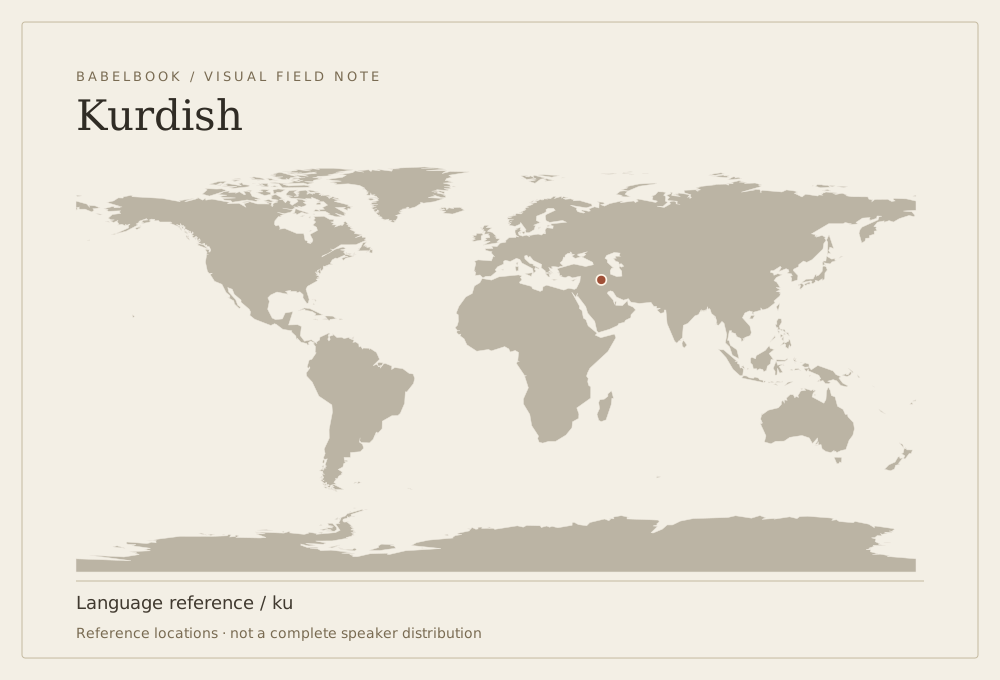
Representative reference points from Glottolog. Historical entries show reference locations, not current speakers. 1 point.
Reference & context ↗Babelbook · original editorial illustration · CC BY 4.0 · Glottolog locations; public-domain Natural Earth land
Source excerpts, selected, shortened and where noted editorially corrected from Kurdish language by Wikipedia contributors. Retrieved 2026-10-05. CC BY-SA 4.0. These excerpts are not an independently verified scholarly history; missing accounts are identified above.
Read further in the source
Classification and origin
The Kurdish varieties belong to the Iranian branch of the Indo-European family. They are generally classified as Northwestern Iranian languages, or by some scholars as intermediate between Northwestern and Southwestern Iranian. Martin van Bruinessen notes that "Kurdish has a strong South-Western Iranian element", whereas "Zaza and Gurani [...] do belong to the north-west Iranian group". Ludwig Paul concludes that Kurdish seems to be a Northwestern Iranian language in origin, but acknowledges that it shares many traits with Southwestern Iranian languages like Persian, apparently due to longstanding and intense historical contacts. Windfuhr identified Kurdish dialects as Parthian, albeit with a Median substratum. Windfuhr and Frye assume an eastern origin for Kurdish and consider it as related to eastern and central Iranian dialects. Vladimir Minorsky regarded Kurdish as a descendant of the Median language, describing it as an "ancient and powerful basic language." He argued that this origin explains why the fundamental structural and lexical characteristics of Kurdish are preserved in all dialects despite their wide geographical distribution, reflecting a shared historical foundation. The present state of knowledge about Kurdish allows, at least roughly, drawing the approximate borders of the areas where the main ethnic core of the speakers of the contemporary Kurdish dialects was formed. The most argued hypothesis on the localisation of the ethnic territory of the Kurds remains D.N. Mackenzie's theory, proposed in the early 1960s (Mackenzie 1961). Developing the ideas of P. Tedesco (1921: 255) and regarding the common phonetic isoglosses shared by Kurdish, Persian, and Baluchi, Mackenzie concluded that the speakers of these three languages may once have been in closer contact.
History
During his stay in Damascus, historian Ibn Wahshiyya came across two books on agriculture written in Kurdish, one on the culture of the vine and the palm tree, and the other on water and the means of finding it out in unknown ground. He translated both from Kurdish into Arabic in the early 9th century AD. Among the earliest Kurdish religious texts is the Yazidi Black Book, the sacred book of Yazidi faith. It is considered to have been authored sometime in the 13th century AD by Hassan bin Adi (b. 1195 AD), the great-grandnephew of Sheikh Adi ibn Musafir (d. 1162), the founder of the faith. It contains the Yazidi account of the creation of the world, the origin of man, the story of Adam and Eve and the major prohibitions of the faith. According to The Cambridge History of the Kurds, "the first proper 'text'" written in Kurdish is a short Christian prayer. It was written in Armenian characters, and dates from the fifteenth century. From the 15th to 17th centuries, classical Kurdish poets and writers developed a literary language. The most notable classical Kurdish poets from this period were Ali Hariri, Ahmad Khani, Malaye Jaziri and Faqi Tayran. The Italian priest Maurizio Garzoni published the first Kurdish grammar titled Grammatica e Vocabolario della Lingua Kurda in Rome in 1787 after eighteen years of missionary work among the Kurds of Amadiya. This work is very important in Kurdish history as it is the first acknowledgment of the widespread use of a distinctive Kurdish language. Garzoni was given the title Father of Kurdology by later scholars. The Kurdish language was banned in a large portion of Kurdistan for some time. After the 1980 Turkish coup d'état until 1991 the use of the Kurdish language was illegal in Turkey.
Current status
Today, Sorani is an official language in Iraq, and Kurmanji is a recognized national language in Syria. Prior to the Fall of the Assad regime, publishing materials in Kurdish was forbidden in Syria, although this prohibition was not enforced since the Syrian civil war. Before August 2002, the Turkish government placed severe restrictions on the use of Kurdish, prohibiting the language in education and broadcast media. In March 2006, Turkey allowed private television channels to begin airing programming in Kurdish. However, the Turkish government said that they must avoid showing children's cartoons, or educational programs that teach Kurdish, and could broadcast only for 45 minutes a day or four hours a week. The state-run Turkish Radio and Television Corporation (TRT) started its 24-hour Kurdish television station on 1 January 2009 with the motto "we live under the same sky". The Turkish prime minister sent a video message in Kurdish to the opening ceremony, which was attended by Minister of Culture and other state officials. The channel uses the X, W, and Q letters during broadcasting. However, most of these restrictions on private Kurdish television channels were relaxed in September 2009. In 2010, Kurdish municipalities in the southeast began printing marriage certificates, water bills, construction and road signs, as well as emergency, social and cultural notices in Kurdish alongside Turkish. Also Imams began to deliver Friday sermons in Kurdish and Esnaf price tags in Kurdish. Many mayors were tried for issuing public documents in Kurdish language. The Kurdish alphabet is not recognized in Turkey, and prior to 2013 the use of Kurdish names containing the letters X, W, and Q, which do not exist in the Turkish alphabet, was not allowed. In 2012, Kurdish-language lessons became an elective subject in public schools. Previously, Kurdish education had only been possible in private institutions. In Iran, though it is used in some local media and newspapers, it is not used in public schools. In 2005, 80 Syrian and Iranian Kurds took part in an experiment and gained scholarships to study in Kurdistan Region, Iraq, in their native tongue. In Kyrgyzstan, 96.21% of the Kurdish population speak Kurdish as their native language. In Kazakhstan, the corresponding percentage is 88.7%.