Komi
Komi (коми кыв, komi kyv, IPA: [komi kɨv] ), also known as Zyran, Zyrian or Komi-Zyryan (зыран коми кыв, zyran komi kyv), is the native language of the Komi (Zyrians). It is one of the Permic languages; the other regional varieties are Komi-Permyak, which has official status, and Komi-Yazva. Komi is spoken in the Komi Republic and other parts of Russia such as Nenetsia and Yamalia. There were 285,000 speakers in 1994, which decreased to 160,000 in 2010. It was formerly written in the Old Permic script created by Stephen of Perm for liturgical purposes in the 14th century, though very few texts exist in this script. The Cyrillic script was introduced by Russian missionaries in the 17th century, replacing it. A tradition of secular works of literature in the modern form of the language dates back to the 19th century.
Translate in Komi ↗Komi (коми кыв, komi kyv, IPA: [komi kɨv] ), also known as Zyran, Zyrian or Komi-Zyryan (зыран коми кыв, zyran komi kyv), is the native language of the Komi (Zyrians). It is one of the Permic languages; the other regional varieties are Komi-Permyak, which has official status, and Komi-Yazva. Komi is spoken in the Komi Republic and other parts of Russia such as Nenetsia and Yamalia. There were 285,000 speakers in 1994, which decreased to 160,000 in 2010. It was formerly written in the Old Permic script created by Stephen of Perm for liturgical purposes in the 14th century, though very few texts exist in this script. The Cyrillic script was introduced by Russian missionaries in the 17th century, replacing it. A tradition of secular works of literature in the modern form of the language dates back to the 19th century.
Global / other
Present-day use
The captured source does not contain a separate current-use account.
Origins
The captured article does not contain a separate origins section. See the historical account and linked source.
Development
The captured article does not contain a distinct historical account. No chronology has been invented.
Writing
The Old Permic script is the first writing system for Komi. It was invented in the 14th century by the missionary Stephen of Perm. The alphabet resembled medieval Greek and Cyrillic. The script was also known as Anbur (Komi: 𐍐𐍝𐍑𐍣𐍠, Анбур), named for the first 2 letters of the script, "an" & "bur" (𐍐 & 𐍑, respectively). It is no longer in use today, though it has received Unicode Support as "Old Permic" in recent times. The script saw use in Komi-inhabited areas, primarily the Principality of Great Perm and parts of Bjarmaland. In the 16th century, this alphabet was replaced by the Russian alphabet with certain modifications for affricates. In the 1920s, the language was written in the Molodtsov alphabet, which also derived from Cyrillic. In the 1930s, during the Latinisation in the Soviet Union, Komi was briefly written with a version of the Latin script. Since the 1940s it uses the Russian-based Cyrillic alphabet with the additional letters І, і and Ӧ, ӧ. Letters particular to the Molodtsov alphabet include ԁ, ԃ, ԅ, ԇ, ԉ, ԋ, ԍ, ԏ, most of which represent palatalized consonants.
Beyond the typeface.
Signs, manuscripts, published pages and contextual photographs, with their place, period, source and reuse terms. Captions identify historical spellings, regional examples, community references and character imagery.
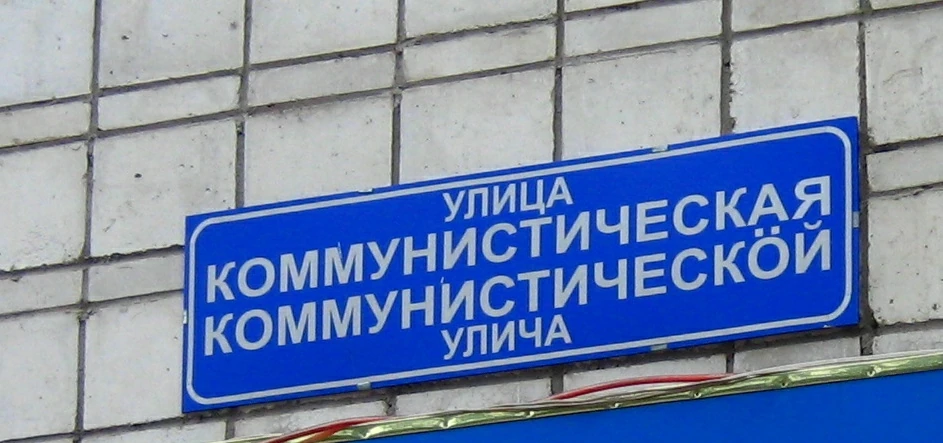
Bilingual street sign in Syktyvkar. Commons identifies the lower wording as Komi and the upper as Russian, both naming Communist Street.
Saved in Babelbook · resized display copy. Select the image to open it independently of its source.
Ds02006 · Source ↗CC BY-SA 3.0 ↗View the local visual field note
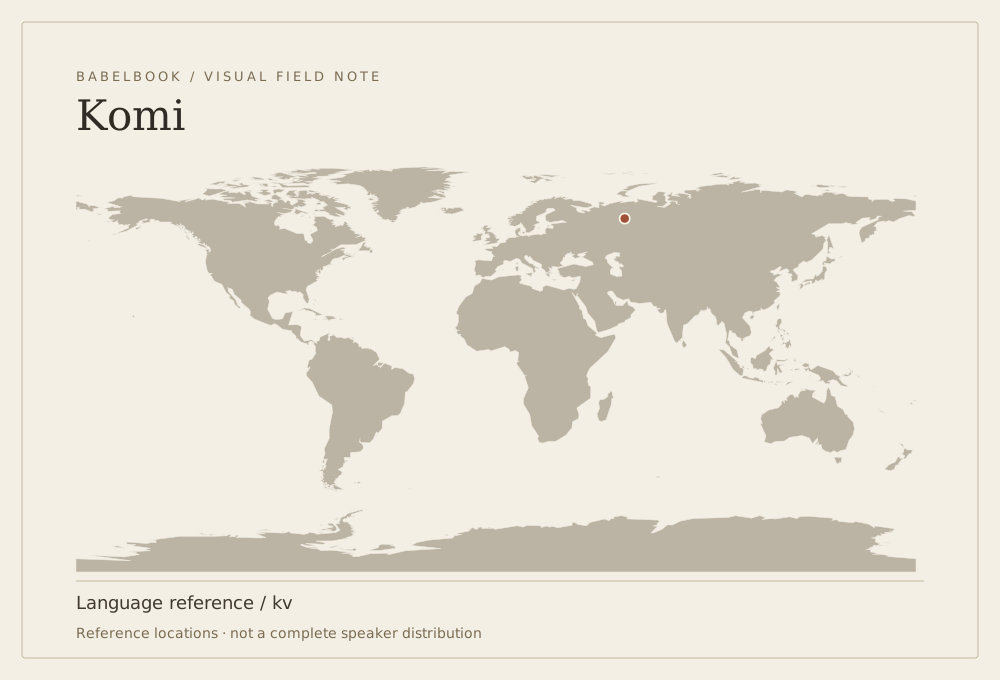
Representative reference points from Glottolog. Historical entries show reference locations, not current speakers. 1 point.
Reference & context ↗Babelbook · original editorial illustration · CC BY 4.0 · Glottolog locations; public-domain Natural Earth land
Source excerpts, selected, shortened and where noted editorially corrected from Komi language by Wikipedia contributors. Retrieved 2026-10-05. CC BY-SA 4.0. These excerpts are not an independently verified scholarly history; missing accounts are identified above.
Read further in the source
Dialects
Komi has ten dialects: Syktyvkardin (Sysola), Lower Ežva (Vychegda), Central Ežva (Vychegda), Upper Ežva (Vychegda), Luz-let, Upper Sysola, Pećöra, Iźva, Vym, and Udora dialects. Syktyvkardin is spoken in the region of Syktyvkar and forms the model for the generic standard dialect of the language. Dialects are divided based primarily on their use of /v/ and /l/:
Older */l/ remains unchanged in Upper Ežva and Pećöra dialects (also in most dialects of Komi-Permyak). In Central dialects, /*l/ changed to /v/ syllable-finally; for instance, in literary Komi */kɨl/ → /kɨv/ "tongue". In Northern dialects, changes of /l/ continued with complete vocalization of syllable-final /l/, resulting in long vowels. The start of the change date to the 17th century. It is not seen in the oldest Komi texts from the 14th century, nor in loanwords from Komi to Khanty, dated to the 16th; though it fully occurred before Russian loanwords that entered the language in the 18th century as /l/ remains unchanged in these. Some dialects are further distinguished based on the palatalized alveolars /dʲ tʲ/, which have unpacked in syllable-final position as clusters /jd jt/.
Writing system
The Old Permic script is the first writing system for Komi. It was invented in the 14th century by the missionary Stephen of Perm. The alphabet resembled medieval Greek and Cyrillic. The script was also known as Anbur (Komi: 𐍐𐍝𐍑𐍣𐍠, Анбур), named for the first 2 letters of the script, "an" & "bur" (𐍐 & 𐍑, respectively). It is no longer in use today, though it has received Unicode Support as "Old Permic" in recent times. The script saw use in Komi-inhabited areas, primarily the Principality of Great Perm and parts of Bjarmaland. In the 16th century, this alphabet was replaced by the Russian alphabet with certain modifications for affricates. In the 1920s, the language was written in the Molodtsov alphabet, which also derived from Cyrillic. In the 1930s, during the Latinisation in the Soviet Union, Komi was briefly written with a version of the Latin script. Since the 1940s it uses the Russian-based Cyrillic alphabet with the additional letters І, і and Ӧ, ӧ.
Letters particular to the Molodtsov alphabet include ԁ, ԃ, ԅ, ԇ, ԉ, ԋ, ԍ, ԏ, most of which represent palatalized consonants.