Cornish
Cornish (Kernewek or Kernowek [kəɾˈnuːək]) is a Celtic language of the Brittonic subgroup that is native to the Cornish people and their homeland, Cornwall. Along with Welsh and Breton, Cornish descends from Common Brittonic, a language once spoken widely across Great Britain. For much of the medieval period Cornish was the main language of Cornwall, until it was gradually pushed westwards by the spread of English. Cornish remained a common community language in parts of Cornwall until the mid-18th century, and there is some evidence for traditional speakers persisting into the 19th century. Cornish became extinct as a living language in Cornwall by the end of the 18th century; but knowledge of Cornish persisted with some families and individuals. A revival started in the early 20th century, and in 2010 UNESCO reclassified the language as critically endangered, stating that its former classification of the language as extinct was no longer accurate. The language has a growing number of second-language speakers, and a small but increasing number of families now raise children to speak revived Cornish as a first language. Cornish is currently recognised under the European Charter for Regional or Minority Languages, and the language is often described as an important part of Cornish identity, culture and heritage. Since the revival of the language, some Cornish textbooks and works of literature have been published, and an increasing number of people are studying the language. Recent developments include Cornish music, independent films, and children's books.
Translate in Cornish ↗Estimates of the number of Cornish speakers vary according to the definition of a speaker, and is difficult to determine accurately due to the individualised nature of language take-up. Nevertheless, there is recognition that the number of Cornish speakers is growing. From before the 1980s to the end of the 20th century there was a sixfold increase in the number of speakers to around 300. One figure for the number of people who know a few basic words, such as knowing that "Kernow" means "Cornwall", was 300,000; the same survey gave the number of people able to have simple conversations as 3,000. A report on the 2011 Census published in 2013 by the Office for National Statistics placed the number of speakers at somewhere between 325 and 625. In 2017 the ONS released data based on the 2011 Census that placed the number of speakers at 557 people in England and Wales who declared Cornish to be their main language, 464 of whom lived in Cornwall. The 2021 census listed the number of Cornish speakers at 563. The Cornish Language Strategy project commissioned research to provide quantitative and qualitative evidence for the number of Cornish speakers: due to the success of the revival project it was estimated that 2,000 people were fluent (surveyed in spring 2008), an increase from the estimated 300 people who spoke Cornish fluently suggested in a study by Kenneth MacKinnon in 2000. Jenefer Lowe of the Cornish Language Partnership said in an interview with the BBC in 2010 that there were around 300 fluent speakers. Bert Biscoe, a councillor and bard, in a statement to the Western Morning News in 2014 said there were "several hundred fluent speakers".
Europe
Present-day use
In 1904, the Celtic language scholar and Cornish cultural activist Henry Jenner published A Handbook of the Cornish Language. The publication of this book is often considered to be the point at which the revival movement started. Jenner wrote about the Cornish language in 1905, "one may fairly say that most of what there was of it has been preserved, and that it has been continuously preserved, for there has never been a time when there were not some Cornishmen who knew some Cornish." The revival focused on reconstructing and standardising the language, including coining new words for modern concepts, and creating educational material in order to teach Cornish to others. In 1929 Robert Morton Nance published his Unified Cornish (Kernewek Unys) system, based on the Middle Cornish literature while extending the attested vocabulary with neologisms and forms based on Celtic roots also found in Breton and Welsh, publishing a dictionary in 1938. Nance's work became the basis of revived Cornish (Kernewek Dasserghys) for most of the 20th century. During the 1970s, criticism of Nance's system, including the inconsistent orthography and unpredictable correspondence between spelling and pronunciation, as well as on other grounds such as the archaic basis of Unified and a lack of emphasis on the spoken language, resulted in the creation of several rival systems. In the 1980s, Ken George published a new system, Kernewek Kemmyn ('Common Cornish'), based on a reconstruction of the phonological system of Middle Cornish, but with an approximately morphophonemic orthography.
Origins
The captured article does not contain a separate origins section. See the historical account and linked source.
Development
Cornish evolved from the Common Brittonic spoken throughout Britain south of the Firth of Forth during the British Iron Age and Roman period. As a result of westward Anglo-Saxon expansion, the Britons of the southwest were separated from those in modern-day Wales and Cumbria, which Jackson links to the defeat of the Britons at the Battle of Deorham in about 577. The western dialects eventually evolved into modern Welsh and the now extinct Cumbric, while Southwestern Brittonic developed into Cornish and Breton, the latter as a result of emigration to parts of the continent, known as Brittany over the following centuries.
Writing
Until around the middle of the 11th century, Old Cornish scribes used a traditional spelling system shared with Old Breton and Old Welsh, based on the pronunciation of British Latin. By the time of the Vocabularium Cornicum, usually dated to around 1100, Old English spelling conventions, such as the use of thorn (Þ, þ) and eth (Ð, ð) for dental fricatives, and wynn (Ƿ, ƿ) for /w/, had come into use, allowing documents written at this time to be distinguished from Old Welsh, which rarely uses these characters, and Old Breton, which does not use them at all. Old Cornish features include using initial ⟨ch⟩, ⟨c⟩, or ⟨k⟩ for /k/, and, in internal and final position, ⟨p⟩, ⟨t⟩, ⟨c⟩, ⟨b⟩, ⟨d⟩, and ⟨g⟩ are generally used for the phonemes /b/, /d/, /ɡ/, /β/, /ð/, and /ɣ/ respectively, meaning that the results of Brittonic lenition are not usually apparent from the orthography at this time. Middle Cornish orthography has a significant level of variation, and shows influence from Middle English spelling practices. Yogh (Ȝ ȝ) is used in certain Middle Cornish texts, where it is used to represent a variety of sounds, including the dental fricatives /θ/ and /ð/, a usage which is unique to Middle Cornish and is never found in Middle English. Middle Cornish scribes tend to use ⟨c⟩ for /k/ before back vowels, and ⟨k⟩ for /k/ before front vowels, though this is not always true, and this rule is less consistent in certain texts. Middle Cornish scribes almost universally use ⟨wh⟩ to represent /ʍ/ (or /hw/), as in Middle English.
Beyond the typeface.
Signs, manuscripts, published pages and contextual photographs, with their place, period, source and reuse terms. Captions identify historical spellings, regional examples, community references and character imagery.
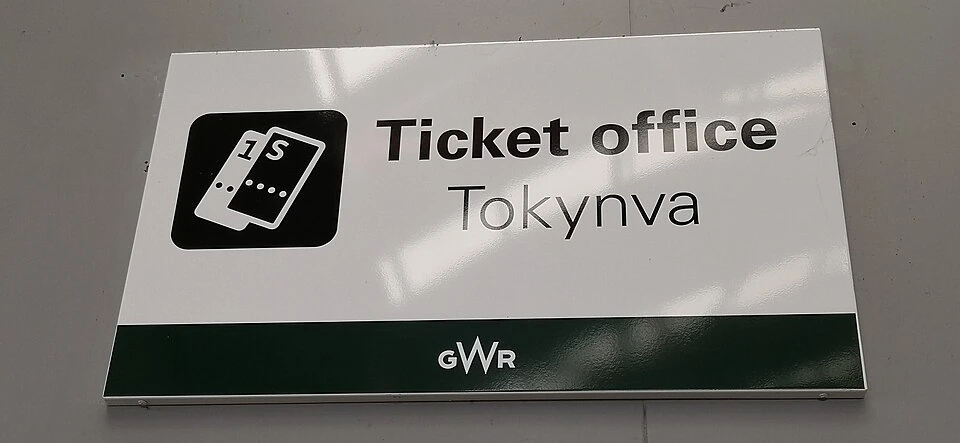
English and Cornish ticket-office sign at Penzance railway station. Language identification follows Commons metadata; not independently transcribed.
Saved in Babelbook · resized display copy. Select the image to open it independently of its source.
Cdjp1 · Source ↗CC BY-SA 4.0 ↗View the local visual field note
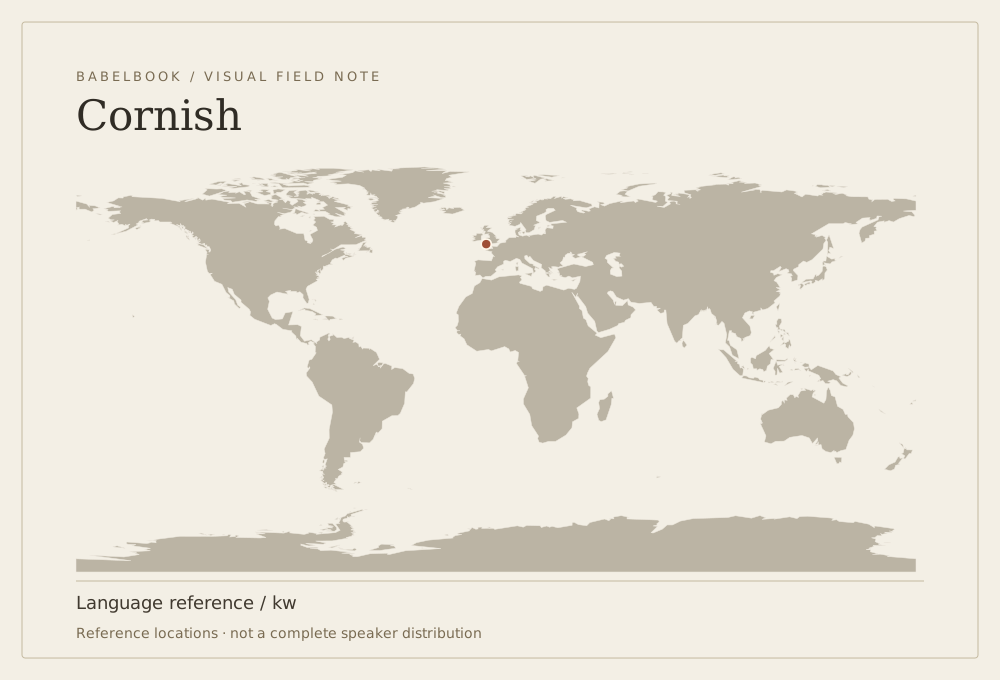
Representative reference points from Glottolog. Historical entries show reference locations, not current speakers. 1 point.
Reference & context ↗Babelbook · original editorial illustration · CC BY 4.0 · Glottolog locations; public-domain Natural Earth land
Source excerpts, selected, shortened and where noted editorially corrected from Cornish language by Wikipedia contributors. Retrieved 2026-10-05. CC BY-SA 4.0. These excerpts are not an independently verified scholarly history; missing accounts are identified above.
Read further in the source
History
Cornish evolved from the Common Brittonic spoken throughout Britain south of the Firth of Forth during the British Iron Age and Roman period. As a result of westward Anglo-Saxon expansion, the Britons of the southwest were separated from those in modern-day Wales and Cumbria, which Jackson links to the defeat of the Britons at the Battle of Deorham in about 577. The western dialects eventually evolved into modern Welsh and the now extinct Cumbric, while Southwestern Brittonic developed into Cornish and Breton, the latter as a result of emigration to parts of the continent, known as Brittany over the following centuries.
Revived Cornish
In 1904, the Celtic language scholar and Cornish cultural activist Henry Jenner published A Handbook of the Cornish Language. The publication of this book is often considered to be the point at which the revival movement started. Jenner wrote about the Cornish language in 1905, "one may fairly say that most of what there was of it has been preserved, and that it has been continuously preserved, for there has never been a time when there were not some Cornishmen who knew some Cornish." The revival focused on reconstructing and standardising the language, including coining new words for modern concepts, and creating educational material in order to teach Cornish to others. In 1929 Robert Morton Nance published his Unified Cornish (Kernewek Unys) system, based on the Middle Cornish literature while extending the attested vocabulary with neologisms and forms based on Celtic roots also found in Breton and Welsh, publishing a dictionary in 1938. Nance's work became the basis of revived Cornish (Kernewek Dasserghys) for most of the 20th century. During the 1970s, criticism of Nance's system, including the inconsistent orthography and unpredictable correspondence between spelling and pronunciation, as well as on other grounds such as the archaic basis of Unified and a lack of emphasis on the spoken language, resulted in the creation of several rival systems. In the 1980s, Ken George published a new system, Kernewek Kemmyn ('Common Cornish'), based on a reconstruction of the phonological system of Middle Cornish, but with an approximately morphophonemic orthography. It was subsequently adopted by the Cornish Language Board and was the written form used by a reported 54.5% of all Cornish language users according to a survey in 2008, but was heavily criticised for a variety of reasons by Jon Mills and Nicholas Williams, including making phonological distinctions that they state were not made in the traditional language c. 1500, failing to make distinctions that they believe were made in the traditional language at this time, and the use of an orthography that deviated too far from the traditional texts and Unified Cornish. Also during this period, Richard Gendall created his Modern Cornish system (also known as Revived Late Cornish), which used Late Cornish as a basis, and Nicholas Williams published a revised version of Unified; however neither of these systems gained the popularity of Unified or Kemmyn. The revival entered a period of factionalism and public disputes, with each orthography attempting to push the others aside. By the time that Cornish was recognised by the UK government under the European Charter for Regional or Minority Languages in 2002, it had become recognised that the existence of multiple orthographies was unsustainable with regards to using the language in education and public life, as none had achieved a wide consensus. A process of unification was set about which resulted in the creation of the public-body Cornish Language Partnership in 2005 and agreement on a Standard Written Form in 2008. In 2010 a new milestone was reached when UNESCO altered its classification of Cornish, stating that its previous label of "extinct" was no longer accurate.
Speakers
Estimates of the number of Cornish speakers vary according to the definition of a speaker, and is difficult to determine accurately due to the individualised nature of language take-up. Nevertheless, there is recognition that the number of Cornish speakers is growing. From before the 1980s to the end of the 20th century there was a sixfold increase in the number of speakers to around 300. One figure for the number of people who know a few basic words, such as knowing that "Kernow" means "Cornwall", was 300,000; the same survey gave the number of people able to have simple conversations as 3,000.
A report on the 2011 Census published in 2013 by the Office for National Statistics placed the number of speakers at somewhere between 325 and 625. In 2017 the ONS released data based on the 2011 Census that placed the number of speakers at 557 people in England and Wales who declared Cornish to be their main language, 464 of whom lived in Cornwall. The 2021 census listed the number of Cornish speakers at 563. The Cornish Language Strategy project commissioned research to provide quantitative and qualitative evidence for the number of Cornish speakers: due to the success of the revival project it was estimated that 2,000 people were fluent (surveyed in spring 2008), an increase from the estimated 300 people who spoke Cornish fluently suggested in a study by Kenneth MacKinnon in 2000. Jenefer Lowe of the Cornish Language Partnership said in an interview with the BBC in 2010 that there were around 300 fluent speakers. Bert Biscoe, a councillor and bard, in a statement to the Western Morning News in 2014 said there were "several hundred fluent speakers". Cornwall Council estimated in 2015 that there were 300–400 fluent speakers who used the language regularly, with 5,000 people having a basic conversational ability in the language. A study that appeared in 2018 established the number of people in Cornwall with at least minimal skills in Cornish, such as the use of some words and phrases, to be more than 3,000, including around 500 estimated to be fluent. As of February 2026, the BBC reported that between 2,500 and 5,000 have at least a basic understanding of the language. The Institute of Cornish Studies at the University of Exeter is working with the Cornish Language Partnership to study the Cornish language revival of the 20th century, including the growth in number of speakers.
Legal status and recognition
In 2002, Cornish was recognized by the UK government under Part II of the European Charter for Regional or Minority Languages. UNESCO's Atlas of World Languages classifies Cornish as "critically endangered". UNESCO has said that a previous classification of 'extinct' "does not reflect the current situation for Cornish" and is "no longer accurate". In November 2025, the UK Government notified the Council of Europe that Cornish would be covered under Part III of the European Charter for Regional or Minority Languages, extending the level of protection previously applied under Part II. Part III status places Cornish alongside Welsh, Scottish Gaelic and Irish within the Charter framework and commits the state to a set of specific undertakings to promote the language across areas such as education, public administration, culture and media. The extension followed sustained advocacy by Cornwall Council, language organisations and community groups, and is subject to periodic monitoring by the Council of Europe.
Old Cornish orthography
Until around the middle of the 11th century, Old Cornish scribes used a traditional spelling system shared with Old Breton and Old Welsh, based on the pronunciation of British Latin. By the time of the Vocabularium Cornicum, usually dated to around 1100, Old English spelling conventions, such as the use of thorn (Þ, þ) and eth (Ð, ð) for dental fricatives, and wynn (Ƿ, ƿ) for /w/, had come into use, allowing documents written at this time to be distinguished from Old Welsh, which rarely uses these characters, and Old Breton, which does not use them at all. Old Cornish features include using initial ⟨ch⟩, ⟨c⟩, or ⟨k⟩ for /k/, and, in internal and final position, ⟨p⟩, ⟨t⟩, ⟨c⟩, ⟨b⟩, ⟨d⟩, and ⟨g⟩ are generally used for the phonemes /b/, /d/, /ɡ/, /β/, /ð/, and /ɣ/ respectively, meaning that the results of Brittonic lenition are not usually apparent from the orthography at this time.
Middle Cornish orthography
Middle Cornish orthography has a significant level of variation, and shows influence from Middle English spelling practices. Yogh (Ȝ ȝ) is used in certain Middle Cornish texts, where it is used to represent a variety of sounds, including the dental fricatives /θ/ and /ð/, a usage which is unique to Middle Cornish and is never found in Middle English. Middle Cornish scribes tend to use ⟨c⟩ for /k/ before back vowels, and ⟨k⟩ for /k/ before front vowels, though this is not always true, and this rule is less consistent in certain texts. Middle Cornish scribes almost universally use ⟨wh⟩ to represent /ʍ/ (or /hw/), as in Middle English. Middle Cornish, especially towards the end of this period, tends to use orthographic ⟨g⟩ and ⟨b⟩ in word-final position in stressed monosyllables, and ⟨k⟩ and ⟨p⟩ in word-final position in unstressed final syllables, to represent the reflexes of late Brittonic /ɡ/ and /b/, respectively.
Late Cornish orthography
Written sources from this period are often spelled following English spelling conventions since many of the writers of the time had not been exposed to Middle Cornish texts or the Cornish orthography within them. Around 1700, Edward Lhuyd visited Cornwall, introducing his own partly phonetic orthography that he used in his Archaeologia Britannica, which was adopted by some local writers, leading to the use of some Lhuydian features such as the use of circumflexes to denote long vowels, ⟨k⟩ before front vowels, word-final ⟨i⟩, and the use of ⟨dh⟩ to represent the voiced dental fricative /ð/.
Revived Cornish orthography
After the publication of Jenner's Handbook of the Cornish Language, the earliest revivalists used Jenner's orthography, which was influenced by Lhuyd's system. This system was abandoned following the development by Nance of a "unified spelling", later known as Unified Cornish, a system based on a standardization of the orthography of the early Middle Cornish texts. Nance's system was used by almost all Revived Cornish speakers and writers until the 1970s. Criticism of Nance's system, particularly the relationship of spelling to sounds and the phonological basis of Unified Cornish, resulted in rival orthographies appearing by the early 1980s, including Gendal's Modern Cornish, based on Late Cornish native writers and Lhuyd, and Ken George's Kernewek Kemmyn, a mainly morphophonemic orthography based on George's reconstruction of Middle Cornish c. 1500, which features a number of orthographic, and phonological, distinctions not found in Unified Cornish. Kernewek Kemmyn is characterised by the use of universal ⟨k⟩ for /k/ (instead of ⟨c⟩ before back vowels as in Unified); ⟨hw⟩ for /hw/, instead of ⟨wh⟩ as in Unified; and ⟨y⟩, ⟨oe⟩, and ⟨eu⟩ to represent the phonemes /ɪ/, /o/, and /œ/ respectively, which are not found in Unified Cornish. Criticism of all of these systems, especially Kernewek Kemmyn, by Nicolas Williams, resulted in the creation of Unified Cornish Revised, a modified version of Nance's orthography, featuring: an additional phoneme not distinguished by Nance, "ö in German schön", represented in the UCR orthography by ⟨ue⟩; replacement of ⟨y⟩ with ⟨e⟩ in many words; internal ⟨h⟩ rather than ⟨gh⟩; and use of final ⟨b⟩, ⟨g⟩, and ⟨dh⟩ in stressed monosyllables. A Standard Written Form, intended as a compromise orthography for official and educational purposes, was introduced in 2008, although a number of previous orthographic systems remain in use and, in response to the publication of the SWF, another new orthography, Kernowek Standard, was created, mainly by Nicholas Williams and Michael Everson, which is proposed as an amended version of the Standard Written Form.