Kyrgyz
Kyrgyz is a Turkic language of the Kipchak branch spoken in Central Asia. It is the official language of Kyrgyzstan and a significant minority language in the Kizilsu Kyrgyz Autonomous Prefecture in Xinjiang, China and in the Gorno-Badakhshan Autonomous Region of Tajikistan. There is a very high level of mutual intelligibility between Kyrgyz, Kazakh, and Altay. A dialect of Kyrgyz known as Pamiri Kyrgyz is spoken in north-eastern Afghanistan and northern Pakistan. Kyrgyz is also spoken by many ethnic Kyrgyz through the former Soviet Union, Afghanistan, Turkey, parts of northern Pakistan, and Russia. Kyrgyz was originally written in Göktürk script, gradually replaced by the Perso-Arabic alphabet (in use until 1928 in the USSR, still in use in China). Between 1928 and 1940, a Latin-script alphabet, the Uniform Turkic Alphabet, was used. In 1940, Soviet authorities replaced the Latin script with the Cyrillic alphabet for all Turkic languages on its territory. When Kyrgyzstan became independent following the Soviet Union's collapse in 1991, a plan to adopt the Latin alphabet became popular. Although the plan has not been implemented, it remains in occasional discussion.
Translate in Kyrgyz ↗Kyrgyz is a Turkic language of the Kipchak branch spoken in Central Asia. It is the official language of Kyrgyzstan and a significant minority language in the Kizilsu Kyrgyz Autonomous Prefecture in Xinjiang, China and in the Gorno-Badakhshan Autonomous Region of Tajikistan. There is a very high level of mutual intelligibility between Kyrgyz, Kazakh, and Altay. A dialect of Kyrgyz known as Pamiri Kyrgyz is spoken in north-eastern Afghanistan and northern Pakistan. Kyrgyz is also spoken by many ethnic Kyrgyz through the former Soviet Union, Afghanistan, Turkey, parts of northern Pakistan, and Russia. Kyrgyz was originally written in Göktürk script, gradually replaced by the Perso-Arabic alphabet (in use until 1928 in the USSR, still in use in China). Between 1928 and 1940, a Latin-script alphabet, the Uniform Turkic Alphabet, was used. In 1940, Soviet authorities replaced the Latin script with the Cyrillic alphabet for all Turkic languages on its territory. When Kyrgyzstan became independent following the Soviet Union's collapse in 1991, a plan to adopt the Latin alphabet became popular. Although the plan has not been implemented, it remains in occasional discussion.
Central Asia
Present-day use
The captured source does not contain a separate current-use account.
Origins
The captured article does not contain a separate origins section. See the historical account and linked source.
Development
In 925, when the Liao dynasty defeated the Yenisei Kyrgyz and expelled them from the Mongolian steppes, some Ancient Kyrgyz elites settled in Altai and Xinjiang where they mixed with the local Kipchaks, resulting in a language shift. After the Mongol conquest in 1207 and a series of revolts against the Yuan dynasty, Kyrgyz-speaking tribes started to migrate to Tian Shan, which was already populated by various Turco-Mongol tribes. As Chaghatai Ulus subjects, the Kyrgyz converted to Islam. This resulted in the Kyrgyz language absorbing Persian and Arabic loanwords, but to a much lesser extent than Kazakh, Uzbek and Uyghur.
Writing
Historically the Old Turkic Script was the first script used to write Kyrgyz. The Kyrgyz in Kyrgyzstan use a Cyrillic alphabet, which uses all the Russian letters plus ң, ө and ү. In the Xinjiang region of China, an Arabic alphabet is used. Between 1928 and 1940, a Latin alphabet was used for many minority languages in the USSR, including Kyrgyz. There have been attempts after 1990 to introduce other Latin alphabets which are closer to the Turkish alphabet, e.g. the Common Turkic Alphabet. There are political shades to the Cyrillic-Latin debate. In April 2023 the chairman of Kyrgyzstan's National Commission for the State Language and Language Policies, Kanybek Osmonaliev, announced that Kyrghyz would change the alphabet from Cyrillic to Latin to bring the country in line with other Turkic nations. Osmonaliev was reprimanded by President Sadyr Japarov, who later clarified that Kyrgyzstan had no plans to replace the Cyrillic alphabet.
Beyond the typeface.
Signs, manuscripts, published pages and contextual photographs, with their place, period, source and reuse terms. Captions identify historical spellings, regional examples, community references and character imagery.
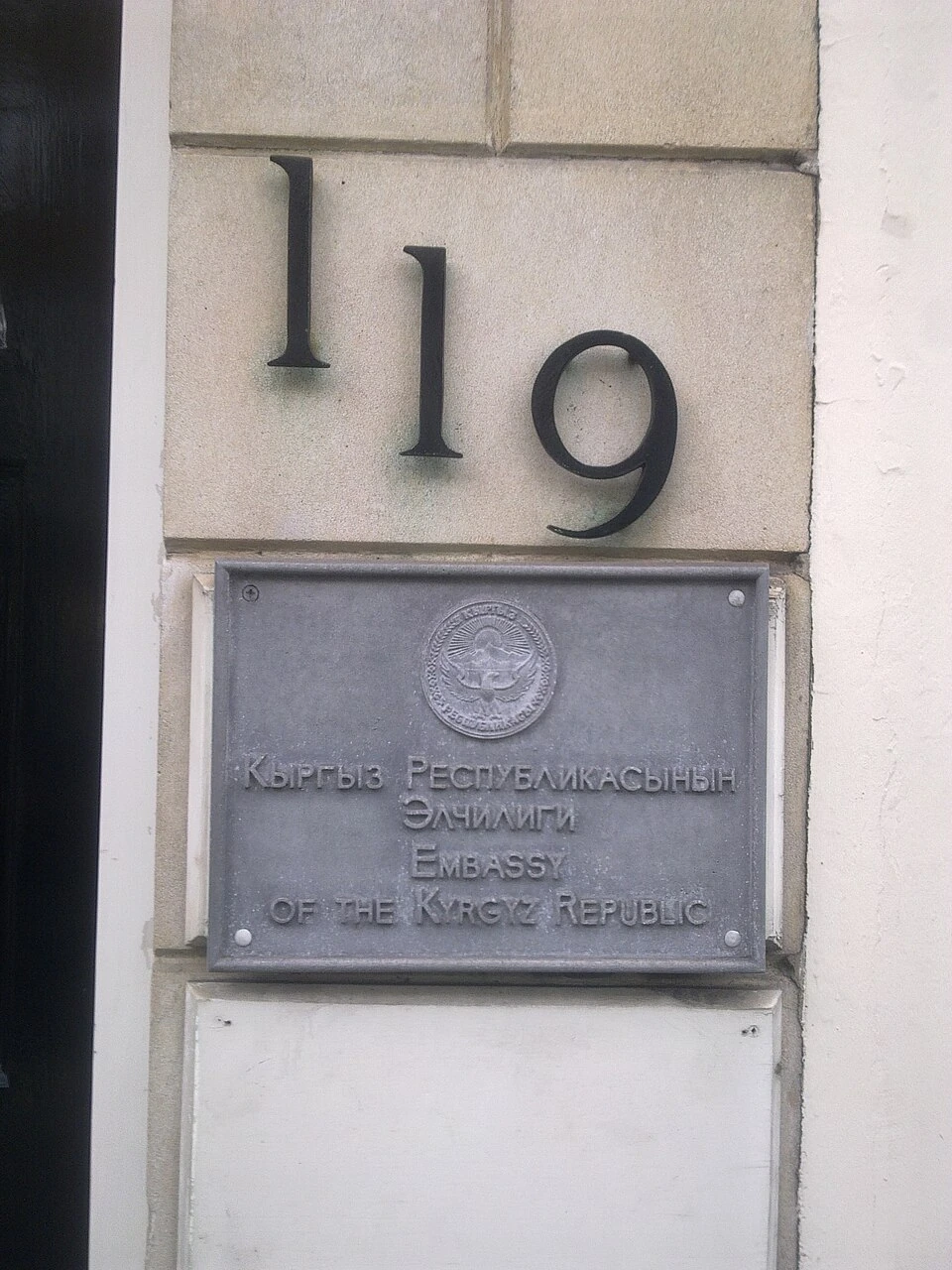
A diplomatic plaque at the Kyrgyz embassy in London, catalogued as English–Kyrgyz signage.
Saved in Babelbook · resized display copy. Select the image to open it independently of its source.
Sdrawkcab · Source ↗CC BY-SA 3.0 ↗View the local visual field note
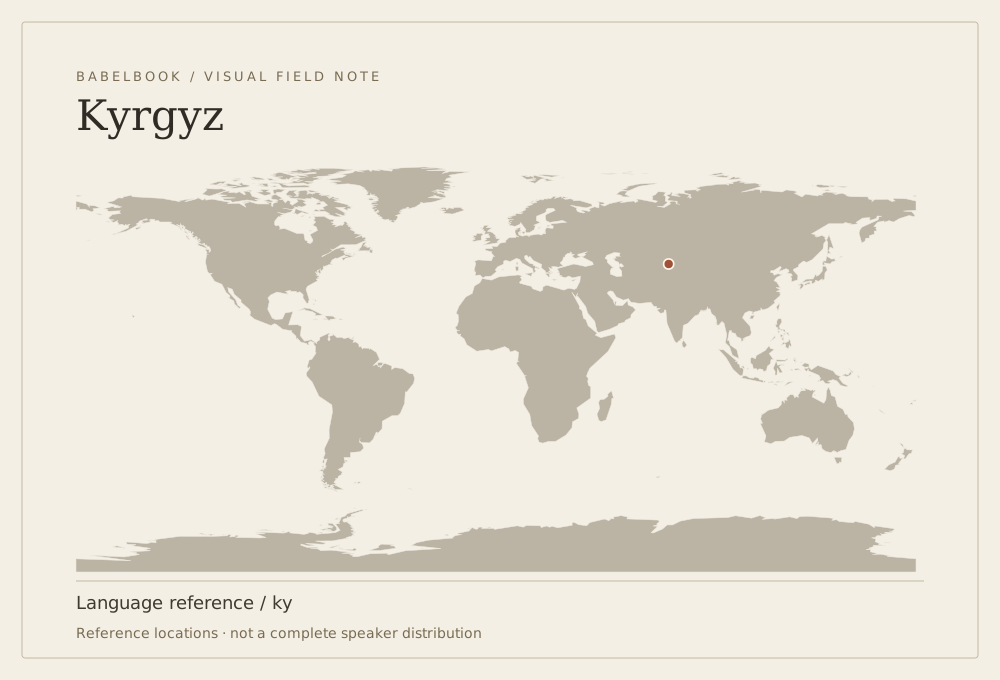
Representative reference points from Glottolog. Historical entries show reference locations, not current speakers. 1 point.
Reference & context ↗Babelbook · original editorial illustration · CC BY 4.0 · Glottolog locations; public-domain Natural Earth land
Source excerpts, selected, shortened and where noted editorially corrected from Kyrgyz language by Wikipedia contributors. Retrieved 2026-10-05. CC BY-SA 4.0. These excerpts are not an independently verified scholarly history; missing accounts are identified above.
Read further in the source
History
In 925, when the Liao dynasty defeated the Yenisei Kyrgyz and expelled them from the Mongolian steppes, some Ancient Kyrgyz elites settled in Altai and Xinjiang where they mixed with the local Kipchaks, resulting in a language shift. After the Mongol conquest in 1207 and a series of revolts against the Yuan dynasty, Kyrgyz-speaking tribes started to migrate to Tian Shan, which was already populated by various Turco-Mongol tribes. As Chaghatai Ulus subjects, the Kyrgyz converted to Islam. This resulted in the Kyrgyz language absorbing Persian and Arabic loanwords, but to a much lesser extent than Kazakh, Uzbek and Uyghur.
Dialects
Kyrgyz is divided into two main dialects, Northern and Southern. The Northern dialect has more Mongolian loanwords while the Southern one has more Uzbek ones. Standard Kyrgyz is based on Northern Kyrgyz. There is also a third smaller dialect called Pamiri Kyrgyz.
Orthography
Historically the Old Turkic Script was the first script used to write Kyrgyz. The Kyrgyz in Kyrgyzstan use a Cyrillic alphabet, which uses all the Russian letters plus ң, ө and ү. In the Xinjiang region of China, an Arabic alphabet is used. Between 1928 and 1940, a Latin alphabet was used for many minority languages in the USSR, including Kyrgyz. There have been attempts after 1990 to introduce other Latin alphabets which are closer to the Turkish alphabet, e.g. the Common Turkic Alphabet. There are political shades to the Cyrillic-Latin debate. In April 2023 the chairman of Kyrgyzstan's National Commission for the State Language and Language Policies, Kanybek Osmonaliev, announced that Kyrghyz would change the alphabet from Cyrillic to Latin to bring the country in line with other Turkic nations. Osmonaliev was reprimanded by President Sadyr Japarov, who later clarified that Kyrgyzstan had no plans to replace the Cyrillic alphabet.