Latin
Latin (lingua Latina or Latinum) is a classical language belonging to the Italic branch of the Indo-European languages. Latin was originally spoken by the Latins in Latium (now known as Lazio), the lower Tiber area around Rome, Italy. Through the expansion of the Roman Republic, it became the dominant language in the Italian Peninsula and subsequently throughout the Roman Empire. It has greatly influenced many languages, including English, having contributed many words to the English lexicon, particularly after the Christianisation of the Anglo-Saxons and the Norman Conquest. Latin roots appear frequently in the technical vocabulary used by fields such as theology, the sciences, medicine, and law. By the late Roman Republic, Old Latin had evolved into standardised Classical Latin. Vulgar Latin refers to the less prestigious colloquial registers, attested in inscriptions and some literary works such as those of the comic playwrights Plautus and Terence and the author Petronius. While often called a "dead language", Latin did not undergo language death. Between the 6th and 9th centuries, natural language change in the vernacular Latin of different regions evolved into distinct Romance languages. After the fall of the Western Roman Empire, Latin remained the common language of international communication, science, scholarship and academia in Europe into the early 19th century, by which time modern languages had supplanted it in common academic and political usage. Late Latin is the literary form of the language from the 3rd century AD onward.
Translate in Latin ↗Latin was or is the official language of several European states. It had official status in the Kingdom of Hungary from the 11th to mid-19th centuries, when Hungarian became the exclusive official language in 1844. The best known Latin language poet of Hungarian origin was Janus Pannonius. Similarly, in the Kingdom of Poland and the Polish–Lithuanian Commonwealth, Latin was officially recognised and widely used between the 10th and 18th centuries, commonly used in foreign relations and popular as a second language among some of the nobility. Latin was also the official language of the Croatian Parliament from the 13th to the 19th century (1847). The oldest preserved records of the parliamentary sessions (Congregatio Regni totius Sclavonie generalis)—held in Zagreb (Zagabria), Croatia—date from 19 April 1273. An extensive Croatian Latin literature exists. Latin was used on Croatian coins on even years until 1 January 2023, when Croatia adopted the Euro as its official currency.
Europe
Present-day use
Switzerland has adopted the country's Latin short name Helvetia on coins and stamps, since there is no room to use all of the nation's four official languages. For a similar reason, it adopted the international vehicle code CH and the Internet top-level domain ch, for Confoederatio Helvetica, the country's full Latin name. Some film and television in ancient settings, such as Sebastiane, The Passion of the Christ and Barbarians (2020 TV series), have been made with dialogue in Latin. Occasionally, Latin dialogue is used because of its association with religion or philosophy, in such film/television series as The Exorcist and Lost ("Jughead"). Subtitles are usually shown for the benefit of those who do not understand Latin. There are also songs written with Latin lyrics. The libretto for the opera-oratorio Oedipus rex by Igor Stravinsky is in Latin. The continued instruction of Latin is seen by some as a highly valuable component of a liberal arts education. Latin is taught at many high schools, especially in Europe and the Americas. It is most common in British public schools and grammar schools, the Italian liceo classico and liceo scientifico, the German Humanistisches Gymnasium and the Dutch gymnasium. Occasionally, some media outlets, targeting enthusiasts, broadcast in Latin. Notable examples include Radio Bremen in Germany, YLE radio in Finland (the Nuntii Latini broadcast from 1989 until it was shut down in June 2019), and Vatican Radio & Television, all of which broadcast news segments and other material in Latin. A variety of organisations, as well as informal Latin circuli, 'circles', have been founded in more recent times to support the use of spoken Latin. Moreover, a number of university classics departments have begun incorporating communicative pedagogies in their Latin courses. These include the University of Kentucky, the University of Oxford and Princeton University. There are many websites and forums maintained in Latin by enthusiasts.
Origins
The captured article does not contain a separate origins section. See the historical account and linked source.
Development
A number of phases of the language have been recognised, each distinguished by subtle differences in vocabulary, usage, spelling, and syntax. There are no hard and fast rules of classification; different scholars emphasise different features. As a result, the list has variants, as well as alternative names. In addition to the historical phases, Ecclesiastical Latin refers to the styles used by the writers of the Roman Catholic Church from late antiquity onward, as well as by Protestant scholars.
Writing
Some inscriptions have been published in an internationally agreed, monumental, multivolume series, the Corpus Inscriptionum Latinarum. Authors and publishers vary, but the format is about the same: volumes detailing inscriptions with a critical apparatus stating the provenance and relevant information. The reading and interpretation of these inscriptions is the subject matter of the field of epigraphy. About 270,000 inscriptions are known. Latin was written in the Latin alphabet (A, B, C, D, E, F, G, H, I, K, L, M, N, O, P, Q, R, S, T, V, X), derived from the Etruscan alphabet, which was in turn drawn from the Greek alphabet and ultimately the Phoenician alphabet. This alphabet has continued to be used over the centuries as the script for the Romance, Celtic, Germanic, Baltic, Finnic and many Slavic languages (Polish, Slovak, Slovene, Croatian, Bosnian, Serbian and Czech); and it has been adopted by many languages around the world, including Vietnamese, the Austronesian languages, many Turkic languages, and most languages in sub-Saharan Africa, the Americas and Oceania, making it by far the world's single most widely used writing system. The number of letters in the Latin alphabet has varied. When it was first derived from the Etruscan alphabet, it contained only 21 letters. Later, G was added to represent /ɡ/, which had previously been spelled C, and Z ceased to be included in the alphabet, as the language then had no voiced alveolar fricative. The letters K, Y, and Z were later added to represent Greek letters kappa, upsilon, and zeta respectively, in Greek loanwords. W was created in the 11th century from VV in some areas and UU in others. It represented /w/ in Germanic languages, not Latin, which still uses V for the purpose. J was distinguished from the original I only during the late Middle Ages, as was the letter U from V.
Beyond the typeface.
Signs, manuscripts, published pages and contextual photographs, with their place, period, source and reuse terms. Captions identify historical spellings, regional examples, community references and character imagery.
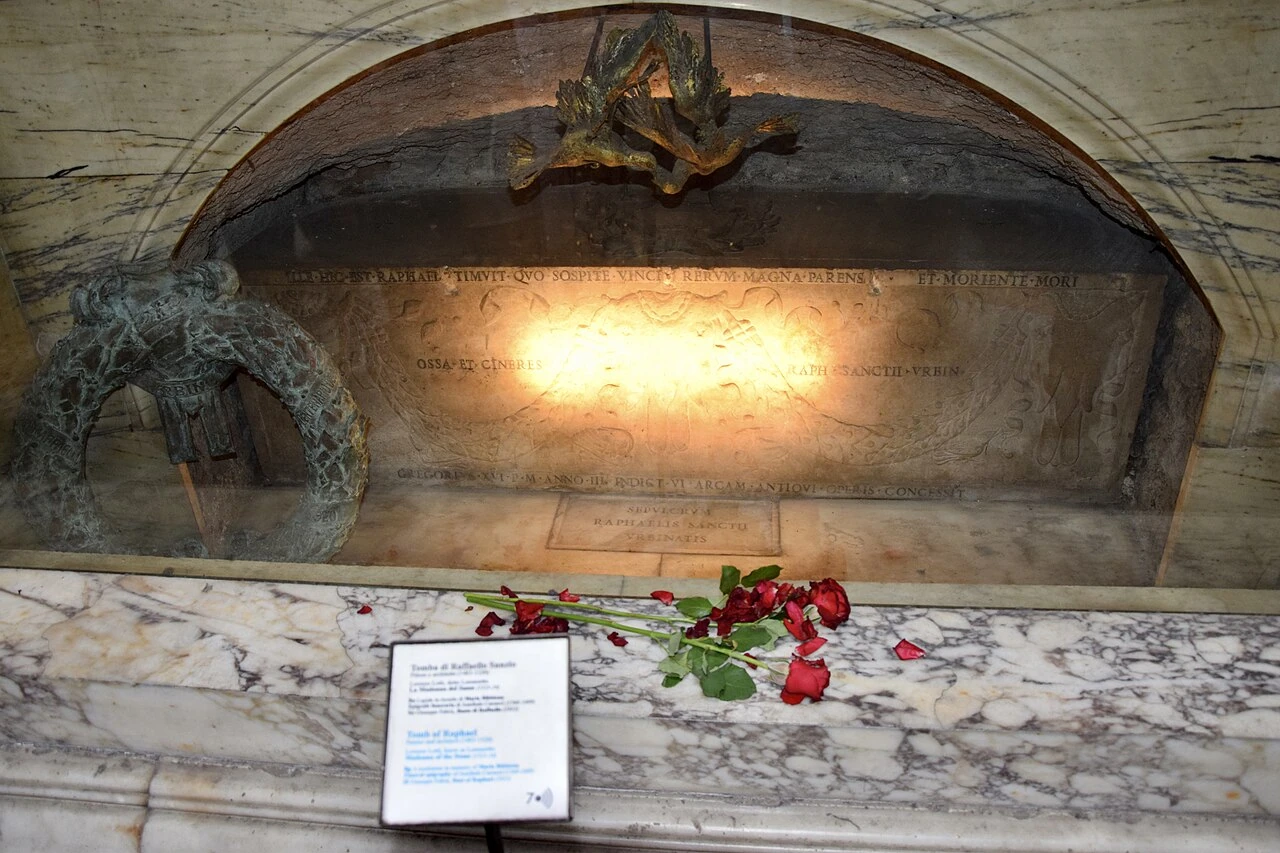
Commemorative Latin at Raphael’s tomb in Rome. A Renaissance subject, not an ancient Roman inscription. Displayed at reduced size; no additional crop.
Saved in Babelbook · resized display copy. Select the image to open it independently of its source.
Ank Kumar · Source ↗CC BY-SA 4.0 ↗View the local visual field note
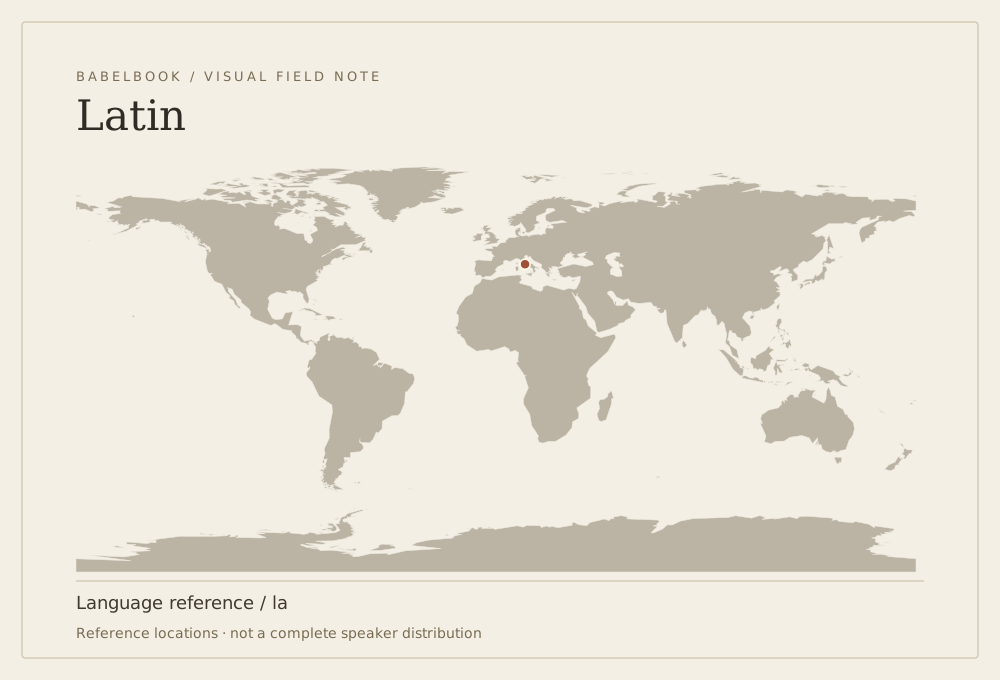
Representative reference points from Glottolog. Historical entries show reference locations, not current speakers. 1 point.
Reference & context ↗Babelbook · original editorial illustration · CC BY 4.0 · Glottolog locations; public-domain Natural Earth land
Source excerpts, selected, shortened and where noted editorially corrected from Latin by Wikipedia contributors. Retrieved 2026-10-05. CC BY-SA 4.0. These excerpts are not an independently verified scholarly history; missing accounts are identified above.
Read further in the source
History
A number of phases of the language have been recognised, each distinguished by subtle differences in vocabulary, usage, spelling, and syntax. There are no hard and fast rules of classification; different scholars emphasise different features. As a result, the list has variants, as well as alternative names. In addition to the historical phases, Ecclesiastical Latin refers to the styles used by the writers of the Roman Catholic Church from late antiquity onward, as well as by Protestant scholars.
Official status
Latin was or is the official language of several European states. It had official status in the Kingdom of Hungary from the 11th to mid-19th centuries, when Hungarian became the exclusive official language in 1844. The best known Latin language poet of Hungarian origin was Janus Pannonius. Similarly, in the Kingdom of Poland and the Polish–Lithuanian Commonwealth, Latin was officially recognised and widely used between the 10th and 18th centuries, commonly used in foreign relations and popular as a second language among some of the nobility. Latin was also the official language of the Croatian Parliament from the 13th to the 19th century (1847). The oldest preserved records of the parliamentary sessions (Congregatio Regni totius Sclavonie generalis)—held in Zagreb (Zagabria), Croatia—date from 19 April 1273. An extensive Croatian Latin literature exists. Latin was used on Croatian coins on even years until 1 January 2023, when Croatia adopted the Euro as its official currency.
Orthography
Latin was written in the Latin alphabet (A, B, C, D, E, F, G, H, I, K, L, M, N, O, P, Q, R, S, T, V, X), derived from the Etruscan alphabet, which was in turn drawn from the Greek alphabet and ultimately the Phoenician alphabet. This alphabet has continued to be used over the centuries as the script for the Romance, Celtic, Germanic, Baltic, Finnic and many Slavic languages (Polish, Slovak, Slovene, Croatian, Bosnian, Serbian and Czech); and it has been adopted by many languages around the world, including Vietnamese, the Austronesian languages, many Turkic languages, and most languages in sub-Saharan Africa, the Americas and Oceania, making it by far the world's single most widely used writing system. The number of letters in the Latin alphabet has varied. When it was first derived from the Etruscan alphabet, it contained only 21 letters. Later, G was added to represent /ɡ/, which had previously been spelled C, and Z ceased to be included in the alphabet, as the language then had no voiced alveolar fricative. The letters K, Y, and Z were later added to represent Greek letters kappa, upsilon, and zeta respectively, in Greek loanwords. W was created in the 11th century from VV in some areas and UU in others. It represented /w/ in Germanic languages, not Latin, which still uses V for the purpose. J was distinguished from the original I only during the late Middle Ages, as was the letter U from V. Although some Latin dictionaries use J, it is rarely used for Latin text, as it was not used in classical times, but many other languages use it.