Luxembourgish
Luxembourgish ( LUK-səm-bur-ghish; also Luxemburgish, Luxembourgian, Letzebu(e)rgesch; endonym: Lëtzebuergesch [ˈlətsəbu̯əjəʃ] ) is a West Germanic language that is spoken mainly in Luxembourg. About 400,000 people speak Luxembourgish worldwide. The language is standardized and officially the national language of the Grand Duchy of Luxembourg. As such, Luxembourgish is different from the German language also used in the Grand Duchy. The German language exists in a national standard variety of Luxembourg, which is slightly different from the standard varieties in Germany, Austria and Switzerland. Another important language of Luxembourg is French, which had a certain influence on both the national language, Luxembourgish, and the Luxembourg national variety of German. Luxembourgish, German and French are the three official languages (Amtssprachen) of Luxembourg. As a standard form of the Moselle Franconian variety, Luxembourgish has similarities with other High German dialects and the wider group of West Germanic languages. The status of Luxembourgish as the national language of Luxembourg and the existence there of a regulatory body have removed Luxembourgish, at least in part, from the domain of Standard German, its traditional Dachsprache. It is also related to the Transylvanian Saxon dialect spoken by the Transylvanian Saxons in Transylvania, contemporary central Romania.
Translate in Luxembourgish ↗Luxembourgish is considered the national language of Luxembourg and also one of the three administrative languages, alongside German and French. In Luxembourg, 77% of residents can speak Luxembourgish, and it is the primary language of 48% of the population. It is also spoken in the Arelerland region of Belgium (part of the Province of Luxembourg) and in small parts of Lorraine in France. In the German Eifel and Hunsrück regions, similar local Moselle Franconian dialects of German are spoken. The language is also spoken by a few descendants of Luxembourg immigrants in the United States and Canada. Other Moselle Franconian dialects are spoken by ethnic Germans long settled in Transylvania, Romania (Siebenbürgen). Moselle Franconian dialects outside the Luxembourg state border tend to have far fewer French loanwords, and these mostly remain from the French Revolution. The political party that places the greatest importance on promoting, using and preserving Luxembourgish is the Alternative Democratic Reform Party (ADR) and its electoral success in the 1999 election pushed the CSV-DP government to make knowledge of it a criterion for naturalisation. It is currently also the only political party in Luxembourg that wishes to implement written laws also in Luxembourgish and that wants Luxembourgish to be an officially recognized language of the European Union. In this context, in 2005, then-Deputy Prime Minister Jean Asselborn of the LSAP rejected a demand made by the ADR to make Luxembourgish an official language of the EU, citing financial reasons and the sufficiency of official German and French. A similar proposal by the ADR was rejected by the Chamber of Deputies in 2024.
Europe
Present-day use
Luxembourgish is considered the national language of Luxembourg and also one of the three administrative languages, alongside German and French. In Luxembourg, 77% of residents can speak Luxembourgish, and it is the primary language of 48% of the population. It is also spoken in the Arelerland region of Belgium (part of the Province of Luxembourg) and in small parts of Lorraine in France. In the German Eifel and Hunsrück regions, similar local Moselle Franconian dialects of German are spoken. The language is also spoken by a few descendants of Luxembourg immigrants in the United States and Canada. Other Moselle Franconian dialects are spoken by ethnic Germans long settled in Transylvania, Romania (Siebenbürgen). Moselle Franconian dialects outside the Luxembourg state border tend to have far fewer French loanwords, and these mostly remain from the French Revolution. The political party that places the greatest importance on promoting, using and preserving Luxembourgish is the Alternative Democratic Reform Party (ADR) and its electoral success in the 1999 election pushed the CSV-DP government to make knowledge of it a criterion for naturalisation. It is currently also the only political party in Luxembourg that wishes to implement written laws also in Luxembourgish and that wants Luxembourgish to be an officially recognized language of the European Union. In this context, in 2005, then-Deputy Prime Minister Jean Asselborn of the LSAP rejected a demand made by the ADR to make Luxembourgish an official language of the EU, citing financial reasons and the sufficiency of official German and French. A similar proposal by the ADR was rejected by the Chamber of Deputies in 2024.
Origins
The captured article does not contain a separate origins section. See the historical account and linked source.
Development
The Codex Mariendalensis, a nearly 6000-line epic poem about the life of the 13th-century Yolanda of Vianden, has been described by the National Library of Luxembourg as the earliest known text written in Luxembourgish. It was published in the early 14th century and discovered in 1999 at Ansembourg Castle. Luxembourgish was considered a German dialect like many others until about World War II but then the language underwent ausbau, creating its own standard form in vocabulary, grammar, and spelling and therefore is seen today as an independent language. Luxembourgish managed to gain linguistic autonomy against a vigorous One Standard German Axiom by being framed as an independent language with a name rather than as a national pluricentric standard variety of German. As Luxembourgish has a maximum of some 285,000native speakers, resources in the language such as books, newspapers, magazines, television and internet are limited. Since most Luxembourgers also speak Standard German and French, there is strong competition with these languages, which both have large language resources. Because of this, the use of Luxembourgish remains limited.
Writing
Latin or customary script (catalog classification; see the source for context).
Beyond the typeface.
Signs, manuscripts, published pages and contextual photographs, with their place, period, source and reuse terms. Captions identify historical spellings, regional examples, community references and character imagery.
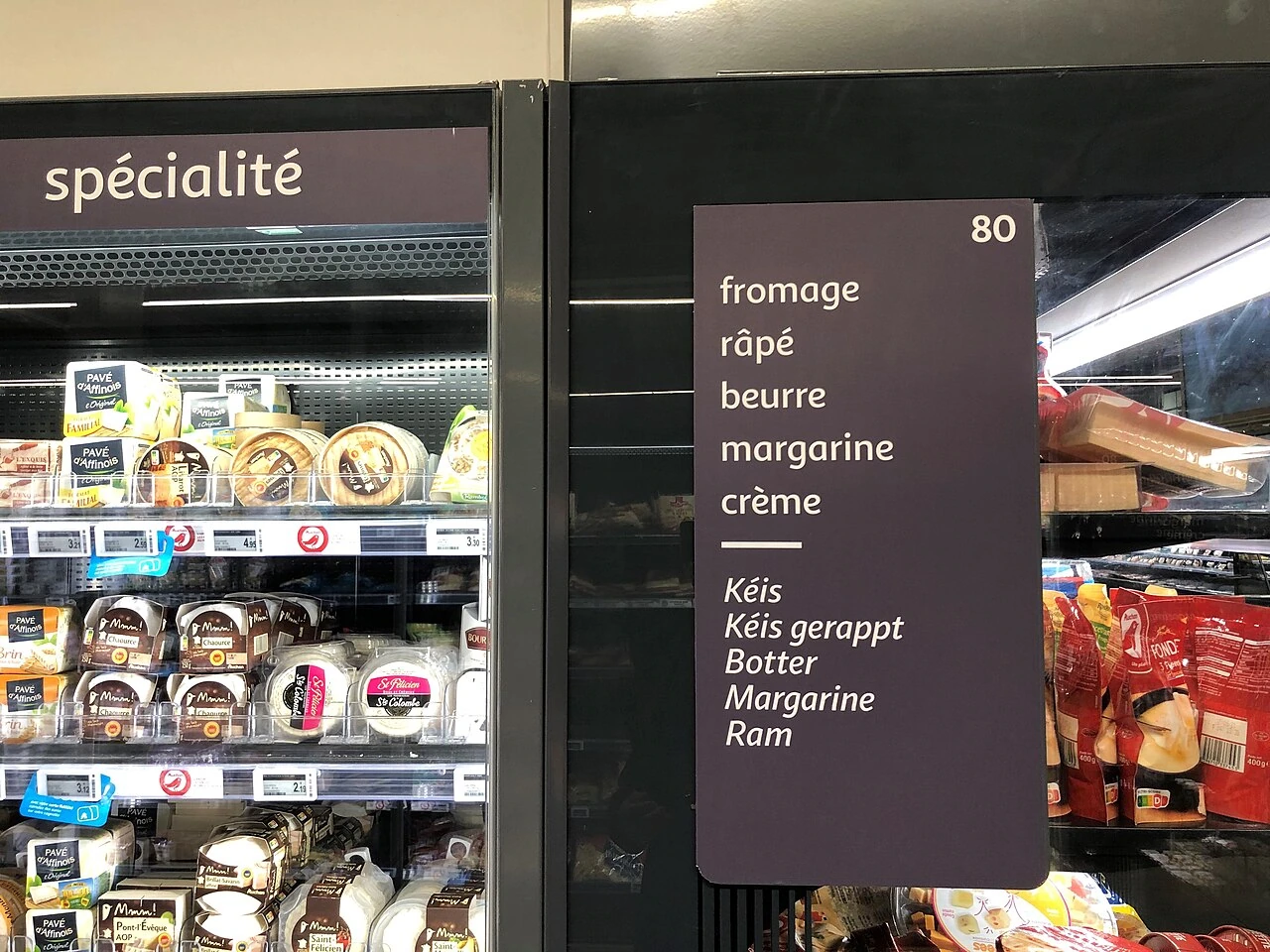
French and Luxembourgish on a supermarket cheese-section sign in Luxembourg, photographed in 2021. Language identification follows Commons descriptions or categories; not independently transcribed.
Saved in Babelbook · resized display copy. Select the image to open it independently of its source.
Bdx · Source ↗CC BY-SA 4.0 ↗View the local visual field note
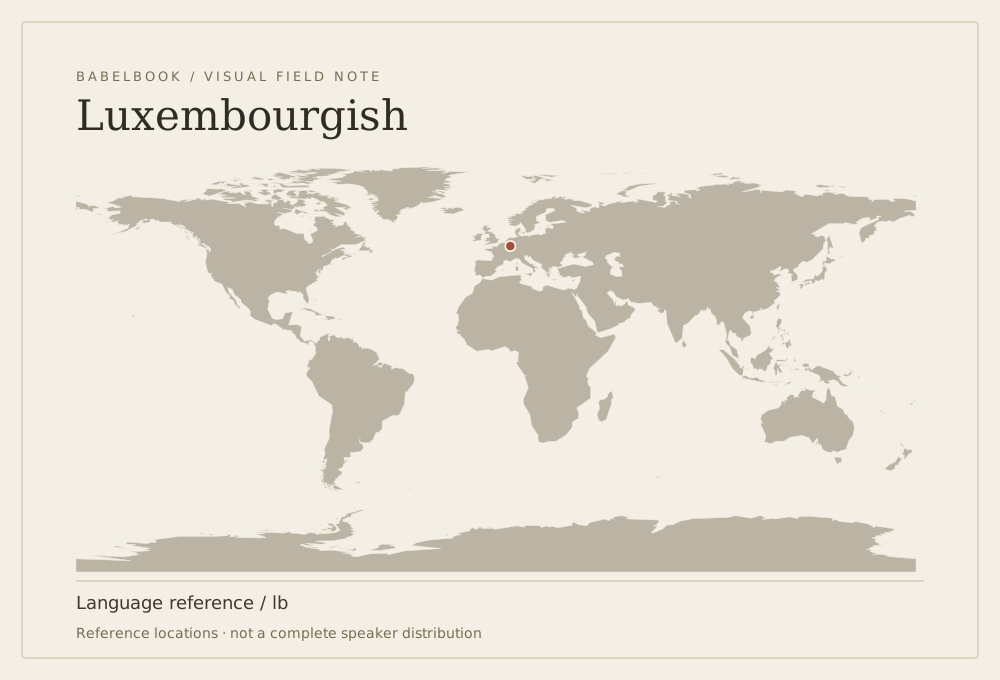
Representative reference points from Glottolog. Historical entries show reference locations, not current speakers. 1 point.
Reference & context ↗Babelbook · original editorial illustration · CC BY 4.0 · Glottolog locations; public-domain Natural Earth land
Source excerpts, selected, shortened and where noted editorially corrected from Luxembourgish by Wikipedia contributors. Retrieved 2026-10-05. CC BY-SA 4.0. These excerpts are not an independently verified scholarly history; missing accounts are identified above.
Read further in the source
History
The Codex Mariendalensis, a nearly 6000-line epic poem about the life of the 13th-century Yolanda of Vianden, has been described by the National Library of Luxembourg as the earliest known text written in Luxembourgish. It was published in the early 14th century and discovered in 1999 at Ansembourg Castle. Luxembourgish was considered a German dialect like many others until about World War II but then the language underwent ausbau, creating its own standard form in vocabulary, grammar, and spelling and therefore is seen today as an independent language. Luxembourgish managed to gain linguistic autonomy against a vigorous One Standard German Axiom by being framed as an independent language with a name rather than as a national pluricentric standard variety of German. As Luxembourgish has a maximum of some 285,000native speakers, resources in the language such as books, newspapers, magazines, television and internet are limited. Since most Luxembourgers also speak Standard German and French, there is strong competition with these languages, which both have large language resources. Because of this, the use of Luxembourgish remains limited.
Status
Luxembourgish is considered the national language of Luxembourg and also one of the three administrative languages, alongside German and French. In Luxembourg, 77% of residents can speak Luxembourgish, and it is the primary language of 48% of the population. It is also spoken in the Arelerland region of Belgium (part of the Province of Luxembourg) and in small parts of Lorraine in France. In the German Eifel and Hunsrück regions, similar local Moselle Franconian dialects of German are spoken. The language is also spoken by a few descendants of Luxembourg immigrants in the United States and Canada. Other Moselle Franconian dialects are spoken by ethnic Germans long settled in Transylvania, Romania (Siebenbürgen). Moselle Franconian dialects outside the Luxembourg state border tend to have far fewer French loanwords, and these mostly remain from the French Revolution. The political party that places the greatest importance on promoting, using and preserving Luxembourgish is the Alternative Democratic Reform Party (ADR) and its electoral success in the 1999 election pushed the CSV-DP government to make knowledge of it a criterion for naturalisation. It is currently also the only political party in Luxembourg that wishes to implement written laws also in Luxembourgish and that wants Luxembourgish to be an officially recognized language of the European Union. In this context, in 2005, then-Deputy Prime Minister Jean Asselborn of the LSAP rejected a demand made by the ADR to make Luxembourgish an official language of the EU, citing financial reasons and the sufficiency of official German and French. A similar proposal by the ADR was rejected by the Chamber of Deputies in 2024.
Dialects
There are several distinct dialect forms of Luxembourgish including Areler (from Arlon), Eechternoacher (Echternach), Dikrecher (Diekirch), Kliärrwer (Clervaux), Miseler (Moselle), Stater (Luxembourg City), Veiner (Vianden), Minetter (Southwest Luxembourg) and Weelzer (Wiltz). Further small vocabulary differences may be seen even between small villages. These varieties are grouped into North, East, South, and Center dialects which can be automatically categorised with a correctness of about 80%. Increasing mobility of the population and the dissemination of the language through mass media such as radio and television are leading to a gradual standardisation towards a "Standard Luxembourgish" through the process of koineization.
Standardisation
A number of proposals for standardising the orthography of Luxembourgish can be documented, going back to the middle of the 19th century. There was no officially recognised system until the adoption of the "OLO" (ofizjel lezebuurjer ortografi) on 5 June 1946. This orthography provided a system for speakers of all varieties of Luxembourgish to transcribe words the way they pronounced them, rather than imposing a single, standard spelling for the words of the language. The rules explicitly rejected certain elements of German orthography (e.g., the use of ⟨ä⟩ and ⟨ö⟩, the capitalisation of nouns). Similarly, new principles were adopted for the spelling of French loanwords.
fiireje, rééjelen, shwèzt, veinejer (cf. German vorigen, Regeln, schwätzt, weniger) bültê, âprê, Shaarel, ssistém (cf. French bulletin, emprunt, Charles, système) This proposed orthography, so different from existing "foreign" standards that people were already familiar with, did not enjoy widespread approval. A more successful standard eventually emerged from the work of the committee of specialists charged with the task of creating the Luxemburger Wörterbuch, published in 5 volumes between 1950 and 1977. The orthographic conventions adopted in this decades-long project, set out in Bruch (1955), provided the basis of the standard orthography that became official on 10 October 1975. Modifications to this standard were proposed by the Permanent Council of the Luxembourguish language and adopted officially in the spelling reform of 30 July 1999. A detailed explanation of current practice for Luxembourgish can be found in Schanen & Lulling (2003).