Ganda
Ganda or Luganda ( loo-GAN-də; Oluganda [oluɡâːndá]) is a Bantu language spoken in the African Great Lakes region. It is one of the major languages in Uganda and is spoken by more than 5.56 million Baganda and other people principally in central Uganda, including the country's capital, Kampala. Typologically, it is an agglutinative, tonal language with subject–verb–object word order and nominative–accusative morphosyntactic alignment. With at least 5.6 million first-language speakers in the Buganda region and 5.4 million second language speakers fluent elsewhere in different regions especially in major urban areas like Mbale, Tororo, Jinja, Gulu, Mbarara, Hoima, Kasese etc. Luganda is Uganda's de facto language of national identity as it is the most widely spoken Ugandan language used mostly in trade in urban areas. The language is also the most-spoken unofficial language in Rwanda's capital Kigali. As a second language, it follows English and precedes Swahili in Uganda. Lusoga, the language spoken in Busoga to the east of Buganda, is very closely related to Luganda. The two languages are almost mutually intelligible, and have an estimated lexical similarity of between 82% and 86%.
Translate in Ganda ↗Ganda or Luganda ( loo-GAN-də; Oluganda [oluɡâːndá]) is a Bantu language spoken in the African Great Lakes region. It is one of the major languages in Uganda and is spoken by more than 5.56 million Baganda and other people principally in central Uganda, including the country's capital, Kampala. Typologically, it is an agglutinative, tonal language with subject–verb–object word order and nominative–accusative morphosyntactic alignment. With at least 5.6 million first-language speakers in the Buganda region and 5.4 million second language speakers fluent elsewhere in different regions especially in major urban areas like Mbale, Tororo, Jinja, Gulu, Mbarara, Hoima, Kasese etc. Luganda is Uganda's de facto language of national identity as it is the most widely spoken Ugandan language used mostly in trade in urban areas. The language is also the most-spoken unofficial language in Rwanda's capital Kigali. As a second language, it follows English and precedes Swahili in Uganda. Lusoga, the language spoken in Busoga to the east of Buganda, is very closely related to Luganda. The two languages are almost mutually intelligible, and have an estimated lexical similarity of between 82% and 86%.
Sub-Saharan Africa
Present-day use
The captured source does not contain a separate current-use account.
Origins
The captured article does not contain a separate origins section. See the historical account and linked source.
Development
Luganda, a Bantu language, shares its roots with other Bantu languages spoken in the African Great Lakes region. Its specific origins remain a subject of scholarly debate, but it's generally accepted that it evolved from Proto-Bantu, the ancestral language of all Bantu languages. During the 18th -19th century, due to interaction with foreign communities, Luganda borrowed a number of loan words from the incoming peoples (Arab traders, missionaries and colonialists), mostly for things that were inexistent in the land, such as a number of words from Arabic like chai from Arabic shay (tea), ddiini (religion), ssala (prayer), and from English, for example ssaati (shirt) or emotoka (car).
Writing
Luganda spelling, which has been standardized since 1947, uses a Latin alphabet, augmented with one new letter ŋ and a digraph ny, which is treated as a single letter. It has a very high sound-to-letter correspondence: one letter usually represents one sound and vice versa. The distinction between simple and geminate consonants is always represented explicitly: simple consonants are written single, and geminates are written double. The distinction between long and short vowels is always made clear from the spelling but not always explicitly: short vowels are always written single; long vowels are written double only if their length cannot be inferred from the context. Stress and tones are not represented in the spelling. The following phonemes are always represented with the same letter or combination of letters: Short vowels (always spelt a, e, i, o, u) All consonants apart from /l~r/, /c/ and /ɟ/ The palatals /c/ and /ɟ/, when followed by a short vowel (always spelt c, j), except when the short vowel is itself followed by a geminate consonant, or when the vowel is /i/ The following phonemes can be represented with two letters or combinations of letters, with the alternation predictable from the context: Long vowels (spelt a, e, i, o, u where short vowels are impossible; aa, ee, ii, oo, uu elsewhere) The liquid /l~r/ (spelt r after e or i; l elsewhere) The following phonemes can be represented with two letters or combinations of letters, with unpredictable alternation between the two: The palatals /c/ and /ɟ/, when followed by a long vowel, or by a short vowel and a geminate consonant, or by an i sound (/i/ or /iː/) (spelt with c, j, with ky, gy, or, before i, with k, g). It is therefore possible to predict the pronunciation of any word (with the exception of stress and tones) from the spelling. It is also usually possible to predict the spelling of a word from the pronunciation.
Beyond the typeface.
Signs, manuscripts, published pages and contextual photographs, with their place, period, source and reuse terms. Captions identify historical spellings, regional examples, community references and character imagery.
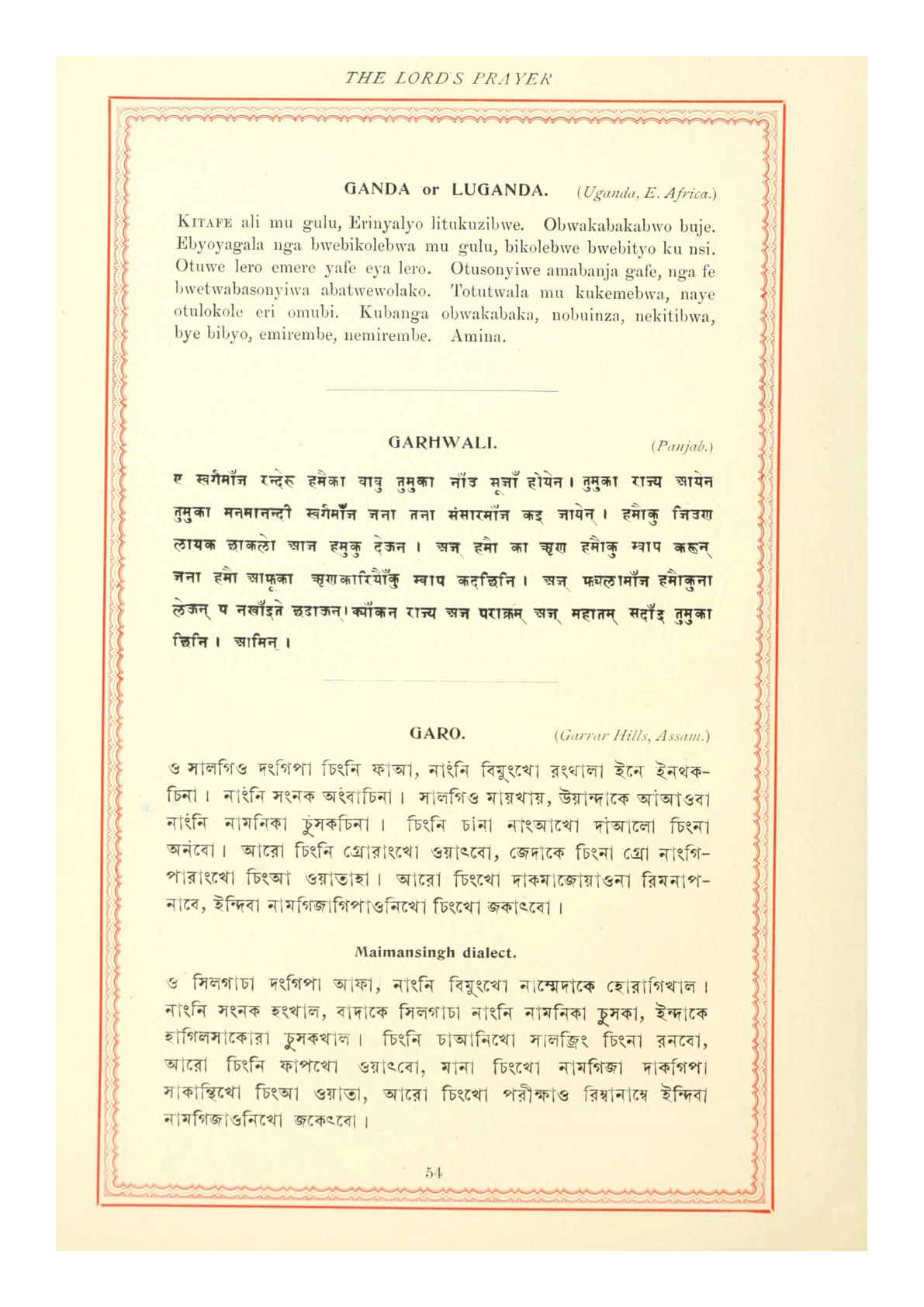
Historical printed prayer headed “GANDA or LUGANDA” in The Lord’s Prayer in Five Hundred Languages, printed page 54. This older label is cross-referenced to Ganda by the linked language authority. The Commons record dates the compilation to 1905; this copy also contains a publisher note dated June 1908. Orthography and translation reflect the historical source, not a modern usage standard. Other languages appear on the same page. The source includes period terminology and editorial annotations; these are historical evidence, not Babelbook’s current terminology or claims.
Saved in Babelbook · resized display copy. Select the image to open it independently of its source.
Reinhold Rost (compiler); Gilbert & Rivington / Wm. Clowes & Sons (publishers); Internet Archive scan · Source ↗Public domain ↗View the local visual field note
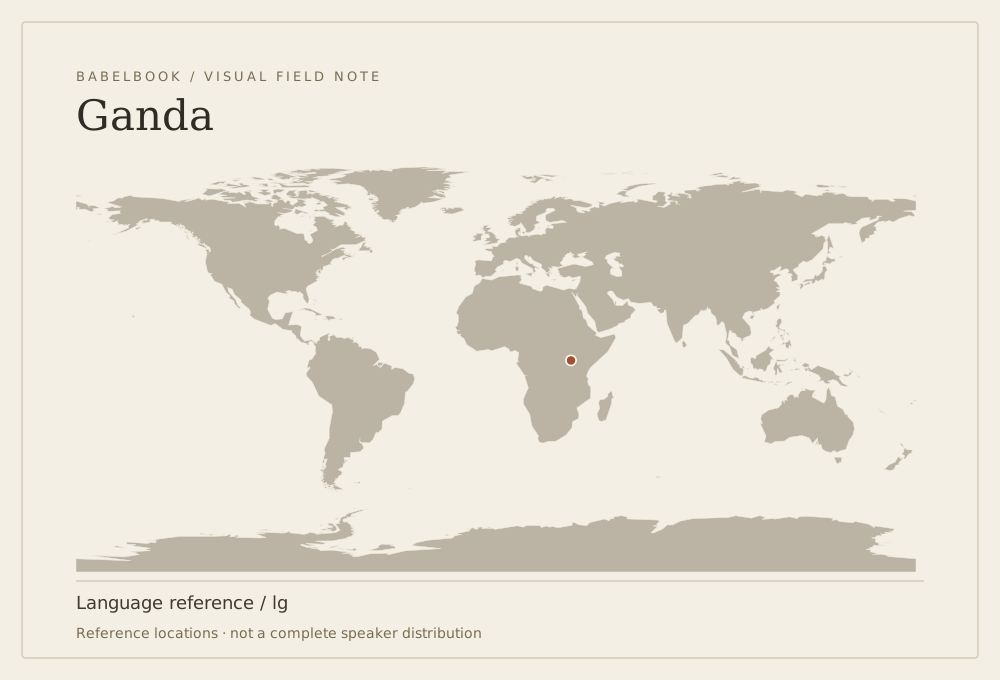
Representative reference points from Glottolog. Historical entries show reference locations, not current speakers. 1 point.
Reference & context ↗Babelbook · original editorial illustration · CC BY 4.0 · Glottolog locations; public-domain Natural Earth land
Source excerpts, selected, shortened and where noted editorially corrected from Luganda by Wikipedia contributors. Retrieved 2026-10-05. CC BY-SA 4.0. These excerpts are not an independently verified scholarly history; missing accounts are identified above.
Read further in the source
History
Luganda, a Bantu language, shares its roots with other Bantu languages spoken in the African Great Lakes region. Its specific origins remain a subject of scholarly debate, but it's generally accepted that it evolved from Proto-Bantu, the ancestral language of all Bantu languages. During the 18th -19th century, due to interaction with foreign communities, Luganda borrowed a number of loan words from the incoming peoples (Arab traders, missionaries and colonialists), mostly for things that were inexistent in the land, such as a number of words from Arabic like chai from Arabic shay (tea), ddiini (religion), ssala (prayer), and from English, for example ssaati (shirt) or emotoka (car).
Orthography
Luganda spelling, which has been standardized since 1947, uses a Latin alphabet, augmented with one new letter ŋ and a digraph ny, which is treated as a single letter. It has a very high sound-to-letter correspondence: one letter usually represents one sound and vice versa. The distinction between simple and geminate consonants is always represented explicitly: simple consonants are written single, and geminates are written double. The distinction between long and short vowels is always made clear from the spelling but not always explicitly: short vowels are always written single; long vowels are written double only if their length cannot be inferred from the context. Stress and tones are not represented in the spelling. The following phonemes are always represented with the same letter or combination of letters:
Short vowels (always spelt a, e, i, o, u) All consonants apart from /l~r/, /c/ and /ɟ/ The palatals /c/ and /ɟ/, when followed by a short vowel (always spelt c, j), except when the short vowel is itself followed by a geminate consonant, or when the vowel is /i/ The following phonemes can be represented with two letters or combinations of letters, with the alternation predictable from the context:
Long vowels (spelt a, e, i, o, u where short vowels are impossible; aa, ee, ii, oo, uu elsewhere) The liquid /l~r/ (spelt r after e or i; l elsewhere) The following phonemes can be represented with two letters or combinations of letters, with unpredictable alternation between the two:
The palatals /c/ and /ɟ/, when followed by a long vowel, or by a short vowel and a geminate consonant, or by an i sound (/i/ or /iː/) (spelt with c, j, with ky, gy, or, before i, with k, g). It is therefore possible to predict the pronunciation of any word (with the exception of stress and tones) from the spelling. It is also usually possible to predict the spelling of a word from the pronunciation. The only words where this is not possible are those that include one of the affricate–vowel combinations discussed above. Note, however, that some proper names are not spelled as they are pronounced. For example, Uganda is pronounced as though written Yuganda and Teso is pronounced Tteeso.