Limburgish
Limburgish (Limburgs [ˈlɪm˦bʏʀ(ə)xs] or Lèmburgs [ˈlɛm˦-]; Dutch: Limburgs [ˈlɪmbʏr(ə)xs]; also Limburgian, Limburgic or Limburgan) is the collective designation for a group of closely related language varieties spoken in most of Belgian and Dutch Limburg and in the adjacent areas of North Rhine-Westphalia. The Limburgish dialects lack a standardized form and instead comprise multiple varieties, each with its own distinctive features. A characteristic feature of many dialects of Limburgish is the occurrence of a lexical pitch accent (Franconian tone accent), which these dialects adopted from and share with the adjacent Central Franconian dialects of German. In the Netherlands, Limburgish has been officially recognized as a regional language by the Dutch government since 1997. In Belgium and Germany, Limburgish dialects have no formal legal status.
Translate in Limburgish ↗In 2012 it was concluded that dialect use in both Limburg provinces as well as in the adjacent Rhineland has been declining with each generation. A 2021 study by dialect society Veldeke Limburg found that 67% of the inhabitants of Dutch Limburg reported speaking Limburgish fluently. However, there were marked discrepancies by age group: among the youngest cohort surveyed (18–34 years), only 52% reported fluent command of the dialect. More than half of Limburgers expected that the use of Limburgish dialects would decrease in the future, while only 4% believed it would increase. Alongside Standard Dutch, approximately 57% of Limburgish parents spoke Limburgish with each other in 2003; the percentage who also spoke Limburgish with their children was somewhat lower. This finding corresponds to earlier studies from the 1990s, which indicated that parents tended to consider Standard Dutch more appropriate for addressing their children. Within the Netherlands, dialect use is relatively highest in Limburg.[29] In areas that experienced strong migration flows from other parts of the country, such as the Limburg mining district, the use of the local dialect has weakened. The urban dialect of Heerlen reflects this most clearly, largely due to the higher socio-economic status of Standard-Dutch-speaking migrants in the first half of the twentieth century. In western South Limburg and Central Limburg, Limburgish continues to be spoken relatively most frequently. While the use of Limburgish dialects as spoken language has consistently declined, written use of Limburgish has increased significantly, a trend attributed to the rise of the internet and a reduction in illiteracy. In Belgian Limburg, various studies have likewise revealed a correlation between age and the proportion of Limburgers who are dialect speakers.
Europe
Present-day use
Until well into the eighteenth century, the Limburgish elite associated the Limburgish dialects with the lower classes and regarded them as subordinate and inferior to written and cultural languages such as Dutch, German, and especially French. In the nineteenth century, appreciation for Limburgish dialects grew in a cultural-historical sense, though their socio-linguistic status remained low. This lower prestige contributed in South Limburg to the emergence of Koelhollands (Limburgish: 'Coal Dutch' a play on both the Dutch word steenkolenengels and the coal mining industry then present in the area): a sociolect formed through the blending of Standard Dutch and Limburgish dialects, as parents believed their children would have better opportunities if they spoke Standard Dutch. In surveys conducted in 1987 and 1997, many speakers of Limburgish dialects nevertheless identified these as their first language. In Belgian Limburg, the status of Limburgish dialects is clearly demarcated in socio-cultural terms, both positively and negatively. The dialect is the language of informal situations, village life, the workplace, carnival, and folklore, but it is also considered the language of older and less educated people. Within several Limburgish dialects, especially urban ones, class distinctions can also be discerned. Although less pronounced than, for example, in the dialect spoken in The Hague, both the Roermond- and Maastricht dialect exhibit upper and lower class variants. Speakers of upper-class Maastricht-variety, for instance, use significantly more French loanwords. Within the Dutch dialect renaissance that began in the early 1990s, Limburgish has held a prominent place, particularly through the music of Rowwen Hèze.
Origins
The name Limburgish (and variants of it) derives only indirectly from the now Belgian town of Limbourg (Laeboer in Limburgish, IPA: /ˈlæːbuʁ/), which was the capital of the Duchy of Limburg during the Middle Ages. More directly it is derived from the more modern name of the Province of Limburg (1815–39) in the Kingdom of the Netherlands, which has been split today into a Belgian Limburg and a Dutch Limburg. In the area around the old Duchy of Limburg the main language today is French, but there is also a particular cluster of Limburgish (or Limburgish-like, depending on definitions) dialects. The use of the word Limburgish is first attested at the close of the 19th century. People from Limburg usually call their language plat, a term also used by speakers of Low Saxon to refer to their respective dialects.
Development
After the third century, the dynamics between the Germanic peoples and the Romans along the lower course of the Rhine began to change. Whereas in earlier centuries relations had primarily consisted of trade with occasional raids, the crises that increasingly beset the Roman Empire led to larger numbers of Germanic groups settling on the left bank of the major rivers. These tribes most likely spoke dialects that had developed from Weser-Rhine Germanic, which by the fifth century had merged into what is known as Old Frankish. The cultural predominance of the Romans nevertheless remained significant, manifesting itself in a relatively gradual transformation of the linguistic landscape and in the adoption of numerous Latin loanwords, particularly in formerly strongly Romanized areas where these Germanic peoples settled. As a result, compared to all other West Germanic varieties, the Limburgish dialects and those of the adjacent Rhineland contain the greatest number of early Latin loanwords, and for a long time, bilingual Romance–Germanic language islands continued to exist in parts of Limburg. The region around Sint-Truiden and the area between Aachen and Vaals, for instance, were only definitively Germanized after the tenth century. Traces of this linguistic development remain, such as in the village of Cadier en Keer near Maastricht, where Cadier represents the Romance evolution and Keer the Germanic evolution of the original Latin word calidarium (a heated bathhouse). Beginning in the sixth century, the Second Germanic Sound Shift spread northward from southwestern Germany. This development caused Old Frankish to split into a non-shifted variety (Old Dutch, also known as Old Low Franconian) and several shifted varieties: the dialects of Old High German spoken in and around the Middle Rhine. The later Limburgish dialects trace their origins to the eastern branch of Old Dutch.
Writing
The Limburgish dialects do not constitute a unified language, which means that Limburgish texts are always written in a particular dialect, with spelling conventions often varying from one individual to another. The Limburgish dialect association Veldeke has, however, developed an orthographic system intended for all dialects, with the aim that the same sound be represented in the same way across dialects. This system is known as the Veldeke spelling. The first version was published in 1928, followed by revisions in 1952, 1983, and 2000. Although the spelling system has no official status, it is often described as “officially promoted,” as it is used by both the Raod veur ’t Limburgs and the Veldeke dialect association. The Veldeke spelling is also employed, for example, on bilingual place-name signs in Dutch Limburg. The most recent version of the spelling dates from 2003. In 1994, the regional journalist Paul Prikken (1946–2013) developed his own standard form, called Algemeen Geschreven Limburgs (“General Written Limburgish”), which he proposed in his dictionary De taal van de Maas and used for his columns in the newspaper De Limburger between 1995 and 2004. This form gained little traction. A proposal to adopt it at the provincial level was rejected.
Beyond the typeface.
Signs, manuscripts, published pages and contextual photographs, with their place, period, source and reuse terms. Captions identify historical spellings, regional examples, community references and character imagery.
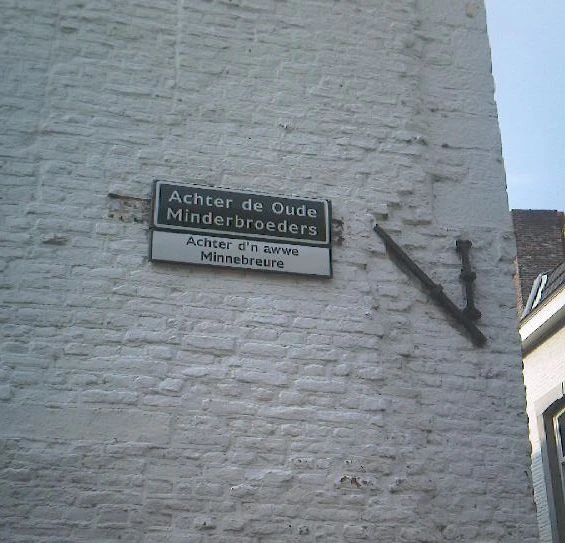
Bilingual street sign in Maastricht. Commons explicitly identifies the lower street name as the Maastrichtian variant of Limburgish and the upper name as Dutch.
Saved in Babelbook · resized display copy. Select the image to open it independently of its source.
LightPhoenix · Source ↗CC BY-SA 3.0 ↗View the local visual field note
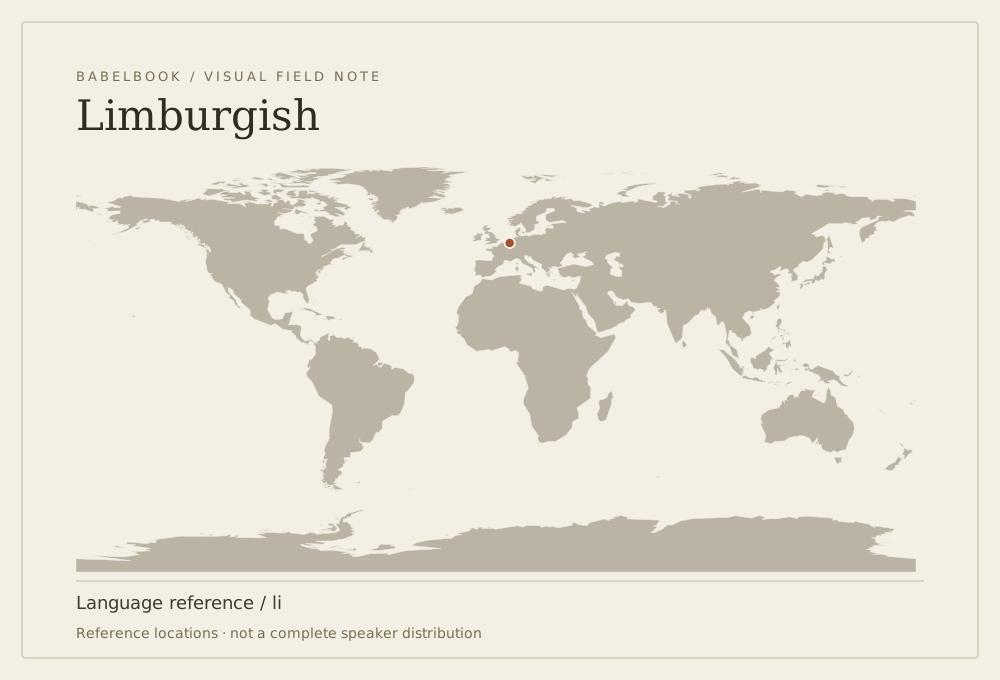
Representative reference points from Glottolog. Historical entries show reference locations, not current speakers. 1 point.
Reference & context ↗Babelbook · original editorial illustration · CC BY 4.0 · Glottolog locations; public-domain Natural Earth land
Source excerpts, selected, shortened and where noted editorially corrected from Limburgish by Wikipedia contributors. Retrieved 2026-10-05. CC BY-SA 4.0. These excerpts are not an independently verified scholarly history; missing accounts are identified above.
Read further in the source
History
After the third century, the dynamics between the Germanic peoples and the Romans along the lower course of the Rhine began to change. Whereas in earlier centuries relations had primarily consisted of trade with occasional raids, the crises that increasingly beset the Roman Empire led to larger numbers of Germanic groups settling on the left bank of the major rivers. These tribes most likely spoke dialects that had developed from Weser-Rhine Germanic, which by the fifth century had merged into what is known as Old Frankish. The cultural predominance of the Romans nevertheless remained significant, manifesting itself in a relatively gradual transformation of the linguistic landscape and in the adoption of numerous Latin loanwords, particularly in formerly strongly Romanized areas where these Germanic peoples settled. As a result, compared to all other West Germanic varieties, the Limburgish dialects and those of the adjacent Rhineland contain the greatest number of early Latin loanwords, and for a long time, bilingual Romance–Germanic language islands continued to exist in parts of Limburg. The region around Sint-Truiden and the area between Aachen and Vaals, for instance, were only definitively Germanized after the tenth century. Traces of this linguistic development remain, such as in the village of Cadier en Keer near Maastricht, where Cadier represents the Romance evolution and Keer the Germanic evolution of the original Latin word calidarium (a heated bathhouse). Beginning in the sixth century, the Second Germanic Sound Shift spread northward from southwestern Germany. This development caused Old Frankish to split into a non-shifted variety (Old Dutch, also known as Old Low Franconian) and several shifted varieties: the dialects of Old High German spoken in and around the Middle Rhine. The later Limburgish dialects trace their origins to the eastern branch of Old Dutch. Some of the earliest known Dutch texts are written in this variety, such as the famous Wachtendonck Psalms of the tenth century. Both East and West Old Dutch contributed to the formation of Middle Dutch, but after the thirteenth century, features characteristic of Flemish and Brabantine (both western dialects) became dominant in the written record. Although Middle Dutch appears relatively homogeneous in writing, this is not assumed to have been the case in the spoken language. Limburgish constitutes one of the five principal dialect groups of Middle Dutch. The Middle Dutch Limburgish dialects were marked by features of the Second Germanic Sound Shift, which had spread northwestward from the city of Cologne. A specific example is the presence of the ik–ich isogloss in Middle Dutch varieties of Limburgish, whereas the shift from ik to ich had not yet taken place in Old East Dutch (the direct predecessor of the present-day dialects in central and southern Limburg). Traditionally, the Battle of Worringen (1288) is seen as a turning point in the linguistic history of the Limburgish dialects. Following this battle, the Limburg region reoriented itself: the old Duchy of Limburg, the County of Dalhem, and what is now Dutch South Limburg — collectively known as the Lands of Overmaas — came under the rule of the Duchy of Brabant. Instead of looking primarily to nearby German cities, the region shifted its economic and cultural orientation westward, toward the flourishing Brabantine cities and, further afield, to Ghent, Bruges, and Ypres in Flanders. With the dominance of the Brabantine dialects (the so-called Brabantine expansion), developments in the opposite direction set in: typically Middle Dutch sound changes — such as final devoicing, assimilation, and vowel reduction — spread west-to-east, counteracting the earlier High German influence. The adoption of Brabantine features occurred earliest and most strongly in the dialects west of the Meuse, notably in present-day Belgian Limburg, Maastricht, and Weert. When, in the early sixteenth century, the first extensive attempts were made to standardize Dutch, Brabantine provided the main basis. After the fall of Antwerp during the Eighty Years’ War, however, the cultural, political, and economic center of gravity shifted to the Northern Netherlands, especially to the province of Holland. The result was that Hollandic — though still influenced by Brabantine — acquired a dominant role in the formation of the Dutch standard language, particularly in pronunciation. Consequently, the Limburgish dialects have left relatively few traces in Standard Dutch. By contrast, the Dutch standard language has exerted an increasing influence on Limburgish, particularly since the nineteenth century, as the dialects have moved progressively closer to Standard Dutch. The earliest texts written in a Limburgish dialect date from the nineteenth century. A precursor is the Sermoen euver de Weurd (“Sermon on the Words”), composed in Maastricht dialect in 1729. Pioneers in the documentation of Limburgish dialects included Pieter Willems (1840–1898), professor at Leuven University but born and raised in Maastricht, and Joseph Schrijnen (1869–1938), professor first in Utrecht and later in Nijmegen. Their research was, as was common at the time, conducted primarily through written questionnaires. In the twentieth century, with the rise of radio and television as new media, marked differences arose in the extent to which dialects were spoken in Belgium, the Netherlands, and Germany. In Belgium, the South Low Franconian dialect lost ground to so-called Verkavelingsvlaams, while in Germany the Rhineland regiolect increasingly took hold. The linguistically Limburgish dialects in Germany are also subject to the influence of the German standard language. Under the influence of Cologne broadcaster WDR, Ripuarian accents have been spreading on the left bank of the Rhine, at the expense of the traditional Limburgish and Kleverlandish dialects.
Speakers
In 2012 it was concluded that dialect use in both Limburg provinces as well as in the adjacent Rhineland has been declining with each generation. A 2021 study by dialect society Veldeke Limburg found that 67% of the inhabitants of Dutch Limburg reported speaking Limburgish fluently. However, there were marked discrepancies by age group: among the youngest cohort surveyed (18–34 years), only 52% reported fluent command of the dialect. More than half of Limburgers expected that the use of Limburgish dialects would decrease in the future, while only 4% believed it would increase. Alongside Standard Dutch, approximately 57% of Limburgish parents spoke Limburgish with each other in 2003; the percentage who also spoke Limburgish with their children was somewhat lower. This finding corresponds to earlier studies from the 1990s, which indicated that parents tended to consider Standard Dutch more appropriate for addressing their children. Within the Netherlands, dialect use is relatively highest in Limburg.[29] In areas that experienced strong migration flows from other parts of the country, such as the Limburg mining district, the use of the local dialect has weakened. The urban dialect of Heerlen reflects this most clearly, largely due to the higher socio-economic status of Standard-Dutch-speaking migrants in the first half of the twentieth century. In western South Limburg and Central Limburg, Limburgish continues to be spoken relatively most frequently. While the use of Limburgish dialects as spoken language has consistently declined, written use of Limburgish has increased significantly, a trend attributed to the rise of the internet and a reduction in illiteracy. In Belgian Limburg, various studies have likewise revealed a correlation between age and the proportion of Limburgers who are dialect speakers. For instance, in Bilzen (located between Hasselt and Maastricht), 42% of the population still reported speaking dialect, though this percentage varied substantially by age. Among those over 55 years of age, 60% spoke dialect; among those aged 25–54, this declined to just over 40%; and in the under-25 group, only 11% spoke the local dialect.
Sociolinguistics
Until well into the eighteenth century, the Limburgish elite associated the Limburgish dialects with the lower classes and regarded them as subordinate and inferior to written and cultural languages such as Dutch, German, and especially French. In the nineteenth century, appreciation for Limburgish dialects grew in a cultural-historical sense, though their socio-linguistic status remained low. This lower prestige contributed in South Limburg to the emergence of Koelhollands (Limburgish: 'Coal Dutch' a play on both the Dutch word steenkolenengels and the coal mining industry then present in the area): a sociolect formed through the blending of Standard Dutch and Limburgish dialects, as parents believed their children would have better opportunities if they spoke Standard Dutch. In surveys conducted in 1987 and 1997, many speakers of Limburgish dialects nevertheless identified these as their first language. In Belgian Limburg, the status of Limburgish dialects is clearly demarcated in socio-cultural terms, both positively and negatively. The dialect is the language of informal situations, village life, the workplace, carnival, and folklore, but it is also considered the language of older and less educated people. Within several Limburgish dialects, especially urban ones, class distinctions can also be discerned. Although less pronounced than, for example, in the dialect spoken in The Hague, both the Roermond- and Maastricht dialect exhibit upper and lower class variants. Speakers of upper-class Maastricht-variety, for instance, use significantly more French loanwords. Within the Dutch dialect renaissance that began in the early 1990s, Limburgish has held a prominent place, particularly through the music of Rowwen Hèze. The band, popular throughout the Netherlands and Belgium, has played a major role in destigmatizing dialect use in the arts, in increasing the visibility of Limburgish among a wider audience, and has developed into an emblem and expression of pride in Limburgish identity. The degree to which speakers of various Limburgish dialects perceive them as part of a shared “Limburgish” or identify themselves as belonging to a “Limburgish-speaking community” varies considerably. Dialect diversity is traditionally greater among Belgian Limburg dialects than among those of Dutch Limburg, and as a result, Belgian Limburgers generally do not perceive themselves as speaking one and the same language. With the exception of the Maasland region, many Belgian Limburgers do not readily regard their dialects as part of a broader Limburgish construct that also encompasses the varieties of Dutch Limburg. In Germany, dialect awareness is lowest, and speakers there do not use any overarching term (“Limburgish” or otherwise) for the dialects that could linguistically be seen as Limburgish. By contrast, dialect awareness is relatively high in Dutch Limburg, although even there most people identify the term “Limburgish” primarily with their own local dialect. The dialects of Dutch Limburg have been converging. The dialectologist Toon Weijnen (1909–2008) demonstrated in 1939 that internal differences between Dutch Limburgish dialects had decreased, possibly as a result of increased mobility. Conversely, since the late nineteenth century, dialects on either side of the national border have been diverging under the influence of Standard German and Standard Dutch. In 1995, it was concluded that dialect speakers from Germany and the Netherlands, unless restricting themselves to very limited topics that could be covered using the older shared vocabulary, could no longer converse across the border without some knowledge of the other standard language.
Orthography
The Limburgish dialects do not constitute a unified language, which means that Limburgish texts are always written in a particular dialect, with spelling conventions often varying from one individual to another. The Limburgish dialect association Veldeke has, however, developed an orthographic system intended for all dialects, with the aim that the same sound be represented in the same way across dialects. This system is known as the Veldeke spelling. The first version was published in 1928, followed by revisions in 1952, 1983, and 2000. Although the spelling system has no official status, it is often described as “officially promoted,” as it is used by both the Raod veur ’t Limburgs and the Veldeke dialect association. The Veldeke spelling is also employed, for example, on bilingual place-name signs in Dutch Limburg. The most recent version of the spelling dates from 2003. In 1994, the regional journalist Paul Prikken (1946–2013) developed his own standard form, called Algemeen Geschreven Limburgs (“General Written Limburgish”), which he proposed in his dictionary De taal van de Maas and used for his columns in the newspaper De Limburger between 1995 and 2004. This form gained little traction. A proposal to adopt it at the provincial level was rejected. Radboud University, Catholic University of Leuven, Veldeke Limburg, and the Belgian province of Limburg opposed the introduction of a standardized written language, arguing that it would not benefit the great diversity of Limburgish dialects.
Orthographic version (Hasselt, West Limburgish)
De naorderwèndj en de zon weuren an disketaere ever wieë von hin twae het sterrekste weur, toên koem ter dzjuus eejmand verbae diê nen dikke, werme jas àànhaa.
Orthographic version (Maastricht, Central Limburgish)
De noordewind en de zon hadde en drökke discussie euver de vraog wee vaan hunen twieje de sterkste waor, toen zjuus iemand veurbij kaom dee nen dikke, werme jas aonhad.