Lingala
Lingala (or Ngala, Lingala: Lingála) is a Bantu language spoken in the northwest of the Democratic Republic of the Congo, the northern half of the Republic of the Congo, in their capitals, Kinshasa and Brazzaville, and to a lesser degree as a trade language because of emigration in neighbouring Angola or Central African Republic. Lingala has 20 million native speakers and about another 20 million second-language speakers, for an approximate total of 40 million speakers. A significant portion of both Congolese diasporas speaks Lingala in their countries of immigration like Belgium, France or the United States.
Translate in Lingala ↗Lingala (or Ngala, Lingala: Lingála) is a Bantu language spoken in the northwest of the Democratic Republic of the Congo, the northern half of the Republic of the Congo, in their capitals, Kinshasa and Brazzaville, and to a lesser degree as a trade language because of emigration in neighbouring Angola or Central African Republic. Lingala has 20 million native speakers and about another 20 million second-language speakers, for an approximate total of 40 million speakers. A significant portion of both Congolese diasporas speaks Lingala in their countries of immigration like Belgium, France or the United States.
Sub-Saharan Africa
Present-day use
The captured source does not contain a separate current-use account.
Origins
The captured article does not contain a separate origins section. See the historical account and linked source.
Development
Before 1880, Bobangi was an important trade language on the western sections of the Congo River, between Stanley Pool (Kinshasa) and the confluence of the Congo and Ubangi rivers (Republic of Congo and Democratic Republic of Congo). When the first Europeans and their West- and East-African troops started founding state posts for the Belgian king along this river section in the early 1880s, they noticed the widespread use and prestige of Bobangi. They attempted to learn it, but only cared to acquire an imperfect knowledge of it, a process that gave rise to a new, strongly restructured variety, called "the trade language", "the language of the river", or "Bobangi-pidgin", among other names. In 1884, Europeans introduced this restructured variety of Bobangi in the state post Bangala Station to communicate with local Congolese, some of whom had second-language knowledge of original Bobangi, and with the Congolese from more remote areas whom missionaries and colonials had been relocating to the station by force. The language of the river was therefore soon renamed "Bangala", a label the Europeans had since 1876 also been using as a convenient, but erroneous and non-original ethnic name for all Congolese of that region. Around 1901–2, CICM missionaries started a project to "purify" the Bangala language by cleansing it from the "impure", pidginlike features it had acquired when it emerged out of Bobangi in the early 1880s. Around and shortly after 1901, a number of both Catholic and Protestant missionaries working in the western and northern Congo Free State, independently of one another but in strikingly parallel terms, judged that Bangala as it had developed out of Bobangi was too "pidgin like", "too poor" a language to function as a proper means of education and evangelization. Each of them set out on a program of massive corpus planning, aimed at actively "correcting" and "enlarging" Bangala from above [...].
Writing
Lingala is more a spoken than a written language, and has several different writing systems, most of them ad hoc. As literacy in Lingala tends to be low, its popular orthography is very flexible and varies among the two republics. Some orthographies are heavily influenced by French; influences include a double S, ss, to transcribe [s] (in the Republic of the Congo); ou for [u] (in the Republic of the Congo); i with trema, aï, to transcribe [áí] or [aí]; e with acute accent, é, to transcribe [e]; e to transcribe [ɛ], o with acute accent, ó, to transcribe [ɔ] or sometimes [o] in opposition to o transcribing [o] or [ɔ]; i or y can both transcribe [j]. The allophones are also found as alternating forms in the popular orthography; sango is an alternative to nsango (information or news); nyonso, nyoso, nionso, nioso (every) are all transcriptions of nyɔ́nsɔ. In 1976, the Société Zaïroise des Linguistes (Zairian Linguists Society) adopted a writing system for Lingala, using the open e (ɛ) and the open o (ɔ) to write the vowels [ɛ] and [ɔ], and sporadic usage of accents to mark tone, though the limitation of input methods prevents Lingala writers from easily using the ɛ and ɔ and the accents. For example, it is almost impossible to type Lingala according to that convention with a common English or French keyboard. The convention of 1976 reduced the alternative orthography of characters but did not enforce tone marking. The lack of consistent accentuation is lessened by contextual disambiguation. The popular orthographies are often more simplified and ambiguous than the academic-based ones. Many Lingala books, papers, the translation of the Universal Declaration of Human Rights, Internet forums, newsletters, and major websites such as Google's Lingala do not use the Lingala-specific characters ɛ and ɔ. Tone marking is found in most literary works.
Beyond the typeface.
Signs, manuscripts, published pages and contextual photographs, with their place, period, source and reuse terms. Captions identify historical spellings, regional examples, community references and character imagery.
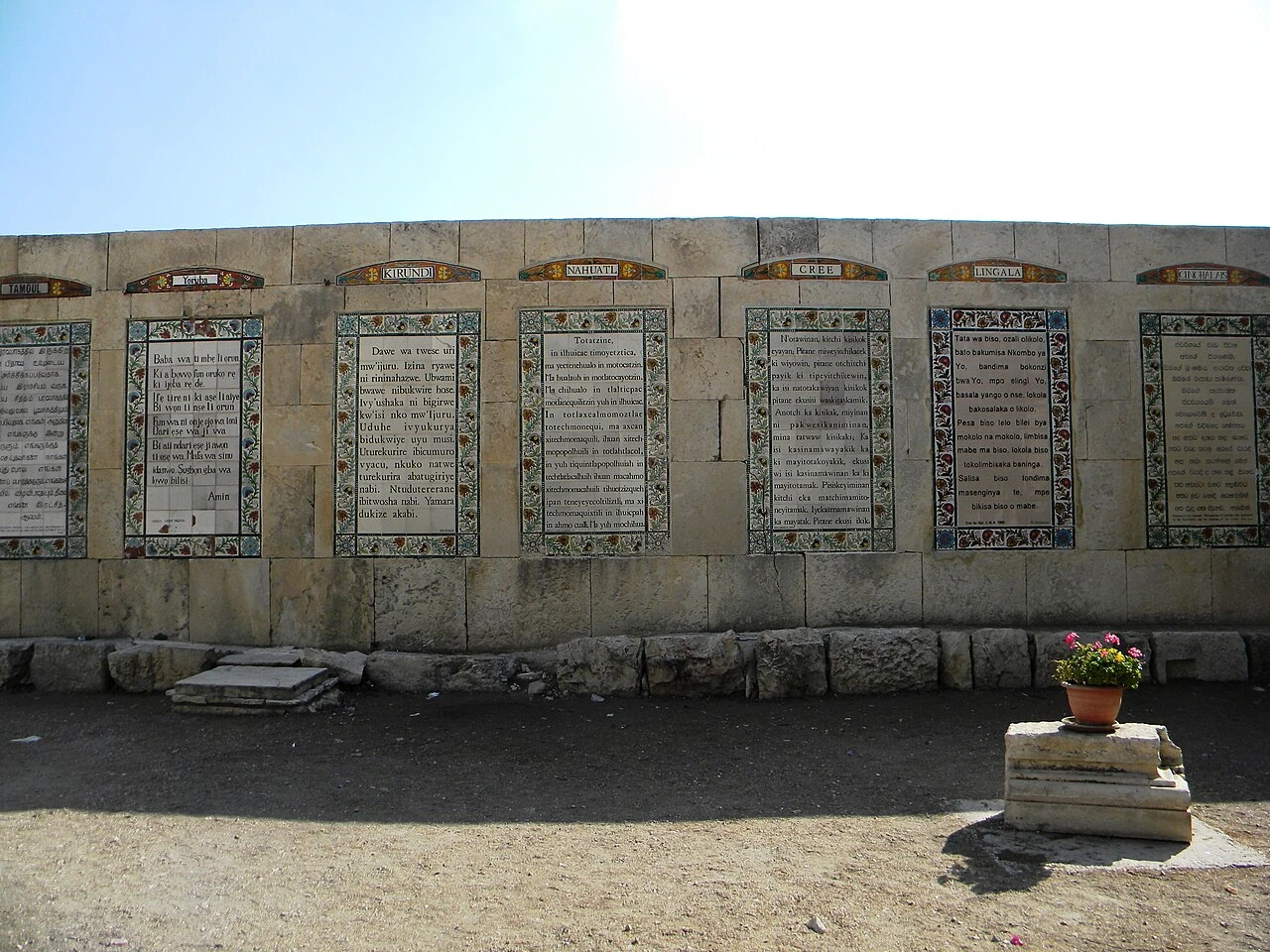
Multilingual prayer tablets at the Pater Noster church in Jerusalem, photographed on 23 October 2014. Commons explicitly classifies the photograph as containing Lingala writing. Not independently transcribed; multiple language panels share the image.
Saved in Babelbook · resized display copy. Select the image to open it independently of its source.
Britchi Mirela · Source ↗CC BY-SA 4.0 ↗View the local visual field note
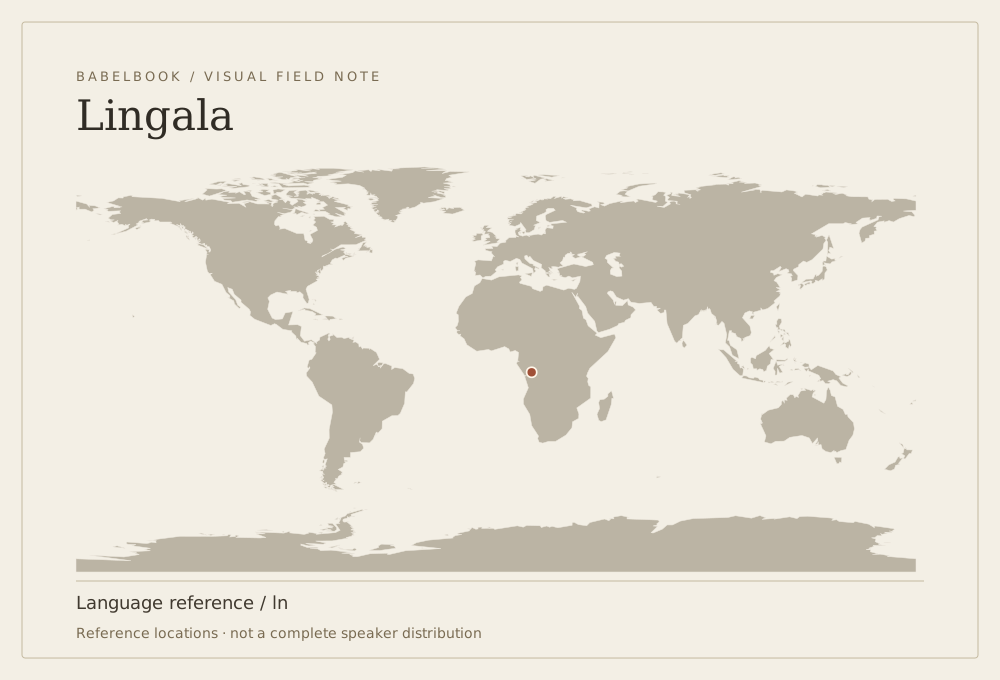
Representative reference points from Glottolog. Historical entries show reference locations, not current speakers. 1 point.
Reference & context ↗Babelbook · original editorial illustration · CC BY 4.0 · Glottolog locations; public-domain Natural Earth land
Source excerpts, selected, shortened and where noted editorially corrected from Lingala by Wikipedia contributors. Retrieved 2026-10-05. CC BY-SA 4.0. These excerpts are not an independently verified scholarly history; missing accounts are identified above.
Read further in the source
History
Before 1880, Bobangi was an important trade language on the western sections of the Congo River, between Stanley Pool (Kinshasa) and the confluence of the Congo and Ubangi rivers (Republic of Congo and Democratic Republic of Congo). When the first Europeans and their West- and East-African troops started founding state posts for the Belgian king along this river section in the early 1880s, they noticed the widespread use and prestige of Bobangi. They attempted to learn it, but only cared to acquire an imperfect knowledge of it, a process that gave rise to a new, strongly restructured variety, called "the trade language", "the language of the river", or "Bobangi-pidgin", among other names. In 1884, Europeans introduced this restructured variety of Bobangi in the state post Bangala Station to communicate with local Congolese, some of whom had second-language knowledge of original Bobangi, and with the Congolese from more remote areas whom missionaries and colonials had been relocating to the station by force. The language of the river was therefore soon renamed "Bangala", a label the Europeans had since 1876 also been using as a convenient, but erroneous and non-original ethnic name for all Congolese of that region. Around 1901–2, CICM missionaries started a project to "purify" the Bangala language by cleansing it from the "impure", pidginlike features it had acquired when it emerged out of Bobangi in the early 1880s.
Around and shortly after 1901, a number of both Catholic and Protestant missionaries working in the western and northern Congo Free State, independently of one another but in strikingly parallel terms, judged that Bangala as it had developed out of Bobangi was too "pidgin like", "too poor" a language to function as a proper means of education and evangelization. Each of them set out on a program of massive corpus planning, aimed at actively "correcting" and "enlarging" Bangala from above [...]. One of them was the Catholic missionary Egide De Boeck of the Congregatio Immaculati Cordis Mariae (CICM, commonly known as "the Missionaries of Scheut" or "Scheutists"), who arrived in Bangala Station – Nouvelle Anvers in 1901. Another one was the Protestant missionary Walter H. Stapleton [...], and a third one the Catholic Léon Derikx of the Premonstratensian Fathers [...]. By 1915, De Boeck's endeavors had proven to be more influential than Stapleton's, whose language creative suggestions, as the Protestant missionaries' conference of 1911 admitted, had never been truly implemented [...]. Under the dominance of De Boeck's work, Derikx's discontinued his after less than 10 years. Lingala's importance as a vernacular has since grown with the size and importance of its main centers of use, Kinshasa and Brazzaville; with its use as the lingua franca of the armed forces; and with the popularity of soukous music.
Writing system
Lingala is more a spoken than a written language, and has several different writing systems, most of them ad hoc. As literacy in Lingala tends to be low, its popular orthography is very flexible and varies among the two republics. Some orthographies are heavily influenced by French; influences include a double S, ss, to transcribe [s] (in the Republic of the Congo); ou for [u] (in the Republic of the Congo); i with trema, aï, to transcribe [áí] or [aí]; e with acute accent, é, to transcribe [e]; e to transcribe [ɛ], o with acute accent, ó, to transcribe [ɔ] or sometimes [o] in opposition to o transcribing [o] or [ɔ]; i or y can both transcribe [j]. The allophones are also found as alternating forms in the popular orthography; sango is an alternative to nsango (information or news); nyonso, nyoso, nionso, nioso (every) are all transcriptions of nyɔ́nsɔ. In 1976, the Société Zaïroise des Linguistes (Zairian Linguists Society) adopted a writing system for Lingala, using the open e (ɛ) and the open o (ɔ) to write the vowels [ɛ] and [ɔ], and sporadic usage of accents to mark tone, though the limitation of input methods prevents Lingala writers from easily using the ɛ and ɔ and the accents. For example, it is almost impossible to type Lingala according to that convention with a common English or French keyboard. The convention of 1976 reduced the alternative orthography of characters but did not enforce tone marking. The lack of consistent accentuation is lessened by contextual disambiguation. The popular orthographies are often more simplified and ambiguous than the academic-based ones. Many Lingala books, papers, the translation of the Universal Declaration of Human Rights, Internet forums, newsletters, and major websites such as Google's Lingala do not use the Lingala-specific characters ɛ and ɔ. Tone marking is found in most literary works.