Lao
Lao (ພາສາລາວ, phasa Lao; [pʰáː.sǎː láːw]), sometimes referred to as Laotian, is a Southwestern Tai language and the official language of Laos. It is also spoken in the Isan region of northeastern Thailand, where it is usually called the Isan language. The political split of the Lao-speaking population along the Mekong River resulted from the Franco-Siamese crisis of 1893. Lao is written in the Lao script, an abugida that evolved from early Tai scripts. Lao is a tonal and analytic language, characteristics shared with other Kra-Dai languages as well as nearby Sino-Tibetan and Austroasiatic languages. It features high mutual intelligibility with Thai and Isan, enabling direct communication between speakers despite differences in their respective writing systems. The Vientiane dialect serves as the de facto standard. In addition to being the sole official language of Laos, Lao serves as a lingua franca among the country's ethnically and linguistically diverse population. It is also spoken by diaspora communities, primarily in the United States, France, and Australia.
Translate in Lao ↗Lao (ພາສາລາວ, phasa Lao; [pʰáː.sǎː láːw]), sometimes referred to as Laotian, is a Southwestern Tai language and the official language of Laos. It is also spoken in the Isan region of northeastern Thailand, where it is usually called the Isan language. The political split of the Lao-speaking population along the Mekong River resulted from the Franco-Siamese crisis of 1893. Lao is written in the Lao script, an abugida that evolved from early Tai scripts. Lao is a tonal and analytic language, characteristics shared with other Kra-Dai languages as well as nearby Sino-Tibetan and Austroasiatic languages. It features high mutual intelligibility with Thai and Isan, enabling direct communication between speakers despite differences in their respective writing systems. The Vientiane dialect serves as the de facto standard. In addition to being the sole official language of Laos, Lao serves as a lingua franca among the country's ethnically and linguistically diverse population. It is also spoken by diaspora communities, primarily in the United States, France, and Australia.
Southeast Asia
Present-day use
The captured source does not contain a separate current-use account.
Origins
The captured article does not contain a separate origins section. See the historical account and linked source.
Development
The captured article does not contain a distinct historical account. No chronology has been invented.
Writing
The Lao script, derived from the Khmer alphabet of the Khmer Empire in the 14th century, is ultimately rooted in the Pallava script of Southern India, one of the Brahmi scripts. Although the Lao script bears resemblance to Thai, the former contains fewer letters than Thai because by 1960 it was simplified to be fairly phonemic, whereas Thai maintains many etymological spellings that are pronounced the same. The script is traditionally classified as an abugida, but Lao consonant letters are conceived of as simply representing the consonant sound, rather than a syllable with an inherent vowel. Vowels are written as diacritic marks and can be placed above, below, in front of, or behind consonants. The script also contains distinct symbols for numerals, although Arabic numerals are more commonly used. Lao is written in the Tai Tham script for liturgical purposes and is still used in temples in Laos and Isan. Traditionally, only secular literature was written with the Lao alphabet. Religious literature was often written in Tai Tham, a Mon-based script that is still used for the Tai Khün, Tai Lü, and formerly for Kham Mueang. The Lao style of this script is known as Lao Tham. Mystical, magical, and some religious literature was written in Khom script (Aksar Khom), a modified version of the Khmer script.
Beyond the typeface.
Signs, manuscripts, published pages and contextual photographs, with their place, period, source and reuse terms. Captions identify historical spellings, regional examples, community references and character imagery.
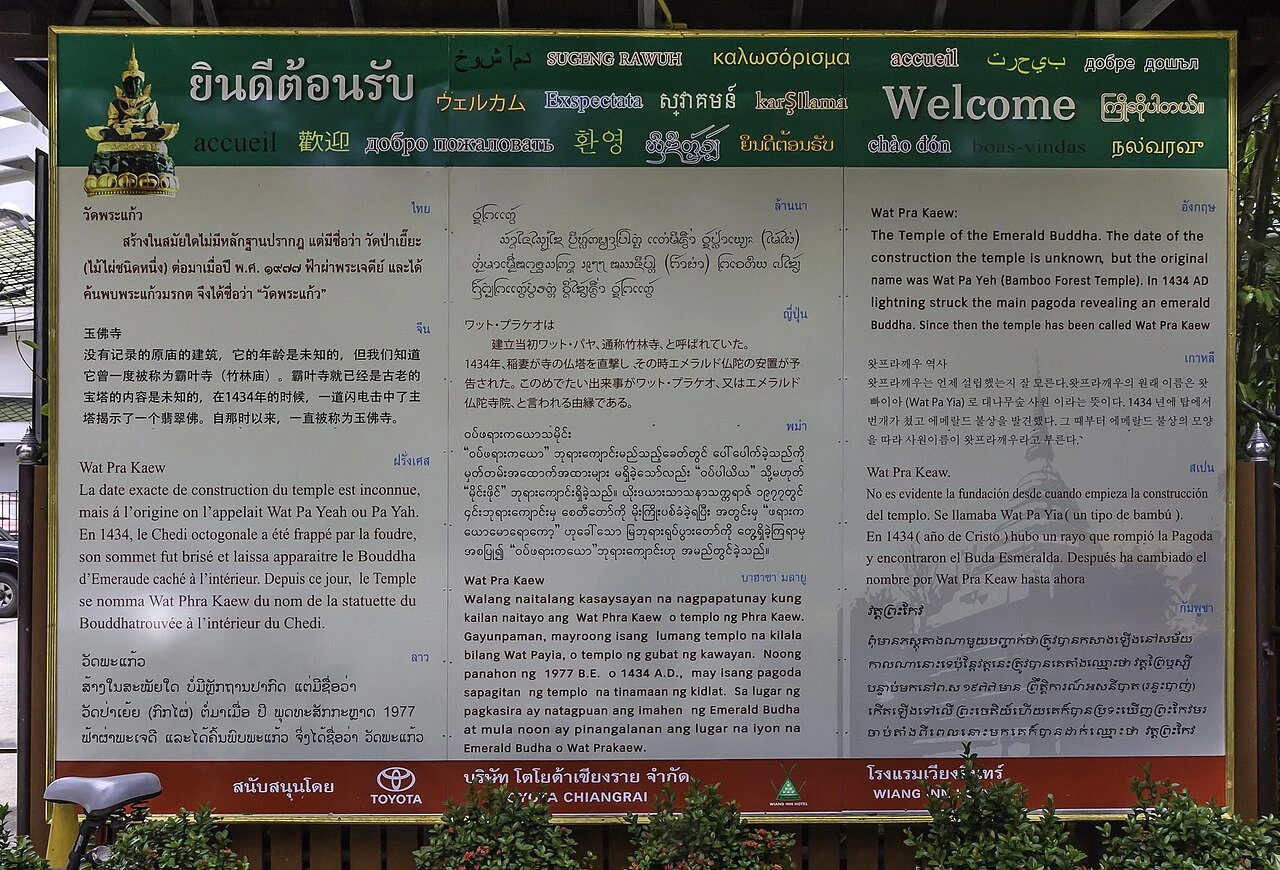
Multilingual information board at Wat Phra Kaeo, Chiang Rai. Commons explicitly lists Burmese, Khmer and Lao among its languages. Language identification follows Commons metadata; not independently transcribed.
Saved in Babelbook · resized display copy. Select the image to open it independently of its source.
Stefan Fussan · Source ↗CC BY-SA 3.0 ↗View the local visual field note
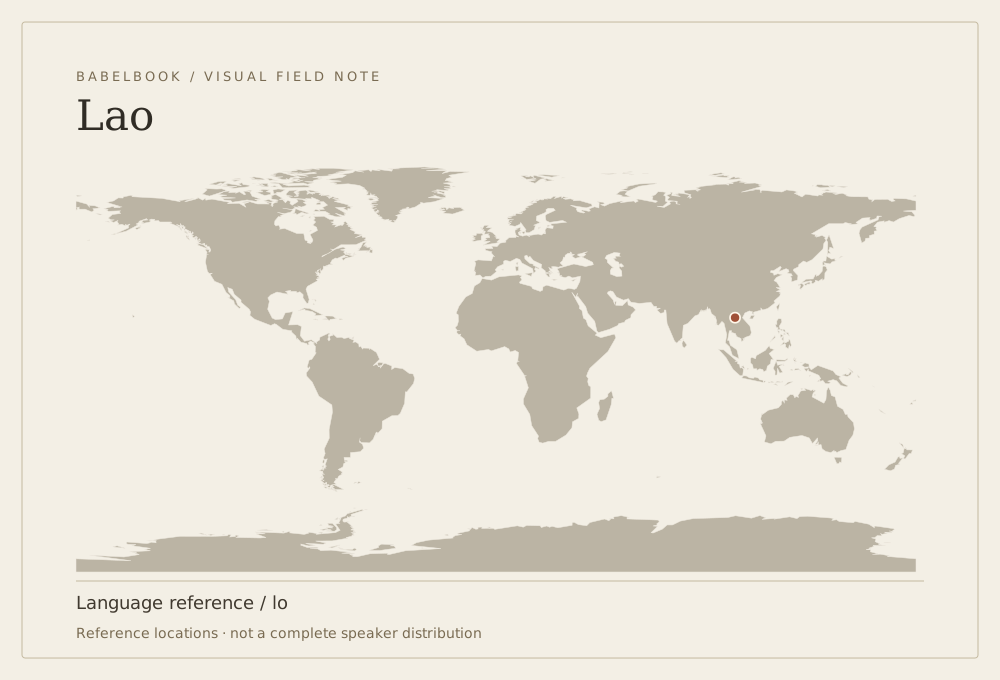
Representative reference points from Glottolog. Historical entries show reference locations, not current speakers. 1 point.
Reference & context ↗Babelbook · original editorial illustration · CC BY 4.0 · Glottolog locations; public-domain Natural Earth land
Source excerpts, selected, shortened and where noted editorially corrected from Lao language by Wikipedia contributors. Retrieved 2026-10-05. CC BY-SA 4.0. These excerpts are not an independently verified scholarly history; missing accounts are identified above.
Read further in the source
Dialects
The standard written Lao based on the speech of Vientiane has leveled many lexical differences between dialects found in Laos, and although spoken regional variations remain strong, speakers will adjust to it in formal situations and in dealings with outsiders.
Vientiane Lao dialect
In Laos, the written language has been mainly based on Vientiane Lao for centuries after the capital of Lan Xang was moved in 1560. The speech of the old élite families was cultivated into Standard Lao as emulated by television and radio broadcasts from the capital as well as taught to foreign students of Lao. The speech of the Isan city of Nong Khai, which sits on the opposite bank of the Mekong, is almost indistinguishable in tone and accent from the speech of Vientiane. Vientiane Lao predominates in Vientiane City, the surrounding Vientiane Province and portions of Bolikhamxai and some areas of Xaisômboun. In Isan, Vientiane Lao is the primary form of Isan spoken in the northern third of the region which was long settled since the days of Lan Xang and was ruled as part of the Kingdom of Vientiane, including most of Nong Khai, Nong Bua Lamphu, eastern Loei and portions of Saiyaphum and Bueng Kan. As a result of the Lao rebellion of 1826 the Tai Wiang (ໄທວຽງ), /tʰáj wíaŋ/), 'Vientiane people' of the city and surrounding parts of the kingdom, were rounded up by Siamese armies and forced to the right bank, greatly boosting the Lao population of what is now Isan. The Tai Wiang strengthened numbers in the northern third, where Vientiane Lao was traditionally spoken, but were scattered across the Isan region overall, with heavier concentrations in Yasothon, Khon Kaen, and Hoi Et provinces. This likely had a leveling effect on the Lao language as spoken in Isan, as most Isan speakers regardless of speech variety are prone to using /ʋ/ as opposed to /w/ and the informal conversion of syllable-initial /k/ to /tɕ/ in relaxed, informal speech, which in Laos, is particularly characteristic of Vientiane speech. For example, the word kaem (ແກ້ມ kèm, /kɛ̂ːm/), 'cheek', is often pronounced *chaem (*ແຈ້ມ chèm, */tɕɛ̂ːm/).
Northern Lao (Louang Phrabang) dialect
Northern Lao is a very distinct dialect, exhibiting several features and lexical differences quite apart from other Lao dialects except Northeastern Lao (Phuan). Even though it borders the Vientiane Lao dialect region, there is a sharp boundary that divides them. The dialect shares many similarities with Tai Lanna and is classified accordingly as a Chiang Saen language by Ethnologue. The dialect is not common in Isan, restricted to western portions of Loei and pockets of villages spread throughout Udon Thani provinces. The Isan people of Phitsanulok and Uttaradit provinces, particularly the narrow strip hugging the shore of the Mekong and bordering Loei, outside of Isan are generally speakers of Northern Lao. In Laos, it is the primary dialect spoken in Louang Phrabang and Xaignabouli provinces. In the other northern Laotian provinces of Oudômxai, Houaphan, Louang Namtha and Phôngsali, native Lao speakers are a small minority in the major market towns but Northern Lao, highly influenced by the local languages, is spoken as the lingua franca across ethnic groups of the area. Northern Lao, specifically the speech of the city of Louang Phrabang was originally the prestigious variety of the language with the city serving as the capital of Lan Xang for the first half of its existence, with the kings of the city made kings of all of Laos by the French. Although the language lost its prestige to Vientiane Lao, Northern Lao is important for its history, as many of the earliest Lao literary works were composed in the dialect, and it served, in a refined form, as the royal speech of the Laotian kings until 1975 when the monarchy was abolished. Louang Phrabang remains the largest city in the northern region of Laos, serving as an important center of trade and communication with the surrounding areas. Despite the proximity to speakers of Vientiane Lao, Northern Lao is quite distinct. Unlike other Lao dialects with six tones, Northern Lao speakers use only five. Due to the distinctive high-pitch, high-falling tone on words with live syllables starting with low-class consonants, the dialect is said to sound softer, sweeter and more effeminate than other Lao dialects, likely aided by the slower speed of speaking. Similar in tonal structure and quality to Tai Lanna, likely facilitated by the immigration of Lanna people to Louang Phrabang after Chiang Mai's fall to the Burmese in 1551, the dialect is classified apart from other Lao dialects as Chiang Saen language by Ethnologue. Northern Lao also resisted the merger of Proto-Tai */aɰ/ and */aj/ that occurred in all other Lao dialects, except Northeastern Lao. This affects the twenty or so words represented by Thai 'ใ◌' and Lao 'ໃ◌', which preserve /aɰ/ in Northern Lao. This vowel has become /aj/, similar to Thai 'ไ◌' and Lao 'ໄ◌' which is also /aj/. Northern Lao also contains numerous terms not familiar to other Lao speakers.
Northeastern Lao dialect (Tai Phouan)
The Phuan language is a Chiang Saen (Thai) language rather than part of the Lao–Phutai languages, but it is considered a Lao dialect in Laos. As a Tai language of northern Southeast Asia, it shares many similarities with Tai Dam and Tai Lan Na. In contrast to other minority languages of Isan, it is not losing ground to the Thai or Isan language in Isan.